Posts Tagged ‘Motherhood’
Experts Examine WHY Breastfeeding is best: We MUST Know!
Sniffing Language
Cobblers notice shoes, hairdressers notice the other end of a person. I’m a domestic violence survivor, writer, reader, and I notice (sniff, I observe, I sense dynamic alterations in) LANGUAGE — the linguistic environment surrounding present and potential policies that might affect the personal survival, health welfare, and safety of my kids, me, or others I know and love, to be quite blunt about this.
I can detail about when and where this started to happen too. I noticed it, a shift in mental processing of things, a heightened sensitivity to the environment. This was odd — the less time I could dedicate to planning a rehearsal, or choosing a method or approach to a certain topic — because my life was totally dedicated to the safety and survival issues at hand, and seeking ways to ensure them, change the dynamics, and safely set a distance from a man that I simply couldn’t get the courts to give me a restraining order on, or enforce an existing court order of ANY sort, upon. Nor could I get any social group to communally put some pressure on the guy to get real, get a job, or get lost. Or, as I say here, “get honest” about any number of manners. So, I didn’t do the usual things I formerly was taught lead to good rehearsals leading to good singing. I had to get the general idea (as in, repertoire), get in there, go on instinct, respond to the singing I heard in the situation, and just lead.
The odd (and disturbing — at least to certain theories about how things work) about this was, they started singing better. Rehearsals were more dynamic, and skills and sound improved. In more than one group. Go figure! Hmm. . . . .
I came to understand that the habit of being dynamically sensitive to my environment, and little details in it, had carried over into the rehearsal situation. And in the arts, this is GOOD, because they come from the spirit and soul within. I had no time to be cerebral, cognitive and detached, I had to be present, open, and responsive. And that was EXACTLY what the job required!
The exact opposite of this approach to life and relationships can be seen in the detached, categorizing, labeling, and pronouncing language of some of the social sciences. I do not think the entire field should be tossed, but I think that there are serious loopholes when doctrine is made in a laboratory, without understanding that people (adults, children, and others) really DO behave differently under observation, for the most part, than when not. If the family law system acknowledged this, I think custody evaluators would probably be done away with. You can’t really evaluate someone who is doing a performance for you, come on! And if anyone is GREAT a “performance” it’s a family, or an individual, caught up in the cycle of abuse, incest, or domestic violence. Or, alcoholism, for that matter. The whole DEAL is about keeping up the pretense, not talking about it.
A woman’s or a child’s safety could be literally dependent upon how good a front she puts up for public, once the abuser knows he’s being looked at more carefully. I know about this.
For more on this hypersensitivity, see the book “Animals in Translation” by Temple Grandin, an autistic (or autims survivor?) animal behavioralist. I understood, after reading this, how my mind had begun to behave more like a deer in the headlights, after a few years post-restraining order, mid-family court, weekly-exchange of kids-wise. I had lost the sense of predictability in our daily schedule, and I had lost this because EVERY weekend, and leading up to it or recovering from it, I had to deal with a potential incident with the father of our children regarding picking up or, if I was able to, retrieving our children from exchanges. This was one of the most insane custody orders post restraining order I have EVER heard of, but it was all we had to deal with. This also relates directly to why I no longer work in a certain field, in which jobs happened on weekends. The two became so associated in my brain that engaging in in the one, to this day, reminds me of that trauma. This can be great on certain arts, and hell on the rest of life.
PREY animals notice more and interpret less. This is why sometimes horses wear blinders, when pulling a taxi in traffic, for example. Humans are designed to interpret more, and once they have got a label, enabling mental filing, notice less. However, a teacher (or conductor) must both keep the goal in mind AND notice, and reconcile the balance. They learn how to do this (for survival).
Theorists, on the other hand, may continue to get a government funding grant, whether or not their theories are true, work, or help or hurt people. There is a considerable distance between funding and performance. I notice, therefore, cognitive detachment in linguistic descriptions in some of these topics.
Sometimes this “noticing language” habit is entertaining and fun. Sometimes, it’s disturbing and annoying. HOWEVER, I think that society might do well, in general, to listen to some of the people on its outskirts. We are the canaries in the coal mine, and certain things we have to say might contradict (in fact generally WILL contradict) the experts.
Of course, the experts are the ones who have the platform, even when their opinions contradict each other — they seem to carry more weight than anyone whose degrees are not as high or deep (Ph.D.) as others. Remind me, next decade, to go get that Ph.D., maybe it will help…..
That’s one way of explaining that I happen to notice language. And there is a style of talking about basic human behavior (of which stalking happens to relate to hunting, which is sometimes followed by a kill, which is why I don’t like being the one followed, or told by people I report this to, you’re exaggerating. No, I’m not…. I trust the instinct in this one.) I’m almost getting to the point that I don’t trust language that doesn’t take into account some basic human instincts and realities –ONE of which is, soon after birth or after giving birth, making the nipple connection, and nursing — or allowing it to take place.
. . .
OK NOW….
Is there really a war on fatherhood? Or is it on motherhood? Where’s Mom?
Consider this word:
Breastfeeding,
When, where, how and why did it become so odd a human behavior that it required research papers to be published, to examine — or safeguard — it?
What is now called breastfeeding used to be (culturally, and universally) commonplace.
Trailer words associated with the fact that both a breast and getting fed happened to be involved, included:
Nursing, Cherishing, Protecting, Imparting,
Loving, Knowing,
Gentleness, Compassion, Confidence one is loved and wanted,
just being there and looking at each other, or nudging each other in a relaxed, nondemanding fashion,
were formerly normal, healthy human behaviors, and not only right after sex.
(If you’re unclear, see “google images” for some visuals)
I CALL THOSE GOOD THINGS.
Now the relationships between some of these must be studied, so as to better predict [and manage] outcomes
I predict that studying what used to be normal, healthy human behaviors (but have been dismantled by various institutions, and industries in “developed’ countries) will soon become the normal human behavior. It certainly appears to be a healthy way to make a steady income, healthier than most. these days, including producing food, if you’re a small farmer, or milking cows.
Asking, well, was it GOOD or NOT good? If it was good, WHY was it good? How can we duplicate it, or better yet, multiply it, without dismantling, if possible, some of the institutions that formerly dismantled, or put some pretty weird warps, in the human family situation.
Who funds these studies and poses these questions? Typically, a government, or a private foundation funding either the government, or some nonprofit, that has an agenda, or some combination of all of the above, as we find in the Fatherhood Movement’s cooperation between many entitities, casting its wide and technically superb (inter)net (presence) over the human, well, language, eliminating the usage of the word “mother” in order to restructure society into a different image. I am going to post another time about a former (not very reputable) campaign from the heart of Fatherland America, which trumpeted the virtues of “motherhood, virtue, patience, temperance” and so forth. And what they did to whoever they thought wasn’t promoting these.
WHY is Breast Best? Well for one thing, anything so many men are fixated on can’t be all that bad.
Just kidding — WHY is breastfeeding best? Why not ask a Mom? (Where did Mom go, anyhow??)
Nursing is normal. Did I know much about it before I began? Honestly, no. I just, well, there was this brand new kid on my tummy, and it seemed the right thing to do.
Seems to me that slavery was one thing that used to break up families, intentionally so. Hmm. SOME folks got educated, but others weren’t supposed to be. They were to be educated to the limit of their job prognosis. Hmmm.
I also predict that with the womb to tomb categorization of humanity, from the moment they are born, caught, extracted, or brought forth (depending on how literary you are feeling) and begin to wiggle, the measuring WILL not stop, we will forget what a normal human, bonding relationship WAS. We won’t have living examples of it to learn from.
Now that ATTITUDE worries me. I have been worried about this for many months, as I began to examine where my justice went, especially this last year. Where my children went had already been determined, and I had also correctly looked up that the correct label for the manner in which they went comes under the category “child-stealing.” The next question was, why was there no concensus on what the law already conceded, and what could I do to get them back? I looked around with wonder and amazement to see that with flip of the coin, what in one situation was a felony, in an entirely different one (see title of this blog) was interpreted as initiative to be rewarded with custody. SURELY a father who would love his children enough to steal them, and harass their mother with court case after court case must have been motivated by love and concern. And SURELy a mother who actually resisted this, and attempted to retain an emotional connection (let alone visual contact) with BOTH her children AND her livelihood (profession) through choosing an alternate educational arrangement must have an unnatural attachment thing going on. Now, I didn’t have one set of kids I DID nurse and one set I DIDn’t for comparison, but I do know that, even absent from them, there’s an attachment there, and it’s weird every day to have it suddenly aborted. Yes, I did use that word.
In my last post I looked at “Where’s Mom?” in a website representing our national direction, and suggested that the ship of state may have lost its moorings, possibly by ignoring the obvious: So far, technologically, you DO need a Mom to actually get a family, even if it’s dis-assembled shortly after birth.
Where’s Mom? is a very relevant question, I thought.
So, here’s an article that came across my (virtual) desk, my Inbox, on some astonishingly new and revolutionary perspectives on WHY breastfeeding is best, at least up until a judge decides she’s doing it for the wrong reasons, to get even with an ex. . . . . and sets a limit on how long this parental alienation can be permitted. The things judges must know these days . . . .
We noncustodial Moms (yes, we converse with each other about how and why that happened, and we research and blog, and vote and call our Congresspeople, and write, and support each other, because the court system sure ain’t…..) were happy to find one that counteracted some of this “father-absence” hypocrisy. YEAH, a lot of fathers are absent. Now let’s talk about WHY! and stop scapegoating an entire gender!
This article supports the premises that for an infant to have a bonding time with Mom growing up (which may or may not contradict our present government’s wish to push things in a different direction, send Mom to work and give us those babies; we have Ph.D.candidate Human Behavioralists needing a grant-funded slot at the local Head Start outfit, think about their job futures, OK? If they do not publish, they might perish! It’s your civic duty to produce low-income babies (or neglect staying home if you’re not low-income) for them to study.)
It IS interesting too, it talks about more than the nipples and what spurts out of them, it talks even about more than the cuddling. It looks at subsequent behaviors. So do I, at the bottom. I picked a few well-known names.
(Did I mention it’s written by women, also?)
Abstract
Research paper no. 43
Breastfeeding and infants’ time use (title is link)
Jennifer Baxter and Julie Smith
Australian Institute of Family Studies, June 2009, 48 pp. ISBN 978-1-921414-09-1. ISSN 1446-9863 (Print); ISSN 1446-9871 (Online)
Being breastfed during infancy is known to improve developmental outcomes, but the pathways by which this occurs remain unclear.
Research Paper no. 43: “Breastfeeding and infants’ time use.”
(More commentary on what governments are studying these days…..)
While I’m glad this study DOES support the concept that breastfeeding is good, as when judges in Canada and Australia have to decide on whether or not to agree with the obvious, or respond to the gentle tug on THEIR consciences from the “But Dads are Nurturers TOO!” demands, Moms (Noncustodial ones, through family court matters) were happy to read this, I still have to ask, WHY do we have to even ask? I mean, in what kind of world are studies needed of this?
Here’s what kind of world:
IN a world of ever-shifting psychological and spiritual plate tectonics, it’s only human to want to be oh so sure about the obvious. WHY do we need to be oh-so-sure? (Using the word “we” loosely, I am not in that mix)
WHY is how to develop and serve “humans” and “families” really necessary?? What are they, food?
Why not leave them alone to figure it out? Why not treat them as animate beings with spirit, soul, body, desires, individuality, and what’s more, hopes, goals, and a variety of pathways in which to wend their way through life, like their hunter-gatherer ancestors?
That is, FYI, what they are — not slabs of flesh, inanimate, passive, waiting to be directed, injected, detected, and projected upon the motion picture screen of some faraway government policy! Unless they (translation: WE — ALL — begin to see each other in this manner, the only logical consequence is more and more literally inanimate, and in fact lifeless (or is it comatose?) slabs of flesh, and there may not be enough slots to store us in. Please, PLEASE, remember Auschwitz, and the ATTITUDES that preceded this, and stop the stereotyping and detached, detached, well thank God it ain’t ME, emotional noninvolvement with other human beings, when it comes to running nations and large enterprises.
People have been born for many, many centuries and millennia. Nations (if not religions, unfortunately) and empires have come and gone.
(And these two are related).
With each new empire, history, and culture, is often re-written, by the winners.
They can crumble over germs or steel, over oppressing people so bad they simply well up and oust a regime, assassinate a dictator, and/or each other. Or assassinations, oustings and regime changes can happen for other reasons. In this world there are now, and have historically been famines, floods, fires, and wars; there is cruelty and prejudice, there is waste and greed. These are qualities that, as far as I can see, have been around a long time, and are not going anywhere soon. And I ABSOLUTELy don’t believe they are going away by government fiat, design or study.
Given that generic assessment of history, I have to ask, then what exactly are were DOING in this profession of Human Behavioral Sciences? What were its origins, what are its purposes and why are “we” doing these things?
I’m a researcher, in fact both my parents were too, one a scientist, the other a librarian. I’m a SEARCHER, I’m curious about causes.
One thing in my searchings I have come to conclude: some of the worst damages to human rights, and people, has been in the name of theories (or doctrines) similar to the ones I’m reading about now, in our country. I think it’s an ATTITUDE thing, to study human populace as if they were rats, or mice, or microbes. I’m not anti-medicine, nad I do appreciate knowing things about molecules, hormones, and, say, that what just happened to me when that stalker called, again, may relate to adrenaline or cortisol, and has some sense behind the chemistry of it.
However, I think in the social sciences, it’s gone off the deep end into crowd control. I think it is a clear indication of caste-maintenance, which ain’t supposed to be in the USA, but is.
Who’s developing this master race and utopia?
Didn’t we learn anything from Hitler, or any other genocides? Didn’t we get embarrased enough by the study of “phrenology” (measuring skull sizes, to assess intelligence) which to me has an uncomfortable sense of sociology.
Anyhow, this study may be supportive of more maternal time. Governments have already determined it’s Breast is Best, but what to do when a couple can’t keep it together til the kid is weaned? Then there have to be policies, judges have to decide, and these judges need experts. W ell, experts are just handy to have around.
Are there any MOMs around who have actually seen children grow up that they nursed (and haven’t been incarcerated for this on the basis of unnatural attachment theory)?
Isn’t smarter, healthier, loved and having been held by Mom at least several times a day enough to know? Apparently not. I tend to wonder if this isn’t because another artificial nipple, breast, nurture and cuddling experience is in the mix, and will need justification. OR, it’s been challenged, and then a study is needed to maintaing a semblance of nature in nurture of infants.
Given what I’ve been reading about our Present Administration’s Parenting Advice (yes, that spells “PAPA”), motherhood is no longer acceptable. It has a conflict with Early Head Start and propping up a seriously design-flawed educational system that neither nurtures nor educates adequately, and was based on producing factory workers who don’t take orders or think too much. Crucial to this is boxing them up, and mediating all experience through the teachers and textbooks (which are highly censored).
I just watched the video of Michael Jackson recently, being interviewed about his father’s severe abuse of all 5 Jacksons, including having them perform with him sitting in his hand with a belt, and ironing cord, using Michael, the youngest, as a role model to chastise the other children, mocking his facial features (you didn’t get it from MY side) and a fairly normal adolescent thing called pimples, about how he didn’t want to grow up (and the uncanny transformation of his own face into something that looks like his hero, Peter Pan), about how his dermatologist nurse (and another surrogate Mom) gave him 3 children, which were snatched at birth (never got to nurse a drop), although by agreement, and now they are going to live with — either Grandpa (that same one that would’ve/should’ve been arrested in our day and time) or Mom (who volunteered her womb and viewed human beings as presents, not people).
The most common sense reason for nursing I can think of is that it APPEARS to be part of the design plan for human beings, and a host of other animals also. Take it away, and they’re sucking down something else for a lifetime perhaps, substitute attachments. I don’t know. It just kinda makes sense. Give the Mom and baby a chance to sit together and make a physical connection. It works together, it helps her womb return to normal size right faster, it’s overall a good arrangement unless she’s been on something harmful which would get into the child. LIfe is rough. Give’em a break!
In the US, we have HHS.
IN Australia, it’s “AIFS”
Australian Institute of Family Studies.
And has these clearinghouses:
- AIFS research
- Australian Centre for the Study of Sexual Assault
- Australian Family Relationships Clearinghouse
- Australian Temperament Project
- Communities and Families Clearinghouse Australia
- Evaluation of the family law reforms
- Family Pathways: studies of separated families in Australia
- Growing Up in Australia: the Longitudinal Study of Australian Children
- National Child Protection Clearinghouse
Like over here, they publish, they serve, they have resources, and they have events. That’s nice…
The natural human response, anyone with some spirit at least, is to resist being managed, and only put up with so much as is necessary to get by. People are MOST human and I say most happy, really, pursuing things — that they CHOSE to pursue. Ask an adolescent male. Ask a stalker. Ask a Mom or Dad going to night school. There’s something about the pursuit of it, not the having it served up in a soup line. There’s something about making one’s own personal goals, that brings out the best in a person, or when it’s in a community, that community. When it gets too large, we lose the human element.
There’s not much more intimate, at the start of life, than what’s now called “breastfeeding.” And there’s not much more tenderizing to a Mom, when it’s in a supportive environment especially, and producing a feeling of well-being, etc., than nursing. I do not mean to idolize this, but I do mean to call attention to this.
I think this term must have come up when other ways of feeding began to compete with it. It’s not just about FEEDING. It used to be called NURSING. Now, Nursing has become a profession (and a great one, I acknowledge), and I hear there’s a shortage of it too. Perhaps if we could give people better EMOTIONAL and PHYSICAL support near the beginning of their lives, they wouldn’t need so much – or go about getting so much in other, unhealthy ways — later on in life. Many diseases and compromised immune systems have origins, it’s coming out, not only in antibodies not received as a kid, but sometimes emotional abuse and trauma — the exact OPPOSITE of nurturing.
So, here’s an article that came across my (virtual) desk, my Inbox, on some astonishingly new and revolutionary perspectives on WHY breastfeeding is best, at least up until a judge decides she’s doing it for the wrong reasons, to get even with an ex. . . . .
Abstract
Research paper no. 43
Breastfeeding and infants’ time use
Jennifer Baxter and Julie Smith
Australian Institute of Family Studies, June 2009, 48 pp. ISBN 978-1-921414-09-1. ISSN 1446-9863 (Print); ISSN 1446-9871 (Online)
Being breastfed during infancy is known to improve developmental outcomes, but the pathways by which this occurs remain unclear.
Well, God forbid the us not knowing by what pathways developmental outcomes can be improved? We are, after all, in the business of improving development.
One possible yet unexplored mechanism is that breastfed infants may spend their time differently to infants who are not breastfed.
Please — PLEASE tell me, some institute is not about to intervene with that Mom’s growing relationship with an infant, and either put a video in the home for later analysis, send a social worker with a note pad to take notes, or ask the MOm, self-reporting, to distract her attention from that little being, to documenther time use. Give them a break! They’ll be in school before age 5 (at least in the US) all right already.
This paper analyses infants’ time use according to breastfeeding status in order to help inform the debate about how breastfeeding leads to improved child outcomes.
“improved child outcomes”
??
OK, well that sounds desirable. I’m just not used to the terminology yet. It sounds odd on my tongue. It sounds like a process that might belong more in an auto assembly line.
Now me, I’m more practically minded. If it works, keep doing it, if it ain’t broke, don’t fix it. That’s what my ex used to tell me when our children were sleeping, and I’d go to adjust something, make them more c omfortable, more covered, more something. “If it ain’t broke, don’t fix it.”
If it works — keep doing it. If it doesn’t work — as, for example, pushing fatherhood on an entire nation as a response to violence against women and/or feminism, appears to be gettingi more women and children, and men, killed — THEN I’d think this should be closely examined. But why breastfeeding works ???
The analysis uses infants’ time use data from the first wave (2004) of Growing Up in Australia: The Longitudinal Study of Australian Children (LSAC), derived from diaries completed by the parents of almost 3,000 Australian infants aged 3-14 months. It explores how much time infants spend in activities such as being held or cuddled, read or talked to, or crying, using data on whether or not infants were still breastfeeding, and taking into account other child and family characteristics. It also compares time spent in different social contexts. Finally, the paper uses the time use data to analyse which infants were still breastfeeding, and what factors are associated with differences in time spent breastfeeding.
The results show that breastfed infants spend more time being held or cuddled and being read or talked to, and less time sleeping, or eating, drinking or being fed other foods. {{Well, in America, Obesity is a major issue}}
They also cried slightly more, and watched television slightly less {{I’d say that’s positive}} than infants who were not being breastfed. Those who breastfed spent more time with their parents, and in particular, almost one additional hour a day alone with their mother compared to non-breastfeeding infants. {{This beats being ignored in a daycare situation. This gives baby and Mom some down time, which she could use also!}}
These findings have important implications for how children grow, and show the value of time use data in exploring pathways to development for infants and young children. The possibility that cognitive advantages for breastfed children may arise from their distinct patterns of time use and social contexts during the breastfeeding phase is an important area for future research using survey data such as from LSAC.
Summary
Being breastfed during infancy contributes to positive developmental outcomes, as well as to good nutrition and health. Expert guidelines for optimal infant feeding recommend that infants be exclusively breastfed for the first six months of life (National Health and Medical Research Council, 2003) and, along with appropriate complementary foods, continue to be breastfed for up to two years and beyond (World Health Assembly, 2001).
{{I did this for one child. I couldn’t for the other, but there were intervening factors (like Dad hitting me, and I know this affected the hormonal balance) intervening. Neither child has ever had an issue with intelligence or obesity, and they were healthy growing up. They weren’t clingy and they weren’t overly aggressive either, until years later, and this was when they became property fought over, and in the light of this, they were institutionalized again — at least their education was. I know that in our case, this was not aimed to help their education, but to break their bond with me. I cannot speak for every case.}}
While being breastfed during infancy is known to improve developmental outcomes, the pathways by which this occurs remain unclear. Components of breast milk are known to be important to brain development, but an important question remains as to whether the observed developmental advantages of children being breastfed also represent unobserved differences in the early life experiences of infants who were breastfed compared to those who were not. For example, there may be aspects of the breastfeeding mother’s behaviour or her interaction with the infant that differ from the non-breastfeeding mother. {{I KNEW THAT!}} One possible yet unexplored mechanism is that breastfed infants may spend their time differently to infants who are not breastfed. Time use research provides a potentially useful tool for further investigation of this issue.
A possible link between time use and children’s outcomes has a basis in the literature on infant development – for example, attachment theory – which indicates that positive interactions with caregivers have implications for secure attachment and socio-emotional development.
CAREGIVERS are mother-substitutes. They are not in the original plan. If you believe in plans. The word is longer. The short word is “MOM.” or “MOTHER” (pick your language).
I know, from the family law experience, that my behaving as a protective or educated mother was not wanted by certain other parties. My children themselves did not have a problem with this until we went into court, which even the mediator documented. It was a manufactured problem. The mantra, the ostinato, the continual claim was that by refusing to worship the government education factory (based on its performance), I was a heretic, and eccentric, and those kids were going to grow up weird and isolated. It was viewed with suspicion, and it was STOPPED. I have often thought that is children were simply allowed to be in their families (and the families were not violent) for as long as the individual kid was ready, before going to schools, schools would be far better. They do not need to be clingy and run in packs and herds, hurting each other or (when older) their teachers, and vice versa. They might have a sense of identity and belonging, and being loved. Unfortunately, this is NOT part of the economic development plan for “developed” countries.
Children’s development opportunities may therefore be affected by who they are with across the day, and where they are. Further, associations between somewhat older children’s time use and their development have been explored, with some relationships apparent, which lead us to question whether such relationships may also be apparent for infants. In addition to exploring the association between breastfeeding and time use, this paper also provides a broader examination of infants’ time use, to help understand the possible development opportunities for these infants.
And so forth. You can read it. I would just like to end with, after breastfeeding has been properly explicated, I suspect the conclusion would be the same:
DO IT.
Just like after the interrelationship between domestic violence and custody in family law settings has been properly explicated, I suspect that the CORRECT conclusion would be, as to domestic violence.
STOP IT
and as to when this is mixed with custody
DON’T!
THERE IS A REBUTTABLE PRESUMPTION AGAINST CUSTODY GOING TO A BATTERER. BATTERING A WOMAN IS A POOR ROLE MODEL. BATTERERS DO NOT MAKE GOOD PARENTS UNTIL AND UNLESS THEY HAVE ADDRESSED THIS ISSUE AND CHANGED IT AND KEPT IT CHANGED. ONE HIGH MOTIVATION FOR CHANGING IS TO GIVE THEM A DOSE OF THEIR OWN MEDICINE, WITH EXPLANATION. THE ALTERNATIVE BEING, TO KEEP PROVIDING HIM OPPORTUNITIES FOR MORE OF THE SAME. THIS INCLUDES STRICT ADHERENCE TO THE RESTRAINING ORDER (ONE VIOLATION = IMMEDIATE ARREST). PART OF ABUSE, IN CASE YOU HAVEN’T BEEN THERE YET (LET’S HOPE) IS SETS OF MEANINGLESS, TRIVIALLY JUSTIFIED, AND EVERCHANGING RULES APPLIED TO THE TARGET PERSON, NOT THE PERPETRATOR.
(I’D BETTER STOP, THIS RESEMBLES MANY SCHOOL SITUATIONS).
I expect that after I’m a long gone (which I hope will be a long time away) that family law system will still be around, and attempting to dilute and explicate the truth, that it just don’t make sense to say a person can beat another person (or have sex with a minor child) and be a good enough role model for custody, let alone visitation, let alone supervised visitation. These things — giving custody, visitation or supervised visitation, to a person who has not addressed this problem, called criminal behavior within the family — are going to naturally confuse a child about what’s right and what’s wrong, not exactly something I’d like the next generation to be confused on.
I’d like to end with what I’d consider a common sense and practical outlook towards human development, both in the womb and immediately after birth: this is a healthy attitude towards onesself, I believe. It just makes sense:
While all these things are wonderful to understand, and be aware of:
List of tables
- Overview of infants’ activities
- Who infants were with
- Breastfeeding time use
- Effects of breastfeeding on infants’ activities after adjusting for other characteristics
- Effects of breastfeeding on children’s social contexts after adjusting for other characteristics, different estimations compared
- Infants’ activities in minutes per day, OLS results (coefficients and [95% confidence intervals])
- Infants’ social contexts, OLS results (coefficients and [95% confidence intervals])
Can I summarize this?
Psalm 139
12Yea, the darkness hideth not from thee; but the night shineth as the day: the darkness and the light are both alike to thee.
13 For thou hast possessed my reins: thou hast covered me in my mother’s womb.
14 I will praise thee; for I am fearfully and wonderfully made: marvellous are thy works; and that my soul knoweth right well.
15 My substance was not hid from thee, when I was made in secret, and curiously wrought in the lowest parts of the earth.
16 Thine eyes did see my substance, yet being unperfect; and in thy book all my members were written, which in continuance were fashioned, when as yet there was none of them.
17 How precious also are thy thoughts unto me, O God! how great is the sum of them!
18 If I should count them, they are more in number than the sand: when I awake, I am still with thee.
Those are the words of a man who understands he is in relationship with Someone who loved him, wanted him, knows him, and that he knew was constantly thinking of him, that would never leave him alone. What better model for this than, at the beginning of life, being held, loved, and nursed by a mother? That act of nurturing and loving is at times attributed to God who, although He is portrayed as a Father, has also these characteristics:
|
|
|||
Nursing and compassion go together. It’s not just about the baby! It’s about the relationship. Not forgetting . . . Not having compassion for a child one has nursed MAY happen, but it’s not the norm.
Here’s another verse about “cherishing” like a nursing mother, Paul (who takes a lot of heat for his supposed views of women):
I Thess 1: Nor of men sought we glory, neither of you, nor yet of others, when we might have been burdensome, as the apostles of Christ. 7 But we were gentle among you, even as a nurse cherisheth her children: 8 So being affectionately desirous of you, we were willing to have imparted unto you, not the gospel of God only, but also our own souls, because ye were dear unto us.
These are from before the days of Enfamil, and babies were nursed by another human being. For the most part. It wasn’t always Mom, but it was a woman. Why? because there weren’t factories, cubicles, etc., to the extent we now have them. And it was common knowledge that this was a cherishing, tender activity, and associated with it, the desire to give to that child, because the child was precious.
I understand this. I nursed my children. I don’t see them, I still would like to give, and have been prevented from doing so. Even though they’re almost grown, they were not full-grown when the sudden breakoff of that relatinoship (by a felony act called “child-stealing,”) was a radical disruption to what I was doing with my life which was called imparting good things to my kids. I do not think that I was inbred — in fact I was a practicing music professional in my communities, and as networked and integrated into other people’s and community institutions as most people are (if not more so, being self-employed). I most certainly had an independent soul, personality, and preferences — something I had to fight for during marriage (where this wasn’t welcome), and rebuild after it. I had close and long-term personal friendships, also.
But the primary one was with my children, because they were not yet grown up. They were not in college. And some crucial life struggles and issues were still in process. So, that’s what my life was centered around. This was part role model part provision, part demonstrating, by providing, that they were worth sacrificing for, but that a mother was not to be “used.”
A major part of this struggle (in our case) had been to assert a simple right to leave abuse, and as such, that this did not entail suddenly entering a childlike incompetence (in fact it was the opposite) and inability to make decisions, or face a challenge. . . . . An assumption was made that my daughters were a BURDEN that needed to be relieved, and dumped in a school, so I could get about my REAL life, which was not (as I had been at the time), a profession, but actually making sure I found a 9-3 job, (or a 9-5 job with daycare) and left the real education to the real experts. . . . Well, that was nonsense. The insult was that, I should view children as a burden to be dropped off. I found the attitude odd. And it was coming from people who did not themselves have kids. I have since come to the conclusion (or opinion, really), that these people, like I was at one time, were relationship-starved, despite all the art, all the literature, all the work, and all the adult friends they maintained. I think they were bored and lacked purpose in life. And I had the misfortune to come near their radar screen with children in hand. The assumption was that I could not POSSIBLY walk and chew gum, or work and have kids, and what was worse, HOMESCHOOL them too? This was based on an incredible ignorance of almost all the above topics.
And I was forced back onto the welfare state, needlessly, and told to be thankful. I’ll tell you how I feel about this. I HATE it because I know how it happened, needlessly. It’s abusive, it’s insane, and it communicates a pervasive distrust of me as a person, and bottom line assumption is of incompetence. Oddly enough, the factors driving me to this point also made the same assumptions.
I HATE having choice being so taken away from me, but whether to take a handout, or not, resulting in an unnatural relationship. I HATE the insanity that a government would come in and because of Food Stamps be forbidden to buy vitamins, toilet paper, or cat food, lest I might really be buying cigarettes or booze. I can go and buy candy and sweets or potato chips, til I get diabetic with the same money, so why not a little choice? the real reason is the need to have something to measure. At the same time, they do not take kindly to being measured themselves, lest they come up a little short.
Back to this topic:
Noncustodial mothers, and I know many, do not understand why there is such a national drive to disgrace us and scapegoat us individually, and collectively. Individually, we have some pretty good ideas why this happens, but nationally, I’m here to tell you, this thing ‘mother’ is important, along with “father.” Any version of “fatherhood” that cannot pronounce the word “mother” alongside it is a bastardized version of the real thing, a caricature. Good grief. We are cruel enough already, why add to this?
The word “nurse” in the last reference doesn’t mean the one in a white uniform with a crisp cap (and hypodermic in hand), but the mother (“her own children.”) It’s a noun used only once in the Greek NT, “trophos” (transliterated), but the verb it comes from “trepho”, means is “
A primary verb (properly, threpho; but perhaps strengthened from the base of trope through the idea of convolution); properly, to stiffen, i.e. Fatten (by implication, to cherish (with food, etc.), pamper, rear) — bring up, feed, nourish.
Here’s one more:
Matthew 23:37 (ERV)
O Jerusalem, Jerusalem, which killeth the prophets, and stoneth them that are sent unto her! how often would I have gathered thy children together, even as a hen gathereth her chickens under her wings, and ye would not!
The image of Jesus as a mother hen is not, I admit, the most common one, but the gathering and healing/helping, soothing, stopping the fighting activity (see context) obviously was not..
These verses referring to this common activity: nursing, cherishing, being gentle, imparting, caring, not forgetting, wanting a person (to have a child be WANTED is a big deal!), gathering the kids together and settling the squabbles, before they kill each other ! is not in the competitive context and as opposed to females we find it today “Dads are Nurturers Too!” but was simply part of a natural part of being a complete human being.
These are from the psalms of David, who was a major figure in the Bible, Old Testament and new, whose exploit with giant-slaying (“David and Goliath”) as well as with women (“David and Bathsheba”) as well as his progeny (Jesus Christ is sometimes known as the “Son of David” although there were many generations between the two recorded) and he was able to overcome having to flee, and live in caves and dens, but then fulfil his destiny to become a king. Isaiah (the second quote) was also a key player, and Paul — who takes a lot of grief in some circles, in case you didn’t know — over the supposed, “woman shut up in church!” thing –and is heavily relied on for this same reason by a lot of churches that never see MY face any more — in practice, well, I just don’t seem him acting terribly dismissive of women in the book.
Another major figure in the Bible is Moses. His story is, during a time of oppression and state-mandated male infanticide to get rid of the potentially upstart slave population’s potential men (and rebels), the midwives were instructed to kill the males. They didn’t. Moses was hid by his parents, and as it goes, they sent him down the river where Pharoah’s daughter (wanting a son!) picked him up, and raised him as her own. Well, I guess she had a figure and a schedule to maintain, and a wet nurse was hired, which ended up being Moses’ true mother. That worked out neatly, and I will bet that sometime during those months or years in which she got to nurse her own son, she also talked to him, and let him know who he was, and his heritage. 40, 80 years later, he is a national hero, confronting his own (surrogate) father and leading millions out of slavery.
These major players in Bible history: in approximate order: God, Moses, Isaiah, David, Jesus, and Paul (most of whom have been portrayed in statue and paintings by artists also — in fact, I think Michelangelo did at least David, God, and Moses) — all freely referred to the characteristics of nursing, cherishing, caring and in short, the supportive bonding relationship as a human need.
I would quote from a different sacred script, but this happens to be the one I know best. Please feel free to comment, if you wish, and if you’ve got some additional (relevant) quotes, I”ll incorporate them into the post.
Nursing was taken for granted as part of human life, and verbs and adjectives were associated with both nursing, and the word mother.
How did these people do such great, history-changing things without expert analysis of WHY breast was best?
Can we say nursing is a good deal for both mother, child, and the rest of us? Yes, it’s not always possible or advisable, but i DO wonder what we’re in such a rush to get rid of it for (pre-, pre-, pre-school in the US) and then, from afar, examine, pronounce and compare it with something else (is there something else superior?) as if it were a foreign thing?
Let’s compare the language used to describe some of this one more time:
Psalm 13913 For thou hast possessed my reins: thou hast covered me in my mother’s womb.
14 I will praise thee; for I am fearfully and wonderfully made: marvellous are thy works; and that my soul knoweth right well.
A soul that knows he has a place in this world and was KNOWN. Assurance, reverence, awe, and praise. This psalmist went on, being the youngest and often treated dismissively by brothers, and father, to defend and protect his sheep (he could nurture), to slay his giant, to also do music (the psalms), to survive being a fugitive from jealousy, and to go on to be king. When a prophet came to anoint the future king, the littlest one was ignored, not being thought worth a mention. Older, bigger, better smarter? ones were paraded in front of the prophet, but finally (as it goes) this one was brought out, and anointed officially, prophesied over, and then (apparently) the troubles and jealousy began. Oh well. Who would have predicted that? The best of predictions and analyses go wrong sometimes.
Was he himself breastfed? Did he have parenting time? Was he, as a shepherd, familiar with the life process of conception, child(lamb)birth, protection of young, leading, feeding, and staving off dangers from the flock?
Another thing, incidentally, he was famous for was humility — when caught in some serious wrongdoing (adultery, and deceitfully getting another man killed so he could have the wife) and confronted, he admitted it. This is called repentance, and was commended.
It’s all in the attitude.
Now, for contrast, a phrase from Study #43 on why, seeking to better perfect human growth patterns and predict, and, and, and . . . .
These findings have important implications for how children grow, and show the value of time use data in exploring pathways to development for infants and young children. The possibility that cognitive advantages for breastfed children may arise from their distinct patterns of time use and social contexts during the breastfeeding phase is an important area for future research using survey data such as from LSAC.
.These data are then used to investigate the central issue explored in this paper: are the days of breastfed and non-breastfed infants spent differently, to the extent that differences in how breastfed infants spend their time could explain their more positive developmental outcomes?
The analysis shows that infants who were still breastfed spent significantly longer in the day being held or cuddled (32 minutes more) and being read, talked or sung to (27 minutes more), after taking into account other child and parental characteristics. There was a small positive effect of breastfeeding on spending time crying or upset. Breastfed infants were more likely to have been reported to have spent some time crawling, climbing or swinging arms/legs, and some time colouring, drawing and looking at books or puzzles. Breastfed children, on the other hand, spent significantly less time sleeping (40 minutes less), other eating, drinking or being fed (54 minutes less) and watching television (9 minutes less).
Breastfed infants spent longer with their mother (57 minutes more) than infants who were not breastfed, including more time alone with their mother (45 minutes more). Breastfed children also spent somewhat more time with their father (15 minutes more), although this was related to time that the mother and father were together, as breastfeeding was not associated with a difference in the amount of time the child spent with the father alone.
(It’s a RELATIONSHIP THING, I told you!) I wish our countries (respectively) would get OUT of the business of designing (measuring, comparing producing, evaluating and predicting, etc.) families. I really do. OR, alternately, worshipping them as a national ideal. I think this can backfire, too.
As a word of explanation, I am not writing to discredit the authors, or the study. Their credits are below. My point was in the larger context of, my own wonder and awe not at, well, being fearfully and wonderfully made, but at the whole industry of studying human behavior with a view to predicting, developing, understanding, justifying, and possibly controlling it. This is actually a positive contribution to the understanding that MOTHERING is important. Not SMOTHERING.
In my readings about the history of some of the larger social institutions dedicated to studying children and families, it came up that one cause of this was the tremendous amount of orphans caused by war, specifically World Wars I and II. It was both a problem and a ready source of oobservation of what happens to kids without families.
Along these lines, and based on my experiences (and associations, readings, etc.) I am personally very disturbed by the nationalized, so-called “public education” system. Over the long haul — and my life is five decades long, plus some — I was an academic success in a public school, but some of the values problems, and the absence in this context, of solid human connections with more than a few teachers, of discussions about the meaning and purposes of life was absent Though smart, smart was not appreciated in our high school, in fact it was social detriment. Though smart as a kid, I was also picked on as a kid, and my main memory of elementary school was this. I’m not complaining, I’m thinking here. It never occurred to me to tell my mother (or father) about the bullying, which went on a long time; I was very young, and the entire schoolyard was involved at playtimes. I still remember. I had everything handed to me, excelled here and there, and came to life around high school because of music, and I know this was because of the communal experience of doing something worthwhile other than sitting in a classroom, bored, and waiting for the bell.
As to bonding with one’s children, there is a bond. I can’t help thinking about Michael Jackson’s 3 children, basically kids for hire, given up AT BIRTH (I don’t think any one of them got a single sip from their mothe’s breast, and the 3rd, he related, he took away right away, placenta and all, as soon as the cord was snipped. The stunned reporter, well, was stunned. Putting this together with Michael’s stories of his threatening domineering father (they practiced with him sitting by with a belt) and when relating it, Michael put his hand over his mouth. His features were mocked, blaming it on the Mom. Fantastic wealth, fame, and musical success, yet this person, I looked at him on TV, had tried to turn himself into Peter Pan, he did not want to grow up. What did he have for his mother — a woman who was as chastised as the Dad? His own children didn’t know mother, at all, and ALL of them are going to go now either to abusive grandparents (let’s hope that’s changed), or a mother who gave them up at birth and viewed them (the first 2) as a “present” for Michael. They might be fought over, they probably won’t be hurting for food (one never knows) but what would be their place in the world? And what identity?
I am also looking at all the GRIEF in my own home, and life — first the bastardized version of “fatherhood” and “headship” that I lived with in marriage, which entailed also being domineered and, when necessary to make a point, assaulted, in the name of this ideal– and then, after I left that, the closest handy male who himself ALSO had not become a father, or raised a family, tried to catch up on lost time, with the assistance of his wife, and united with husband to remove the children from my care on the basis that i CERTAINLY couldn’t run a life without a man’s direction. The real basis, I believe was their need as people, despite all success, to have a meaningful relationship with young people they were related to. It just so happened they were short two, and mine were on the radar, and basically, that was that.
I don’t mean to give a hard time to people who can’t or don’t keep children with them longer. It can work out.
I do believe, though, that when it comes to national policy, it would be suicide to practice the disappearing Mom act. It’s the beginning of life, and it sets a standard. Leave those children alone! And let them bond with their Moms. Support that standard, and many other things will do better — it might make for better mothers, too, if we allow them space and time to do it. NOW, I have got to say, I think that the educational system exists in relationship to the job system. They are intertwined.
And i think sooner or later when we look at educational failures, and human behavioral failures (which domestic violence, and associated things ARE), we have too look at conceptual failures to acknowledge some basic human truths. And one of those is that MOST of us don’t like being treated like cogs in a machine, or parts in an assembly line. MOST of us would like some decent relationship with a sane human being that knows us, appreciates us, thinks POSITIVELY of us (which many school programs, alas, do not), and does not have an ulterior motive – job stability, money, sex, power, fame, prestige — etc. in there competing with why we are being raised as we are.
Human beings need a raison d’etre, a purpose in life, too. A friend of mine likes to say, all we need is:
- Someone to love
- Work to do.
One way to be able to love someone else is to have some self-respect (skills mastery, accomplishment, service, function in a community) oneself. A sense that one is unique, not just a point on a bell-curve. Let’s have a little motherhood in here, it’s a great start to other endeavors. That nursing baby NEEDS Mom, and to be held. That Mother/baby situation NEEDS Dad to protect it, and enable this situation. If, however, Dad has become inappropriate because of violence, or absent by choice, or incarceration, then they need a little space to grow up. Neither of them needs to be around violence or poverty and no child certainly should be treated as a piece of property — which is EXACTLY how too many institutions are indeed treating them, no matter what the sign on the doors.
How complex is that? In this regard, I think many institutions have got it wrong in trying to give people what they might rather earn or learn themselves.
Sorry to be so long-winded today.
Here are the women who did the study; it’d be great to read the entire thing (link up top):
About the authors
Jennifer Baxter is a Research Fellow at the Australian Institute of Family Studies (AIFS), where she works largely on employment issues as they relate to families with children. Since starting at AIFS, Jennifer has made a significant contribution to a number of important reports, including the Department of Families, Housing, Community Services and Indigenous Affairs (FaHCSIA) Social Policy Research Paper No. 30, Mothers and Fathers with Young Children: Paid Employment, Caring and Wellbeing (Baxter, Gray, Alexander, Strazdins, & Bittman, 2007) and AIFS’ submission to the Productivity Commission Parental Leave Inquiry (2008). She has also contributed several Family Matters articles and had work published in other journals. Her research interests include maternal employment following childbearing, child care use, job characteristics and work-family spillover, breastfeeding, children’s time use and parental time with children. She has made extensive use of data from the Longitudinal Study of Australian Children (LSAC) to explore these areas of research.
Jennifer was awarded a PhD in the Demography and Sociology Program of the ANU in 2005. Her work experience includes more than fifteen years in the public sector, having worked in a number of statistical and research positions in government departments.
Julie Smith is a Research Fellow at the Australian Centre for Economic Research on Health at the Australian National University (ANU). She has published over 20 articles on public finance and health policy issues in peer-reviewed journals across several disciplines. She has authored two books on taxation (Taxing Popularity and Gambling Taxation in Australia), and received an Australian Research Council Postdoctoral (APD) Fellowship and Discovery Project funding for her research on the economics of mothers’ milk. She conducted a significant national survey of new mothers’ time use in 2006-07. Her research interests include: economic aspects of breastfeeding; the time use of new mothers <www.acerh.edu.au/programs/Time_Use_Survey.php>; non-market economic production and the care economy; taxation, tax expenditures and public finance policy; economics of the non-profit sector; tobacco control; and health financing. Julie was previously a senior economist in the Australian and New Zealand treasuries, and a Visiting Fellow in the Economics Program at the ANU Research School of Social Sciences. She was awarded a PhD in Economics (ANU) in 2003.
SHARE THIS POST on...

“Where’s Mom?” Or, “Virtually Invisible in Public Policy Agenda” — The Amazing, Disappearing Word, “Mother”!
If Momma ain’t happy, ain’t nobody happy.
I revisited WhiteHouse.Gov/Issues/Families (again) to check my memory or whether the Change we are to hold in our national imagination, did not include — almost at all — the concept of MOTHER in association with the word FAMILY.
I was right, and will demonstrate this for you today:
Despite public proclamations that we are suffering from “father-absence,” in fact, our country’s going to hell fast unless we declare war on fatherlessness (source of society’s ills), I am here to tell you, to the contrary, public policy actually is suffering — and has been for some years now — from “MOTHER-ABSENCE.”
I mean, I went looking and the word is just about Not There! Below (skip down to the color-coded section if you are short on time) I am going to take you by the hand (so to speak) and show you this, from “whitehouse.gov.” If time and fate allow, on another day, I will show you the almost identical phenomenon on the “Family Violence Prevention Fund” website. Possibly this relates to the respectable, and long-established nonprofit having taken its funding from certain government departments (like HHS), or perhaps it relates to its Board of Directors (I did look); it seems to be a sea-change. We’ve gone so Ga-ga over Dada that it has become necessary, supposedly, to eradicate the mere mention of “Mama” from the vocabulary.
I have picked up a similar trend, possibly, in even the National Organization for Women, which I declare HAS helped me considerably in family law matters (no, I am not a member), but which appears in some respects to have dropped the ball. It seems that no one can really picture a world with the word “mother” in it, but instead daycare is in order — only. LGBT rights and Pro-Choice candidates (that means, choice to abort) are the word of the day. The fantastic background, for example, that I see on the California NOW Family Law Page, seems to have languished since about 2005. More on that later. Yet feminism, motherhood, and choice to stay home with one’s own, ARE women’s issues. That topic, I have not fully looked at yet — I am too upset by the current topic.
Women are allowed to exist, just not for the most part, “mothers.” I don’t think this is accidental.
How are we supposed to fulfill our maternal obligations in any personally responsible manner if someone one at the Top Doesn’t Remind us of it (and promise to Reward us for it, too, you know, the carrot and stick routine of behavioral modification? That is, FYI, what our government is doing these days to Fathers. It’s stroking their — egos — verbally, talking them, it hopes, into an upright, erect, and functional position within their families.
Which, apparently, do not include mothers. I mean, can YOU Find it on these pages?
I went looking again, and if you can tolerate my bad taste, off-color sarcasm (which makes me — and I’m a Momma with a bad hair day in progress — a little happier). If you can’t change it, mock it. But I mean, how come this type of talk is being taken seriously? Is our public education system, nationally speaking, worse off than I even imagined? I mean– is it that no one is LOOKING? Or is it that this is now normal talk?
You can either scroll right down past the opening (long) dialogue (again, which makes me feel a little better for having said it) to the portion where I start color-coding a page of the white house web page (I think this is called profiling, but I don’t think it’s illegal) to illustrate just how many times the word “mother” appears on a full blown description of “Families.” and the Obama Administration’s agenda for us.
I know someone who runs a blog called “Mothers of Lost Children.” (wordpress.com in case you were curious). However, this pages talks plenty about “children,” but seems to have lost a grip on the fact that before you get a single child, ANY child, somehow, somewhere, sthere has to be a delivery. And she can be cutt open, conscious or unconscious, she can push it out, with or without help, but THE second that baby comes, alive, out of her womb, SHE becomes technically speaking, a MOTHER. So IO just feel that as a good proportion of the population, and as mother of ALL of the US population, wherever we presently are, the word MOTHER should be statistically a little better represented than it currently is. Below.
Of course the reason I myself am actually LOOKING at these sites, is that I want answers for why my mothering wasn’t good enough for this court system; behaviorally, I committed no crime, obeyed the law, and shared my kids with Dad. I also worked, taught, and educated those girls. I speculate (below, top rant — not summary rant) on what the cardinal sin was. You may not be interested, but I bet the color coded guide to the Family page might be relevant to these discussions. Perhaps — this will show why I got all hot and bothered when a group from Australia surfaced, talking about the issues of domestic violence and poverty, and could actually SAY the word “mothers” in a non-negative sense. (NCSMC).
Well, wordpress takes about 4 minutes to save these days, so here it goes:
I complained about this last April, also
I know I have been picking on “President Obama” in this blog.
Well, He’s not my Daddy, and he’s not the Nation’s Daddy, He’s not the Father of all the Head Start Children, and He’s not my Webster’s Dictionary or Roget’s Thesaurus. Neither He, nor the Executive Branch of the United States, nor all 3 branches together, not one entity is my Messiah either.
You can’t tell this by reading what the White House has been saying, or taking a good look at some of the HHS budget. We are in Designer-Family mode (designer-nation mode?) Have we ALL forgotten the words, republic? Legislature? etc.? Just because some people have fancier, faster, and more interlaced internet connections (i’ve had to FIGHT even to keep mine on, post-divorce), that shouldn’t eradicate our form of government (of, by for the people, right?) How many people, specifically?
I’m a domestic violence survivor, and a vocal/choral person. My BUSINESS has been paying attention to words, for performance, and for survival. They are indicators, they are signposts, and they can incite people to different activities, including sometimes wars, or genocides. And I have studied some of these, and just as there ARE parallels between PTSD after domestic violence and PTSD after war, there are also parallels between the talk PRECEDING such things as the Holocaust and Rwanda. Hate-talk, broad sweeping declarations, and scapegoating.
I can’t figure out what’s behind scapegoating motherhood as a whole, unless someone really HAS produced an artificial womb, and we will not longer be even needed for the first 9 months or so. Whatever’s behind it, I say, wake up!
Back to our President. He’s NOT my kids, or the nation’s kids, “Daddy.”
He’s the Elected (and not by a landslide, either) President, and sworn-to-uphold the Constitution Man on the Job. I think too many Americans (perhaps we may point to our school systems?) have forgotten that document, along with the Bill of Rights, and have possibly lost our moorings among the designers of the titanic (pun intended) ship of state.
LINGUISTICALLY, I can say that language doesn’t even match biology on many of the white house sites, evidence-based practice or no “evidence-based practice.”
Upholding the Constitution and performing the office of President — and not designing and restructuring families, linguistically or any other way — IS the job description, among other things — detailed in the U.S. Constitution.
ANECDOTAL TESTIMONY
I’m a mother. I’m no longer kicking out babies to shortly thereafter kick out of my house (to go to Head Start, Early Head Start, or offer their poor little selves for a 0 to 5 program evaluation of “how children learn” or “the effect of paternal involvement on school readiness” or such.
I didn’t become a Mom:
undereducated,
poor(relatively speaking), or
unacquainted with responsible MOTHERhood,
Like many of my cohorts, I got more than a bachleor’s degree — and professional experience — before hooking up and settling down, I wasn’t clueless on how life works or how to have a healthy baby.
I also didn’t become a Mom even outside wedlock, which happened mostly to be simply part of my belief system, both common sense and faith.
I also didn’t become a Mom in my teens (or pre-teens), or even 20s, but late 30s, in fact I was 40 for one child. Nor am I at all alone in this statistical profile.
I had not been taught how instinctively to tell when wedlock might turn into a “headlock” which mine did, physically speaking. Maybe a more promiscuous lifestyle, or prostitution for that matter, MIGHT have taught me to judge men better, but I doubt it.
Now I have a rhetorical question, for Father Obama: I realize you are recently a President (although as a Senator — and in 2007, the 10th richest in the US, according to one study I read), you did not START the Fatherhood thing, and we now have a pretty good idea who. (“WE” meaning women who’ve been through what I have. Note. Most of us wouldn’t qualify for spitting out more kids for the 0 to 5 program. One thing I have recently Re-qualified for is Food Stamps.) Actually, I have two questions:
QUESTION 1:
(1) Where’s the Change in the fatherhood propanda? Aren’t we done yet? If not, why not? You are talking just like Bush & Clinton in this regard. The talk matches the budget — you don’t want the kids with Mama, and you consider OUR kids YOUR (communal) property, i.e., the “Property of the State.” While this may be appropriate for a prison uniform (only) or a courthouse, it is NOT appropriate for boys, girls, and adult mothers, or, for that matter, law-abiding fathers.
When about half the US is female, and a GOOD portion of those are OVER 21 years AND mothers, one time or another, Where’s the Representation of this word in the White House Style Sheets? Because I’ve looked, and I see “women” (though not filed, for the most part, under “families”) but I don’t see “MOTHER.”
So rhetorical question one is, that aint’ change — where’s the change in this talk, action, and budgeting?
QUESTION 2:
(2) Since you have now proved how a single MOTHER can get a son into the U.S.Presidency (and married to a Harvard grad), and since
I have now proved how a single MOTHER can get get one intact (female) child into the UC Berkeley, and graduating in the top 3% of her class, despite hell she went through from 2-8 (when I filed TRO with kickout) and MORE hell and abuse (including parental kidnapping — unchecked, unreported, and uncorrected), and I also proved how to get my entire household OFF food stamps and within plain view of solvent — withOUT taking up some of the $XX,000 of state (or is it federal?) public education funds to do so — how come YOU can’t keep YOUR administration out of MY family’s pants, purse, and pursuit of excellence, let alone happiness?
How come you can’t say the word “MOTHER” on the site “FAMILIES” in “WHITE HOUSE.GOV”
I’m now back on a Food Stamps leash (no nonfoods, no cat food, no vitamins, no fish oil, and only certain– higher -riced — stores are acceptable).
While I”m on the topic, we have recently learned that the head of “Office of Child Support Enforcement” (Nicholas Soppa) and “Project Save Our Children” is himself a deadbeat Dad in the employ of — get this – the largest federal department, you guessed it, HHS. Last I heard, he spends his weekends in jail rather than pay that money-grubbing bitch (MOTHER of his children). I doubt it’s that he can’t, or needs job training. He is himself a deadbeat Dad. And how come the HHS refuses to garnish his wages?
Why has “competent single mother” become an unpronounce-able concept? Why have women like myself become a social pariah? Because I might show someone else where certain policies are full of holes
Now, I had myself off that, and my household too, until Family Law had a better program design, a seamless, womb to tomb, morning to night, hospital to hospital (birth/death), nationalized everything plan. I didn’t want to sign up for the educational portion of this, which REALLY, I guess put a monkey wrench in the works — a solvent single mother not on food stamps and off the radar. “Help, help, get her back!” Was the sense I had.
And I was within range of getting off that child support safety (?) net too. I ALMOST made it. I called this behavior “Life, Liberty and the Pursuit of Happiness,” which didn’t take $100K a year for me, IN fact, I have since learned, I was making somewhere around what it costs to incarcerate an adult male in my state, for a year.
But I had just not done my patriotic and Personal Responsiblity to JOIN the welfare state. I wasn’t earning enough money to fund a foundation, or REALLOY kick in some tax revenues, NOR was my family, really on welfare and as such providing fodder for the Ph.D. programs’ federal grants to study.
(NOTE: this may sound irrational. Don’t judge until you’ve followed more of the links, posts, and data I have, many of them on this site. I was stunned, too. I felt fiscally clobbered at first, finding out how, why, and pretty much by whom my household — FAMILY – had gotten legally clobbered.)
Anyhow, back to then, me as single mother, daring to pursue happiness without enough government guidance. This HAD to be stopped. I would like to note here, that the guidance counselor (unsolicited), self-appointed, for the job, and just graduated from a government (actually, state) certification program, at which time it became clear that, as wet as (he, coincidentally, not “she” at this point) was under the ears in this category, this was no deterrent. Full of age, gender, pride, and presumption, he jumped, full-immersion style, into my personal business and continued to attempt to run it against my will, even after I (politely) put him out of my house and closed the door afterwards. And said, No thank you.
In fact, it was in this person’s subsequent (again, unsolicited) essays to me, about my sins (what else?), including dire prophecies and psychological armchair insights, (and a medical diagnosis or two of me, or my children thrown in for good measure), that I noticed this linguistic tricks, and perspective-switching talk, such as calling something “dysfunctional” which had already been called “violent” and mentally erasing about 20 hears of my life history, addressing me as if I was a little ignorant child, and a wayward one at that.
Anyhow, several years ago< i was caught in the act of being Personally Responsible AND a Mother, and without a man in the house. I forgot to add, our daughters were seeing Daddy regularly, in fact weekly (unless he skipped by choice). Even though a DV restraining order was in place. We were healing, recovering, and prospering. Horrors! !!!
Enter “Family Law” venue, the reversal of the income growth chart, and back go Food Stamps, eventually. It took a little while, because I fought back. Oh yes, that’s not a responsible motherhood behavior either. No, no.
ANYHOW:
Virtually Invisible in Public Agenda
This should be not taken personally, although I am having a bit of hard time, on behalf of the many, many mothers who became noncustodial as what now seems to be an overdosage of federal fatherhood funding f–ing (excuse me..) “duking it out with” due process in the family law arena.
I have noticed this before. I thought I would visually and statistically SHOW how ODD it is that the word “mother” just went underground, in favor of “father.”
Hey, if cars are going off the road and hitting pedestrians (see my last “can we call it a Day on these “Days”? post), which they are (some of them kids, many of them women), one might look at mechanical system (laws, rules of court). One might look at the gas in the tank (VERY few do this, some do, Liz Richards of NAFCJ.net in the D.C. area being one, also people in StopFamilyViolence.now and some others have finally begun looking at the FUNDING) (see randijames.com also). FINALLY.
How many are also looking, perhaps at the carburetor? It adjusts the mix of gas and air in the inflow right? (I’m obviously no mechanic). How rich is the fuel? Is there oxygen?
Well, the “atmosphere” of the “inflow” (of gas — cf. $$) is the rarefied vocabulary of the tops, decisionmaking intake funnels of these places.
Today, we look at usage. WORDS.
WHERE’S MOM? WHERE ARE MOTHERS?
what did we do, to deserve to disappear?
I have some friends who belong to N.O.W. (I don’t) and we commented on the need to return
this issues of mothers and the courts to the dialogue. The public has a short attention, but it takes a good 18 years at least to raise a responsible father or a safe mother, or (tap on wood) perhaps both genders might make it to 21 without starting a family yet.
I personally feel that keeping the public education system both relevant and engaging MIGHT help in this matter, but that’s my private opinion.
I already did this for FVPF.org. Here, I am doing it for WHITEHOUSE.GOV/ISSUES/FAMILY.
The Message is in the Usage.
The Power of Repetition
WHAT IS THIS, GENDER/BIOLOGICAL FUNCTION PROFILING?
HOW DOES OBAMA/WHITE HOUSE/YOUR GOVT? LOVE THEE?
LET ME COUNT (and Color Code) THE WAYS.
- 1x PINK — mothers — ONE, and ONLY one, stellar appearance, (not independently of fathers.)
- 10x BROWN — Families
- BLUE — Fathers OR Fatherhood
- 4x GREEN — PARENTS
- 13x Grape — Children, Young people
- 3X RED: — Women. (“Ladies first”)
- (Never independent of “and men” or children
- 3x “and men”/1x “young men”
- “President Obama Is/was/are/will”
FAMILY
Progress
Ten days after taking office, the President established a White House Task Force on Middle Class Working Families, led by Vice President Biden. The Task Force is focused on raising the living standards of middle-class, working families across America.
The President’s American Recovery and Reinvestment Act provided needed support to families enduring difficult times.
- The Act protects health coverage for 7 million Americans who lose their jobs through a 65 percent COBRA subsidy to make coverage affordable.
- The Act also boosts family incomes by expanding the Child Tax Credit to cover an additional 10 million children in working families and creating a new Make Work Pay tax credit.
- To help working mothers and fathers obtain quality child care, the Act includes an additional $2 billion for the Child Care and Development Block Grant, $1 billion for Head Start, and $1.1 billion for Early Head Start.
- To fight hunger, the Act includes a $20 billion increase for the Supplemental Nutrition Assistance Program (SNAP), formerly known as Food Stamps, as well as funding for food banks and the Special Supplemental Nutrition Program for Women, Infants, and Children (WIC).
- The Act increases the Weatherization Assistance Program by $5 billion to help low income families save on their energy bills by making their homes more energy efficient.
- The Act increases job training funds for those who need them most, with $3.95 billion in additional funding for the Workforce Investment system, which will support green job training, summer jobs for young people, and other opportunities.
- The Act provides increased income support, including an increase of $25 per week for Unemployment Insurance recipients and incentives for states to expand unemployment insurance eligibility, as well as an extra $250 payment to Social Security and Supplemental Security Income beneficiaries and new resources for the Temporary Assistance for Needy Families (TANF) program.
Guiding Principles
A strong nation is made up of strong families. Every family deserves the chance that so many of our parents and grandparents had – to make a better future for themselves and their children. Strong families will always be front and center of President Obama’s agenda.
Support Working Families
President Obama is committed to creating jobs and economic opportunities for families across America. And he is restoring fairness to the tax code and increasing child care so that working families have the support they need.
Reform Health Care
President Obama is committed to working with Congress to pass comprehensive health reform in his first year in order to control rising health care costs, guarantee choice of doctors, and assure high-quality, affordable health care for all Americans.
Invest in Education
President Obama is committed to providing every child access to a complete and competitive education, from cradle through career. First, the President supports a seamless and comprehensive set of services and support for our youngest children, from birth through age 5. Next, President Obama will reform and invest in K-12 education so that America’s public schools deliver a 21st Century education that prepares all children for success in the new global workplace. Finally, President Obama is committed to ensuring that America will regain its lost ground and have the highest proportion of students graduating from college in the world by 2020.
Promote Work-family Balance
Millions of women and men face the challenge of trying to balance the demands of their jobs and the needs of their families. Too often, caring for a child or an aging parent puts a strain on a career or even leads to job loss. President Obama believes we need flexible work policies, such as paid sick leave, so that working women and men do not have to choose between their jobs and meeting the needs of their families.
Strengthen Families
President Obama was raised by a single parent ** and knows the difficulties that young people face when their fathers are absent. He is committed to responsible fatherhood, by supporting fathers who stand by their families and encouraging young men to work towards good jobs in promising career pathways. The President has also proposed an historic investment in providing home visits to low-income, first-time parents by trained professionals. The President and First Lady are also committed to ensuring that children have nutritious meals to eat at home and at school, so that they grow up healthy and strong.
**{{President Obama’s parent: REALLY? WAS IT A MOTHER OR A FATHER? IS THIS A PUBLIC SECRET?? CAN WE SAY “MOTHER” HERE?}}}
RELATED BLOG POSTS
MON, JUNE 22, 9:29 AM EST
A little more backstory on the famous and exceptional fathers who came to the White House for the “Responsible Fatherhood” event on Friday.
SUN, JUNE 21, 10:27 AM EST
A special Father’s Day video, and an op-ed from the President on being a responsible father.
Includes video.
FRI, JUNE 19, 7:39 PM EST
The President hosts a town hall at the White House to discuss the importance of fatherhood and personal responsibility.
Updated with video.
FROM THE PRESS OFFICE
FRI, JUNE 19, 4:15 PM EST
FRI, JUNE 19, 9:28 AM EST
Presidential Proclamation Father’s Day
FRI, JUNE 19, 8:26 AM EST
ADVISORY: President Obama to Discuss Importance of Fatherhood and Personal Responsibility
MY COMMENTARY:
Hey, I had a choice of candidates, and he got my vote, for many reasons. ONE of which was, I felt that perhaps, having been raised by a single MOTHER (translated below into the word “parent”), he might acknowledge, along with me, a single mother who, absent government interference through this family law forum, and despite domestic violence, was shouldering my “Personal Responsibility” without complaining about it, hesitating, or dodging it, either. I’m not anti–work. I also loved my children. In fact, when someone was interfering with me doing this, I actually sought help so I could continue to carry my share of work, and I already was of parenting. When their education was inferior, I also returned to the former, superior brand of it, innocently enough and reasonably so.
MORAL: NEVER, if possible get on one more than 3 governmentally organized radars simultaneously.
Little did then I know what demonstration projects had been projected upon our populace in this geographic area, and how deeply this would trickle down to the courtroom.
WHY did I not know?
Well, if your car ain’t running, would you think of looking at the atmosphere? or its mechanical operation? And how many people would go look at a federal agency (and its history) as well as a host of related credentialing and certifying organizations, and a child support agency, to figure out why this car keeps running off the side of the road (of evidence, facts, and fairness) into pedestrians? ANd yet, so extensive is the operating system these days, that this is about HOW ponderous, how networked, and how invasive and pervasive some very, very basic human processes are.
~ ~ ~ ~ ~ ~ ~
When I did certain kinds of music, for years, I lived, breathed, talked and walked certain melodies, harmonies, vocabularies. Even in some of my mental down time (including going to, from and sometimes during school, as I took buses), and on weekends, and among my friends, this was what and who we were, enthusiastically so. We knew the jargon, and used it and could discern varieties of practice within it.
WELL, the Family Experts live, breathe, talk, and walk certain jargon with each other too. When Federal talks to Nonprofit talks to University talks to Court, guess what? that’s common air inhaled.
And where’s Mom? Where did she go? Is she hiding under “Women’s Issues?” Maybe. . . . I’ll have to go look (again) Where is the positive, federally promoted ACT of MOTHERING or being a MOTHER?
Even God, and an apostle or two, compared himself in some aspects to a nursing mother, a tender nurse cherishing. Jesus Christ compared himself one time (in grief) to a mother hen. One of his hallmarks (hey– it’s my blog! Did I say no religion? My Government hasn’t said that — they have a national religion (see last few posts) and faith-based advisories too. So, deal with it!) was that he actually NOTICED women that his disciples and others ignored: widows, women caught in adultery, (Where was the man), a broke widow casting in her last mite (for the cause), and old woman stooped over, a woman with a fever, and so forth. The reason I have noticed this is the stark contrast with many buildings, and locations, I’ve been in using the word “God,” and they not only didn’t notice women (except when their services were needed), they didn’t notice when one of the men was beating on one of his women. Or, living with him, they lacked, when he didn’t — same household. Basics.
Where did the concept of Motherhood go?
I gather, it is not wanted. We are to go to work, no matter what the wages and what the future, or hand over our children to a federal program. Alternately, we could seek to enforce child support, in which case, sooner or later, it’s quite likely that any “dude” who woudln’t willingly pay it may protest, and go grab his kids back, in which case she is STILL handing over them kids.
WHOSE CHILDREN ARE THEY?
Look above: they are “our” children.
I want to know why the word “mother” is in disfavor, and whose policy was it to eliminate the usage. As a copyeditor, I know that there are “style sheets” and that these differ with different publishing houses.
As an educator, I read “The Language Police” (about the text publishing industry, telling how self-censorship affects even the proposal level of textbooks, for political correctness. I also know that, as in courts, California leads the way, along with Texas, in this arena).
So, HOW COME a private nonprofit (well-funded) dedicated to prevention of violence against families, including WOMEN, has now gone all gaga over fathers? And how come this reminded me of the whitehouse site as well?
How many people here noticed that the incoming “change.gov” did not have a hyperlink for (correct me if I was wrong), “women.”
How dare anyone talk so much about families, which requires 9 months (usually) of gestation, followed by labor for even one baby, to come to suck air, and sometimes this even can occur outside a hospital or without a doctor, and the child survive, or thrive, yet not say the word “mother?”
SHARE THIS POST on...
Causal vs Casual relationships in single mother households, Violence, Poverty
Dear Silent Visitors,
I have some more news for you. Actually, this is over 4 years old in Australia, but apparently news to large sectors of America (North, USA):
UNLIKE Family Violence Prevention Fund, or, say,
White House.Gov (Issues – Family)
Australia actually USES the word “mothers” in conjunction with the words “Families” in a public forum.
When I saw, I was so excited, I had to post it.
I have also some more initials for you:
NCSMC
(Australia: 2005, NCSMC, Inc. writes SCFHS, Gov. (Say, Huh?)
http://www.aph.gov.au/house/committee/fhs/reports.htm
22 April 2005
SUBMISSION NO. 108
AUTHORISED: 9 2OS~QS I
Committee Secretariat
Standing Committee on Family and Human Services
Parliament House
CANBERRA ACT 2600
fhs.reps@aph.gov. au
Dear Secretariat,
Please find attached the submission of the National Council of Single Mothers and their Children to
the Commonwealth Parliamentary Inquiry into Balancing Work and Family.
This submission specifically addresses the second term of reference in relation to single mothers. In
particular, we would like to draw to the committee’s attention how experiences of violence impact
on single mothers’ transitions from welfare to paid employment. We note that this is an area that is
largely unexplored and urge the committee to consider the need to rectify this.
NCSMC would welcome the opportunity to make oral submissions to the Secretariat in support of
this submission.
If you have any need for further information with respect to the issues raised, please contact myself
or the Executive Officer, Jac Taylor.
Yours sincerely,
Dr Elspeth Mclnnes
Convenor
NCSMC National Council of Single Mothers and their Children Inc.
220 Victoria Square Tarndanyangga Adelaide SA 5000 Ph: 0882262505 Fax: 0882262509
ncsmc~ncsmc.orc.au http://www.ncsmc.org.au
1
About NCSMC
The National Council of Single Mothers and their Children Incorporated was formed in 1973 to
advocate for the rights and interests of single mothers and their children to the benefit of all sole
parent families, including single father families.
NCSMC formed to focus on single mothers’ interests at a time when women who were pregnant
outside marriage were expected to give up their children for adoption by couple families and there
was no income support for parents raising children alone. Today most single mothers are women
who have separated from a partner. Issues of income support, child support, paid work, housing,
parenting, child-care, family law, violence and abuse continue as concerns to the present day.
NCSMC has member organisations in states and territories around Australia, many of which also
provide services and support to families after parental separation.
NCSMC aims to:
• Ensure that all children have a fair start in life;
• Recognise single mother families as a viable and positive family unit;
• Promote understanding of single mothers and their children in the community that they may
live free from prejudice;
• To work for improvements in the social economic and legal status of single mothers and
their children.
This submission will focus primarily on the second term of reference:
Making it easier for parents who so wish to return to the paid workforce.
NCSMC wishes to highlight that existing legislation does not allow single mothers on income
support to choose the circumstances of return to work as they are compelled to undertake certain
activities as part of their “mutual obligation”. It would appear that the Australian Government
intends to significantly increase these obligations, making choice even more limited. Thus,
NCSMC wishes the committee to note the double standard that currently applies where single
mothers face compulsion to undertake paid work, compared to couple mothers who may choose
their involvement.1
Parental separation and violence
Single-parent households comprise more than one in five households with dependent children in
Australia and comprise one the fastest growing family forms (Wise, 2003). Most single parents are
1 Refer to Appendix A for NCSMC’s Guiding Principles to further welfare reform.
2
mothers, with nine out of 10 children living with their mothers after parental separation (ABS
1999). The rise in single-parent households is primarily attributable to the rising rate of separations
between parents, and violence is implicated as a strong driver of relationship breakdown. Recent
Australian research into the reasons for divorce found that, after general communication
breakdown, violence and addictions were the most common reasons women gave for ending the
relationship (Wolcott & Hughes 1999).
This reasoning is supported statistically in the ABS (1996) survey of women’s safety, which found
that single women with an ex-partner were the most likely to have experienced violence, and the ex-
partner was the most probable assailant. The population survey found that 23% of adult women
who had ever partnered had experienced violent assault by a current partner or former partner, but
single women who had previously been partnered were at highest risk of experiencing assault, with
42% reporting violence at some time during their relationship (ABS 1996, p. 51). Family court data
indicates that 66% of separations involving children have violence or abuse (Family Law Pathways
Report 2001).
The data reported in the submission are drawn from a doctoral research project undertaken in South
Australia in the 1 990s (Mclnnes 2001), which compared the family transition experiences of single
mothers who left violent relationships with those who did not have to content with violence.2
Interviews were conducted with 36 single mothers, which included separated and divorced mothers
and women who had given birth outside of an established partnership. Of the 29 women
interviewed who became single mothers as the result of relationship break down, 18 reported that
their relationship ended due to violence. Abuse was self-defined by respondents and always
included physical violence and sometimes included sexual, social, financial and emotional abuse.
The violence typically formed part of the relationship dynamic in which the mother and children
lived in constant fear and anxiety, rather than a single explosive event.
Labour market participation
Only 4 of the mothers interviewed had never participated in the paid workforce, and 28 of the 36
women were either undertaking paid work or study at the time of interview. Thus for the majority,
paid work and/or study formed an integral part of their identity and daily experience.
Single mothers who separated from violent relationships were less likely to be in paid work, but
more likely to be studying, than other mothers at the time of interview. Of the 20 survivors of
childhood and/or adult violence, 70% were mainly reliant on income support. Two-thirds of the
3
mothers who were mainly reliant on income support were studying at the time of interview and
three out of four single mother students had left violent relationships. This fits with existing
research that found that divorced women who had been exposed to severe abuse were less likely to
be in the paid workforce than other divorced women (Sheehan and Smyth 2000).
The differences between single mothers’ paid work and study status according to their exposure to
violent relationships indicates that analysis of single mothers’ economic participation cannot be
reduced to infrastructure needs such as childcare. Women’s exposure to gendered violence and their
responsibilities for care of children combine to qualitatively change their access to the paid
workforce.
Gender and working parents
Australia’s paid workforce is highly gendered, where women’s work is predominantly clustered in
low-paid part-time service work (Baker and Tippin 1999; Edwards and Magarey 1995; Pocock
1995; Sharp and Broomhill 1988). Women’s increased participation in paid work has not produced
a proportionate decline in their share of domestic and family work relative to men (Bittman &
Lovejoy 1993; Hochschild 1997). Thus gender remains a clear determinant ofworkforce
participation, reflecting women’s unpaid caring responsibilities, and the higher rewards of work
available to men.
Current family policy increases the risks ofunemployment for single parents. Current family policy
pays higher rewards to mothers in couple families withdrawing from the workforce, through the
non-means tested payment of FTB B to single income families. When mothers are not partnered
they become subject to new participation requirements to maintain access to a subsistence income
support payment. Current family policy is thus incoherent and inconsistent by paying some mothers
to stop work and requiring other mothers to start work. The best protection against unemployment
for single mothers is to enable all parents, couple and single, to make structured transitions in and
out of the workforce as caregiving needs require over the life course. This means consideration of
initiatives such as maternity leave and paternity leave, quality affordable child care services,
retraining packages and subsidy entitlements for caregivers returning to work.
2 All identifying information has been removed to protect the privacy and confidentiality of respondents.
4
Single Mothers and Paid Work
A study comparing return to work programmes for low income mothers across Australia, Canada,
New Zealand and the United Kingdom concluded that the variation in levels of workforce activity
required of mothers affected the level of difficulty experienced by families, but did not essentially
change the degree or scope of poverty of single mother households (Baker and Tippin 1999).
Along with responsibility for dependent children, low paid work in insecure jobs in a gender-
segmented labour market prevented single mothers from gaining access to economic independence.
Only well-paid, secure full-time jobs would enable parents to support their children on a single
income, without any reliance on income support.
In the Economic Consequences of Marriage Breakdown study, McDonald (1986) found that being
in the workforce at the time of separation was the most important factor influencing post-separation
workforce participation of mothers with dependent children. Women who had undertaken paid
work during the marriage, particularly after the birth of the second child, were the most likely to
continue paid work participation. Women with professional occupational experience had a higher
workforce attachment, and better access to secure working conditions. Reporting these findings,
Funder (1989:82) noted that decisions taken during the marriage about the gender division of paid
work and child rearing responsibilities strongly influenced women’s post separation employment
prospects.
Recommendations:
• NCSMC recommends that government policy be reviewed to address inconsistencies that
“encourage” single mothers, on the one hand, to enter paid work, and couple mothers, on
the other, to stay at home.
• NCSMC recommends that family support policy be reviewed to introduce paid maternity
leave and paternity leave, quality affordable child care services, retraining packages and
subsidy entitlementsfor caregivers returning to work
Factors such as the women’s level of education and history of paid work also affect their likelihood
of paid work participation. A relatively high wage was needed to compensate for work costs and
the loss of income support, as well as rent increases for mothers living in public housing. Research
in Australia into sole parents leaving the income support system, has confirmed that access to well-
paid employment with family-friendly workplace conditions and appropriate affordable childcare
was the most sustainable path out of poverty for single mothers (Chalmers 1999:45; McHugh &
Millar 1996; Wilson et al. 1998).
5
Factors identified in previous research as producing the highest incidence of reliance on income
support were:
• Being out of the paid workforce at time of separation;
• Not being involved in the decision to separate;
• Having an income lower than the benefit level paid;
• Having less than Year 12 schooling; and
• Not re-partnering within five to eight years (Funder 1989:85).
The number of children in the family also affected a mother’s labour market participation with
participation in work declining as the number of children rose (Funder 1989). In Mclnnes 2001, 72
percent of the sample had one or two children, and four out of five of these were working or
studying. None of the respondents with three or more children were in the paid workforce at the
time ofinterview, although seventy percent of these were studying.
p
Paid work and caring responsibilities
In the study by Mclnnes 2001, parents felt torn between their parenting and earning roles. The dual
demands of being the only available parent and income earner made participation in paid work a
balancing act for many women. While mothers expected to work and earn their own income as
their children grew older, a lack of alternative care meant they could not easily work outside
standard office hours.
If you have a partner it~s much easier to stay back at work. Childcare finishes atfive thirty and you have
to be there to pick the child up. I always had to leave early to pick her up … I missed out on hours of
work. Iwas only paid by the hour (Juanita, 41, 1 child).
It would be very difficult doing shifi work. There~s lobs that I’ve had that I wouldn’t be able to do now,
like when I was working with young disabled people 8 hour sh~fis over a 24 hours period seven days a
week and I]ust wouldn’t be able to get child care (Ann, 40, 1 child).
I couldn’t possibly see howl could keep a night-time job. Childcare was something that wasn’t available
at night in those days… My mother was prepared to have the children but only ~fItook them to her house.
She had no room set up for them. I had to pick them up at 11 o’clock at night, take them out and put them
in the car, and drive home (Kerry, 31, 2 children).
Respondents stressed that being able to meet their children’s needs came first, and their ability to
undertake paid work had to fit in around these needs. However, they did sacrifice their own needs
especially in relation to recreation and leisure time, leading to increased isolation and stress.
Work made me really very isolated because I was losing my energy … I was coming back at about seven
o clock in the evening and … trying to cook something for her. She was screaming because.. she spent
between ten and twelve hours in a day-care centre so she was miserable (Sasha, 42, 1 child).
6
When Ifirst came back, because I was so tired and getting so little sleep, I was bursting into tears all the
time and Ifound it very hard to look professional… I’ve had to go home during the day and have sleeps
because I was just so knackered (Ann, 40, 1 child).
Where mothers had made the transition into paid work some found themselves having to return to
income support due to illness, lack of child care, lack of transport and stress.
I can’t nurse any more … I’ve got registration however I’m not able to work any more as a nurse because
I have to take care ofeverybody including my ex. I had to accommodate my life to suit his 4fe because he
refused to do it (Sasha, 41, 1 child).
Recommendation:
NCSMC recommends that ‘welfare to works policy must enable easy and fast transition between
paid work and income support to ensure single mothers are able to meet their children ~sneeds.
Despite their efforts to find ways to work, single mothers’ workforce participation remained
subordinate to the demands of family for a number of reasons: P
• There was no other present parent to share care for children;
• Mothers barely saw their children when they worked full-time;
• Working full-time meant risking exhaustion;
• Children needed their remaining parent’s attention.
For those mothers who had experienced violence, their family demands were higher due to the
continuing impact of trauma on their own and their children’s health. Taft (2003) notes that there
are strong links between intimate violence and damage to women s mental health, including
depression, anxiety, substance misuse, suicidality and post traumatic stress disorder.
Child Care
The single mothers in the sample (Mclnnes 2001) drew on both formal and informal sources of
care, with the most advantaged mothers being able to draw on a wider range. Informal sources
included relatives, friends and the other parent and had the advantage of being both flexible and
cost free. For women who had experienced violence their choices were far more limited as they
were often isolated from both informal and formal sources of care.
Consistent with other research (Swinbourne et al. 2000; Wijnberg & Weinger 1998), the women in
the sample with close relationships with family found this the best form of alternative care. But not
all women could rely on family support, especially migrant women. Women who had experienced
7
childhood violence could not rely on family, and those who had experienced violence as an adult
had been forced to move away from their ex-partner and were thus isolated from family.
Only 13 mothers (3 6%) in the sample (Mclnnes 2001) had regular contact with their ex-partner. A
study of labour force capacity of sole parents who shared care with the other parent found that
mothers who shared care in a regular, co-operative, flexible and satisfactory arrangement with the
other parent were considerably more likely to be in paid work than single mothers who did not
share care (Dickenson et al. 1999). However, where mothers did depend on ex-partners for care
while they undertook paid work, ex-partners were able to continue to exert control over mother’s
activities, echoing other research findings that partners decided whether to ‘allow’ mothers to work
in couple families (Eureka Strategic Research, 1998:68). Full time work by mothers could also
create barriers to regular contact with the non-resident parent. When mothers were working full-
time, weekends were their only opportunity to spend leisure time with their child, competing with
non-resident fathers’ time. Access to care by the other parent was not possible for the women
whose ex-partners were absent, and not in the child’s interest when the other parent was abusive.
Survivors ofviolence thus had less access to this source of care.
A third source of alternative care was neighbourhood networks, providing the convenience of
locality. Like family, friends were an important resource out of hours, or when children were sick
and could not attend school or childcare. Relocation after separation created barriers to women
sustaining the neighbourhood friendships that had developed before their relationships ended.
Women fleeing violence were often forced to move away form their neighbourhoods. Those who
were able to remain in their homes during and after the separation were more likely to have access
to neighbourhood support networks that could replace or extend family support.
Most commonly, formal child care was used. Less flexible and more expensive, it was more
reliable for mothers to meet work and study commitments. Survivors of violence and migrants
were more reliant on formal childcare services. However, child care usually had to be booked in
advance, creating difficulties for women who worked casual hours and were unsure of their child
care needs. Cost limited mothers’ use of child care. Mothers who had experienced abuse of
themselves or their children were often distrustful of childcare. Overall, survivors of violence
experienced relative disadvantage in access to all sources of alternative care.
Despite the limitations, high quality affordable, accessible childcare was important to reducing
isolation among survivors ofviolence, migrant mothers and others who did not have ready access to
informal care sources. The data indicate that accessible, affordable, safe child care remains
8
fundamental to enabling single mothers to participate in paid work, particularly for migrant women
and those who have survived violence. Identification and awareness of the needs of parent and
child survivors of violence could provide considerable support to women seeking to improve their
workforce opportunities.
Recommendation:
NCSMC recommends that government fund affordable, accessible, appropriate, quality child care
places, in numbers sufficient to meet demand.
Workforce motivations and barriers
Poverty Trays
Gaining financial rewards from work was important to justify the additional cost and effort of
workforce participation for mothers, however, poverty traps undermined respondents’ motivation to
work. Respondents in this research (Mclnnes 2001) calculated the impact of market eamings on
their income support payments and felt there needed to be greater financial incentives to enter the
workforce, particularly for those living in public housing, when earnings also increased rent.
I was earning maybe one hundred and fifty extra but I had to cut it down to part-time and it just wasn’t
worth it. Housing Trust put your rent up. Social Security takes away money and I was aboutfive dollars
better off (Bonny, 28, 3 children).
My rent went up over sixty dollars a week when I started working and when I complained about that they
said ~youare already in subsidised housing what are you complaining about’ (Laurel, 38, 3 children).
The combination of low-paid, insecure jobs with high effective marginal tax rates in income tests on
public rental rates and income support payments, provided no economic benefit to families in public
housing to compensate for the time pressure and the financial and family costs of going to paid
work. Poverty traps did not as severely affect single mothers in private rental housing or
homebuyers as earnings did not directly increase their housing costs. Survivors of violence and
mothers without wage income capital assets were more likely to be living in public housing, and
were thus more severely affected by poverty traps than other mothers. The paradox of poverty traps
is that mothers with higher income earning capacity and assets are less severely affected than
mothers living in deep poverty, in public housing, with poor income prospects.
Recommendations:
• NCSMC recommends the removal of quadruple income test (Youth Allowance, Family Tax
Benefit, Child Care Benefit and Child Support).
• NCSMC recommends federal and state governments cooperate to address the public housing
rental / market earnings poverty trap.
9
Access to transyort
A key dimension of poverty and isolation among single mothers was their access to private
transport. The study or workforce prospects of single mothers without access to private transport
were limited, compared to those who held a driver’s licence and could afford to run a car (Mclnnes
2001). Getting children to child care or school on public transport and then getting to workplaces,
often required mothers to rouse children at dawn. Women living in non-metropolitan areas were at
an even greater disadvantage due to limited services.
I would have had to drop him at somebody’s house atfive in the morning, having got myself up and the
baby up – it would have to be a house close by… I would have to have him there including weekends when
there was sh~fl work and it~ harder to find child care on rotating shifts (Judith, 34, 1 child).
I had to take her in the morning on the bus, then catch another bus, with the pusher, with her bottle, her
nappies, everything, to the child care. I then had to walk down to the day care centre, then come back
and walk to my classes and then back to pick her up. Whew! I was walking. It was a slavery (Sasha, 42,
1 child).
I was catching buses. I didn’t have a licence. I was leaving home at quarter to six in the morning to be at
work by seven and I wasn’t getting home tillfive thirty at night (Judith, 34, 1 child).
Women’s life histories of income status, relationships, culturally scripted gender roles and
motherhood formed part of the context in which some had not been able to learn to drive. Some
women had grown up in low income households without a car, others had lived in relationships in
which only men were drivers, and therefore controlled women’s mobility. Gaining a driver’s licence
meant gaining freedom to move.
Recommendation:
NCSMC recommends that government provide funding to single mothers on income support to
cover the cost of driving lessons and purchase ofdriver ‘s licence.
Post Sevaration Violence
Despite the widespread belief that leaving the relationship stops domestic violence, a number of
survivors of violence reported continuing harassment, stalking, threats and physical attacks by their
ex-partner (Mclnnes 2001). Mothers who had to maintain contact with a violent ex-partner for
child contact found that management of their ex-partner’s violence changed, but did not necessarily
stop after separation. Their actions were still constrained and conditioned by the need to manage
and reduce the risk of further violence against themselves and their children.
I still have to appease his moods. Even though we are apart I have to be careful about what the children
might say on the phone to him so as not to rock the boat … in order to protect myself to protect the
children (Mabel, 36, 6 children).
10
There was ofien conflict at exchange at access so we have been through the Family Court and had
restraining orders put in place and conditions of access and that sort of thing (Tare, 36, 2 children).
In cases of continuing contact between children and abusive fathers, both mothers and children
were unable to work on recovery from their trauma, remaining hostage to the potential and actuality
of ongoing violence. Mothers whose children had been abused by their father were presented with
a no-win situation in which they had left the relationship to protect their children from abuse, yet
they were required to cooperate with presenting their child for contact with the alleged perpetrator.
Recommendations:
• NCSMC endorses the Family Law Council (2002) and Every Picture Tells a Stoiy Report
(2004) recommendations that a national child protection service be established, improving the
quality of child abuse investigation and evidence available to the Family Court.
• NCSMC recommends that the Family Law Act be amended to privilege child(ren) ~ safety in
determining his/her best interests.
Education and Work Histories
Those in the sample (Mclnnes 2001) with little education had mainly held low paid, part time jobs
such as cleaning, retailing or food and hospitality services. The mothers with post-secondary
qualifications were more likely to be mainly reliant on market income than those who had no post-
school qualification. Forty-five percent of the sample had not finished Year 12. Of these mothers
many had held jobs with no training, no security and relatively low pay. For women who grew up
with an abusive parent, leaving home and schooling was a way to escape the abuse.
Women who had not succeeded at school did not expect that they would be able to handle study as
an adult. Success at education as adults prompted women to re-evaluate their capacities and goals.
Gendered expectations about women’s working lives, the demands of marriage and family, as well
as experiences of violence were the main factors which had shaped single mothers’ education and
work histories. Many respondents had left education as young women believing they would
eventually be supported by their partners, or to escape abuse from their family. Husbands’ views on
mothers’ workforce participation, as well as the demands of children, restricted women’s work
during the partnership, and left many single mothers with a low income earning capacity after the
relationship ended.
Gaining new or updated workplace skills was an important step for single mothers who wanted to
return to work. Study and training courses provided women with new opportunities; however,
11
women were interested in careers which would support themselves and their children, rather then
short-term low-paid job options.
Single Mothers and Study
Combining parenting and studying generated similar conflicts to those between paid work and
parenting demands. Students were more able to be flexible to meet family demands, but student
workloads were often organised around the lifestyles of young adults without dependants. Mothers
often experienced time and family stress while studying. Not only did the demands of children and
study conflict, but educational institutions made few allowances for the needs of carers.
On the first day of orientation we had someone come in to talk about time management and he proceeded
to tell single parents why they shouldn’t be at university. That was my introduction.., we all felt really
bad. He told us you can’t be a good parent and study (Anita, 38, 2 children).
Despite the lack of flexibility and recognition of single mothers’ family needs by some education
institutions, access to higher education was greatly valued by women in the study. Department of
Family and Community Services data shows that sole parents were the income support group with
the highest rate of participation in education (Landt & Peck 2000).
Half of the respondents (Mclnnes 2001) were enrolled in a post-secondary course at the time of
interview. Two-thirds of these were enrolled in university and the remaining third in TAFE
courses. Further education was seen as a way to improve their earning capacity in the longer term.
The data showed a trend for the level of education to increase with age. Many respondents who had
returned to study as a single mother discovered they were able to succeed educationally. Success at
education was important to recovering a positive sense of identity and achievement, as well as
expanding social networks and decreasing isolation. However, poverty remained a barrier to single
mothers’ participation in education, and survivors of violent relationships often lived in deeper
relative poverty, with less access to assets from the relationship and less access to child support.
In summary, respondents’ motivations to begin studying were linked to their desire to achieve
longer term career goals. Success in education offered a positive sense of self-esteem and
achievement sufficient to persist though barriers including lost earning opportunities, costs of
studying, risks of not getting a job on completion and the stress on the family. When the family
experienced increased stress due to illness or other crises, mothers preferred to defer studies to
attend to family demands.
12
Recommendation:
NCSMC recommends government promote and encourage single mothers on income support to
undertake higher education, by subsidising places at institutions, allowing study as an approved
activity, and ensuring the continuation of the Pensioner Education Supplement.
Summary of Research Findings
The impact on work and study arising from violence emerged in the research (Mclnnes 2001) as an
issue for women in the workforce. Violence against women and children is commonly constituted
within a welfare paradigm of social policy providing crisis housing and financial relief, while the
legacy of violence on survivor’s work and education opportunities has received comparatively little
attention (Danziger et al. 2000). The poverty, health impacts, isolation and loss of trust arising
from violence affected survivors access to paid work and study and their use of alternative care
resources.
Single mothers’ opportunities to develop market earnings were underpinned by a range of
prerequisites which could not be assumed within the cumulative gendered effects of prolonged
poverty, experiences of violence and responsibility for dependent others. Such prerequisites for
labour market participation included:
• Physical safety for parent and child(ren);
• Emotional and physical health of the parent and child(ren);
• Secure housing;
• Access to transport;
• Access to appropriate child care resources;
• Access to suitable training / education;
• Access to network with employment opportunities.
Violence negatively impacted on single mothers’ workforce and study opportunities in a number of
complex ways, mediated by other factors:
• Survivors of violence often experienced increased family demand due to the physical, emotional
and financial stresses of past and continuing violence, thereby reducing their sustained
availability for other activities.
• Survivors were more restricted in access to alternative forms of care. Survivors were often
isolated from family and friends through having to move or go into hiding. They could not
safely call on their ex-partner to provide care, and their experiences often made them more
distrustful of childcare.
13
• Survivors were more likely to have been housed in public housing, and were thus exposed to
deeper poverty traps compared to those in privately rented or purchased housing.
• Survivors were less likely to have access to private transport, due to poverty, and never
obtaining a driver’s licence.
• Survivors of violence as children had often left home and education to escape, placing them at
risk of long-term disadvantage in the labour market.
• Survivors of violence carry the costs, including impaired physical and mental health of both
child and adult targets, which impact on their capacity to participate in paid work and education.
There are the increased financial and time costs of attendance at health services, medications,
and disability aids. Many survivors of violence also face increased legal costs to try to protect
themselves and their children using the state and federal courts. There is also the cost of the
loss or damage to housing and possessions arising from the destruction of property, forced
abandonment of home, debts arising from the relationship and forgone claims to property of the
relationship.
Policy approaches assisting mothers to seek work need to take account of the extra demands on
survivors of violence and the responsibilities of providing care. Constructing mothers as gender-
neutral agents in the labour market cannot adequately account for the gendered dimensions of the
distribution of unpaid care, poverty and violence. Thus increased compulsion on single mothers to
participate in workforce activity can be expected to create increased burdens on the most vulnerable
families and do little to address the drivers of relative disadvantage among single mothers.
Policy reforms such as increased financial rewards for paid work, increased access to affordable,
quality, flexible child care and increased assistance with transport and education cost are necessary
to supporting single mothers to improve their income-earning opportunities. Recognition of the
impact of gendered violence on single mother’s poverty and their subsequent working opportunities
indicates the need to dramatically improve legal responses to financially compensate mothers and
children for violence against them, and the support their safety and recovery after separation.
Recommendations:
• NCSMC recommends that government, in considering policies to encourage transitions from
welfare to paid work, prioritise rights to safety, healing and recovery for all victims ofviolence,
beyond the current scope of crisis intervention.
14
• NCSMC recommends that government does not overlook the imperative to consider the impact
of violence when developing policy to encourage the transition from welfare to paid work. In
doing so, further research specifically addressing this area will need to be undertaken.
• NCSMC recommends that government consider how it could improve the legal responses to
victims of violence to financially compensate them for the violence suffered, and help in their
healing and recovery.
• NCSMC recommends that government fund the provision of training and education of
professionals, volunteers and helpers who come into contact with victims of violence. This•
needs to include prevalence, characteristics, dynamics and consequences of violence/abuse in
families, how to recognise it and what to do about it. Workers need to know how to go about
prioritising responses to achieve safety, and supporting healing and resiliencefor victims.
• In addition to the above recommendations, NCSMC recommends that government implement
thefollowing policies in recognition of the unpaid care work single mothers undertake:
1. Increased national investment in access to retraining and education packages for
parents and carers who haveforegone wages to meet care commitments.
2. The development of wage subsidy packages to build worliforce attachment and skillsfor
parents and carers who haveforegone wages to meet care commitments.
3. A nationalflexible system of maternity leave and parental leave to support parents and
carers who haveforegone wages to meet care commitments in the early period of
children ‘s lives, with pathways back to employment emphasising parental choice and
flexibility.
4. Affirmative action in the workplace to support women ‘s and mothers~ access to
permanent employment with career paths and skills acquisition.
5. Increased investment in family support services, with pathways to employment and
education servicesfor parents and carers who haveforegone wages to meet care
commitments.
REFERENCES
Australian Bureau of Statistics (1996) Women~ Safety After Separation, Catalogne Number 4128.0,
AGPS, Canberra.
Australian Bureau of Statistics (1999) Children, Australia: A Social Report, Catalogue Number
4119.0, AGPS, Canberra.
15
Baker, M. & Tippin, D. (1999) Poverty, Social Assistance and the Employability ofMothers,
University of Toronto Press, Toronto.
Bittman, M. & Lovejoy, F. (1993) “Domestic Power: Negotiating an Unequal Division of Labour
within a Framework of Equality”, Australian and New Zealand Journal ofSociology, 29(3),
pp. 302-321.
Chalmers, J. (1999) Sole Parent Exit Study: Final Report, Social Policy Research Centre, Sydney.
Danziger, Sandra, Corcoran, M., Danziger, Sheldon, Helflin, C., Kalil, A., Levin, J., Rosen, D.,
Seefeldt, K., Siefert, K., Tolman, R. (2000) “Barriers to the Employment of Welfare
Recipients”, in Cherry, R. & Rodgers, W. (eds.) Prosperityfor All? The Economic Boom
and African Americans, University of Michigan, Michigan.
Dickenson, J., Heyworth, C., Plunkett, K., Wilson, K., (1999) “Sharing the Care of Children Post
Separation: Family Dynamics and Labour Force Capacity”, Family Strengths Conference,
University of Newcastle, November.
Edwards, A. & Magarey, 5. (1995) Women in Restructuring Australia, Southwood Press, Sydney.
Eureka Strategic Research (1998) Qualitative Research on Women~ and Families’ Workforce
Participation Decisions, Dept. of Health and Family Services, Dept of Social Security,
Office of the Status of Women, Canberra.
Family Law Council (2002) Family Law and Child Protection, AGPS, Canberra.
Family Law Pathway Advisory Group, (2001), Out of the Maze: Pathways to the Future for
Families Separation, AGPS, Canberra.
Funder, K. (1989) “Women’s Post Separation Workforce Participation” in Whiteford, P. (ed.) What
Futureforthe Welfare State? Volume 5, Income Maintenance and Income Security, SPRC Reports
and Proceedings 83, Social Policy Research Centre, Sydney.
Hochschild, A. (1997) The Time Bind, Henry Holt & Company, New York.
House of Representatives Standing Committee on Family and Community Affairs, (2003), Every
Picture Tells a Story: Report on the Inquiry into Child Custody Arrangements in the Event
of Family Separation, AGPS, Canberra.
Landt, J. & Pech, J. (2000) “Work and Welfare in Australia: The Changing Role of Income
th
Support”, 7 AIFS Conference, Sydney, 24-26 July.
McDonald, P., (ed) (1986) Settling Up: Property and Income Distribution on Divorce in Australia,
AIFS & Prentice Hall, Melbourne.
McHugh, M. & Millar, J. (1996) Sole Mothers in Australia: Supporting Mothers to Seek Work,
Discussion Paper 71, SPRC, Sydney.
Mclnnes, E. (2001) Public Policy and Private Lives: Single Mothers, Social Policy and Gendered
Violence , Thesis for Doctor of Philosophy, FUSA, Bedford Park.
16
Mclnnes, E. (2004) Keeping Children Safe: The Links Between Family Violence and Poverty,
Because Children Matter.~ Tackling Poverty Together, Uniting Missions National
Conference, Adelaide.
Mclnnes, E. (2004) The Impact of Violence on Mothers’ and Children’s Needs During and After
Separation, Early Childhood Development and Care, 174(4), pp. 357-368.
O’Connor, J., Orloff, A. & Shaver, 5. (1999) States, Markets, Families: Gender, Liberalism and
Social Policy in Australia, Canada, Great Britain and the United States, Cambridge
University Press, Cambridge.
Pocock, B. (1995) “Women’s Work and Wages”, in Women in Restructuring Australia: Work and
Welfare, Allen & Unwin, Sydney.
Sharp, R. & Broomhill, R. (1988) Short Changed: Women and Economic Policies, Allen & Unwin,
Sydney.
Sheehan, G. & Smyth, B. (2000) “Spousal Violence and Post Separation Financial Outcomes”,
Australian Journal ofFamily Law, 14(2), pp. 102-118.
Swinbourne, K., Esson, K., Cox, E. & Scouler, B. (2000) The Social Economy of Sole Parenting,
University of Technology, Sydney.
Taft, A., (2003), Promoting Women’s Mental Health: The Challenges of Intimate/Domestic
Violence Against Women, Issues Paper No. 8., Australian Domestic and Family Violence
Clearinghouse, UNSW, Sydney.
Wilson, K., Bates, K. & Pech, J. (1998) “Parents, the Labour Force and Social Security”, Income
Support, Labour Markets and Behaviour: A Research Agenda Conference, Background
Paper, Dept. of Family & Community Services, Canberra, November 24-25.
Wijnberg, M. & Weinger, 5. (1998), “When Dreams Wither and Resources Fail: the Social Support
Systems of Poor Single Mothers”, Families in Society: The Journalfor Contemporary
Human Services, 79(2), pp. 212-219.
Wise, 5. (2003) Family Structure, Child Outcomes and Environmental Mediators, Research Paper
30, AIFS, Melbourne.
Wolcott, I. & Hughes, J. (1999) Towards Understanding the Reasons for Divorce, Working Paper
No. 20, AIFS, Melbourne.
17
Appendix 1
Guiding Principles — Sole Parents & Welfare Reform
Overview
NCSMC recommends that the Australian Government does not increase participation requirements
for Parenting Payment recipients for the following reasons:
• Sole parents are the most active income support recipient population undertaking paid work,
employment assistance programs, study and training;
• Demand for employment assistance programs, training and child care places far exceeds P
supply;
• No evaluation data is yet available to determine the success or otherwise of the Australians
Working Together legislation as implemented as at 30 September 2002, and 30 September
2003.
NCSMC recommends that the Australian Government implements the following reforms:
• Invest in the well being ofAustralian sole parent families by increasing the number of
places available in employment assistance programs, training and child care;
• Facilitate the uptake of such places by providing sufficient funding to allow sole parents to
fill these places;
• Provide evaluation data so the success or otherwise ofthe existing Australians Working
Together legislation can be determined. This should include, but not be limited to, data with
respect to parents and others on:
~ Movement from benefit to paid work (including casual, part time, and full time)
~ Access to services, including return to work programs (eg JET, TTW), training
education, and child care;
~ Breaching rates
Consultation
To ensure proper consultation takes place, NCSMC recommends the following consultation process
takes place:
• Public meetings to be held in each state/territory;
• A Discussion Paper is drafted by DEWR and released for public comment (by written
submission and with reasonable time line);
• Following this, an Options Paper is drafted and released for public comment (by written
submission and with reasonable time line).
NCSMC
National Council of Single Mothers and their Children Inc.
220 Victoria Square Tarndanyangga Adelaide SA 5000 Ph: 0882262505 Fax: 0882262509
ncsmc(~2ncsmc.om.au http://www.ncsmc.org.au
18
Assistance / Supports IServices in DEWR lan2uaael
• Retention of current Parenting Payment (pension) levels and income test (with taper rate at
40 cents in the dollar) for existing Parenting Payment recipients and new applicants;
• There should be acknowledgement that further assistance and support is needed (both access
to and funding of) to address the structural disadvantage faced by sole parents;
• Access to affordable, accessible, appropriate, quality child care, including before and after
school, vacation, night-time & weekend care;
• Provision of funding for appropriate and long term substantive training and/or education,
including the retention of the Pensioner Education Supplement (PES), as well as expansion
of PES to those receiving Parenting Payment Partnered (PPP);
• Access to and funding for appropriate transport, noting that sole parents have a double
transport burden (children to school and parent to work);
• Access to funding for job search costs; (noting that these costs were never factored into
current pension amounts, as raising children alone was considered sufficient activity);
• Access to appropriate employment / return to work programs, with appropriately trained
staff (eg TTW, JET, PSP) — these programs need to be responsive to needs of sole parents
and their children, flexible, friendly and not based on compliance;
• Access to and funding for health or other therapeutic services (parents and children) needed
to enable a parent to engage in participation requirements;
• Access to wage subsidy programs that lead to real jobs (paid work experience); P
• Access to family friendly workplaces;
• The RTW/JET child care subsidies should extend to all PP recipients undertaking labour
market related activity;
• Participation supplements, and/or well publicised, dedicated funds within Job Seeker
Accounts and RTW/JET budgets to assist with the direct costs ofjob search, employment
and education and training.
Incentives / Removal of Disincentives IWork Incentives in DEWR 1an~uas~e1
• Retention of pension income test (taper rate at 40 cents in the dollar), and this taper rate
should also apply to PPP recipients to encourage part time paid work;
• Removal of quadruple income test (Youth Allowance, Family Tax Benefit, Child Care
Benefit and Child Support);
• Progressively remove anomalies that result in reduction / loss of family income once
youngest child turns 16;
• Addressing major disincentives to repartnering (ie marriage like relationships);
• Addressing uncertainty brought about by forced participation (eg focus on meeting
obligations demands less focus on children’s needs, ability to transfer from paid work to
pension);
• Breaking down disincentives; including cost of child care, cost of working (especially initial
costs of work entry)
• Activities must lead to “real” jobs;
• Public housing rent increases / disincentives
• Concessions cards — need to retain access for some time as it provides access to state (eg
transport, telephone) concessions; and these concession cards should be available to PPP
recipients as well.
19
R&iuirements IWork obli2ations in DEWR 1an~ua~e1
Should the Australian Government not accept NCSMC’s recommendation and choose to pursue
an increase in participation requirements, at a bare minimum the following protections should
be legislated:
The legislative protections underpinning the participation requirements introduced in
Australians Working Together should be retained, including:
(1) any requirements should be averaged over a number of weeks rather than a fixed
number ofhours per week
(2) parents should have the option to participate in education and training that would
improve their future job prospects and income
(3) parents should be exempted from participation requirements where they have:
~ a child with a disability,
~ a sick child, or
~ where a critical event in the family’s life (e.g. divorce proceedings, threat of
domestic violence) would make compulsory participation unreasonable at this
time.
(4) decisions on breaches ofparticipation requirements or agreements should continue to
be made by the delegate of the Minister pursuant to social security legislation
(5) an accessible, fair and prompt Social Security Appeals system should remain in
place, and payments should continue or be resumed while appeals are being
considered
(6) existing arrangements to waive penalties on compliance and use suspensions rather
than breaches to encourage attendance should continue
• The following additional protections should be introduced:
(1) The legislation should specify that any participation requirements must be
reasonable, taking account of children’s needs, parents’ education employment and
training history and goals, and barriers to participation such as disabilities
(2) The breaches system should be reformed in accord with the Pearce Report:
including a reduction in maximum non payment periods to a maximum of eight
weeks
• no requirements apart from interviews should be imposed for the first twelve months
after the recipient receives Parenting Payment
• The current participation requirements for sole parents on income support whose
youngest child is 13 should not be increased;
• The legislation should protect the legal obligations / primary responsibility of parents to
provide care to their children without risk of loss or reduction of income support, or
other penalty (this would include missing appointments, leaving the work place, failing
to attend training, etc when children/domestic needs arise — both in the short term and
over the longer term);
• The legislation should protect the rights of child(ren) to have access to parental time as
needed;
• Where accessible, affordable, appropriate, quality child care is not available , there
should be no requirement to participate;
• Parents should not be required to engage in activities outside of school hours (including
school holidays);
• The number of dependents (children, elderly parents, etc) in a parent’s care should be
recognised as limiting their capacity to participate;
• Time limits should be placed on travel requirements consistent with current AWT
legislation, ie a maximum of45 minutes each way (this includes travel to/from child’s
school and parent’s work);
I
I
P
20
Monitoring
To ensure the well being of single parent families it will be essential to closely monitor the
implementation of any new welfare reform measures. This should include, but is not limited to:
• Ongoing and regnlar publication of data;
• Ongoing and regular consultation with sole parents and organisations involved with sole
parents;
• Independent evaluations of impact of any new reforms;
• A transparent and easily accessible complaints process;
• A transparent and accessible appeals process
P
21
SHARE THIS POST on...
Can we call it a day on these “Days” ?? What are they worth, to you?
Hey, people – – can we talk?
You can see from the gadgets to the right (Feedjit, Statcounter, etc.)
some people are at least zipping through the site. Let’s talk, or load page-views and just snatch data from each other
June 21st was Father’s Day. In May was Mothers’ day. In April, it was the next two holidays, and the other ones below
are of older origins.
If it saved even TWO lives, would you give up the “Days”?
Even if you worked at Hallmark cards, a flower shop, or a newspaper?
Now, I realize that all religions require sacrifice, sometimes (often?) entailing blood, sometimes human, often children.
But perhaps we could simplify, and get it down, nationally at least (or internationally?) to the long-standing world religions, and for good measure, “Bill of Rights” Day in the U.S., with particular emphasis on Amendments I and II, which entails that the Government shall protect our right not to believe in any god, or as a nation worship one, or have our money — our offspring– poured out at its altar.
Bill of Rights
Congress shall make no law respecting an establishment of religion, or prohibiting the free exercise thereof; or abridging the freedom of speech, or of the press; or the right of the people peaceably to assemble, and to petition the government for a redress of grievances.
A well regulated militia, being necessary to the security of a free state, the right of the people to keep and bear arms, shall not be infringed.
I am beginning to think that part of every young person’s education should be memorization, by rote, of these amendments, and training in self-defense, by arms, not just karate. A karate kick doesn’t stop a bullet.
(RECOMMENDED: Intercollegiate Studies Institute //American Civic Literacy Program)
Discussion continued, AFTER you take a good look at two children murdered by their father (along with himself, a.k.a. suicide) last year for this reason: His (younger) wife dared to leave him, in May, and he wasn’t going to have them on Father’s Day, in June:

http://www.mirror.co.uk/news/top-stories/2009/02/09/wife-tells-of-ex-husban-s-sick-plan-to-murder-kids-then-blow-her-up-after-father-s-day-115875-21109000/
Twisted dad Brian Philcox – who murdered his two young children because he couldn’t see them on Father’s Day – planned a “spectacular few days of destruction” from beyond the grave.
He drove Amy, seven, and three-year-old Owen to a country lane, attached a hosepipe to the exhaust, fed it through the window and left the engine on.
All three died huddled in the back of his Land Rover at a North Wales beauty spot last June.
It was just the start of a day of horror that evil 52-year-old Philcox had carefully planned.
He had booby-trapped his home in Runcorn, Cheshire, in an attempt to kill his estranged wife Lyn McAuliffe.
And he sent a parcel bomb to her son Ryan, 18. Fortunately, none of the devices exploded.
Speaking for the first time since the tragedy, Lyn, 37, said: “He had planned the whole thing for a spectacular few days of destruction. He wanted to blow me up in his house before murdering his own children.
“He also sent a bomb in the post to my son Ryan. He planned for it to arrive the day after Father’s Day, when me, the kids and Brian should already have been dead.
And in another article:
Gassed children unlawfully killed
Those are the children above. I’m a little unclear on when it might be “lawful” to kill children — on what grounds, self-defense?
 Mr Philcox had collected the children from their home in Runcorn, Cheshire in an arranged access visit last June {{2008}} the inquest heard. // But after drugging them with chloroform from a padded envelope, he attached a vacuum cleaner pipe to the exhaust of his Land Rover in an isolated spot near Llanrwst in north Wale. //
 The 52-year-old karate expert had separated from his wife in May 2008 after eight years of marriage.
The children’s mother, Lyn McAuliffe, 38, from Runcorn, Cheshire, wept as details of the deaths were read.

~ ~ ~ ~ ~ ~ ~ ~ ~
A typical court order, at least over here (US), will say: Children to be with their Father on Father’s Day, Mother on Mother’s Day, and then will specify the usual holidays — geared typically to the school year, which itself is generally arranged around (oddly enough) major Christian holidays, although Christianity, if not talk of “God” (as if real) is out of favor in many educational systems these days.
In my case, zero of these were enforced for the past almost 3 full years. The last time I attempted to stick up for this, there was retaliation. NONE of the “Shared Parenting” advocates seem too bothered when mothers, as opposed to fathers, are not seeing their children — sometimes removed on grounds of “Parental Alienation” (a.k.a., reporting child sexual abuse, or some other criminal behavior. In my case the criminal offence, I gather, was expecting, and saying openly, to everyone involved (including agencies) that I expected my ex- to be held accountable to obey all court orders, like I was. And to work, like I was…..”
WHY I DIDN”T POST ON FATHER’S DAY:
For one, grief. This news article came across my inbox, and others.
I am a mother. I was unable to see my own daughters on Mother’s Day in: 2005, 2006, and 2007. I did not make plans to blow anyone up or get vengeance. I had a hard time, I’ll admit this Father’s Day — especially that now I’ve done some research on the state of “Der Vaterland” religion in my country here — and did not post. It was a hard day for many noncustodial mothers worldwide, which I know because we talk with each other sometimes.
I also received another no-answer call, from a cell phone, from the same geographic vicinity as my ex, who has recently (though having won in court and happily ensconced with a new woman, and who would think in need of yet another “victory” or some sort) been both texting, calling, and at least once, showing up at my doorstep unannounced and unwanted. This, in this context, is called Stalking. If it was not him, still, the fact that I should have to do a reverse phone lookup, because it was so disturbing and part of an unbroken pattern is significant.
Here’s what the holidays meant for our family — and I know many others who have divorced, not amicably — occasions for incidents.
The national religion is, we are supposed to be happy, rejoicing, and ensconced in a family or extended family setting at these times. Or in a soup line for the homeless, being charitable (or, eating).
Add to this, I’m a musician, and major music events occurred around them, they were also financial fiascos. What should then, have been a joyful occasion became for me, a cause for anxiety and trigger to post-traumatic stress. With good cause, too. This was true BEFORE we separated, as well. We had to perform as a family. My ex apparently had performance stress, and one of my most major, earliest (though not THE earliest) memories of an outrageous physical (assault & battery, now that I know the proper term) of me, while pregnant, happened seconds after a nice family dinner event around Christmas, with my relatives. He had been embarrassed, somehow, and I was going to pay. One kid was dashed into the bedroom and dumped into a crib so two hands would be free to punish me properly. The other one had no choice, not having been born yet.
Let’s reduce the occasions for violent incidents!
Let’s move away from nationalized, attention-deficit-friendly, polytheism and ADD closer to either monotheism, or atheism?
It might give us more time to breathe, reflect, THINK, and memorize our national constitutions.
Here — this is only >>one<< instance of incidents planned for Father’s Day. There were others for Mother’s Day, for example, major political leaders in the US gearing up for the 10th Anniversary of Father’s Day (right around Mother’s Day), and (lying) to the public about how neglected and underfunded the concept of fatherhood was, and how we need to pass more laws, and send more money, of course, hire more experts, to protect the concept.
Included in such proclamations are the usual (gag….) statistics on how female-headed (formerly called “single-mother” only we are now carefully avoiding the use of this word “mother” in public arenas, except YOUNG ones that might generate home nurse visitation programs, also part of the agenda under Health and Human Services, USA). It’s no longer MOTHERS, it’s Children and Families. And, of course Fathers.
Absent from those statistics would be, for example, children such as Amy & Owen above. They are no longer “at risk” for anything at all, except, depending on your version of reality and the universe, possible resurrection, or is it fossilization. Their long-term futures are not going to be part of any Head Start, Healthy Families, or Low-Income Maternal/Parental bonding studies. So if you are reading any of these studies, generally footnoted by a number of Ph.D.’s, LCSW’s, MFTs, etc. (as are some of the contrary studies), just remember — the statistics are skewed. SOME kids never make it this far, and THAT is one reason why “FEMALE-HEADED HOUSEHOLDS” can — yes indeed — be dangerous to children.
Especially as mediated by a court system that doesn’t take this possibility into account.
Incidents like this arouse emotions in the rest of us — of course. When people’s emotions are at high pitch is not always a great time to make major decisions, and it is DEFINITELY not a great time to analyze government spending. SOMEONE’s money is going to transfer hands, on the basis of these things. Some grants are going to get funded, adn for sure a few print newspapers were sold on the backs of those two kids, as well as the on-line search ratings.
Since I began this blog, I noticed that by the time I had one incident up, or narrated/commented on, another one had hit the news. It was impossible to intelligently keep up commentary with all of them, let alone analysis:
Search Results
-
Brian Philcox Inquest: Killed Children Amy And Owen In Llanryst …
Feb 20, 2009 … A father “unlawfully killed” his two young children and rigged up a makeshift bomb at his house before committing suicide, an inquest has …
news.sky.com/…/Brian–Philcox…Lyn–McAuliffe/…/200902315226750 – Similar – -
Man who killed himself and his two children left ‘Bitch’ note …
Feb 21, 2009 … Lyn McAuliffe is helped into the inquest into the deaths of her two … Mr Gittins told Miss McAuliffe: ‘When Brian Philcox took Amy and …
http://www.dailymail.co.uk/…/Man-killed-children-left-Bitch-note-rigged- homemade-bomb-wife.html – Similar – -
Lyn McAuliffe: Birthday visit for tragic mum – Liverpool Echo.co.uk
Feb 10, 2009 … Brian Philcox 320. A WOMAN whose two children were gassed to death by her … Lyn McAuliffe, 38, said she would go to the graveside of her …
http://www.liverpoolecho.co.uk/…/lyn–mcauliffe-birthday-visit-for-tragic-mum- 100252-22893336/ –Similar – -
Daily Post North Wales – News – North Wales News – Mum of children …
Feb 21, 2009 … Karate expert Brian Philcox drugged his two children, Amy, seven, …Philcox’s then wife Lyn McAuliffe had begun divorce proceedings …
http://www.dailypost.co.uk/…/mum-of-children-killed-in-north-wales-will-not- forgive-dad-55578-22975841/ – Cached – Similar – -
Brian Philcox: Philox killed kids and planned to kill 2 more …
Brian Philcox, 53, of UK, devised a homemade bomb to kill his wife and mother of his 2 children. … Philcox later called McAuliffe to ask her to enter his home. … India News, Jade Goody, Jamie Hince, Jamie Lynn Spears, Janet Jackson …
celebgalz.com/brian–philcox-philox-killed-kids-and-planned-to-kill-2-more- photos/ –Cached – Similar – -
Mama Liberty
-
26 February 2009 – Local Runcorn & Widnes news …
Feb 26, 2009 … Lyn McAuliffe describes Amy and Owen Philcox’s killer as evil and … Child killer Brian Philcox had glittering career in world of karate …
http://www.runcornandwidnesweeklynews.co.uk/runcorn…/26/
Now, the United States, and I believe other countries, are in the grip of a nationalized religion, but one that still hasn’t — other major world ones, stood the test of time — I mean, thousands, or at least hundreds, of years.
We have a nationalized public educational system, and it has to get organized around SOMETHING, as far as schedule. Ironically –according to at least one of my readings on the history of this system — it was pushed and promoted in part as a RE-action by Protestant Christians against an influx of Catholic immigrants from Southern Europe, and/or Ireland. I don’t think Jews or Muslims made honorable mention in this, let alone Hindu, Buddhist, or anything else. There were also the Harvard Unitarians versus the mainline Trinitarians. It was basically fear-mongering about the incoming religions (plus economic and sometimes military, force) backing it up. A land grab was involved of church properties. If you’re really interested, submit a comment, and I’ll submit some bibliography.
So what do we have now, in the school schedules, and reflected in the family court visitation orders (schedules) as well? Ironically, we have some of the most Catholic in origin holiday schedules: Christmas, Easter, Halloween. Google these, and you’ll get somewhere back to the time of Constantine, Rome, and recognize that they, too, had a national religion, and had to sort of, er, do a melting pot. Polytheism was patriotic, monotheism was, well, unnatural.
Jews, and later, Christians, protested, refusing to sacrifice and well, this was entertainment and gladiator fodder. They were made examples of, and you can read history on your own times for a better version of the word “holiday.”
I’m working on this theme, but it seems to me that any national religion pushed down the national throat — is going to produce a reaction, and reactionary elements, and they will kill. There will be war.
What I see right now is Male Supremacists versus “Ms.” and I see LGBT vs. Healthy Marriage enshrined, and I do mean that.
I also see — and if you follow my blog, or others linked to it (see the buttons), or if you simply are motivated enough — how with ONE side of the mouth, our government is taking advice from “faith-based initiatives” on how marriage is ALWAYS just so wonderful, that we should play matchmaker, federally speaking. What do do about cases like the young man in Tennessee, who had 21 children by 5 (or was it 15?) different women is a little unclear. And a moot point — he wasn’t earning much. A
And from another Department (of Education), same Branch (Executive) — there’s a battleground for conttrol of our children in the K-12 school system, i.e., “It’s Elementary” and “Days of Silence,” spawning all kinds of nonprofits justice groups to track this, and defend that. Generally speaking, the ACLU is probably going to come up the other side of, say, Pacific Justice Institute, who tend to defend the conservative Christian groups. WHICH (in case you wondered), I’m not. Primarly because they won’t stick up for women when their own are being beaten, nor was I raised thus anyhow.
So what we have here is:
So you have a built-in war between the EDUCATION system (if you’re rusty, EXECUTIVE Branch) and the COURT system (JUDICIAL BRANCH). One way to also conceptually phrase THAT war could be on the basis of sexuality (LGBT vs. Hetero, plus Dads Rule), OR, it could also be considered, Religion versus no religion.
THIS CREATES BUILT-IN CONFLICT AND POVERT – for some, and professions — for to.
See my (hopefully) upcoming post(s) on Responsible Citizenhood (Parts III, IV and V) and
“Survival of the Fittest: Study and Prosper, or Be Broke and Be Studied” a.k.a.,
“Multiple (Life) Choices in a New Brave World: (1) Etymologist or (2) the Bug on the Plate”
NOW – I have a recommendation (See top of post):
Can we reduce our specialty days, in the courts, and in the educational systems to perhaps FIVE? or SEVEN?
And no two in the same month:
- One for atheism.
- One (or you say how many) for polytheism.
- One, or at most 3, for each of the three monotheistic religions: Judaism, Christianity, Islam (In chrono order). Or, Christianity, Islam, Judaism (in alpha order). Or . . . . .
(Kind of like mono and poly unsaturated fats, right?)
Or, extend the school year, and shorten the work week, as Friday, Saturday and Sunday characterize these weekly holy days, right?
(The naming, versus numbering, of the days of the week is itself a pagan concept.)
And teachers, you will have to find some other “themes” (such as skills development?) around which to build the school year, not, respectively, (Sept.-June):
Labor, Halloween (DV awareness), Thanksgiving, Hannukah-Kwanzaa-Christmas, Presidents, Martin Luther King, Jr., St. Patrick, Easter (SA/CA/PAS awareness), Veterans & Mothers ((although the parallel seems appropriate in some contexts…), Fathers, and Hallelujah, summer vacation — or school, depending on how well your children concentrated the above in one piece).
No WONDER pharmaceuticals are needed to keep kids focused.
Independence Day (July 4th, US), is coming up. Now, I know the above is ludicrous — but I hope I showed at least that these federally-sponsored (that’s your tax dollars, USA) institutions:
- National Holidays
- PUBLIC School
- Courts
- Government Institutions (at least a few of them)
- Religions
are all intertwined. These institutions also affect the workforce.
WHAT LEVEL OF ATTRITION (translation: Crime, death, waste) IS ACCEPTABLE? IN ORDER TO JAM A NUMBER OF RELIGIOUS BELIEFS INTO SEVERAL OF THESE INSTITUTIONS, CAUSING “WARS” AMONG THEM, AND WITHIN SOME OF THEM, MEANWHILE PROCLAIMING THAT CONGRESS IS NOT, IN FACT, MAKING A LAW ESTABLISHING A RELIGION?
Let’s talk profession — remember the joke: What is the “oldest profession in the world”? (Put one of two possible answers). Now you just saw the oldest religion too.
Sex, for money. So who is being sold what?
I note that Mr. Philcox, having been booted out of the house (guess that was HIS religion) opted –quickly– to kill his entire family and himself, and partially succeeded. Guess we know what religion THAT was. He picked up a single mother (who had a son at around age 20), about 15 years his junior, and quickly made some babies, was aggressive towards the son NOT of his gene pool, and when those who WERE of his gene pool were not allowed to live with him, apparently, he wiped them out. Possibly Darwinist?
Would you give up at LEAST: Mother’s and Father’s Day to save a few children’s lives?
Note: This might affect which Congressperson you elect next term. There is no “motherhood” initiative, but there sure as hell– and it’s been hell on Moms, and kids — a “Fatherhood” one! And I already posted who voted for it, in both Houses of the Legislature.
Or do you believe that female-headed households are dangerous and should be eliminated, by hook or by crook, or by pipe bomb?
You know, some prophesies are self-fulfilling, and at this rate, unless some major institutions are somewhat re-arranged (NO, I am NOT advocating the overthrow of anything United States — particularly not the Constitution, Bill of Rights, and due process in all 3 branches of government), it looks to be heading towards Armageddon.
PERHAPS — just PERHAPS — if we could dissolve some of the more monolithic aspects here, and allow a bit more fluidity and dynamic response to actual situations (within the scope of, of course, law), there would be fewer reactionary fundamentalist factions proclaiming, pronouncing, warring, and killing — or stealing. Kids, and dollars.
SHARE THIS POST on...

Keeping Uncle Sam Away from Toddlers (IWF article)
For once, I agree with “Independent Women’s Forum”
Brief #22
IWF Policy Brief
Cutting-edge analysis of the news of the day from the Independent Women’s Forum
June 11, 2009
Keep Uncle Sam Away from Toddlers:
The Case Against Government Funding for Preschool
By Carrie Lukas
Executive Summary
The President has suggested that greater federal
government support for early childhood education is an
important component of improving educational
opportunities in the United States and would be an
investment in our human capital. Yet there is little
evidence to support the case for greater federal
involvement in preschool.
While policymakers assume that an investment in public
preschool will lead to improved student outcomes, the
research on the effects of preschool is far from
conclusive. Some studies have linked preschool
attendance with short-term gains in student test scores
and other education-related outcomes, but those
improvements fade over time. Additionally, most studies
that have found significant gains associated with
preschool have focused on lower-income or at-risk
student populations. There is no reason to think that such gains would also occur among the general
student population, which is the target of most “universal” preschool proposals. Still, other studies
have linked increased time in preschool with negative social behavior, which would suggest that
encouraging greater use of preschool could contribute to as many problems as it solves.
LINK:
http://www.iwf.org/files/ccd51591aa7467a111d9f4437830ea9c.pdf
This is better viewed as PDF than on here.
However, as a reminder:
The words School, Education, and Learning are not synonymous, if you think about them.
The attempt of the present (and past) administrations to equate the U.S. Public School Educational system with either Education, or Public, is linguistically and financially ridiculous.
Language is not math. For example, anyone declaring, openly, that
10+10 =/= 20
would probably not become President, Governor, or a U.S. Senator or Assemblyperson. It lacks a certain credibility. It creates a certain cognitive dissonance, until the missing data shows up, such as, perhaps:
10(-15+5)+10=/=20
EVEN a US public school 4th grader PROBABLY (wish I could say this for sure) would recognize that something was amiss with that equation. If they knew the symbol “=/=,” which is unlikely, come to think of it. It is simply my intent — in this blog — to show some of the missing math behind the Linguistic Cognitive Dissonance of Government Proclamations that are getting people killed, or raped, or keeping them artificially on welfare. This is NOT rocket science, it simply takes — like the best most effective kind of learning will — being highly motivated to know, and being willing to remove a few blinders and sunglasses that have made the glaring facts a little less difficult to handle.
Unfortunately, we have had Presidents (plural), and U.S. Senators AND Representatives (I haven’t checked all the “governors” yet) pronouncing a similar epidemic and supposed problem without substantial questioning of it — from the general public. Now, that simply lacks credibility. I posted, after Mother’s Day, the data that “fatherhood” was NOT woefully, federally underfunded in 2009, 2008, or at any identifiable time since about 1995.
There’s perhaps more than one reason it’s sad that “religion” (supposedly) was deleted from the public school system. Now, as a person who has taken some serious hits — literally — under the guise of “wives submit” as from the Bible, I have seen its underbelly. But there are SOME upsides to some of the wisdom in some of these holy writs of the major religions. For example, how sad that all women about to engage in a sexual — let alone marital — relationship, didn’t understand this simplicity:
(I’ll give a version I have no respect for — it even comes across in this one):
GOD’S WORD® Translation (©1995)
A gullible person believes anything, but a sensible person watches his step.
Now, when nearly an entire nation is this gullible, on one of the FIRST places I would look is at the educational system.
“misogyny”
What motivated me to find out WHY Family Court AND the child support system uniformly didn’t do their assigned and proclaimed jobs was being slapped in the face (while minding my own business) when they didn’t. It bounced me out of work and back onto dependence. The LAST thing I wanted after leaving domestic violence, and the last lesson I wanted my smart children to absorb: Sell your soul to the highest bidder, and cast your lot with whichever parent is NOT under prolonger, personal fire.
Language is NOT math, yet it does have a FEW logical rules attached, for example as a thesaurus would show, NOT all nouns are synomymous.
When the same President (and Administration) that tells us, an epidemic of fatherlessness just rained down from heaven, and female-headed households are doomed for disaster (Say, what? Are you or are you NOT President?) because struggle and hard times (or emotions) were involved, now says that:
Education = Public School Education only
Head Start actually helps long-term
(and this same President has virtually deleted the concept of ‘motherhood” and the word “mother” from public dialogue)
(and the concept of “educational choice” as allowing charter schools (which are also government-funded) ignoring that “homeschooling” DOES exist (and many times works better), and other such propaganda,
Then we have not only a linguistic, but also a financial crisis in credibility. We have a cognitive crisis becoming a mental health crisis. NOW, I have a question: Who stands to profit from an ongoing source of cognitive dissonance? (let alone “high-conflict” divorces). WHO is profiting from the womb-to-tomb, paid for by the people involved in it (and even others without children) cognitively dissonant proclamation that “Big Brother Knows Best” when it comes to “education.” The more correct word is mass-indoctrination.
Sound analysis of ANY problem comes from looking at the history of it, and linguistics are a GREAT clue.
And as it relates to family court matters — mine — as a single mother, I did not have time to waste, and as a mother (period), I didn’t appreciate having my daughters’ education slowed down while fighting my ex (who did not graduate from college, and at the time was not even working steadily, nor had he an exactly stellar track record as to lawful lifestyle — see prior domestic violence) and a member of my family with whom he’d had a male-bonding moment (who had not himself had children, nor taught extensively as I had, nor for that matter, bothered to report, refer, intervene, or acknowledge that when I filed that restraining order with kickout, there was a collection of weapons in the home, often used to intimidate me out of Independent Woman actions (such as participating in music events without ex present), and talk of suicidality. Which, incidentally, didn’t go away with the piece of paper.
On the pronouncement that I “couldn’t” do what I at the time both had been, and was, I was forced (by a family law judge) BACK into a lifestyle that had already been tried, and found VERY wanting, by my household — not the person driving the situation, which was not even a parent and had no legal standing to do so. When reminded of the “no legal standing” in a firm manner, I was then harrassed by mail repeatedly, and (being busy) was on the verge of taking legal action on this (simultaneously with attempting to renew a restraining order, which that mail in fact was enabling the father to break), only to find myself suddenly in a full-blown custody suit by the person who had attempted to offer his own daughters’ visitation time to this particular couple.
I thus believe that the basic problem in some of these discussions is simply that of common literacy.
The picture below is ONE usage of the word SCHOOL
If you want to understand the public school educational system in this country, in a paradigm, look at this picture:
5-
 ot.
ot.
NOW: You are the parents of a beautiful child, or several children. You have to work a job (not own a business, learn to handle investments, inherited wealth, were raised in a Senator’s household, are not an attorney as is at least one prominent father’s rights advocate, Mr. Leving (very cozy with President Obama, and hailing from the same state), and because your job doesn’t pay too well, you and/or the partner (spouse) living with you, are going to MISS the most formative years and hours of your beautiful children’s upbringing. Every day, someone else is going to be their “prime-time” trainer and values assigner, and you will get the leftover of YOUR day and of THEIR day to remediate, inculcate, supplement, or HUG them — hopefully. YOu have been taught that this is how life is, and always will be. It isn’t for everyone, but right now, it is for you, and people you associate with you.
In the above picture, would you want your child to grow up to be a little fish in a pack of fish at the bottom of the food chain (almost), or would you want to teach him to be a shark (given only those two options?), and at least swim free for a while, and have some teeth, and respect. Heck, even have a blockbuster movie named after you ‘Jaws.”
Would you want to toss the dice and hope the shark doesn’t get YOUR kid (or rely on prayer), but understand that part of the deal is, darting this way or that IF a shark comes near during school hours (and certain types of personalities ARE attracted to crowds of children, it’s true), while one of their classmates is eaten up instead?
Would you want your child, for reasons of simple survival, to learn by example how to act like the shark and consider other human beings as part of his food chain (whereas, when it comes to humans, they ARE the same species, if not personalities).
This shark was designed to use its teeth, and swim, act, and behave in certain manners. PEOPLE do not have to.
Here’s another type of No Child Left Behind behavior, named after a different animal: Google (images for) “Goose-step. Even the phrase “No Child Left Behind” indicates none are excelling (which is on many levels also a lie, as it only refers to this one system). What a narcissistic mindset. If the government doesn’t do it, it can’t be done, or doesn’t matter. It doesn’t count.
FOLKS:
It’s not about “education” it’s about “Schooling.”
(Primary book dates back to 1990, “Dumbing Us Down.” Still true today).
AH WELL, Independent Women’s Forum is MUCH more moderate in its proclamations. Perhaps they are all still married, or have not lost children in the mix somewhere. I’ll stop. . . . No more comments from me below (I think one short interjection, that’s all). See the original site, above.
(BELOW HERE IS QUOTATION:)
2
“There is also reason for concern that greater government involvement in preschool could actually reduce the quality of
education available to and received by many children, and discourage parents from enrolling children in programs that
reflect their values.”
Depending on how programs are structured, government preschool programs could encourage parents
to switch from private preschool providers to subsidized public programs. The often dismal record of
our public school system in providing children with a quality education in kindergarten through 12th
grade should caution policymakers about the potential quality of public programs for three- and four-
year-olds.
It’s also worth noting that there is nothing in the Constitution that would suggest that providing early
educational opportunities {{LetsGetHonest comment: or any other education…}} is a proper use of federal power.
The care and education of children,
particularly children as young as three and four, should the responsibility of parents, not Uncle Sam.
Introduction
Among President Obama’s campaign promises was to
increase the federal government’s commitment to early
childhood education. Specifically, on their campaign
website, candidates Obama and Biden describe their
“Zero to Five Plan,” which would emphasize not only
expanding educational opportunities to three- and four
year-olds, who are typically not yet eligible for public
kindergarten, but “early care and education for infants.”
Specifically, President Obama pledged to create “Early
Learning Challenge Grants” that would be given to
states to support their efforts providing educational
opportunities for those under age five and to help move
states toward “voluntary, universal preschool.”1
The President and Democratic Congress have already begun to expand federal government support for early learning initiatives. The $787 billion economic
stimulus package (officially entitled the American Recovery and Reinvestment Act) included more than $1 billion over two years for the federal Head Start program, which supports educational opportunities for three- and four-year-olds from low-income families, and $1.1 billion over two years for the Early
Head Start program, which supports initiatives for infants, toddlers, and pregnant women. Other money included in the stimulus package for education programs (such as funding for the Individual with Disabilities Education Act and Title I) will also be used by states to bolster early learning
programs.2 (footnotes below)
Individual states are also increasingly creating programs to subsidize or provide preschool opportunities
for parents. For example, Georgia, Oklahoma, and Florida already offer universal preschool, and
numerous other states (Arizona, New Mexico, Washington, South Carolina, Virginia, and West
Virginia) have all considered proposals that would move in that direction.3
3
Supporters of these programs believe they will better prepare young children for school, improve
student’s education, and lead to better life outcomes. For example, during a speech to the Hispanic
Chamber of Commerce, President Obama argued:
Studies show that children in early childhood education programs are more likely to score
higher in reading and math, more likely to graduate from high school and attend college, more
likely to hold a job, and more likely to earn more in that job. For every dollar we invest in these
programs, we get nearly $10 back in reduced welfare rolls, fewer health care costs, and less
crime.4
Yet as this policy brief highlights, policymakers shouldn’t assume that such results will come expanded
government support of preschool, especially as government’s support expands beyond the low-income
or “at risk” student population.
Does Preschool Improve Student Outcomes?
Those supporting increased government provision of preschool typically suggest that the money
invested in such programs pays off by creating much larger benefits for individuals and society at large.
They claim that high quality preschool programs lead to improved student outcomes and ultimately a
more educated, productive workforce and expanded tax base. Yet a balanced look at the available
research on the effects of preschool should give policymakers pause.
Most evaluations of preschool programs which are cited as evidence of their great potential benefits
have analyzed programs that serve low-income children and those considered at risk of failing to thrive
in traditional public school. And even when studies are focused on disadvantaged populations, the
research is far from a slam dunk in proving preschools’ long-term efficacy. As Darcy Olsen, an
education analyst and president of the Goldwater Institute, writes:
Taken as a whole, a review of the research shows that some early interventions have had
meaningful short-term effects on disadvantaged students’ cognitive ability, grade-level retention,
and special education placement. However, most research also indicates that the effects of early
interventions disappear after children leave the programs.5
The program that is most frequently touted as evidence of the great potential benefits of universal
preschool is the High/Scope Perry Preschool Project. And indeed, this study, which began in the
1960s and has followed an experimental and control group for 40 years, has found meaningful benefits
enjoyed by those who participated in the program on a range of outcomes, including high-school
graduation rates, adult crime, and earnings. Yet researchers caution against assuming that the impact of
this program would be replicated by a universal preschool program serving the general population. As
education analysts from the Lexington Institute explain:
It’s important to note that there were only 58 preschoolers in the experimental group (and 123
in all, including the control group), and all were not only disadvantaged but deemed at risk for
“retarded intellectual functioning and eventual school failure.” They received one or two years
4
“Several states have
implemented aggressive
preschool programs and
there is little to suggest that
it is paying off in terms of
improving the states’ overall
education climate.”
of half-day preschool and home visitations. This was certainly not a large or representative
group, not even of the disadvantaged populations, and it is a real stretch to generalize results
into a rationale for pouring billions of dollars into public pre-K for all, including the children of
affluent families.6
Evaluations done on Head Start, the federal program
dedicated to providing preschool opportunities for low-
income families, are also not encouraging. Generally,
studies show initial modest gains in terms of student
abilities and outcomes, but those gains quickly dissipate.
By early elementary school, researchers could find no
differences between the test scores of those who had
participated in Head Start and peers who hadn’t
participated in a preschool program.7
Even many proponents of preschool programs for those in the low-income or at risk population have
cautioned against assuming that the benefits enjoyed by that population would translate into similar
benefits for the general population. James Heckman, a Nobel prize winning economist, makes the case
for increased investment in early education programs for disadvantaged populations because of his
belief in its potential for significant payoffs. However, when asked about universal preschool
programs, he reiterated the case for targeted programs, explaining “Functioning middle-class homes are
producing healthy, productive kids. …It is foolish to try to substitute for what the middle-class and
upper-middle-class parents are already doing.”8
And indeed, if more preschool was a surefire way to improve student outcomes among the general
population, one would expect to find ample evidence of that dynamic already occurring. Several states
have implemented aggressive preschool programs and there is little to suggest that it is paying off in
terms of improving the states’ overall education climate. As education analysts from the Reason
Foundation wrote in the Wall Street Journal:
[T]he results from Oklahoma and Georgia—both of which implemented universal preschool a
decade or more ago—paint an equally dismal picture. A 2006 analysis by Education Week
found the Oklahoma and Georgia were among the 10 states that had made the least progress on
NAEP. Oklahoma, in fact, lost ground after it embraced universal preschool: In 1992 its
fourth and eighth graders tested one point above the national average in math. Now they are
several points below. Ditto for reading. Georgia’s universal preschool program has made
virtually no difference to its fourth-grade reading scores.9
Rates of preschool attendance have soared during recent decades. The Department of Education
estimated that, in 1965, five percent of three-year-olds and 16 percent of four-year-olds attended
preschool. By the beginning of this decade, 42 percent of three-year-olds and 68 percent of four-year-
olds were enrolled in preschool.10 Yet the data on important educational outcomes—from
5
“There is significant
evidence to suggest that
there is a link between the
amount of time young
children spend outside of
their parents’ care and
behavioral problems.”
performance on nationalized tests to graduation rates—has shown no significant gains during this
period, and in some cases have declined.11
There is also cause for concern that encouraging greater enrollment in preschool may not just fail to
produce positive results, but it could lead to some adverse outcomes. Some researchers have found
evidence suggesting that increased enrollment in preschool programs could lead to problem behaviors.
For example, one study conducted by researchers at Stanford
University and University of California, Berkeley concluded
kindergartners who had attended more than fifteen hours of
preschool each week were more likely to exhibit aggressive
behavior in class.12
Negative behavioral effects would likely be particularly
pronounced if the government moves in the direction of
President Obama’s “Zero to 5” proposal to encourage the
enrollment of babies and young toddlers. There is significant
evidence to suggest that there is a link between the amount of
time young children spend outside of their parents’ care and
behavioral problems. The National Institute of Child Health and Human Development, for example,
conducted a study of children in ten geographic sites who were followed from birth to kindergarten and
found an association between greater amount of non-maternal care and behavioral problems:
The more time children spend in any of a variety of non-maternal care arrangements across the
first 4.5 years of life, the more externalizing problems and conflict with adults they manifest at
54 months of age and in kindergarten, as reported by mothers, caregivers, and teachers…more
time in care not only predicts problem behavior measured on a continuous scale but at-risk
(though not clinical) levels of problem behavior, as well as assertiveness, disobedience, and
aggression. It should also be noted that these correctional finding also imply that lower levels
of problems were associated with less time in child care.13
In summary, the evidence simply does not support the claims of universal preschool proponents that
an investment in early education will pay off in terms of improving the educational and life prospects of
the general population.
Crowding Out Private Preschool Providers
Another reason for concern about the potential for greater government involvement in preschool is the
potential that, as government expands its support for early learning opportunities, parents could end up
having fewer options for their children’s education instead of more. To the extent that the government
creates specific center-based programs or focuses its support on programs provided through the public
school system, policymakers would be putting private schools and early learning centers at a
disadvantage. Parents committed to enrolling their children in a preschool would face the choice of
paying for private preschool or sending their children to a subsidized public option. As a result, many
6
“Lawmakers would be
better off focusing on
identifying why the
public school system
regularly fails so many
of its charges instead
of expanding its
mandate in education.”
parents who currently pay for private early learning opportunities may switch to enrolling their child in
a public school. This dynamic could result in the elimination of private options, and fewer choices for
parents.
The potential crowding out of private preschool providers in favor of government-run options should
be of particular concern to those who see early education opportunities as critical not just for skill
development, but for children’s socialization and moral development. Given the reticence of so many
advocates of increased educational funding to allow any dollars to reach any organization that isn’t fully
secular (for example, through a voucher or other school choice program), it is likely that many states
would exclude preschools with a religious affiliation from participating in any government supported
preschool program. This means that many parent who currently choose a facility in part to support
their values and provide additional moral education will find themselves with a difficult choice of
forgoing the subsidized service (supported with their tax dollars) or forgoing the moral environment
they had hoped to provide to their children.
Problems with Existing Government Run Schools
Before lawmakers extend the responsibilities of the public
education system to include three- and four–year-olds, it would
be prudent to examine how it is performing its existing duties
in serving students eligible for kindergarten through twelfth
grade.
President Obama himself has been critical of the performance
of many public schools:
And yet, despite resources that are unmatched
anywhere in the world, we’ve let our grades slip, our
schools crumble, our teacher quality fall short, and other nations outpace us. …The relative
decline of American education is untenable for our economy, it’s unsustainable for our
democracy, it’s unacceptable for our children — and we can’t afford to let it continue.14
And indeed, a look at the statistics about our public school system’s performance is sobering. The
National Assessment of Educational Progress, a standardized test designed to assess the overall
performance of American students, regularly shows that the system is failing too many of its students:
in 2007, one third of 4th graders and one quarter of 8th graders scored “below basic” in reading, and
nearly twenty percent of 4th graders and 30 percent of 8th graders scored “below basic” in math. More
than one-quarter of American children don’t graduate from high school. And, as President Obama
noted, the United States often lags behind other developed nations on academic tests despite spending
more on education.15
The disheartening performance of the public school system should caution those who would believe
that greater government involvement in the lives and education of our youngest children will necessary
7
“Government programs
that support preschool
also fail on the measure
of fairness: they
support the choices
made by some parents
over others.”
improve their prospects. Lawmakers would be better off focusing on identifying why the public school
system regularly fails so many of its charges instead of expanding its mandate in education.
There Are Better Ways to Support Parents with Young Children
Government programs that support preschool also fail on the measure of fairness: they support the
choices made by some parents over others. For example, many parents believe that they are their
children’s best teacher and would prefer to keep a parent at home with their three- or four-year-old.
And, even if preschool were generally associated with benefiting most four-year-olds, certainly there are
some who would do better with another year at home. Parents are
best positioned to determine if preschool, and what kind of
preschool, will benefit their children. Government programs that
subsidize specific services, instead of children, would discourage
parents from making decisions based on their children’s unique
needs.
If the real goal is to support the educational development of young
children, lawmakers would do better by providing a refundable tax
credit to families with children of an eligible age, which could be
used to pay for preschool, other educational services, educational
materials, such as books and age-appropriate curriculum, or even to compensate for the reduced
earnings enjoyed by families that opt to keep a parent at home. Such a tax credit would give parents
more latitude to make decisions based on their personal beliefs and situation, and would be superior to
merely expanding government services to provide for a select group of children.
Conclusion
While lawmakers rarely seem concerned about the founders’ intentions, it is worth noting that there is
nothing in the Constitution to suggest that using taxpayer money to support preschool programs in a
proper role for the federal government. Policymakers claim that using taxpayer money to fund more
access to preschool enhances the greater good, but there is little evidence to suggest that this holds true
for the general population. There is also reason for concern that there would be unintended
consequences to pushing greater enrollment in publicly-supported preschool programs, both for
individual students and for the education system as a whole.
Lawmakers would do better by focusing on improving the existing K-12 education system, instead of
seeking to expand it, and to helping families provide for their children by reducing their tax burden.
About the Author
Carrie Lukas is the vice president for policy and economics at the Independent Women’s Forum and
author of The Politically Incorrect Guide to Women, Sex, and Feminism.
{{I said above, I do not swim in the same direction on ALL the issues here, particularly domestic violence and feminism. The thing about feminism is the backlash, My goodness. . . . }}
8
Endnotes
1
Available at: http://www.barackobama.com/issues/education/index.php#early-childhood.
2
Christina A. Samuels, “Stimulus Providing Big Funding Boost for Early Childhood,” Education Week, March 27,
2009.
3
Darcy Olsen and Lisa Snell, “Assessing Proposals for Preschool and Kindergarten: Essential Information for
Parents, Taxpayers, and Policymakers,” Reason Foundation, Policy Study No. 344, May 2006, p. I.
4
“President Obama’s Remarks to the Hispanic Chamber of Commerce,” New York Times, March 10, 2009.
Available at: http://www.nytimes.com/2009/03/10/us/politics/10text-obama.html?_r=1&pagewanted=3.
5
Darcy Olsen and Jennifer Martin, “Assessing Proposals for Preschools and Kindergarten: Essential
Information for Parents, Taxpayers, and Policymakers,” Goldwater Institute, Policy Report No. 201, February 8,
2005, p. 4.
6
Robert Holland and Don Soifer, “How Sound an Investment? An Analysis of Federal Prekindergarten
Proposals,” Lexington Institute, March 2008, p.10.
7
Shikha Dalmia and Lisa Snell, “Universal Preschool Hasn’t Delivered Results,” San Francisco Chronicle, October
17, 2008.
8
Robert Holland and Don Soifer, “How Sound an Investment? An Analysis of Federal Prekindergarten
Proposals,” Lexington Institute, March 2008, p.9-10.
9
Shikha Dalmia and Lisa Snell, “Protect Our Kids from Preschool,” The Wall Street Journal, August 22, 2008.
10
Darcy Olsen and Lisa Snell, “Assessing Proposals for Preschool and Kindergarten: Essential Information for
Parents, Taxpayers, and Policymakers,” Reason Foundation, Policy Study No. 344, May 2006, p. 6.
11
Dan Lips, Shanea Watkins, Ph.D. and John Fleming, Does Spending More on Education Improve Academic
Achievement?,”, Heritage Foundation Backgrounder #2179, September 8, 2008. Available at:
http://www.heritage.org/research/Education/bg2179.cfm.
12
Shikha Dalmia and Lisa Snell, “Protect Our Kids from Preschool,” The Wall Street Journal, August 22, 2008.
13
National Institute of Child Health and Human Development Early Child Care Research Network, “Does
Amount of Time Spent in Child Care Predict Socioemotional Adjustment During the Transition to
Kindergarten,” Child Development, July/August 2003, Volume 74, Number 4, 989.
14
“President Obama’s Remarks to the Hispanic Chamber of Commerce,” New York Times, March 10, 2009.
Available at: http://www.nytimes.com/2009/03/10/us/politics/10text-obama.html?_r=1&pagewanted=3.
15
Dan Lips, Jennifer Marshall, and Lindsey Burke, “A Parent’s Guide to Education Reform,” The Heritage
Foundation, September 2, 2008.
SHARE THIS POST on...

An Oral Fixation on Fatherhood as it relates to Bovine Growth Hormone?
Family Law Adjudications affecting infant health. . . . .
This is an extension of the previous post on the poor Australian kids that had to adjust weekly from cow’s to human milk because of a 2006 law about Shared Parenting. That’s not sharing, that’s kid-kickball. That’s jug-juggling. What set of men (and 2nd wives) dreamed that one up?
Inspired originally by Daniel Slack, whose Newsvine seed said this:
I do not understand why it would be OK to drink from a cow Teat, but not from a human Teat. I have found evidence to the detrimental effect of cow’s milk with Bovine Growth Hormone. One study not only shows evidence that it leads to obesity and excessive male breast development, but suggests that drinking nonorganic milk will give women a 42% higher chance, and men a 20% higher chance of developing Breast cancer.
Mostly, I wrote the article so that people will start questioning why we believe what we believe is OK. Society says it is OK to drink cow milk. Society also says we should expect politicians to lie, judges to take bribes, and car dealers to try to rip us off. How far back are we personally willing to push the boundaries of what society says is acceptable? Is it worth it, to improve your health?
If the government could so intervene in and screw up one of the most basic human instincts, other than making babies (or trying to, or trying NOt to, but still going through the motions), such as eating, specifically sucking it down (“raw,”) perhaps we can learn, individually and communally to stop sucking down the dialectic straight from the government teat, grow out incisors, molars, and wisdom teeth, and chew our own data.
And nurse and educate our own kids, too.
(I promise to stop milking this analogy — in the next post. Not this one. It’s just SO appropriate. . . . )
In this post, we progress (discursively, that is), from Human Milk to Cow’s milk (raw), through pasteurization, the regulation of the stalwart “we want it raw” farmers (by the federal government, who else? Protecting the rest of us from Common Sense, or Independence) and then through the natural battle some people, and farmers, go through to SELL it, Raw, and eventually will land back to the topic of how can a separating couple in Australia navigate these treacherous, debate-ridden waters of whose milk to feed, or express, for their growing offspring, after they grew emotionally apart as adults? Mom’s or Cow’s?
I got to remembering this book, “The Milk of Human Kindness (Is not Pasteurized).” One benefit of homeschooling, I forgot to mention, is that time to read and browse bookstores (half-priced ones especially) and libraries, helped improve my own literacy level, as well, and that was coming in with two college degrees and professional experience itself pretty varied. But what about LIFE experience, and then reading up on that?
Sometimes things I read years ago leap alongside my thinking to contribute to the present dialogue. When thought is actually processed, this happens more and more.
WHAT does this have to do with Fatherhood (proclamations) and oral fixations?
Well, I think that SOME fathers and men, have a fixation on orating about things of which they have insufficient personal experience.
And it shows in this topic of one basic human nutrient — not Dad, but food.
Paternal Pro/Efficiency (expertise, regulation) vs. Maternal Nurture
I think that ideally the world should be ruled — in small sections only, and somewhat fluid ones — by a balanced partnership between men and women. I do not think women should rule the world. I do not think ALL men are tunnel-vision, efficiency-obsessed, better at getting things done (and more callous about who gets hurt in the process), and we already explored that maybe their Corpus Callosus is NOT skinner than ours (and if so, it may or may not be relevant). I think that the idealized, ritualized, stereotyped MYTHs of MANHOOD (as opposed to manliness, or masculinity which, believe it or not, I DO appreciate, so long as choice is involved and gender stereotypes (his, and mine) is not rammed down my throat, allegorically speaking) (and which would be a pretty comprehensive description of the previous “marriage”) are deleterious to us all. The widespread acceptance of these myths (added to pornography), and now enshrined in government declarations, resolutions, policies, and initiatives, show us that the genuine article is probably in short supply. (Or, is otherwise, and more productively, occupied).
OK< . . . .
“John Stoltenberg (1945[1]-) is an American radical feminist activist, scholar, author, and magazine editor.[2] He is the managing editor of AARP the Magazine, a bimonthlypublication of the United States-based interest group AARP (formerly American Association of Retired Persons), a position he has held since 2004. Although he formed a relationship with and eventually married Andrea Dworkin, he considers himself gay.[1]
Hmmm. I’ll have to think about this a little more. I know the book “The End of Manhood” (as a virtual concept) spokes sense to me, a woman whose humanity had to disappear while her sole defining characteristic, allowable in marriage, was my gender, thereby I gather helping bolster a husband that was less secure of himself than he appeared initially. I will put it together with this one (whose author has actually been decorated by the Fatherhood promoters, like the above book, the title to this one is also misleading: “Hating Women.” My copy is dogeared and underlined.
Review excerpt:
Boteach’s book is primarily a discussion of image and perception, which he sums up in eight archetypes, four female and four male. He then gives examples of his stereotypes via the media and through his experiences working as a rabbi and counseling. Anecdotal as some of this stuff may be, it’s still powerful.
(SToltenberg) He holds degrees in divinity and fine arts. He is well known as a feminist activist and author. He has written a series of books and articles criticizing traditional concepts of manhood or maleness, such as “Refusing to Be a Man: Essays on Sex and Justice” (Meridian, 1990), “Why I Stopped Trying to be a Real Man,” [1] and “The End of Manhood: A Book for Men of Conscience” (Penguin USA/Plume, 1994).
He created “the Pose Workshop,” which entailed men adopting the poses that women strike in pornographic shots (intended partly for men attending Christian retreats), a version of which was broadcast on BBC television. He was Andrea Dworkin‘s life partner for thirty-one years. They began living together in 1974; in 1998 they married. He was a founder of the group ‘Men Can Stop Rape’ [2] and conceived and creative directs the group’s ‘My Strength’ [3] campaign which aims to educate young men on sexual relationships, consent and rape.
Stoltenberg is credited with the quote “Pornography tells lies about women. But pornography tells the truth about men.” The quote is from the essay The Forbidden Language of Sex in his book “Refusing to Be a Man: Essays on Sex and Justice” (Meridian, 1990).
SUFFICE IT TO SAY (don’t laugh!), I am much more interested in relating to genuine human beings with more than the stereotyped posturing to offer in their dealings with me. These could be (and have historically been) either male or female. The topic of Me Tarzan, You Jane is temporarily interesting only, and in certain contexts only, and cannot sufficiently handle all that life requires of all of us these days. While our sexuality certainly affects and influences the rest of us, JUSTICE should not be tied to GENDER. And one gender should not have a national totalitarian power to define ITself, the OTHer gender, Childhood, or for that matter, parenting. Or, as today’s topic is, nutrition, either. The more I look at the major institutions in this country, the more inhuman they seem to be in origin.
They are like false idols, bending reality to fit theory, even when it comes to infants, and like the bed of Procrustes, that fits EVERYONE (he says, to potential guests). “Come on in.“
I will say that some are, and too many of these orally fixated on making pronouncements folks happen to have found an outlet, if not calling in religion, and from there to politics, and from there to regulatory agencies coaching government. All along the way they are pronouncing esoteric truths, some of which a lowly MD or so will later then expose as, well, not waterproof.
Format of this post: MOST of it is quotes, generally the titles are the URL, with chronology (years) as headings. Generally speaking, any emphasis (italic, bold, color) is mine. Summary comment at the bottom, as usual. This first, blue, segment, is me, though:
MILK, CONSIDERED
Milk is so basic as to be considered essential to the beginning of life. It is a noun, literal and figurative, and the verb is also literal, for some involving human contact, and for others, mass-produced mechanical teat-receptors. The figurative use, “milking the moment” (which I am, in this topic) relates back to the basic format, person milking cow. By hand. So let’s consider how this plays into what type of THINKING permeates (or is that saturates) the family law field?
I am old enough (or was raised rural enough?) to remember a milk truck, with cold bottles delivered early, and cream at the top, and old ones turned back in. Now, homogenization is the rule, in education as well as in milk, as well as in legislation.
The Exodus of Insight:
For example, in California, it used to be possible to get raw cow’s milk. There was a concerted effort to outlaw it. This had nothing to do with health and everything to do with politics. Pasteurization may clean things up, but it also (due to heat) destroys enzymes, which we NEED. And the presence of pasteurization, this book asserts, ended up covering up some pretty squalid additions to cow’s milk, on the basis it was all sterilized to s start with.
Nursing, then has (d)evolved in this country, I gather, from Mom’s mammaries, raw (although I’m sure the word “raw” dated closer to pasteurization, to Cow mammaries, RAW, to Cow mammaries, Pastuerized, and then sooner or later we have Dr. McDougall, among others probably, being an M.D., noticing a few things about pasteurized milk.
And we then have…
1985
The Milk of Human Kindness, even if Bovine, is Raw, not Pasteurized, and here’s why:
According to “TheMilkBook.com

(Review:) The Milk Book – The Milk Of Human Kindness Is Not Pasteurized –
The Milk Book – How Science Is Destroying Nature’s Neatly Perfect Food. Children are denied whole milk because pediatricians are obsessed with the cholesterol myth. These same gutless wonders don’t say anything about children drinking half-a-dozen bottles of Coca-Cola a day, stating before breakfast! But kids can’t get a decent glass of milk. Adding vitamin D to milk is a risky business. The New England Journal of Medicine reported many cases of vitamin D intoxication resulting from excessive fortification of commercial milk. Today, you can’t get a decent glass of milk. Even if you buy whole milk, thinking it is better than that sickly blue stuff called skim, you can’t win, because all of the commercial milk is homogenized. I am convinced that homogenization is even more detrimental to the nutritional quality of milk than the heat processing called pasteurization.
– William Campbell Douglass II, MD (I believe this book,which I have read, came out about 1985.)
What is the logical thing to do then? Outlaw raw (cow’s) milk, naturally. Dirty, natural, dangerous stuff, just a step above, say, breastfeeding from a human. Disgusting! In Mad Cow Loco mood, the Federal Government squirts some sense into the populace:
NOT TO BE OUTDONE,
1986
“In 1986, the federal government banned all interstate shipments of raw milk, cream and butter.”
1989
- ScienceDaily (Aug. 5, 2005)— An analysis of 21 studies that have investigated the link between ovarian cancer and the consumption of milk products and lactose has found some support for the hypothesis that high intake is associated with increased cancer risk. The results of this analysis, published online August 5, 2005 in the International Journal of Cancer, the official journal of the International Union Against Cancer (UICC), found that support was stronger in cohort studies, compared to case-control studies, which offered varying results. The article is available via Wiley InterScience at http://www.interscience.wiley.com/journal/ijc
- Since a positive correlation between ovarian cancer risk and the consumption of milk products and lactose was first reported in 1989 , many epidemiological studies have further examined the relationship. However, these studies have yielded conflicting conclusions.
- To better understand the uncertain relationship, researchers led by Susanna C. Larsson of the National Institute of Environmental Medicine at the Karolinska Institute in Sweden, conducted a meta-analysis of relevant case-control and cohort studies., many epidemiological studies have further examined the relationship. However, these studies have yielded conflicting conclusions. To better understand the uncertain relationship, researchers led by Susanna C. Larsson of the National Institute of Environmental Medicine at the Karolinska Institute in Sweden, conducted a meta-analysis of relevant case-control and cohort studies.
2003 (URL):
Ron Shmid, ND, a naturopathic physician, outlined the laws governing sales of raw milk in his 2003 book The Untold Story of Milk:
“Twenty-five states technically allow on-farm sales of raw milk, but nearly all place restrictions on the farmer by limiting the amount he may sell, banning advertising, imposing excessive fees or regulations, or allowing local town Boards of Health to ban sales. Two of those 25 states limit sales to raw goat milk… Eleven of these 25 states have provisions allowing for some retail sales, but in most such sales are limited by many of the same restrictions… In practice, however, raw milk is available in stores only in Arizona, California, Connecticut, and Maine…
Six states allow sales of raw milk for animal consumption only, without requiring the addition of dyes… Two states make all sales of raw milk illegal with the exception of raw goat milk when prescribed in writing by a licensed physician… In two states, Montana and Washington, the situation is murky. Regulations could be interpreted to allow sales of raw milk but state officials do not follow these interpretations… Sixteen additional states and the District of Columbia make all sales of raw milk illegal…
In 1986, the federal government banned all interstate shipments of raw milk, cream and butter.”
[Editor’s Note: ProCon.org received an e-mail from the Weston A. Price Foundation on Sep. 27, 2007, alerting us to the fact that as of Dec. 1, 2004, the states of Washington, New Mexico, Pennsylvania, and South Carolina also began allowing the sale of raw milk in stores. That brings the total to eight states that allow in store sales of raw milk (This information was confirmed by ProCon.org through additional research in Sep. 2007 and again in Sep. 2008). For a listing of all state laws pertaining to raw milk please see (etc.)
2004, Dr. Mercola:
Joseph Mercola, DO, an osteopathic physician, stated in his April 24, 2004 article “The Real Reasons Why Raw Milk Is Becoming More Popular,” published on his website:
“Raw {COW’s} milk is a highly health-promoting food… While it is certainly possible to become sick from drinking contaminated raw milk, it is also possible to become sick from almost any food source. But it seems that raw milk has been unfairly singled out as a risk, when only a very small risk exists…
Raw milk is an outstanding source of nutrients including beneficial bacteria such as lactobacillus acidophilus, vitamins and enzymes, and it is, in my estimation, the finest source of calcium available…
People who have been allergic to pasteurized milk for many years can typically tolerate and even thrive on raw milk. Raw milk is truly one of the most profoundly healthy foods you can consume, and you’ll feel the difference once you start to drink it.”
2005
Well, 20 years later, the local yokels are fighting back, some. Here’s commentary:
(TOM PHILPOTT, 11/28/2005)
RAW MILK, HOT COMMODITY
Despite a recent crackdown, Washington State’s raw-milk policy might point way forward.
In a nation riddled with diet-related maladies like obesity and diabetes, the official fear that greets raw milk is impressive.
You can waltz into any convenience store and snap up foods pumped liberally with government-subsidized high-fructose corn sweetener, deep-fried in government-subsidized partially hydrogenated soybean oil. Yet in many states, teams of bureaucrats devote themselves to “protecting” us from raw milk — and imposing onerous fines on farmers who dare sell it.
Some states ban raw milk outright; others have erected elaborate barriers between farmer and consumer. Here in North Carolina, for example, I have to pretend I’m buying animal fodder when I visit a nearby dairy farm to pick up a gallon or two of raw milk.
Even so, consumers are increasingly demanding it, banding together with farmers to form Prohibition-like cells from New York City to Portland. To me, it tastes better, more alive, than even the best pasteurized milk; and I tend to believe the health claims made for it.
According to this AP article, Washington State is stepping up enforcement of its raw-milk restrictions, which are actually relatively enlightened. The article says that in Washington, farms that sell raw milk must be “licensed through the state, which requires monthly testing of the milk and inspection of the farm and milk bottling room.” Further, “each bottle must contain a warning label saying it may contain harmful bacteria.”
However, a law that went into effect July 1 allows the milk to be hand-bottled. That means farms don’t have to lay out large investments in bottling equipment — a requirement that would eliminate milk sales as a potential revenue source for many small operations.
As long as compliance costs are low, Washington’s raw-milk code could actually help build the market for the product. While I think that consumers are their own best health inspectors — I wouldn’t buy raw milk from a farm I hadn’t inspected myself, or whose operator didn’t have a top-notch reputation in his or her community — many people don’t feel comfortable consuming something as potentially dangerous as raw milk without government oversight.
(There is of course a bitter irony here: The government has long shown itself to be more responsive to corporate dictates than public-health concerns. To cite just one example: The FDA continues to countenance the use of hydrogenated oil, despite decades of evidence of its deadly effects.)
Direct-marketed raw milk is a potential boon to dairy farms that have languished for years under the heel of rising costs and stagnant prices for their goods. Consolidation in the dairy-processing industry means that in most places, a single buyer exists for a farm’s milk output. By selling direct to consumers, farmers have more leverage to get a decent price.
2006
California, too!
(Sept. 2006)
First, bags of spinach were found to be contaminated with E Coli, which made people sick. The strain of E Coli in the spinach (0157:H7) was the same strain found in those people who were sick. Now four children who consumed raw dairy products from Organic Pastures dairy have become ill with E Coli as well. At least one of these children had the strain 0157:H7 confirmed on lab tests, the same strain present in the contaminated spinach. However, tests of the raw dairy products have failed to detect any E Coli in samples.
Nonetheless, the California State Veterinarian, Dr. Richard Breitmeyer, has placed a temporary ban and recall of all raw milk products from Organic Pastures as a precautionary measure
Like most foods, the less processing that dairy products undergo, the more nutritious it is. Although pasteurization will kill potentially harmful bacteria in milk, it also destroys bacteria and enzymes that help people digest and absorb nutrients in milk. The benefits of consuming raw milk have been advocated by many groups. The website www.realmilk.com (operated by the Weston A. Price Foundation) describes these many benefits (www.westonaprice.org). Others are critical of dairy product consumption by humans in any form (www.notmilk.com).
An alternative to raw milk is organic, non-homogenized (cream top) pasteurized milk. Homogenization distributes the fat in milk throughout the solution, but also makes the fat unavailable. The fat is needed for calcium absorption and is a good source of saturated fat for children.
Parents who have found that switching to raw milk products solves the problems associated with processed milk, may have more difficulty now obtaining raw milk, and will get more pressure to use pasteurized dairy products. And the whole issue of dairy product consumption is a hotbed of controversy.
It is illegal for dairies to produce and sell raw milk in 23 states. Consumers have found ways to get around these laws by buying milk directly from farmers. And in California and other states where raw milk is legal, dairies have been able to supply consumers with their products through health food stores. But state health departments frown on raw milk production and often go after dairies.
In California the health department has forced the Organic Pastures dairy to indefinitely stop all distribution and recall all raw dairy products from stores because of an alleged connection to four children who have E Coli illnesses.
So far, this is still about the condition/quality of COW’s milk (just a reminder)
2008
From: , Organic Consumers Association, More from this Affiliate
Published April 7, 2008 08:22 AMCalifornia Threatens to Outlaw Sales of Raw Milk
California raw milk producers warn that a new law to impose strict requirements on raw milk, will outlaw and require the disposal of perfectly safe milk. AB 1735 requires that all raw milk sold in California be tested for 10 coliform bacteria per milliliter or less. But raw milk producers and activists say that most coliform bacteria is perfectly safe, and that tests are already carried out for a handful of such bacteria, including E. coli 0157:h7 and Listeria monocytogenes, that can cause disease in humans. The new law does not require testing for those bacteria.
“My customers’ choices are now being limited by a law that makes no sense,” said Mark McAfee, owner of the country’s largest raw dairy, Organic Pastures. “Why test for coliform bacteria when you can test for pathogenic bacteria directly?”
“Officials cite health risks to raw milk, but once milk has been pasteurized, all the anti-microbial and immune-supporting components are reduced or destroyed,” said Sally Fallon, founder of “A Campaign for Real Milk.”
. . .
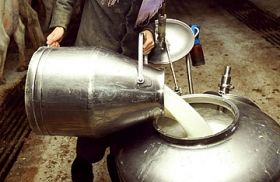
And here’s an interesting discussion, pro, con, complete with testimony and statements from propononents and opponents:
Is raw (cow’s) milk more healthful than pasteurized milk?
(A few links above led here also):
Now, back to Mama and MOTHER’s MILK (NB: I think you need to have been a mother, or at least pregnant, before you can produce, although not having tried myself before I became pregnant, I can’t say for sure.) Anyhow, for the sake of consistency, I prefer “Mother’s” to “Human” milk.
2009
The Milk of Human Kindness – Uses for Human Breast Milk
News Type: Event — Sun Apr 26, 2009 12:19 AM PDT
Every year, the citizens of the United States drink on average 21 gallons of milk. Most of this milk is from cows. Ever since I heard that PETA wanted Ben & Jerry’s Ice Cream to use human milk, {{For the record, yes, I DO object, women are not cows! We are already being treated as surrogate mothers in the courts, and sometimes functioning as them in life. Let’s keep it to the first part of life, and OK? STOP the ObamaInterventionProgram to get them babies away from them Mamas and into child care (and her into WalMart or somewhere else) and put them back with their Moms. It’s better for Moms, too. Let’s learn how to take care of our relationships, for once in our life!}}{{There are already ads enough for women and men of a certain age to sell their eggs and sperm;DNK if blood; too bad I missed them while trying to collect child support arrears}}
I {author, not blog author} have been researching about the advantages and uses of it. Here is what I have come up with.
)Human Breast Milk has been used as a medication for thousands of years. In the ancient world, breast milk was sometimes consumed as Medicine, in Fertility Rituals, and in other religious ceremonies. The Ancient Egyptians used are honey and human breast milk as medicine. Not only did they have medicinal values, they also are believed to have been used to ward off evil spirits and demons. It is even theorized that our ancestors not only breast fed their children during long migrations, but also breast fed their men too!
7) It helps fight off long term health problems. Breast milk can help prevent ear infections. People who drink it are less likely to develop asthma, Multiple Sclerosis, and help prevent some food allergies. It is said that Breastfeeding protects against cancer, helps prevent heart disease and even relaxes tension caused by stress . People with GI disorders and organ donation recipients also benefit from the immunologic powers of human breast milk. Talk about a health drink!!
Antibodies (also called Immunoglobulins) are made by the body’s immune system in an attempt to protect it from harmful substances such as bacteria, viruses, fungus, or animal dander. The antibodies work by attaching to these substances so that the immune system can destroy them.
There are five major types of antibodies: IgA, IgG, IgM, IgE, and IgD. All are found in breast milk. IgA antibodies protect body surfaces that are exposed to outside foreign substances. They are found primarily in the nose, breathing passages, digestive tract, ears, eyes, vagina, saliva and tears. This makes IgA particularly important for babies who are always putting things in their mouths.
In patients that are suffering from immunilogical diseases, such as AIDS, Leukemia, or Hepatitis, or patients recieving a therapy that deteriorates the immune system, such as chemo or radiation therapy, have shown the benefit when supplimenting their diets with human breast milk.
For more information:
http://www.breastfeeding.com/allabout.html6) People are always complaining in the USA, about stupid people doing stupid things. People cutting us off, insulting us, and even lacking common sense. Well, turns out that Human Breast Milk may actually increase intelligence. Studies show breastfed infants have higher IQ s than bottle fed infants.
For more information:
http://www.breastfeeding.com/all_about/all_about_iq.html5) Breastfed babies grow up to be leaner than bottle fed babies. Maybe it has to do with the fact that babies digestive systems are still in development. Then again, it maybe just that babies are trying to fill a psychological need with food. When a baby nurses with its mother, he is learning the basics of relationships. He is learning the recognize boundaries for good behavior, and what is not acceptable. The closeness that develops during breast feeding carries over to any relationships later in life. We, as Humans, learn by example.
Read more at:
http://www.schizophrenia.com/sznews/archives/004125.html
{{NOTE: this is a MAN speaking! He’d never qualify for a government post….}}
There are more and more people considering the advantages of breast milk not just for the treatment of illness.
4) PETA wants Ben and Jerry’s ice cream made from Human Milk. People for the Ethical Treatment of Animals sent a letter to Ben Cohen and Jerry Greenfield, co founders of Ben & Jerry’s Homemade Inc., urging them to replace cow’s milk they use in their ice cream products with human breast milk, according to a statement recently released by a PETA spokeswoman.
http://www.wptz.com/news/17539127/detail.html3) Swiss restaurant to serve meals cooked with human breast milk . The owner of the Storchen restaurant in the exclusive Winterthur resort will improve his menu with local specialties such as meat stew and various soups and sauces containing at least 75 per cent of mother’s milk.
2) In France, a “dairy” produces Human Milk Cheese. Founded in 1947, the cheese Cosma was able to recover the wealth of a farmer ancestral tradition Ardennaise forgotten until then. Indeed, the Petit Singly, the only cheese with woman’s milk , has long remained in the shadow of specialty cheeses, ordinarily milk cow, goat or sheep.
In France, no other product of this quality is listed, the Petit Singly has managed over time refining its taste thanks to the expertise of the master cheese maker, Patrice Cosma. Tinged with a touch of hazelnut and a subtle caramel color, sweetness and its basis will only tempt you.
For more information on this:
http://membres.lycos.fr/petitsingly/1) A Business in Miami, FL wants to promote the virtues of Human Breast Milk Ice cream. U.S. citizens consumed an average of 23 gallons of bovine milk in 2001. Quite an astonishing amount when you consider that Homosapiens are the only organisms known to consume milk beyond infancy. Even more extraordinary is the fact that humans are the only organisms that consume the milk of other animals!
Female mothers in the Class Mammalia produce nutrient-rich milk for consumption by their own newborn babies. Humans have attained the unique (and bizarre) position in the food web from which they exploit the reproductive cycle of other animals (particularly Bovidae) for food. Adding to the cultural mystique of milk consumption is the widely held taboo against consumption of human breast milk either by unrelated individuals or persons beyond some generally unspecified age.
It is the mission of MMICCo. to challenge the traditional paradigm that there is nothing abnormal about conversion of mammalian milk into luxury food items. Mother’s milk is a natural creation that we should celebrate, but is the milk of other species truly fair game for human consumption? If so, why isn’t human milk? Our hope is to provide a delicious frozen product while framing this conversation in a way that leads to fruitful progress in consideration of the ecological niche of Homosapiens.
For more information on this:
http://www.bio.miami.edu/muscarella/mothersmilkicecream.htmlI do not understand why it would be OK to drink from a cow Teat, but not from a human Teat. I have found evidence to the detrimental effect of cow’s milk with Bovine Growth Hormone. One study not only shows evidence that it leads to obesity and excessive male breast development, but suggests that drinking nonorganic milk will give women a 42% higher chance, and men a 20% higher chance of developing Breast cancer.
Mostly, I wrote the article so that people will start questioning why we believe what we believe is OK. Society says it is OK to drink cow milk. Society also says we should expect politicians to lie, judges to take bribes, and car dealers to try to rip us off. How far back are we personally willing to push the boundaries of what society says is acceptable? Is it worth it, to improve your health?
Here are some more informative sites for further information:
This one is the world famous La Leche League, promoting Worldwide Awareness to the benefits of Brestfeeding
Legislative records show that raw milk dairies were specifically discussed during the debate on AB 1735, but neither raw milk producers nor consumers were consulted on the legislation

Hmm, there is a certain parallel to the low-income parents who were being randomly studied, categorized, and legislated about when it comes to family law, as well. Not to mention, I do not recall a NATIONAL poll at any time on the wisdom of fatherhood becoming the new state religion, moreso than, say, motherhood. I wonder how many of the about 50% of the US population (women, i.e.) were indeed consulted by the legislators (primarily male), governors (I believe ditto), and pastors (probably still so), etc. promoting these policies.
Finally, my last “find” on the issue of, at least, cow’s milk. Be sure to check out the study on link to cancer:
http://www.milksucks.com/index2.asp
A question comes up, as to pushing milk in the school cafeterias. I have worked in an urban area (more than one, actually), where it could be sarcastically but with some relevance said, the major health risks were homicide and diabetes. Some people, and populations, have allergies to cow’s milk. The aspect of the public schools as a dairy-dumping ground comes to mind.
Just because it can be mass-produced doesn’t mean it’s a good idea.
I think this commentary goes for almost any primary aspect of life, including parenting, education, families, fatherhood, and nursing.
I think trying to indoctrinate an entire country from the top-down is an oppressive, fat burdensome Big Brother. Or is that, “Mama”?
Only, it ain’t motherhood, these days, it’s fatherhood. Time to let go of the oral fixation on making pronouncements, in private, and enforcing them upon the general public. And when they don’t work out as planned, making more pronouncements, and telling the general public, we’re out of funding.
Let’s get off that virtual teat, OK?
And create (how?) a brave, new, world than this one.
On reflection, I omitted an important year, in my chronology of human food, above:
1984
Like George Orwell’s 1984, this novel (Brave New World) depicts a dystopia in which an all-powerful state controls the behaviors and actions of its people in order to preserve its own stability and power. But a major difference between the two is that, whereas in 1984 control is maintained by constant government surveillance, secret police, and torture, power in Brave New World is maintained through technological interventions that start before birth and last until death, and that actually change what people want. The government of 1984 maintains power through force and intimidation. The government of Brave New World retains control by making its citizens so happy and superficially fulfilled that they don’t care about their personal freedom. In Brave New World the consequences of state control are a loss of dignity, morals, values, and emotions—in short, a loss of humanity.
SHARE THIS POST on...

Nature (specifically, nipples) vs. Shared Parenting: Family Law Inanity in Australia, too…
Humor me here….
Sometimes I have a bit of an inferiority complex when I read the generally higher level of discourse in news articles outside the U.S. This began years ago when I was corresponding with a certain UK group concerned about the British system which they said was, unfortunately, adopting practices that had already failed in the USA. Not that this STOPPED such practices, but the Brits & Scots were complaining too on a number of lines. California was specifically named. I’m not a West Coast native, and didn’t quite duck my head in shame.
What IS it about California?
I don’t know whether it’s hiring former actors as and Governors, if not later President, or whether it’s Hollywood per se, or it’s maybe because the pride from having succesfully detached from England a few hundred years ago filled American think tanks with hot air, or whether educational policy — what IS it, then that causes “educated” people to lose their grip on reality, and really stupid stuff to erupt, Krakatoa-like from this part of the Pacific Rim, and drift transcontinentally, via Internet, El Nino, (sorry wrong medium)or in the winds of change, and drop its dusty thinking world-wide, gunking up thousands of otherwise sane and at least semi-functional lives?
(More realistically, the dust driving the Dust Bowl of idiotic legal behavior, if you read yesterday’s post, is more likely Gold. Which I could also blame on California in another century, I suppose).
Maybe it’s reverse psychology — if it IS absolutely In-ane, or otherwise quack science, SOMEONE will declare it “scientific” and a market niche is born. Hence, PAS is now being taught in Spain, I heard, by people already discredited in the US, and we already had the Judge in Toronto making decisions on breast-feeding vs. shared parenting.
Thank God, Inane, Insane Behavior is not Indigenous to the USA!
Now here it is in Australia too. Finally I can hold my head a little higher as an American, because another continent(‘s legal/judicial system) has sunk to our shameful, dogma-driven level (drivel?), when it comes to Fatherhood, Healthy Marriage, Co-parenting, Joint Custody with severely aggressive batterers (resulting in family-cides) and Judges (??) making decisions as to how healthy an INFANT (and Mum) are allowed to be.
Given the chaos, progress, or perhaps it is liberality that is “U.S.,” especially on the West Coast, the headline “Breastfeeding Mums forced to share care” (below) has someone like me naturally wondering at first whether this piece was about one such same-sex marriage and two Mums sharing parenting. Gee, I hadn’t thought about THAT one yet. My confusion is understandable, I hope. First of all, I’ve been in family court system for many years and found out the most words in there are topsy turvy to start with (for example, “mediator,” which means, a person whose favor one must win, within 45 minutes of a first encounter, after which, the hearing process is a simply a shoe-in…), or, say, the word “family” to start with, the composition, schedules, members, relationships, and prosperity of which typically ends up different going out than going in. The word meat grinder comes to mind…
Moreover, being as I am from the home of the brave, the land of the free, and one of the several US states that legitimized, at least for a period, same-sex marriages, and is working HARD at promoting the concept at elementary school level, the words “Breastfeeding Mums (plural) forced to share care” brings up images of an individual case, not an entire class of cases. Perhaps if they had said “with whom” these Mums (and how many of them) were forced to share care, I might have had an easier first-glance assessment. Don’t point the finger at me, I already know anything goes from a number of angles.
However, on actually reading the article, it appears to have been heterosexual couples uncoupling, and thereafter, as children were involved, they must go through the system and face the same old insanity — every time a couple parts, a family law judge will have to play God and juggle priorities. Added to the complications, the children involved were not yet weaned. No matter, a decision is here…
“Breastfeeding as parental alienation”? If so, then the judge could simply penalize the mother, about $250,000, for not sharing nuturing well enough with the children’s father, as a Canadian judge did recently. I wonder if it was the same Toronto judge that ruled on how long the mother could breastfeed, and what her real motivations for doing so were. Family law judges are well-known for mind-reading and intention assessing.
In short, there appears to be no area of life which judges are not deemed to be expert to pronounce upon. If they lack expertise, no matter, experts are at the beck and call of the court to add the appearance of logic to decisions.
By the time my children are grown and I am 100% divorced, and hopefully into a new profession not subject to first-trimester-abortion-by-child-napping or frivolous lawsuits, I will probably have experienced every emotion, and aspect of life possible, and should probably head for a judge-ship. I will keep a coin handy for flipping during the more difficult cases, and hire a private security guard in case I mistakenly rule AGAINST a battering or child-abusing, indigent, law-breaking, stalking or kidnapping parent, thereby alienating my colleagues in the courts.
(HEY — even the best of us have our fantasy life, right?)
Back to the topic of allotting nipple-nudging time in a co-parenting plan.
IMAGINE being that judge:
Do I, as judge:
wield my ??-appointed authority over litigants’ health, wealth, lifestyles, and divorce, choose:
- (A) Growing baby’s health and Mom’s, as already determined by clear medical evidence (and milennia of practice, world-wide) and bend shared-parenting laws to accommodate breast-feeding, knowing (as the average adult, I hope already does) that breastfeeding is indeed in the best interest of the child on a score of physical, emotional, psychological categories, for BOTH Mom post-delivery, and breast fed babies tend to be smarter, healthier, less obese, and more disease-resistant, as well as cow’s milk has several contraindicators (first of which is, it was designed for herbivores, not omnivores, and for large-boned bovines, and more)**
- {{**Certain exceptions apply, as when Mom is abusing a substance, or possibly is so traumatized or stressed out that cortisol, adrenaline (i.e., stress hormones) are flooding her system, and as such, her nursing infant’s. GEE, what circumstances might engender that? (a) possibly violence in the home? (b) possibly knowing that her nursing infant’s/child’s saftey and future, and her relationship with this “fruit of the womb” is totally in the hands of a family law judge?}}
OR, do I, as judge:
- Go with more recent, and far fuzzier (but currently more popular, at least with the generally dominant gender) psychological assertions that”Fathers are Nurturers Too!” and “Female-Headed Households innately are poorer, and more dangerous, and in short to blame for society’s ills” dogma (imported, I believe, from Southern California legal experts, aided by some conservative think-tanks/foundations, and policy-makers who help drive policy from Washington D.C.). To this, I suppose I should add “Breastfeeding Sucks!” and any Mum who won’t just give it up is overly bonded to her infant, and a parental alienator — doesn’t she care about her kids’ emotional needs for two parents, especially a father?
- Which is it? History, or Recent Theory?
- Do I want to risk criticism from the medical establishment (which has set a clear “Go Thou and Nurse” policy, which my government has already endorsed) or
- Do I want to compromise potential funding (this blogger comments from her USA perspective) from the post-Dr. Spock, feminist-defanging doctrine from about 1980s forward, which the globally mounting drumbeat of fatherhood mongers claim is endangering their offspring’s health by removing the radiant glow of Dad’s presences from Kids’ lives?
Another possible fulcrum of the Decision See-Saw might be:
- Do I want to show I share common sense with the rest of the public, therefore possibly compromising my ambience of near-divine, esoteric insight (I’m JUDGE, right? and no common bloke), or do I want to throw my clout around?
(And DO I CARE that newly-divorced, or restraining-ordered, irate fathers are still dropping kids (excuse me — GIRLS) off bridges, or otherwise killing them, if not themselves also, on visitation, throughout my country, and others).
My imagined judicial angst probably didn’t last long, if it ever arose. There probably was no wavering, no virtual see-saw.
This is FAMILY Court. It’s a no-brainer: Given the obvious, do the opposite: Throw the kid in a carseat, share “parenting”, and “let’em drink (cows’) milk half the time and breast milk the rest. Or make Mom pump extra for 3 days a week. Why cry over spilt milk from both sides?
Moreover, throwing in some inanity shows who’s the boss in court. The next uppity woman who comes through here will know better and make our lives easier. Don’t they know, men don’t like to WAIT in certain matters??
With judicial rulings -and poorly prognosticated legal concepts — like this, who needs Parenting Education (or for that matter “Healthy Marriage” promotion)?
The only other sarcastic “Good Grief!” leverage I could get from this article is to comment that with examples like this, we really don’t need “Healthy Marriage” education in either Australia, or the USA! Just make them read the news…
MY CONJECTURE: Any couple that separates before a child is weaned either (and very possibly) had domestic violence as an issue (in which case, sole custody would be more advisable) or wasn’t too bright to start with – – if they read newspapers, they would surely learn, as of 2006 in Australia, that any child conceived would go through carseat, attachment, and digestive hell unless the parent stuck it out a little longer. Or, she was indeed using him to get a baby. (Not that men have never done this of a woman, either….)
A close friend of mine who is as thoroughly disgusted with my case’s many years in court, not to mention child-stealing, unprosecuted, after I’d just stabilized the household, believes — and it appears to be serious — that people should have breeding licenses. In the current climate, I think a thorough course in the legal system (including recent fads) and the domestic violence statistics, plus a thorough understanding of the cost of attempting to separate, when kids are involved, should be requirements.
Chalk this one up to the hands of the anti-VAWA people. No one in their right mind would subject a child to this, it’d be better to stick it out, and have a safety plan each time someone loses it emotionally in a relationships, than to send a growing human being through this official-DUMB.
Please forgive me, but one more shot: Surely this shared parenting law could NOT have come from legislators who actually breastfed before; it’s like salivating — your body acclimatizes to supply and demand, and let alone jerking the child around emotionally, how about them breasts? (or, to become a judge, possibly, one must act like a man, including as to schedule, and therefore women judges would skip the attachment phase, use formula, or get us to pumping in the lady’s room between hearings?
Incidentally, and Mums would also know this — what comes out the other end is MUCH less offensive when it came from a human teat, not a cow’s one, via pasteurization, or formula, which isn’t even that healthy. So there could be additional causes for grievance, as in, “child was habitually returned to mother with a real stinker.” Good grief! Let the kid nurse. When it’s older, it can see Dad more, and will recognize him well enough.
The legendary , proverbial “King Solomon” — who was noted for taking his inherited kingdom down in good part by too many expensive wives and concubines (no, that was NOT a sideways snipe at the US Congress)(perhaps) supposedly saw two women (were they breastfeeding?) who claimed one child; the other one had been rolled over and smothered to death in sleep. Threatening to enforce “Shared Parenting” by “raised sword” the real Mum piped up and said, “let her have it!” and the real wise king recognized the real Mum, and she got her baby back.
Guess what with all them wimmen in his life, he knew a thing or two about nursing, even vicariously. Or, he’d remembered the story of Moses. Their cultural baby factories, I guess, included wet-nurses, not nurturing Dads vying for kids’ allegiances and affections.
OK, I’m through. If you’d gone through the co-parenting with a controlling personality, thereafter losing your kids scenario (I did, if you’ve read other posts, and at a huge cost, and after a very dedicated motherhood lasting til they were more than half raised), you might be tempted (as I was, and obviously succumbed) to make a point with this Caroline Overington article from “The Australian.”
(The headline is the link also.)
Breastfeeding mums forced to share care
Caroline Overington | June 10, 2009
Article from: The Australian
THE Family Court is placing infants who have not yet been weaned from the breast into shared care arrangements with their separated parents.A study by academics at Flinders University has found that infants less than a year old are spending one week on a diet of cow’s milk, and one week nursing at the breast, so that parents can share their care, as recommended by the Howard government’s shared parenting law.
Others are spending up to three hours a day in a car, shuttling between homes.
The shared parenting laws, introduced in July 2006, are attracting complaints from a range of professionals at the coalface of family law.
The study on the shared care of infants after divorce was conducted by Linda Sweet, of the Flinders University School of Medicine, and Charmaine Power, an associate professor at the School of Nursing and Midwifery.
Their report said the shared parenting law placed “expectations on both parents to participate equally in care, regardless of the child’s age”.
The report said there was “ample evidence that breastfeeding is the best form of nutrition for infants” and the Australian government’s dietary guidelines espouse breastfeeding as the optimal food for children for the first six months of life.
“It would be expected that breastfeeding infants would not be ordered into substantial shared parenting arrangements, ” the report said. “However, many infants regularly are.”
One mother, “Georgianna” , separated from her husband when their child was seven months old. The magistrate ordered week-about shared parenting, saying the boy could have his nutritional needs met by means “other than breastfeeding” .
“Georgianna’ s milk supply became erratic as a result of these week-long absences,” the report said. At the time of interview, her son was receiving breast milk while with her, and cow’s milk while with his father.
“Trish” separated from her husband when their child was five months old. The court ordered shared parenting of seven days a fortnight, but no overnight stays, with dad. The distance between the homes meant the child spent three hours a day in a car seat.
The authors concluded that “national and international guidelines on optimal duration of breastfeeding” have less sway with judges than the benefits of time with fathers. “This in itself is not a bad thing, and all women in our study encouraged father contact,” they said.
Breastfeeding was at issue in a Family Court matter heard in Cairns last year, involving a couple who had been married for less than a year when they separated. Their daughter was five months old. The mother was committed to “attachment parenting” and demand feeding, and would not allow the child to stay overnight with her father.
The judge said the mother had “no time set for the child to be weaned“** and allowed the father to see the child only when a mothercraft nurse was present (the father had an annual income of more than $280,000, plus a $350,000 annual bonus, so hired help was no problem).
The judge said the father “wanted to take the child out and have her stay overnight but could not “because the mother insisted that the child be breastfed”.
The judge said the shared parenting act made it necessary to “consider whether it would be in a child’s best interests” to spend such limited time with her father, and concluded that overnight visits should begin three months from the date of the hearing.
Five months, turn that faucet off, folks! Right?
There are differences between at what age industrialized countries recommend that cow’s milk can be introduced to infants. Most countries recommend waiting until 12 months of age, but according to recommendations from some countries (e.g. Canada, Sweden and Denmark) cow’s milk can be introduced from 9 or 10 months. The main reason for delaying introduction is to prevent iron deficiency as cow’s milk is a poor iron source. In one study mainly milk intake above 500 ml/day caused iron deficiency. Cow’s milk has a very low content of linoleic acid (LA), but a more favorable LA/alpha-linolenic ratio, which is likely to be the reason why red blood cell docosahexaenoic acid (DHA) levels seem to be more favorable in infants drinking cow’s milk compared to infants drinking infant formula that is not supplemented with DHA. It has been suggested that cow’s milk intake can affect the later risk of obesity, blood pressure and linear growth, but the evidence is not convincing. There are also considerable differences in recommendations on at what age cow’s milk with reduced fat intake can be introduced. The main consideration is that low-fat milk might limit energy intake and thereby growth, but the potential effects on development of early obesity should also be considered. Recommendations about the age for introduction of cow’s milk should take into consideration traditions and feeding patterns in the population, especially the intake of iron and long-chain polyunsaturated fatty acids and should also give recommendations on the volume of milk.
**Perhaps instincts, observation, judgment might play a role? Perhaps the father’s substantial income was a factor in his failing to realize that waiting can be a virtue, at times?
~ ~ ~ ~ ~
Object lesson:
Show a 2nd grader a picture of a calf and a baby. Now ask the 2nd grader what the calf eats (grass). Then ask the same child where milk comes from (“cows.”) Ask them to talk about the differences between a Cow and a Person. Pick a female dairy cow for the example.
Object lesson, courtesy Google Search on this phrase:
The Milk Of Human Kindness: Uses For Human Breast Milk
Every year, the citizens of the United States drink on average 21 gallons of milk. Most of this milk is from cows. Ever since I heard that PETA wanted Ben & Jerry’s Ice Cream to use human milk, I have been researching about the advantages and uses of it. Here is what I have come up with.
{{I think this is actually worth a post. Yes, I sucked onto this thread of thought and am not letting go until
What a nice comic break– some posts are “no-brainers,” when their subject matter clearly already is. Just show the article and have a bit of fun.
A certain sense of personal wellbeing (admittedly not very empathetic), comes from realizing that even YOU, had YOu been judge (or, legislator) wouldn’t have been that inane, or cruel to a little, nonambulatory child as to switch its diet, regularly, and hope its intestines and still-plastic brain can figure it out: is it time to suck (and what), or to sit in a carseat, unnurtured by either male chest or female breast, for 3 hours at a time?
With nipple confusion beginning for age one, ADHD is sure to follow by the time he gets to Australia’s equivalent of Early Early Head Start.
On the bright side, if the worldwide intent is to produce confused, passive, detached kids, adolescents, and adults (perchance,lawmakers?), who can’t digest food right, let alone information, this WOULD be the way to go. Get ’em before they know who Mom is. Or Dad.
Meanwhile, “Part I of II” on ‘Who’s Funding My Goverment?” is still forthcoming;
I have been researching. Some leads were hot, some were disconnected.
Court-ordered dysfunction does not, really, proceed from well-intentioned intelligent weighing of right vs. wrong, but rather pays versus doesn’t pay. Just imagine the parenting coordinator business that will come from these scenarios. Child winds up with digestive problems, or a split personality, because Dad can blame Mom for breastfeeding (Breastfeeding as Parental Alienation?) and Mom can blame Dad for compromising baby’s long-term mental and physical health (and be closer to the truth, on that one). More business for civil litigation. Will he get lowered child support payments becauase he actually has to PURCHASE nutrition for the little one?
The possibilities are endless, which of course is the point.
SHARE THIS POST on...
. . . and Non-sense, diagrammed….
1994-2009 , it’s about “Fathers,”
and is beginning to remind me of the Viet Nam war.
Began in secret, finally acknowledged, and I hope someday
we will have something better to talk about, as a nation.
These quotes are from June 2006

June 2006 – THE WAR ON FATHERS: How the ‘feminization of America’ destroys boys, men – and women
The June edition of Whistleblower magazine is a mega-eye-opener exploring one of the most crucial but little-reported (??) phenomena of modern America – what WND calls “THE WAR ON FATHERS.”
The evidence of this almost unthinkable scenario is everywhere:
In public school classrooms across America, in every category and every demographic group, boys are falling behind. Girls excel and move on to college, where three out of five students are female, while young boys – who don’t naturally thrive when forced to sit still at a desk for six hours a day – are diagnosed by the millions with new diseases that didn’t exist a generation ago. To make their behavior more acceptable, they are compelled to take hazardous psycho-stimulant drugs like Ritalin.
This happens to be true. But how is this a war on fatherhood? And why should girls, or grown women, who are already socially conditioned to sit still; do for six hours a day either? They are more likely to daydream and underperform in some response to this, or start intrigues, or other non-scholastically-engaged activity. How is that any more acceptable for girls either?
Boys are more than 50 percent more likely to repeat elementary school grades than girls, a third more likely to drop out of high school and twice as likely to have a “learning disability.” And the suicide rate among teen boys is far higher than that of girls.
“What we have done,” explains Thomas Mortenson, senior scholar at the Pell Institute for the Study of Opportunity in Higher Education, “is we have a K-12 school system that seems to work relatively well for girls and does not work for a very large share of boys.”
(And he cites the same study I just did! but with diffferent conclusions):
I take issue with this “we.” I was born in the 1950s, and I didn’t create the public school system, and, like “war”, it was not conceived, designed, or pushed to full fruition by women.
Common sense says that children are going to learn better where there is some personal relationship with the teachers, and their classmates, that has half a chance of enduring past a semester. And for them to individually recognized for WHO they are, not only how they perform. This will have to require some “down” time and informal associations as well. Putting them in large groups to absorb the nationalized curriculum en masse is a recipe for failure. Moreover, there possibly IS something to the different rates at which boys and girls tend (overall) to be literate and fluent; there already is among different children of the same sex as well. The age-segregation thing — as the rule, and differences, the exception — is unnatural in almost anything but armies. Good grief! It doesn’t happen in families, and doesn’t always in corporations or businesses either. Why do it in school? That’s a recipe for gangs, which — face it — we have.
But declaring that situation, and this clear, systemic educational failure to be a “war on fatherhood” is ridiculous, and ignores that it fails girls just as well. Any system rigged for one gender, or social class to succeed and another to fail, is failing allof them. In fact one of the prime functions of this system, and characteristics, is to set children loose in large groups, where for sheer survival they must figure out a “gang” to belong to, a “type” to become.
And I do not at all approve of our current administration’s promises to “fix” something that has a design flaw — which has been already identified — it sorts by sex, and it also sorts pretty thoroughly by income. It wastes parents time and energy (propping it up by involvement, or by fundraising). It dumbs kids down, and slows them down. I
For more information, please see “edwatch.org”
A mother’s lament/rant on the public school system.
If you want to skip it this time, scroll down past the red ink, which it also has helped drown my household in, as a result, not to mention red tape. I think there might be some forgiveness for my seeing some “red” on this issue!
Also, this post is not copyedited, I’ve had several “saves” so far, and the most current one is not posted. I am not going to proofread here (on such a personal “hot topic,” but simply want the thoughts, references, and information out.
I have participated in education in, around, before, and after public schools, as well as private, home, and some Catholic schools, and I’ve had my share of watching simply intelligent boys be labeled hyperactive. IN one case, I had to throw out a 4-year old from a piano class, but he turned out to have been gifted, and I took him on as a private student. I have taught boys bouncing off the wall (literally sometimes) but able to focus when they were allowed to be engaged — which singing tends to do, to some. I have also had a daughter daydreaming in class while the entire class read aloud a book geared to several grade below her level.
Jonothan Kozol detailed in “I Won’t Learn From You” how some kids get into “Special Ed” that really don’t belong there. John Taylor Gatto wrote of his struggles to get a fluently reading you lady out of a slower classroom. A book on “JUMP” (Junior Undiscovered Math Prodigies) writes of how he worked with supposedly “slow” kids and their successes. There are many more profitable things that can be done when someone fails to learn than labeling and sidelining them. By and large, public schools don’t do this.
My children were forced back INTO this system by a man cheated by it himself (it did not compensate for family lacks), who I’d just left because of violence. I myself am still unlearning values I absorbed while in public school system (at which I excelled), one of which was slowing me down and undervaluing my strengths, and judging myself as a person by the things I was less adept at, rather than appreciating the strengths. I know this affected how hard I pushed in my career, prior to marriage, although that came out pretty decent overall. Now my kids are incorporating the same values.
When we homeschooled, both children were vivacious, engaged, ready to talk to adults, and with time in their schedules to play also. They were, in short, themselves, and felt free to relate to both parents, the custodial one and the noncustodial one. We moved in and out of various learning situations with relative ease, which is typical, and adds interest to the school day. They saw sunshine every day, and not just during gym class or a hurried lunch.
The style, motivation, and goals of us as a homeschooling family differed from the larger classroom, which teaches to the middle or bottom level. As a parent, OR teacher, I’m never interested in my kids’ middle or bottom levels, but their top ones, and had a pretty good idea of where that was, because we lived in the same household, and I had adequate time to see them at work in a variety of situations.
They both excelled although had different learning styles. I watched in horror, and shock, as my own offspring became commodities in a war against allowing them to continue in this fashion because a woman had made a decision to return to it after a non-relative non-parent, non-educator (by lifelong profession) told her to stop. Watching them give up great activities to participate in classrooms where some teachers, let alone the average student, couldn’t put a paragraph together without grammar mistakes, where math was slowed down, and one daughter’s major concern was literally daydreaming in class (and missing something) because they were reading the entire book aloud in class to compensate for kids who otherwise wouldn’t do their homework. . . and that book itself was aimed at a reading level far below hers — this was like torture to a parent.
The school system took me out of their lives in any significant role — because we were a two-household family — and put me in a traffic jam instead, a place no single mother can really afford to be! Time counts! Our schedules were stressed whereas before they weren’t. I have talked to wealthy professional mothers (same neighborhoods) who were equally stressed for the reasons of supplementing the school’s failures with after-school enrichments. I tried to each some of their stressed out students too, and finally became more discriminating in who I would and would not take on as a private student.
NOTE: My children, after years of the School wars, would disagree, and sought peace, at any price. As a parent, I note that they are not yet fully grown, and may (or, OK, may not!) think differently afterwards. I know what it cost our family. And as a musician privileged with 13 years of private lessons, which helped me get into a top liberal arts college — majoring in music — I know that continuity in an instrument is required for some mastery. Mastery of any sort of skill that requires this sort of development opens doors socially, often far beyond grade school. This also goes for other skills, such as language, athletics, gymnastics, or for that matter science interest.
To hold back multiple children from their long suits to help some children learn to read, write and count, sometimes under methods that are known to not work well (such as the deletion of phonics, for a period in US history, or the experimentation in math texts, about which I know something, and which a book called, appropriately (it’s a pun), “Class Warfare” addresses — has GOT to be a form of child abuse. Many, many authors have already addressed this.
If someone wishes to look for a major source of social problems, it would make much more sense to look at significcant institutions in our country, rather than half its populace — women! And declare that they have declared war on the other half in all situations where they left a marriage. Or to declare a new national religion: Fatherhood! The real war is much more likely to be: inherited wealth “haves” from up and coming “have-nots.”
The Rhetoric of “Fatherhood” does exactly this: It rides parasite style on existing situations (in this long post, I address two: education, and war, with attendant PTSD), and co-opts them into the fire fanning the cause. I have seen it also complain about the family law system in the ssame manner, calling it pro-mothers, when the facts are, it svery origin and design, by primarily men (southern California) is to prolong family strife (for an endless cash machine) and diminish the rule of evidence in favor of out-of-court situations where due process can be better violated. I am talking about mediation, where there has already been criminal behavior.
Back to Education as a “war on fatherhood” (implying, by feminists):
In 1990, John Taylor Gatto documented seven primary lessons this system ACTUALLY teaches. Look them up! Like me (I have scope and experience as a teacher, graduate, and having kids go in, out and back in to this system, while in my household, and have also dealt professionally with many parents, year after year, with kids in a variety of schools as well: urban and suburban. Beyond that, I read a lot!), as teh New York State Teacher of the Year at the time, he explains correctly in his little book called “Dumbing Us Down” what this system actually does, as opposed to its stated mission. That he doesn’t mention “war on fatherhood” or unfairness to boys or girls may have been because this was before the founding of the “National Fatherhood Initiative,” or it might have been because that’s not the situation. He DOES mention that it breaks down family units and true communities, as opposed to false, and fleeting networks.
Another author, Samuel Blumenfeld (I picked males, guys, OK?) wrote “Is Public Education Necessary” and narrated some of its history. That’s rhetorical question, folks! Diane Ravitch has written a book called “the Language Police” and she worked FOR the U.S. Dept. of Education, a Dept. our Constitution said nothing about originally. Other books such as Adult Illiteracy, The Literacy Hoax, and many others have categorized its failures. No matter, where there is a government contract, there is an ongoing proposition.
I ran afoul of a recent product of the California Teacher Credentialing process in my own custody and divorce in the 2000s. The same personality took issue with my homechooling (which had been our standard) but none with the violence, not even while the RO was on, instead, characterizing my decision to homeschool as “emotionally violent.” Say What??
I was shocked !! at the prejudice and tunnel vision involved, and at the callousness to the impact on our family household (including its income) in these matters. Our kids are not to be testing grounds for drugs, theories, or human behavioral management techniques. They are not to be strip-searched, punished military style for something their classmates done, indoctrinated, sorted by sex and age, locked down, taken hostage, sexually assaulted (or harassed) by teachers OR fellow-classmates, or shot to death in or near a school, yet this has happened and continues to happen. This is not what childhood is for.
Moreover, childhood passes fast, and it shouldn’t be squandered.
I worked in and around homeschoolers — the student/adult ratio was enough to keep a watch on violence, abuse, hate-talk, and I guarantee you, these kids wouldn’t have thought ganging up on or about stoning me, as a middle school band teacher (female) recently was in this county. I knew the parents of the children I taught. I also know that these people have the power to hire great teachers and fire bad or unreliable ones. I appreciated working with children who were intelligent and had some self-control, this was good for all of us. Moreover, apart from a few relationships around music, the friendships with kids and parents alike that my children formed in this manner were among their most stable and long-lasting ones, lasting beyond a change of schools or personal interests in life. They knew each other as PEOPLE in a variety of situations, which traditional school doesn’t allow.
And neither girls nor boys deserve to be locked up in one box, while parents work in another during daylight hours, when a better way is available. I know the finances of this personally also. It was totally impossible for me to accomplish, in my situation as a single mother with weekly visitation to Dad (in a nearby county) with my kids IN this system what I could had I been given permission for them to exit it.
But the reason I could not relates directly to this school systems’ need to perpetuate itself, and pick off the stragglers who otherwise might put them to shame. My kids experienced parental stealing by their angry father because I as a mother dared to say, this is NOT good enough for our children! ANd that attitude — that doing this — came from the near-lethal (and I do mean that literally) combination of fatherhood promoters (such as these below) and the financial “ancillary interests” serving the public school system.
I will take on any one in fair, open, debate on-line on this matter, with some moderation. This school system is cheating both genders, which should not be blamed on one of them. Moreover, the school system is generally speaking “progressive” and leftist, while the federal government appears to becoming — through these HHS grants I keep speaking of — more and more influenced by conservative right-wingers, who like to keep their women under control, and in large part from supposedly religious bases. Your blogger here has not only experienced this, but also read on the issue of domestic violence as addressed in conservative Christian mainstream press (i.e., Focus on the Family, Promise Keepers, etc.) Books such as “Battered into Submission” and others address their silence on this plague — physical violence backing up other forms of violence, within personal relationships — is always a plague when it’s system- endorsed. Dr Chesler addresses its format in the other fundamentalist religion, Islam, when she writes on honor-killings.
When a school system is actively pro-LGBT and not very friendly to Christianity (as opposed to, say Islam), and a government agency is pushing a Christian agenda through, the natural consequence is conflict. Both approaches are likely to engender a reactionary exodus from the system, or reaction to it. Add to this, underperformance intellectually when a school is more about indoctrination that education, and we have a cesspool of conflicting ideologies and power struggles, both within the school and between parents and the schools.
Most human beings don’t appreciate being the target of a mass label of any sort. This is a way to sort fruit, cattle, or sheep, not people.
Te American public, across the board, and is hostile to competitors, principally homeschoolers. In other countries — such as Germany! — homeschooling is illegal, which should be a message to us all about what direction this is heading. Our economy would be better off with private, market-based competition, and allow people to re-engage in their own communities. Schools throughout Chicago have demonstrated alternatives.
The problem,” said David Kupelian, managing editor of WND and Whistleblower, “is that misguided feminists, intent on advancing a radically different worldview than the one on which this nation was founded,
What would that worldview be — life, liberty, and the pursuit of manliness? . . . . . “Puh-leez!”
As I pointed out in my post of 06-01-09, the exact opposite appears to be true. In general, baseline sanity (as with family court in general, when it comes to labeling) the ground-zero truth is often 180~ reversal of the proclaimed truth.
FOR EXAMPLE, HERE:
I posted the original documents for us to look at, also, or links to them: Declaration of Independence, Gettysburg Address, and Martin Luther King, Jr.’s speech, at the Lincoln Memorial (1776, 1863, 1963) all talk about JUSTICE. In seeking freedom from being colonized by England, the signers pledged their lives and their fortunes as well. In 1863, on the battlefield of a war, commemorating the cost of not letting the South secede and keep their slavery trade going — then-President Lincoln reminded his audience BRIEFLY of 1776. The concept of slavery was supposedly anathema. In1963, another civil rights leader said, that promise was made, but for a certain sector has not been realized. Notably, both Lincoln and Martin Luther King, Jr., were later assassinated. All around this, women had been seeking to vote, at a minimum.
In 1994, VAWA said : STOP! hitting and killing us because we are women. Stop it! It was not a “we hate you because you are men,” but a “what about justice? We are people too!” Anyhow, “Whistleblower” (the source) drones on. . . .
have succeeded in fomenting a revolution. And that revolution amounts to a powerful and pervasive campaign against masculinity, maleness, boys, men and patriarchy.”
No, if along the way, manhood has become associated with the ability to oppress, we have a problem indeed.
Also, in the process of patronizing feminists verbally, let’s get consistent. Either they are misguided, and to be pitied and instructed, or they are wicked and evil revolution-fomenters, disturbing your peace and (Patriarchy), therefore to be hated, because they DO know better but are simply mean, nasty, family-haters. . . . . No wonder this is a call for mental health practitioners in the business; make up your mind! Which is it? Dumb, or bad? And while you are deciding which one women as a whole are (that’s ALL women who want to leave their marriages, or protest abuse of them or the children, and expect protection from this, etc. OR who not only expect BOTh to be (a) protected from assaults AND (b) to have the former assaulter continue to provide for his offspring (yes, you breed’em you feed’em, and it takes two, still, to start one…), for you own credibility that this is not a murder trial, but if it were, either the person would be deemed mentally competent, or not. This type of inflammatory speech, incidentally, isn’t, because it can’t choose between even those two. Among other reasons, which I hope to illustrate below, along with some sensible talk by men addressing issue that pertain, at least, to veterans.
Intelligent discourse (exchange of dialogue, or consideration of ideas/theories) is not possible, really, around these kinds of propositions. Add to that, we know now the Responsible Fatherhood Healthy Marriage Federal funding behind “teaching us our lesson,” so the poor and oppressed paradigm doesn’t really stick. As well as (I hope to also show) some of the funding behind the media portrayal of these issues.
“Issue highlights include:
Note “war;” “win/lose” and fear-mongering vocabulary below:. Get out the paint and drums:
- “Banning ‘mom’ and ‘dad,'” by Joseph Farah, who exposes the latest in bizarre and dangerous legislation by the California legislature.
Did the word “bizarre” come from some of these access/visitation grants? My ex used that one, of a very normal activity we were engaged in, although his description of it made it sound like Guantanamo. Bizarre & Dangerous together conjure up some great images, if the intent is to play them emotions and other rabble-rousing. (I am thinking he’s referring to Prop 8, or the attempt to switch the marriage registration forms from reading “Husband” and “Wife” to Party 1 and Party 2? For gay marriages, I suppose, it could be simply “Husband and husband” (til further notice) and “Wife and wife” I suppose. Or “Ms.” and “Mr.” — but in any case, I don’t think it’s nearly as bizarre or dangerous as the fatherhood movement, presently, which is affecting the justice processes in the U.S.
- “The fathers’ war” by Stephen Baskerville, a troubling look at how increasing numbers of America’s military men risk all to serve their nation in wartime, only to be divorced by their wives and lose their children.
Let’s consider the phrase “be divorced by their wives and lose their children” in its proper context, as to Vets:
Whistleblower author, you didn’t know that War messes with men, and women, both?
Mr (or Dr.) Baskerville must not have served as infantry, or in actual combat? And he doesn’t understand that PTSD happens? And in a soldier, can become lethal, including to his own family?
Let’s hear from some serious authors (not just serious about their own causes…). Senator McCain (See US Veterans article below) served in war — did Jeffrey Leving, David Blankenhorn, Wade Horn? ?? (We know about Clinton, he didn’t fight, and he didn’t “inhale”. either..)
NYTIMES: Across America Deadly Echoes of Foreign Wars
January 13, 2008, By DEBORAH SONTAG and LIZETTE ALVAREZ
Individually, these are stories of local crimes, gut-wrenching postscripts to the war for the military men, their victims and their communities. Taken together, they paint the patchwork picture of a quiet phenomenon, tracing a cross-country trail of death and heartbreak.
The New York Times found 121 cases in which veterans of Iraq and Afghanistan committed a killing in this country, or were charged with one, after their return from war. In many of those cases, combat trauma and the stress of deployment — along with alcohol abuse, family discord and other attendant problems — appear to have set the stage for a tragedy that was part destruction, part self-destruction.
Three-quarters of these veterans were still in the military at the time of the killing. More than half the killings involved guns, and the rest were stabbings, beatings, strangulations and bathtub drownings. Twenty-five offenders faced murder, manslaughter or homicide charges for fatal car crashes resulting from drunken, reckless or suicidal driving.
About a third of the victims were spouses, girlfriends, children or other relatives, among them 2-year-old Krisiauna Calaira Lewis, whose 20-year-old father slammed her against a wall when he was recuperating in Texas from a bombing near Falluja that blew off his foot and shook up his brain
BAD WOMEN, SEPARATING FROM THEIR TRAUMATIZED, LEAN, MEAN FIGHTING-MACHINE HUSBANDS. THEY ARE PARTICIPATING IN A “WAR ON FATHERHOOD.”
NOW, IF IT HAD BEEN A FEMALE HEAD OF STATE THAT SENT THE US INTO IRAQ ON (FALSE PRETEXTS) AND THEN SAID, ‘WELL, WE’RE IN, WE HAVE TO FINISH THE JOB NOW — OR AFGHANISTAN, OR ANYWHERE ELSE,AND ALL THE FEMINAZIS WERE EGGING HER ON, THEN PERHAPS YOU COULD BLAME FATHERS RETURNING HOME AND LOSING THEIR FAMILIES ON WOMEN’S WAR AGAINST FATHERHOOD. SOMEHOW, IT DOESN’T RING AS REAL AS THESE ARTICLES, BELOW . . . . .
These men, and I bet some of then are responsible fathers, too, are actually DOING something about the struggle the veterans have coming home. . .
(1)
Odysseus in America: Combat trauma and the trials of homecoming
By Jonathan Shay, MD, PhD;
Foreword by Senator Max Cleland and Senator John McCain
Book review by Helen A Williams, MS
New York: Scribner; 2002. ISBN 0-7432-1156-1 352 pages. $25.00
Those moved by Jonathan Shay’s first book, Achilles in Vietnam (1995)1–an inquiry into Homer’s Iliad as metaphor for the deforming effects of military combat on character–are in for another compelling read. This time, Shay examines The Odyssey and discovers that Odysseus’ adventures look a lot like the symptoms of what we now call posttraumatic stress disorder, or PTSD. Shay’s gift is to convey these symptoms as dramatis personae from The Odyssey cannibalizing the inner life of the Vietnam veteran.
Jonathan Shay is a psychiatrist in the US Department of Veteran Affairs Outpatient Clinic in Boston, where he began his career in 1987 working with Vietnam veterans suffering with PTSD. Based on Shay’s work with these vets, his second book culminates in a plea for changing the way the US military organizes itself to fight a war–or, at least, for changing the way the military had organized itself through December 2001. The book went to press in 2002, before the war in Iraq began (in March 2003).
(2)
 ’
’
Boston’s Jonathan Shay Honored with MacArthur Fellowship
VA PTSD Psychiatrist Given “Genius” Award
September 25, 2007
WASHINGTON — A Department of Veterans Affairs (VA) employee in Boston, Dr. Jonathan Shay, has been awarded the so-called “Genius Award” from the MacArthur Foundation. Shay, the author of two popular books about post-traumatic stress disorder (PTSD), has been a VA staff psychiatrist treating combat veterans with PTSD since November 1987.
“Dr. Shay is living proof that VA is providing our veterans with the best health care this country has to offer, especially for the treatment of PTSD,” said Secretary of Veterans Affairs Jim Nicholson. “Our veterans deserve — and VA is providing — world-class health care.”
Shay was one of 24 Americans who each recently received a $500,000 grant from the John D. and Catherine T. MacArthur Foundation, one of the nation’s largest philanthropic organizations, for “exceptional merit and promise of continued creative work.” Shay combines a study of classic literature with 20 years of experience treating veterans inBoston to explain PTSD to both the public and health care professionals.
In addition to publications in professional journals, he is the author of Achilles in Vietnam and Odysseus in America, two widely regarded books that helped spread the understanding that PTSD is an age-old battlefield injury by comparing the works of the ancient Greek poet Homer to the experiences of modern combat veterans.
He also pioneered the use of certain anti-depression medicine, called “selective serotonin reuptake inhibitors,” for combat trauma, a treatment that now has broad endorsement for veterans with psychological injury.
(3) The men in my family, in re: military service:
The men in my family background did not come home and get betrayed by their wives, bad women. This is how it went:
One cousin went to Viet Nam and served. He came home, and had a wife and two kids and was an upstanding man. He was done in, eventually, by Agent Orange and died, leaving THEM. The other cousin was disqualified due to poor circulation.
My Dad, I’m told, was held back here to work on a military-funded project for a major research lab in NJ. Naturally, as a kid, I was not privvy to on all of this. Later, I learned more. from a book and the Internet than my own family ever shared. One thing I also learned, and remembered, is that behind MOST technological advances is a military purpose (and money). He died early (65), why, I don’t know. I am sure had he not died early, he might have put my ex in place when the battering began. However, it’s also quite likely that childhood abuse was a factor in his life, and stress level overall. DNK. He overperformed and dedicated himself to study and work, and providing for us.
My uncle served in the war, and I never knew him that well as a person to start with, he was always kind of sidelined in the family; he was very talented artistically, and I have some cartoons of his, sardonic commentaries on how inhumane the treatment of his soldiers. He typically had a silly smile on his face (mental illness? Fetal alcohol syndrome? Smacked around as a kid by his Dad??) and never said much. No one would talk about this. He never married, and died early; I wasn’t told why.
SIDE NOTE: My Dad grew up with domestic violence, we were told. I suspect some of it got to this uncle and may have accounted for how well he did in life, and how short a life he lived. As he lived, so he died — though a niece, I was told next to nothing, then, or now.
In-law: My father in law served in Korea, and came back, at least, paranoid schizophrenic, medicated, and is described by my ex as uninvolved / depressed. My sister in law described him as a drunk (she refused to ride home in the same car with him from the airport). His household was definitely dysfunctional and he was most likely uninvolved as a parent because he was on medication and depressed. Eventually, well after one son divorced, remarried & was jailed for incest, and another one got a restraining order with kickout for domestic violence, and I guess after a daughter had multiple kids with a man who wouldn’t support them, my father in law blew his life out with a bullet to the head. Certificate reads “acute chronic depression.”
A brother in law I never met served in the military, came back, and remarried a woman with children. He was the one jailed for incest — not long enough as far as I am concerned. He since remarried almost 20 years older than than himself and judging an on-line photo, and his track record, I’d say she was desperate.
This was NOT “women leaving their husbands,” and it was not woman’s war on manhood. Perhaps THE logical conclusion of this version of manhood IS war. Period. Manliness = fighting someone. I don’t know. I don’t go for it. Not safe!
- “The war on fathers,” by David Kupelian, an in-depth look at what’s really behind the feminization of America.
Who knows — perhaps the “feminazi” (as we are called) came at one point from having to deal with generation after generation of war-torn fathers, brothers, orphans? Perhaps these men were coming back and acting out what they’d lived in war. . . And we protested.
Anyone who wishes to blame the ‘feminists” for everything has an ahistorical perspective. Where did we come from to start with? Not wanting to be the new slave class? Nationally speaking — and these FR guys DO obviously get national platforms to speak from — they own many of them, and pay for others (which can be traced at least in part) – – have externalized and targeted women as their personal “demons,” For being women, for not going along with the stereotyped gender roles, for wanting to leave the home and work, even if the household is suffering for lack of their doing so, for failing to crawl low enough – — A bigger, better man would face his own issues and think about maybe why she left. . . . . I know the man I left has apparently not done that yet. He’s simply found more people to agree with him, and got them all worked up (and incited to action), also.
- “Why men are being attacked,” by Dr. Laura Schlessinger, who says: “It isn’t all about hating men – it’s largely about disdaining and dismissing them.”
I don’t disdain men overall. For one, that’d be foolish — I work with choirs, and it takes all kinds to sing, deep voices and high voices, “SATB.” Historically within music, I have worked with male and female, let alone straight and gay, old and young. The children’s choirs I hung out with, some were boys and girls, and some girls only, and some boys only. It takes all kinds. I married and had children, which indicates at least a nominal ability of some sort, and stuck it out for almost a decade. I drew the line somewhere between the collections of weapons (more than one kind), destruction of my credit, attempt to keep me without transportation, and being concerned that a suicide was imminent. Not to mention being physically assaulted in front of my own kids, and lectured, too. Enough was too much.
Now, I want a little space, some peace, and sanity within the family court, only to find it is more interested in funneling funds to tweak the male/female family balance because of earlier concerns about welfare vs. child support and the establishment of what looks, sounds, feels, and is experienced like the establishment of a new national religion. Now THAT, I object to.
Those who have lived with certain personality types understand how setting a limit can be interpreted as declaring “war.”
I do reserve the right to determine when someone is talking sense, or nonsense, speaking treasures of wisdom or rubbish coming from sloppy, emotional, thinking. I do reserve the right to not be assaulted in my own home — and for this, I eventually had to have one of us leave — him! (we rented, don’t get all worked up about family property — I had chaos to deal with, from years of the chaos of violence. And plenty of debt. No assets — at all. Period. None, other than books, I suppose. An old car…, and not the only one…)
- “Has the bias pendulum swung against men?” Fewer college-bound, higher suicide rates, shorter life spans suggest males getting shaft. (OR, maybe they are not doing something right?)
NOTE: I am ONE woman, not ALL women. Most women I know are not “ALL” women. To attack us — to the point of killing! — because of perceived injustices by other women shows delusional thinking no different than attacking all people on the basis of race, national origin, or for that matter, body size, or faith. The rhetoric simply makes no sound sense.
- “Paternity fraud rampant in U.S.,” showing how 30 percent of men assessed for court-ordered child support are not actually the fathers of the children receiving the support.
Cites please? And if this is so, it is likely made up for the ones who ARE the fathers not paying it. Plus some fathers who are having custody switched and now their wives pay, or are jailed.
- “‘Shared parenting’ seen as custody solution,” a look at bills in New York that would require courts to treat mom and dad equally. (Courts have never done this, and do not do so now, thanks to the U.S. HHS // ACF programs and many more initiatives from at least as far back as 1994, and ongoing. Millions of dollars gone towards these initiatives. See elsewhere on site.)
“Resolving the boy crisis in schools” by Jeffery M. Leving and Glenn Sacks, showing how today’s public schools are profoundly unsuited for the genuine needs of boys.
I lived and worked in Mr. Leving’s home greater metropolitan area.
I do not think he was practicing on the Chicago’s South Side. I was there in the 1970s and 1980s working under a man who talked less and did more to help support and supplement inner city public schools through inspired excellence in music, the Unitarian church, to help boys AND girls get along together in mixed ensembles and non-age-level-separated situations. Another unique (for his generation) thing he did, starting in the 1950s (before Maryland had fully ratified women’s right to vote, and told Congress so!) was get some of the kids from the privileged Chicago Laboratory (private, upperclass) school and others on the North side of town to function, at work and play, and on tours and rehearsals, with some on the South and West sides. This was (the late) Rev. Christopher Moore. I came in from Oberlin Consevatory, and learned a thing or two as well.
I respect that man (shortcomings and longsuits) because I saw his work and service. Unlike Promoting Responsible Fatherhood, it’s not getting families killed or put back on poverty — except ONE child, “Virgil White” who was shot for quitting gangs through this group. It enriched their lives and infused something terrific INTO these public schools — singing. He also got kids OUT of the schools to sing together after school, and concertizing in front of a variety of others. This group is still going, and infusing emotional, musical and other cultural life into the city, and the lives of the boys and girls (now young men and women, or some gray-haired ones). In 2007 they had their 50th anniversary celebration, brining across male — and female; young — and old – musicians from across the country and across time. We (I came, too) sang for almost 3 days straight and filled the Lyric Opera House as to both audience and stage.
They also had something better (more noble) to focus on than gender, and gender alone. OR marital status. Good grief.
Guess why I was unable to bring a daughter along? Not in small part because of what demagogues like these were pushing through Congress, and then down through the Health and Human Services Department by way of Child Support Enforcement (or non-, as the case may be), and other programs that were set in motion while I was: 1. working to put music back in the schools, and not for high pay; 2. as a woman, pursuing a B.Th because it was part of my faith, and still doing music, and 3. During marriage, getting slapped around, in marriage, in front of pastors, family, employers, and others without intervention. And thereafter, in the family law system, when I was again attempting go rebuilding the profession marriage had trashed.
I can testify that the family law and child support systems are in bed financially with several others, and that groups that helped weaken the VAWA laws and enforcement of existing family codes in place to protect women — and children — and men from beating on them and hounding them out of work — couldn’t/wouldn’t even stick for a mother whose kids were stolen on an overnight visitation, and refused to enforce child support collections diligently either before or afterwards.
So I went to that 2007 50th anniversary of this group (Chicago Children’s Choir, incidentally) without my daughters, and inbetween the 6th & 7th court hearings in one year, ALL of them jumpstarted with a felony crime that no one will take responsibility for to start with: child-stealing.
Had they come, they would’ve had an eye-opener culturally (my daughters have scarcely left the state they were born in, to date) and seen adults respecting their mother, been musically inspired beyond belief, and heard a choir from South Africa sing also. (A group from here has also toured South Africa, and some of them sung for Nelson Mandela). Why should I, because I am female, and single, be prevented from bringing my offspring in front of such wonderful opportunities? How does this figure into the “feminazi war on fatherhood” because I protested that injustice? One daughter is accomplished musically, and still sings in a choir. This would’ve been a great opportunity. What kind of mindset would make that opportunity, for a lower-income single mother (which we became primarily through the courts to start with!), impossible for some growing daughters?
We are indeed in dark times. To me, that’s just totalitarianism.
I’d rather SEE a sermon — or hear a concert — than hear a sermon any day.
I think perhaps we need as a nation to start choosing our leaders from poorer backgrounds, uniformly, and not people who come straight out of college into law school, clerkships, judgeships, and privilege. Our current President apparently didn’t, but what about the rank and file of Congress? I think “royalty” is highly overrated, and the Fatherhood and Healthy Marriage is about neither topic, but about dumbing down the general level of conversation to TWO identifiers only: 1. Gender and 2. Marital Status, both of them to be considered privileged, when neither of them is really a character indicator.
Humanity is much more diverse, as are the issues important to debate nationally. And neither wealth nor poverty are, of themselves, sole indicators of how well a child is going to do in life. Let’s get out of the fields of virtual self-fulfilling prophecies, and predictions, and take a closer look at PROCESS (as in, due process) in the court systems, among other places.
i recommend a closer look at Tom Mortenson’s blog:
“postsecondaryoppotunity.blogspot.com.” There are valuable lessons on it, including one on the recent omission of the “family income” category in US Census work. One of the most stratifying institutions we have today — and one that was supposedly in place to do the opposite — is the k-12 educational system. Because of what comes out, only wealthier communities, or those where nonprofits committed to certain causes exist, to put it back in, as they still do ( from what I recall) in Chicago. Moreover, the monopoly has to be willing to let go some of its privilege and acknowledge failure. ONE of the failures is also character failure. One character builder includes competence, but it is not the only one. Another one is service, and participation in meaningful communities.
I think it’s also time to look at the dependence of our national economy on the public school system. Whole sectors would have to be dismantled if it were, yet it is failing students. I say this as a former teacher and parent, supplemented by experience and reading. Childcare cannot solve everything, and boys in particular, need their mothers when they are very young, and to not be age and grade-sorted with girls, and then stigmatized because they are different. And children who literally DO learn differently, should be allowed to — they are among the creators and inventors, we are drilling out of the population by reducing things to a standardized test answer. Such kids need TIME and some freedom to experiment, and permission to fail also without stigma. Edison did, after all! And Einstein.
That’s all for today.
This blog is becoming unwieldy (electronically), and I recommend that readers perhaps explore some of the links, and do their own research particularly on what our government is doing with tax dollars. There are few subsitutes for a little direction and a lot of googling, mixed with real-life experience and informal, unmonitored conversations with lots and lots of people from many walks of life.
If life is work, church/mosque/synagogue/single community organization, school, and commute — when does this happen?
What are we living, working, schooling, and campaigning/worhipping FOR? The right to direct someone else’s lives, or restrict their opportunities, or living one’s own, peaceably?
Above all, children are not property. Of all things, parents should know this. Too many entitities are making merchandise of them. When parents divorce, Sometimes it’s “no-fault,” but sometimes there are legitimate faults or crimes. At this time, one size fits all does not work, and shouldn’t be forced to at public expense in the courts any more than it does in the school system. ANy more than an employer should be forced to keep incompetent employees affecting its bottom line and public reputation.
As a nation, the US Government is the EMPLOYEE of the American people, as well as employing many in the exercise of its authority. It is in too many different businesses for sure, and has forgotten who it was to be Of, By, and For. Looking at who is greasing the wheels of Congress, and presuming to speak for an entire nation without openly consulting them on its policies, this has gotten entirely out of hand.
Like most bulldozers, or for that matter outsized tanks, it lacks the finesse, and substitutes force. and works best with a free rein in a large area.
People who work primarily as employees, paying taxes, have been bulldozed over at teh behest of private foundations running institutes at major universities driving data for federal purposes not voted on. It is paying salaries of judges who are sometimes caught with their pants down, or taking kickbacks, and trafficking in kids too (I refer to a federal judge in Texas on sexual harassment, a NJ judge on pornography involving kids, and two judges who sent juveniles, improperly, to detention centers, in Pennsylvania, among others).
I’m tired of this — as a mother, and former musician (as to employment) both practices require finesse and a degree of freedom to work right.
As to this post, I apologize for the length and its condition (not up to “snuff”) but hope that some of its links, references, and ideas may spark something in a reader for follow up, or to reconsider some of the rhetoric in light of, perhaps education, versus the gender or ideology wars. Maybe there is a better way!




 Let's Get Honest! Absolutely Uncommon Analysis of Family & Conciliation Courts' Operations, Practices, & History
Mixed Sentiments — from a different battlefield — on the Passing of Senator Ted Kennedy, who valiantly fought: Brain Cancer, for Not Leaving Children Behind, and for Caring for the nation’s Health.
with 2 comments
AUGUST 26, 2009
I rarely sleep, and as the TV flashed with news of this lion of a personality, and carrier of the family name, it coincided unfortunately with the third year since I lost my daughters to felony child-stealing, in retaliation for reporting, in seeking asylum from domestic violence.
I struggle with respecting this event, with discomfort about our nations hyper-respect of public figures. Senator Ted apparently was a womanizer as well as struggled with alcohol, and eventually married a woman 22 years his junior; do his many public accomplishments compensate, is this just the way of “famous men” that change society?
He lost two brothers to assassination, assassinations that affected our country.
I am currently reviewing the work of a young woman, local, that lost a sister and a brother to murder, for being in the wrong place at the wrong time, and probably also wrong color. She too is near the end of her dynasty — both parents gone. Her mother took the loss of two children hard, and also was fighting cancer. Her older sister was seen talking to some people in a van. She was found later, hog-tied, stabbed many times, raped many times, and thrown out like trash in a dumpster. Her SISTER. Her brother was stabbed in the heart for confronting someone trailing other women. Why do I run across people like this? I don’t know, except I don’t live in a castle or gated community, and I find people’s stories interesting. I have been cut out of my own daughters’ stories by a top-heavy, supposedly well-intentioned system that knew that two bright girls were not going to escape its radar or grasp, and that mother must therefore disappear.
Unlike me, she figured out FAST that a system was not going to protect her own two sons, and found a trusted friend to become guardian, so at least she can see them. Like others, for a fee. Like me, she wants some version of the truth to survive for her children.
We are allowed to give birth, but too often, not to also speak.
How famous is Senator Ted, then, and how much more important his story, and his contributions? Should I mourn him more than others? And yet it’s clear he worked hard, campaigned hard, pushed initiatives through, and changed our society. How can I handle this today, when I shouldn’t be blogging but doing something more self-preserving. Do I share the national regret and awe?
Quite honestly, no, but I mean no harm in saying so.
How long can I afford to pause and commemorate?
Probably shouldn’t have today, but i did.
it is easy and common to pick heroes and praise them, and transfer parts of our identity to heroes who gave their lives in service, and forget the non-heroes, some of whom I commemorate below.
I am not sure where Senator Ted falls in this mix. I think the metaphor of this book has come to the rescue. It seems both to symbolize the federalism and the poverty, and the reporting of it that go together in the topic “FAMOUS.”
“Let us Now Praise Famous Men“
My father had a love, and some ear, for poetry, and always claimed he could hear the rhythm of the Lord’s Prayer (or possibly it was the 23rd psalm) in Agee’s “Knoxville, Summer of 1915.” Ever the critic (and unable to carry a tune himself) he tried to talk me out of both music, and Christianity (unsuccessful in both cases), and we had something of a truce. I do not have, emotionally or socially, a family at this point; I have made my own in life, and as to the one with whom I share DNA, it’s the two daughters only (now gone) and the deceased Dad, and my memories of him will have to do. . . .
So perhaps the Agee reference, the federalism, and my wish to point out, that deep poverty and distress still exist, sometimes still caused by either the basic human lusts, or the governmental god-like posturing, will make up for my mixed sense of duty in perhaps failure to “note” with enough awe, the passing of another member of the Kennedy dynasty, regardless of on how wide a screen and with how broad a stroke for how long, he painted his visions of what the United States should be. For one, as a woman, a mother, and a Christian, I do not share his multiple visions on how to help the poor and educate America. I do not think this is the original American vision, a totalitarian welfare state, an inverted pyramid building the 21st century equivalent of pyramids of social structure. I think this “nation/religion” is the way of Egypt, milennia ago. No, I do not. But still, Let us Now Praise Famous Men.
One of the follies of humanity is poor choice of who to praise and with whom to associate — famous preempts worthy.
lthough Agee’s and Evans’ work was never published as the intended magazine article, their work has endured in the form in which it finally emerged, a lengthy, highly original book. Agee’s text is part ethnography, part cultural anthropological study, and part novelistic, poetic narrative set in the shacks and fields of Alabama. Evans’ black-and-white photographs, starkly real but also matching the grand poetry of the text, are included as a portfolio, without comment, in the book.
Although at its heart a story of the three families, the Gudgers, Woods, and Ricketts (pseudonyms for the Burroughs, Tengles and Fields) the book is also a meditation on reporting and intrusion, on observing and interfering with subjects, sufficient to occupy any student of anthropology, journalism, or, for that matter, revolution.
THE ACCOMPLISHMENTS OF SENATOR EDWARD M. KENNEDY 1962-2009
August 26, 2009
FOR IMMEDIATE RELEASE
Reflections:
Who old enough does not remember? the assassinations, the plane crash, and now we have newsbroadcasts, and a nation commemorating the legacy of this Senator from Massachusetts. It is healing to commemorate, with respect, men who have changed the face of the nation. Last night, I watched on TV, Charlie Rose seeking to know this man through former friends and writers, and also speaking with the Senator also. As I saw the shock of white hair, the broad, broad charismatic smile, and listened to Senator Kennedy promote Education and Health Care, his two major federal programs and passions, I had a hard time. I heard the Senator talk about how America cannot be left behind in globalization and MUST give EVERY child the capacity to succeed in a global economy.
I thought, where are the memorials for the people who were not born into Kennedy family, but still died?
Viet Nam Memorial
By thee have I run through a troop and leapt over a wall
Psalm 18:
1 I will love thee, O LORD, my strength.
2 The LORD is my rock, and my fortress, and my deliverer; my God, my strength, in whom I will trust; my buckler, and the horn of my salvation, and my high tower.
3 I will call upon the LORD, who is worthy to be praised: so shall I be saved from mine enemies.
4 The sorrows of death compassed me, and the floods of ungodly men made me afraid.
5 The sorrows of hell compassed me about: the snares of death prevented me.
6 In my distress I called upon the LORD, and cried unto my God: he heard my voice out of his temple, and my cry came before him, even into his ears.
. . . .
With the merciful thou wilt shew thyself merciful; with an upright man thou wilt shew thyself upright;
26 With the pure thou wilt shew thyself pure; and with the froward thou wilt shew thyself froward.
27 For thou wilt save the afflicted people; but wilt bring down high looks.
28 For thou wilt light my candle: the LORD my God will enlighten my darkness.
29 For by thee I have run through a troop; and by my God have I leaped over a wall.
30 As for God, his way is perfect: the word of the LORD is tried: he is a buckler to all those that trust in him.
31 For who is God save the LORD? or who is a rock save our God?
32 It is God that girdeth me with strength, and maketh my way perfect.
33 He maketh my feet like hinds’ feet, and setteth me upon my high places.
34 He teacheth my hands to war, so that a bow of steel is broken by mine arms.
35 Thou hast also given me the shield of thy salvation: and thy right hand hath holden me up, and thy gentleness hath made me great.
36 Thou hast enlarged my steps under me, that my feet did not slip
WHO MOURNS THESE?
Deborah Ross (51) and Ersie Charles Everette (58)
2009 Tried to break up, Shot to death at work, in a Tollbooth, and her male friend in a parking lot, ambushed
Cross said the shootings appeared to stem from a domestic dispute as Burris and Deborah Ross, 51, a California Department of Transportation toll booth collector, had recently broken up.
“He clearly had no regard for human life, so we wanted to apprehend him as soon as possible,” Cross said. “We had authorities all throughout Northern California trying to find this guy.”
Burris apparently opened fire with a shotgun shortly before 6 p.m. Tuesday, killing Ross and Ersie Charles Everette, 58, of San Leandro, Calif., who was sitting in his truck in the toll plaza parking lot.
Ross and Burris had shared a house in Richmond, and neighbors said the two had been having financial problems. Richmond Police were called to the house on Saturday, police spokeswoman Sgt. Bisa French said Wednesday. It is unknown what the nature of the call was as no report was taken, French said.
Although their relationship had just ended, Burris was aware of Everette, who drove Ross to work Tuesday, Cross said.
“Somehow, he knew the guy was there at her job, there’s a connection between the two victims, but what that relationship is, we don’t know at this time,” Cross said.
Everette, known as “Chuck” by those who knew him, was a longtime, well-respected bus driver for Golden Gate Transit who had received numerous accolades, spokeswoman Mary Currie said Wednesday.
“He was a likable guy, a good guy,” Currie said. “Passengers liked him. His co-workers liked him.”
Tuesday’s shootings occurred at the bridge over the northern portion of San Francisco Bay that connects well-to-do Marin County with Richmond and other East Bay suburbs. Witnesses said a man used the butt of a shotgun to shatter the window of the No. 3 toll booth, then fired at least three times inside, stunning rush-hour commuters in the westbound lanes before fleeing in the van owned by Western Eagle Shuttle of San Rafael, Calif.
Officers found Ross’ body inside the booth, while Everette was discovered slumped over in a white pickup truck in a nearby parking lot.
> > >
2009/2008 Torres, Catalina (44) & Eustacio (41), Sgt. Paul Starzyk
Brother, Sister, both domestic violence workers, both murdered by an “ex”
According to the San Francisco chronicle, on the evening of July 19th, Eustacio Torres was shot by his ex-girlfriend at a converted garage that Torres was renovating. Torres and his girlfriend, Bernadette Agustin, met about five years ago when Torres was renovating her house. They became partners in that business for a few years. The market started to tumble downhill, and their buildings went into foreclosure causing them to lose money. This caused tension between the couple. After some time, their relationship started to become difficult for both of them. Torres realized that Agustin was dangerous; however he never got a restraining order against her. On the evening on July 19th Agustin went to meet Torres at the garage. Prior to this incident she bought a pistol. She brought shot him with it.
About a year ago Eustacio Torres’ sister, Catalina Torres, a volunteer for a battered women’s group, was shot and killed inside of her Martinez apartment while trying to protect one of her customers in a beauty salon.
Her customer’s husband, Felix Sandoval, entered the beauty salon raged at his wife who had a restraining order against him. Catalina and her customer jetted out of the beauty salon. Sandoval couldn’t find his wife so he followed Torres to her apartment and shot her in the head, simply because she was affiliated with the incident. He then shot at the door and hit Sgt. Paul Starzyk. He still busted in and shot and killed Sandoval.
Since these two murders are a year apart and both victims come from the same family, the Torres family is suffering deeply from these two tragedies.
It is sad, yet ironic how both tragedies happened in the way that they did. They were related and both incidents happened a year apart. Considering the fact that Eustacio, Catalina’s brother had to help bury her, it is sad that he got killed also. They both worked together in a domestic violence group together. Now the Torres family has lost two of their family members to similar incidents.
MARTINEZ — Last September, Catalina Torres’ family struggled to find answers about why she died at the hands of an estranged in-law who also killed a Martinez police sergeant.
> > >
Less than a year later, they find themselves again trying to find clarity after the slaying late last month of her brother, Eustacio Torres, by an estranged girlfriend in San Diego.
According to San Diego police, the bodies of Eustacio Torres, 41, and Bernadette Agustin, 52, were discovered by his nephew — Catalina Torres’ son — in the early-morning hours of July 20 at his home on in the Paradise Hills area. Investigators believe that Agustin shot Eustacio Torres and herself.
Eustacio Torres’ death follows the slaying of his sister Sept. 6, 2008, by Felix Sandoval. Sandoval burst into a Martinez beauty salon looking for his wife. She was not there, and he confronted her cousin, Catalina Torres, at a nearby apartment. While she shielded one of the home’s residents, Sandoval shot and killed her.
Sandoval then shot at police approaching the apartment, mortally wounding Sgt. Paul Starzyk. But Starzyk’s final act was to kill Sandoval, saving the others in the apartment.
Sandoval was in the midst of a divorce from his wife, who had filed a restraining order against him, and Catalina Torres had been supporting her separation from him. In San Diego, Eustacio Torres was severing ties with Agustin. Although the Torres family has experienced two devastating losses, Noe Torres, youngest of the six siblings, said they do not feel like victims.
A memorial fund has been established in Eustacio Torres’ name. Donations can be made at any Wells Fargo Bank branch to the account number 2629533015.
Since these two murders are a year apart and both victims come from the same family, the Torres family is suffering deeply from these two tragedies.
It is sad, yet ironic how both tragedies happened in the way that they did. They were related and both incidents happened a year apart. Considering the fact that Eustacio, Catalina’s brother had to help bury her, it is sad that he got killed also. They both worked together in a domestic violence group together. Now the Torres family has lost two of their family members to similar incidents.
2008 account “Details emerge in Martinez triple shooting:
Catalina Torres survived domestic abuse and became a strong advocate for a nonprofit group that helps victims of domestic violence.
“She was a battered woman who became an advocate,” said Maria Preciado, Torres’ close friend. “She took negative experiences and turned them into positive things.”
In a tragic turn of events, the 44-year-old STAND Against Domestic Violence volunteer lost her life Saturday, an innocent bystander in a deadly domestic disturbance involving her cousin’s estranged husband.
Officers were called to the salon about 11:35 a.m. Saturday on reports of a domestic disturbance. Sandoval broke the salon’s front window with his hand and entered holding a gun, police said. According to witnesses, he was looking for his estranged wife, salon owner Margarita Sandoval.
Martinez police Chief Tom Simonetti said Felix Sandoval, who was waving the gun around, never fired a shot in the salon, but confronted his teenage daughter in the parking lot behind the salon and told her he was going to kill his wife and his other children. Sandoval ran to an upstairs apartment on the opposite side of the parking lot where Torres, an unidentified woman and three of Sandoval’s children were, the chief said.
Elnora Caldwell, 46
She asked for protection
SEPTEMBER 2008, This beautiful woman Tried to Leave, Died, Stabbed, on side of the road
Contra Costa sheriff building death penalty argument in wife stabbing
Investigators said Monday that they are trying to build a death penalty case against an Oakland man who allegedly stabbed his estranged wife near the Caldecott Tunnel and pushed her out of his pickup in front of stunned motorists. Robert Woods, a 47-year-old former maintenance worker for the city of Oakland, was arrested on suspicion of murdering Elnora Caldwell, 46. Caldwellobtained a restraining order against Woods earlier this year, saying she was afraid of him. She was stabbed to death Saturday night and pushed from the pickup on a stretch of Fish Ranch Road that passes over the east end of the Caldecott Tunnel. ..Caldwell’s family members believe she was kidnapped Saturday from her Oakland home, perhaps by someone other than Woods.
Police and witnesses said Woods went to Caldwell’s Oakland apartment and washed up, then turned himself in to an Oakland police officer in the area. More than a dozen motorists stopped to help Caldwell. Some gave her chest compressions and others jotted down the license plate number of the GMC pickup. Alameda County Superior Court records show that Caldwell applied for a domestic violence restraining order against Woods on April 29, and that the order was to be active until 2013.
Caldwell wrote in her application for the restraining order that Woods had shoved her after showing up unannounced at the Nordstrom department store in San Francisco where she worked and accusing her of infidelity. In 2007, she wrote, Woods pulled her hair during an argument in his truck, forcing her to flee and take a taxi home.
In a third incident, Caldwell said, her husband broke a glass sliding door at her apartment.
“It has to stop,” Caldwell wrote of alleged verbal and physical abuse.
Court records show that Woods was fired from his job as a maintenance worker for the city of Oakland last year for allegedly doing drugs and threatening to kill co-workers.
? ? ?
Domestic Violence Murder/Suicides – Here’s a summary:
Nina Reiser (31), mother of 2. No asylum in America
2006, Russian-born Oby/Gyn tries to divorce Hans Reiser (WIKIPEDIA) but disappears on exchange of children
Hans Reiser Admits to Murdering Nina Reiser, Pleads to Reduced …
Anastasia Melnitchenko, 22, unmarried, No asylum in America
2005 Tried to break up, stalked; a clearly preventable homicide — her body found in car trunk
Jaxon Van Derbeken, Chronicle Staff Writer
Wednesday, October 26, 2005
The El Sobrante man charged with murdering a woman he had repeatedly terrorized attended a two-hour counseling session for domestic violence offenders just days before the slaying, authorities said Tuesday.
McAlpin was on probation stemming from eight felony convictions in two separate cases for stalking, threatening and attacking Melnitchenko on several occasions from 2001 to 2004. Part of his sentence in the most recent case was that he attend a yearlong domestic violence prevention program.
THE BEST WAY TO “PREVENT” VIOLENCE IS TO SEND A CLEAR MESSAGE TO GIVE NO QUARTER TO PERPERTRATORS. MCALPIN WAS A COCKY OVERENTITLED YOUNG MAN WITH NO RESPECT FOR THE WOMAN, OR THE LAW — AND FROM THE STORY, IT’S CLEAR WHY HE HAD NO REASON TO RESPECT THE LAW, TOO. I DNR BUT I SUSPECT HE WAS WHITE. I DON’T THINK THIS POOR WOMAN EVER EVEN LIVED WITH HIM. THEY DATED BRIEFLY. SHE DIED. THE STORY OF HER DEATH INTERSECTS WITH THE STORY OF A JUDGE WITH A MISSION; I MAY TELL IT ANOTHER TIME. THIS EVENT INTERSECTS WITH MY ATTEMPTS TO GET HELP IN 2005, THE SAME YEAR. I REMEMBER TRYING TO TELL MY FAMILY THAT THIS STALKING, THESE INDICATORS, SPELLED TROUBLE! MY PROBLEM WAS WHO I TOLD, WHO I SOUGHT HELP FROM, AS WAS ANASTASIA’S.
Taking matters into their own hand; two brothers kill widow & her relatives:
Winta Mehari, 28; her brother Yonas Mehari, 17;
and their mother, 50-year-old Regbe Bahrengasi
Widow and HER relatives killed in revenge, seeking money, by deceased husband’s relatives. 2 year old involved.
2006 – No Asylum for Eritrean Family from revenge, greed,
extortion? in the Golden State
Planned to exterminate family during Thanksgiving Dinner?
I REMEMBER THIS ONE. I WAS DRIVING TO EAT DINNER, TAKEN CHARITABLY IN, NOT WITH MY DAUGHTERS, BECAUSE THEY’D ALREADY BEEN TAKEN, COMPLICIT WITH MY OWN FAMILY AND AROUND MONEY ISSUES ALSO. I RAN INTO POLICE CARS & TV CAMERAS BLOCKING THE WAY.
Was this misogyny? Was this something like an honor killing? What WAS this? A young man, apparently a good one, was killed, victim to two men seeking revenge on his mother. His crime? Being a brother, apparently!
SUMMARY:
Sometimes there is no refuge from family violence — members take the law into their own hands; oftentimes greed is a factor, as in many cases above. McAlpin appears to have just been a man with a mission intersecting with a system with a different mission. She got cross in the cross-fire of attempts to reform a man after: kidnapping, stalking, assault, and threats to kill.
How IMPORTANT is it that the United States set the standard that misogyny is “anathema” it’s unacceptable?
I fear that Senator Ted, Presidents Bush, Clinton, and now Obama, have failed to do this. Moreover, women’s groups also, subject to the same human emotions, claw and fight each other sometimes to the top, seeking scarce prestige, or abundant federal funds. This is also a spinoff of misogyny. We who watch such things don’t see such huge, huge divides among the men’s groups. We have now an older Republican white President, a young and charming (and philandering) white President, and an even younger and MORE charming African-American President, all united in fixing the crises of fatherlessness, and making sure that mothers don’t actually get to (safely) fulfil their motherhood unless a man is present, and it’s CLEAR we do not have have equal protection or rights under law, despite the claims to the contrary. If so, where are all the dead men on the side of the road simply for leaving? Where are the women blowing away a few family generations to take the law into their own hands? They just aren’t there!
I should be more respectful, and I will take another day to be so, of the passing of a major political figure this week, Senator Ted Kennedy.
I wish I did not have a troubling memory of his womanizing, of the two programs he promoted the mOST (education/health) which have negatively affected my family the MOST. I wish that the date of his passing did not coincide with the date my kids were stolen, yet remain within (at last sighting) driving distance, but inaccessible to me, because I simply took a stand against misogyny and violence.
I took a stand for telling the truth in court, and not mincing words. Perhaps I am very disrespectful.
I wish I were not thinking of how he endorsed our current President, for whom I too voted, not being fully aware of his stance on the ubiquitous and impoverishing, endangering to women “fatherhood” movement. It is never enough, never enough — always another initiative, another grant, through churches, through family members when they are themselves swept up and confronted by their failure to confront, and through family law system, and through an unbelievably condescending virtual caste system by the elite making it near impossible for less fortunate to escape the economic abuse that would enable them to escape threats of injury, death, having children abducted, either by the ex or through the courts or (case in point) both, and through violence to our civil rights within this nation.
They said Sen. Kennedy worked like a dog, and i believe it. Some of us do, too, on a single issue that doesn’t often go away. I never tried to raise his offspring, and I do not appreciate his or any other administration , or their programs, just because they have the platform, prating on about how to raise mine, married or single, through a burdensome system that doesn’t even impart decent values, let alone decent academics. And in 20 years of THIS battle, I’ve never had a hand laid on any of mine, anything that was mine, or on ME, from someone who openly said he or she hated me or wanted to hurt me.
It was always from the “helpers” and those “concerned.” Sure. . . .
But in re:
Kennedy’s Battle With Cancer Lost
U.S. has lost a great statesman, obviously. But before this, long before this, we have lost something else. We have lost self-respect as individuals, and transferred it to our leaders, HOPING in them. This is misplaced hope too often, and it’s unwise.
Jeremiah was a prophet who watched and spoke out against the deterioration of his nation: For this, he got left in a pit without water, and would’ve starved there, were he not later rescued. Later, Jesus Christ, also preaching “repent” got crucified.
Jeremiah 17
~ ~ ~ ~ ~ ~
For the past 20 years, I have sought refuge in my home, from my home, from my family’s close resonance to the tune my ex-husband played. I have a logical mind, and mind seeks logic to piece a life together, even if the logic is to accept chaos. But I HAVE found a logic to the, what I will call, narcissistic, self-referential habit of federal domination of the markets — well MOST markets. Education, family design, health care, welfare, child-bearing practically, and reform.
The U.S. is succeeding at incarceration — we are the world’s LARGEST jailor — and failing at education. The reason we are failing at education is because we have trusted our leaders to design a system. Instead, they designed an ECONOMY to support themselves, and placed our children at its mercy. This was a transformational system of values sold as good, but not in practice good. It is possible to succeed very well in this educational system and be an utter failure as a person. It is also possible to fail in this system and be a business success. Or to fail all round.
I am 50-plus. At this age, I had to pick WHAT to dedicate what’s left of my life to; and it was a hard choice between Family Law system and Educational System. Both systems hurt my kids and my family, and are creating the tiered society, while claiming to provide the opposite. I have a relative with her own children run through a private school system that took offence that i too — in a different way — opted out of the local public schools. In truth, I believe that if our daughters succeeded without wealth at what she’d sacrificed to become wealthy and with wealth BUY, it would somehow show up her life plan. Our respective nieces might be competing for similar college slots – – I don’t know.
But I have watched close up, and then system-wide, forced failure and social exclusion for simply doing something about it. So have many fellow-blogger mothers (see right column).
Look at this graphic:
(it’s an old one) from “America, What Went Wrong“? An book that documents the destruction of the middle class.
An INDEPENDENT middle class, with time to think, and understanding basic business principles, will hold its government accountable. A DEPENDENT (upon professional jobs, many of them government-sanctioned or supplied), which my generation came from (but not my parents) will indeed do the dirty work and bidding of the top group, keeping the heirarchy in place.
From 1990 to 2009, I have been overexposed to impoverishment, and how it’s manufactured. I watched my husband do this, in order to keep himself on top, he was willing that the ship should go down. Nothing more mattered, and all discussions were moot (or off) that didn’t first establish this dominance. Neither I nor our children were actually to show up as people, or with needs, but as performers.
Now, according to the myths taught in public school (and elsewhere) about HOW government works (which dealing with in-home abuse didn’t really leave time for an official study of), it should be possible to leave the situation. No one should care HOW I leave it, so long as it’s done legally and without harm to our children. However once we showed up as a household, without a resident male, in waltzed the “experts,” ignoring the facts, the danger, the track record, and proudly proclaiming situations that didn’t exist as though they did.
Having some exposure to the Bible and its language, this was easy to detect as playing “god.” And naturally, I protested.
And so, the divide and conquer of the middle class, overeducated fools (lots of academia, insufficient truly hard times), scrabbling to assert their intellectual dominance and right to explain away that violence happened in their family, and they, too, failed to report.
In the long run, I chalk it up to basic human emotions of (1) pride (2) fear (3) greed (4) prejudice (THIs kind, “misogyny.”) Where logic fails, dominance by gender — or age (it keeps flipping around, the varieties of messages I get), only a few years — or marital status, or SOMETHING to preserve the us/them, Object/subject relationship which is not a human relationship. Because surely they didn’t misdiagnose a situation, the judges were wrong, I was wrong, the statistics were wrong, everyone else was wrong, and this intact family unit (sort of) was “right.” Or else. . . . . Social shunning was tried, and I didn’t repent, to the antes were upped, and my kids were stolen, and all contact cut off.
Perhaps it is because of working so hard on these issues, I have been watching politics from afar.
Perhaps it is because of these issues, I have a different “take” on the passing of a Senator that was compared last night to Daniel Webster and Henry Clay. The words “dynasty” may apply, but these are NOT words coherent with the U.S. Constitution and Bill of Rights.
Here’s a woman talking sense:
In THE SHOCK DOCTRINE, Naomi Klein explodes the myth that the global free market triumphed democratically. Exposing the thinking, the money trail and the puppet strings behind the world-changing crises and wars of the last four decades, The Shock Doctrine is the gripping story of how America’s “free market” policies have come to dominate the world– through the exploitation of disaster-shocked people and countries.
At the most chaotic juncture in Iraq’s civil war, a new law is unveiled that would allow Shell and BP to claim the country’s vast oil reserves…. Immediately following September 11, the Bush Administration quietly out-sources the running of the “War on Terror” to Halliburton and Blackwater…. After a tsunami wipes out the coasts of Southeast Asia, the pristine beaches are auctioned off to tourist resorts…. New Orleans’s residents, scattered from Hurricane Katrina, discover that their public housing, hospitals and schools will never be reopened…. These events are examples of “the shock doctrine”: using the public’s disorientation following massive collective shocks – wars, terrorist attacks, or natural disasters — to achieve control by imposing economic shock therapy. Sometimes, when the first two shocks don’t succeed in wiping out resistance, a third shock is employed: the electrode in the prison cell or the Taser gun on the streets.
This is the theme of the National Fatherhood Initiative, there is a “crisis in fatherlessness.” I have watched these manufactured crises on a personal level and also a national level and have begun to get an understanding of some of the causes and sources, ONE of which is most definitely the educational system. Divide and conquer, and assume control of assets and assessments. That’s elementary. One very empowering activity, to young people, is the arts, and self-sufficiency. No problem. Delete the arts, if possible, and free time, and uninterrupted quantities of time for reflection, and also do not study (honestly) either history or the economic system, in particular not the history of any system one is currently in. Again, I saw this in my marriage, how the most basic amenities were threatening to my “intimate partner.” THE most threatening one apparently was access to a steady cash flow. If I got this by working, the reserves must be eliminated by his working less, or making the process of getting to/from work more burdensome and timesconsuming. Rooms got trashed or re-arranged while I was out, at class or working or with the kids. There was no stability. Once you get the pattern, it’s only a matter of breaking it. My writing (I was also journaling the abuse) threatened this person. I exported the journals. He exported his behind and friendship to the people into whose care I’d put them. I went and got them back. . . . . But it was too late. They had to be turned, I guess (?).
Here’s another one which speaks to it about “lockdown” of the fortress continents. Care must be taken to incorporate cheap labor:
Fortress continents
The US and Europe are both creating multi-tiered regional strongholds
There is so much in life to be considered, but in considering memorials, again, I keep coming back to scripture:
“Pray for kings and all that are in authority, that we may live a quiet and peaceable life in all godliness and honesty.” (I Tim. 2:1).
“It is not good to have respect of persons.” (James).
You know what, with all due respect, it’s not. LIFE is about what you respect, and who you honor: Thou shalt love the Lord thy God with all thy heart, soul, mind and strength, and thy neighbor as thyself.”
There is not to be a tiered respect of people according to how MUCH of this world they’ve changed. We, ALL of us in the U.S., are to respect ourselves, and the founding principles of this country, which then allow us to respect at LEAST our neighbors.
“Love worketh no ill towards his neighbor.”
Sometimes it’s simply in what one does NOT do, that love.
So, below are my unforgiveable (??) thoughts, in respect that a Senator has died, on seeing the extensive television recognition of this man, and hearing about what he had been doing while I was across the country, trying to stay afloat and keep the pilot light lit in my own life, spiritually and physically.
And I have to go about what’s left of this day, seeking funds sufficient for today and build something to tomorrow.
I saw a charming, Robert-Redford smile, and I thought about Chappaquiddick,
about this man’s marriage to a woman 22 years his junior, a 38 year old divorced attorney single mother, and wondered things that were less respectful than appropriate. I thought about the CFDA pie chart I know, where his two most passionate areas: Education and Health — were THE largest and most impoverishing segments of the budget; and the effect of this incredible top-heavy Federal language transformation into a welfare state directing lives of the lowly.
It did not help when I learned that this person was a prime author of the “No Child Left Behind” act and a real pusher of Head Start. Trust the elite to prescribe for the poor every time. It is also quite unfortunate that his death this week commemorates about 3 years fo the “death” of my relationship with my own daughters, and primarily because I REFUSED to accept that poverty resulting from violence should result in becoming a surrogate womb for childless narcissistic relatives convinced that, having not experienced what my daughters and I did, or accepted court rulings already made, that they, TOO, “knew what was best” for three females leaving family violence. When I refused, I was punished by these people, and part of the punishment was declaring what I provided for our daughters, either was irrelevant and did not exist, and what they wished instead, was somehow superior.
The punishment included the gradual deletion of the arts, the dumbing down of my children, the deletion of jobs in my profession (in the arts) because of the need to fight family!, and eventually the criminal removal of children (minors) from my household in order to, ostensibly, “rescue” them somehow, by totally removing all contact with a law abiding, working, intelligent, informed and independent mother. I have had cause and many years to reflect on the benefits and fallbacks of my own, and my ex-spouses public educations amid dysfuncitonal families, mine in a different way from his, and the values that differ.
This gives a totally different perspective on “No Child Left Behind,” when one realizes that the children of those promoting this policies (if such exist) do not always attend public schools, and if they did, they are not in lower-income neighborhoods. To me, the mark of acceptability is, if it’s good enough for YOUR child, then I’ll listen.
I’ll finish with this well-written summary:
MichaelMoore.com Commemoration
August 26th, 2009 2:25 am
Ted Kennedy Dies of Brain Cancer at Age 77
With all due respect, we do not need any more royalty in this country. We need to set our sites on something invisible, something written, but something of principle, that unites us. Our leaders need to stick to that, and out of respect to OURSELVES ,we should demand that.
SHARE THIS POST on...
Written by Let's Get Honest|She Looks It Up
August 27, 2009 at 1:49 PM
Posted in After She Speaks Up - Reporting Domestic Violence and/or Suicide Threats, compulsory schooling, Designer Families, Domestic Violence vs Family Law, History of Family Court, public education, When Police Are Shot, Where's Mom?
Tagged with Catalina Torres, Constitution, Deborah Ross (51), Declaration of Independence/Bill of Rights, died on the road, Elnora Caldwell (46), Ersie Charles Everette, Eustacio Torres, family annihilation, Hans & Nina Reiser, HHS-TAGGS grants database, Intimate partner violence, laid down their lives, Melitchnenko, Motherhood, murder-suicides, No Asylum in America, parental kidnapping, retaliation for reporting, Sen. Ted Kennedy 1962-2009, social commentary, Tollbooth murder, trauma, triple homicide, U.S. Govt $$ hard @ work.., women's rights