Archive for the ‘1996 TANF PRWORA (cat. added 11/2011)’ Category
Three Footnotes to About 2,500 Words on Why I Still Bother (to Blog). (#2 of 2,June 29, 2019)
Three Footnotes to About 2,500 Words on Why I Still Bother (to Blog). (#2 of 2,June 29, 2019) (short-link ends “-ad3” | just under over 2,000 words). Two Posts published in a row only to segregate the footnotes from post In About 2,500 Words,** Why I Still Bother… (short-link ends “-ac4″/ #1 of 2) which really should be read first. It’s more important and has more content.
These footnotes are named, not numbered; each has its own text box and background color.
Footnote: Taxation + Tax-Exempt Sector: “Not quite the level-playing field facilitator…”
The private, tax-exempt sector can’t even be seen as a whole without significant and ongoing attempts to follow tax returns (audited financial statements, often in rare supply, are also necessary). Unfortunately (?–is it really fortune/happenstance, or coincidental?), structure and access to databases of IRS tax returns are designed, organized, and controlled by the same tax-exempt sector (increasingly, merging into each other, as “Foundation Center” recently did by acquiring “Guidestar” and now labeling it “Candid”) Or, The Urban Institute did by re-structuring its previous data base “NCCS” (National Center for Charitable Statistics), which I just revisited after having noted a year or so back that it’d been shut down; readers were directed to just a few alternate providers). IRS.gov holds much, but doesn’t upload several years worth of returns, and not all organizations that file or once filed are searchable on its Exempt Organization Search list.
Read the rest of this entry »
SHARE THIS POST on...

In About 2,500 Words,** Why I Still Bother… [Published June 29, 2019/#1 of 2]
In About 2,500 Words,** Why I Still Bother… [Published June 29, 2019/#1 of 2] (short-link ends “-ac4”).
**Post title originally: “In About 1,000 Words…” I had to adjust the title several times but quit, cold-turkey, before 3,000 words.
Then I <>added two image galleries with captions and connecting text and three or four more individual images ….<>expanded one of the early “**” references while copyediting for grammar, then footnoted it… <> added to the very bottom a bio blurb from one of the added image captions for a Mark Rodgers, of The Clapham Group (Charlottesville, Virginia), on the Alliance for Early Success‘s (“AES” in Kansas but legal domicile Nebraska) Board of Directors, which information is fascinating, I’m currently writing on because its a classic example of why we all need better language and to establish the habit of identifying, digging up the financials, and comparing them to the public relations material, even when it shows up at Harvard University (https://developingchild.harvard.edu), or backed by people (with heirs) listed in Forbes if not THE richest in a state, others in the same class.
Please see after this, Footnote “Clarification“ at the bottom of this post, (Three Footnotes to About 2,500 Words on Why I Still Bother (to Blog). (#2 of 2,June 29, 2019) (short-link ends “-ad3″| published the same day).
Here, it does and there are already major discrepancies surfacing. It’s also interesting in its own right.
I have to bite my tongue even now to not add to that information, knowing as much as I’ve just discovered within the past week (but had made mental notes of as far back as September 2016)…
It did only take about 2,500 words to state my case. The rest is “for example” and some examples, details behind the declaration.
Details matter. They reveal who’s involved in which roles in any mass social transformation targeting public institutions (i.e., source of ongoing revenues). Discernible practices discourage fair and open debate before any side has enough backing on questionable methods, or even purposes.
Privately networked, cross-jurisdictional collaborations and layered tax-exempt entities obscure full awareness of how few are at the top. Like any pyramid (marketing) scheme: highly networked, compartmentalized by cause at the lower levels.
… Still under 6,000 words (or so) …
Why I still bother to blog: Not just for fun!
I write to communicate what I see in fields whose established leadership do see, but have chosen not to say — including in fields developed essentially within the last two decades or so.
I write for those who like me, should’ve had better validation over two decades ago of things which just didn’t smell right in and around the family courts, on-line complaints and media exposes of the family courts. Those things that weren’t and still aren’t right, if you, like me, have smelled but (unlike me) haven’t yet found the source, know that the “what’s not right” can be seen and identified in objective terms — but not the cause-based rhetoric we are all being fed, constantly. So there’s a matter of functional vocabulary leading to expression in forms of what is seen — and from there, what to do about it, and only from there, how.
It starts with understanding there’s an existing taxonomy, the scaffolding of any operational support for ANY cause, to be considered. IS IT PUBLIC or IS IT PRIVATE — IS IT AN ENTITY or IS IT A PROGRAM POSING AS AN ENTITY shows WHERE IT TIES INTO THE ECONOMY. For collaborations and coordinated programming or any cause, the whole still has parts, and these parts still should be identified.
I also write to show how suppression of functional vocabulary is commonplace, cannot be accidental, it’s nearly universal, and the intent is subjugation of an entire population (and engaging them in keeping others down). In this language and vocabulary are a technology… key tools… leverage. The antidote is self-education. It takes some time and practice, but it’s achievable. One challenge will be time when people’s time is spent fighting to survive economically.
Basic literacy on how we are governed must be in economic terms, and must deal with concepts on submission to taxation in exchange for accountability for use of those tax receipts. Not just trust in leadership, and not just rebellion without understanding how to govern ourselves. (The intended level of dissonance with reality seems to parallel with a historic intent for South Africa: “Hewers of Wood and Drawers of Water”). That’s not the ideal society or a “just and sustainable world” when applied globally.
I write so women (mothers, in particular) might have a choice not just between forms of exploitation or abusing others (& becoming an abuser because it seems safer) or having been driven out of one field, need to make “family court reform” the new one — but walking in without a perspective on the usual guides to “family court reform.”
If what I’m saying is: untrue — challenge it; true, but irrelevant — show me how*; If it’s true and relevant — deal with it, which will require making hard choices.
I know that challenging, or proving irrelevance, or dealing with this material would be itself challenging — because you’d have to consider enough of the material to debate it, and then figure out ways to dismiss it.
It seems to me that too many “thought-leaders” have not accepted that the easy route — dismissal, silence, censoring the discussion, encouraging dependency of followers; let them run interference — won’t work forever.
Read the rest of this entry »
SHARE THIS POST on...

“By Now We Should Know!” (Impromptu Re-cap of Key Players addressing [how to handle] Domestic Violence especially as it impacts Family Courts) (Apr 28 ~> June 22, 2019).
“By Now We Should Know!” (Impromptu Re-cap of Key Players addressing [how to handle] Domestic Violence especially as it impacts Family Courts) (Apr 28 ~> June 22, 2019). (short-link ending “-9NU,” post drafted as insert to “More Perspectives” in late April, under 4,000 words, for starters…). (now exactly 6,000 words; latest revisions for clarity and extra links, 6/23/2019).

re: ‘TWO HELPFUL LINKS’ — Image from TopRightSidebar, ‘GO TO POSTS’ widget, shows TOC 2019 & 2018 + ‘Key Posts 2012-2017’ (LGH, @ Sept. 1, 2019)
TWO HELPFUL LINKS added Sept. 1, 2019 (for recent subject matter overview):
Table of Contents 2019, Family Court Matters’ Posts + Pages: January 1 – August 31 (so far). (Shortlink ends “-ayV.” About 6,300 words,posted August 5, updated Aug. 31) (You can also link to this TOC post any time from the top right sidebar, under”GO TO: All Posts, incl. Sticky, Tables of Contents..” widget, which holds several boxes for navigating to specific important places (posts or pages, incl. the home page), and,
(Table of Contents 2018, Posts and Pages.. (publ. 24Mar2019, short-link ends ‘9y7’)
This post (that you’re reading now) prepares people for another post, already written, which asks a hard, “what-if” rhetorical question. I hope readers on considering that (coming post’s) rhetorical question have the integrity to consider where they may have been radically mis-led about the real purposes of family court reform/fix/correct movements. Even though it may be embarrassing, confronting, or disturbing.
IF I COULD FIGURE THIS OUT 2006-2010, especially (and subsequently)…
If I could figure this out with what I was going through 2006 through 2010 especially (and subsequently) under the related conditions post-DV, post-overnight-custody-switch and all kinds of family betrayal, amid professional livelihood destruction, repeated stalking over the years, and at this point it seems about every other year, another lawsuit of some sort — when I don’t have the ongoing income to predict a future at times more than a half year, or a quarter-year in advance — then I know other, more consistently employed and less family-court-plagued individuals, including professionals such as lawyers, psychologists, law professors, psychology professors, state court administrators, and politicians could have chosen, IF not in on it, to figure it out and, for mutual public benefit and “out of the goodness in their hearts” share it.
And share it not just among the mutual professional circles within court-connected and cause-related [abuse prevention, etc.] fields, but also with the people they are charged to help, while dealing with the issues named and as reflected in the respective organization’s business names (i.e., “Family” or “Battered Women” or “Violence Prevention” etc.)…
What’s more, outside the professionals, there are plenty of women (and men) who have been in my situation who could’ve figured out and reported (blogged! spoken consistently) about the same things I did as just a human being with (I admit) at most times — some times a lot harder to access than others — access to the internet and (eventually) a laptop so that access wasn’t limited to library hours and time limits (where I lived, generally maximum 1 to 2 hours at a stretch)… And common sense enough to pay attention!
“BY NOW, WE SHOULD KNOW!”
In fact (looking for a certain reference to include just before publishing this post), about a year ago, I see I went through it again last spring (May, 2018), even though at that time I was being gradually pushed out of temporary housing, and within just two or three months of having to flee the state:
Post title: How Relevant is AFCC — and Who, UNLIKE many ‘Crisis in (or ‘Enhance/Reform’) the Courts’ groups and associated professionals who won’t, in public or on-line — Acknowledges Its Existence and Significance? (started May 7, 2018) (Case-sensitive shortlink ending “-91l”; that’s two numbers, as in the year “1991” and a lower-case “L”) (Posting “as-is” about 5,680 words on Mothers’ Day (USA) May 13. Subject to later updates for clarity and/or towards bottom of the post).
(I was also active on Twitter today with more links, documentation and as ever, reminder of terms in use in current fatherhood policy, particularly as involves Temple University-housed, Center for Policy Research-organized “FRPN.org” (also previously posted herein). http://bitl.ly/2KVQHOi) {{<~~may be multi-Tweet/ a thread; see the whole thread if so and I tend to have attachments (media) to Tweets to explain them}}
This post will illustrate both those who won’t (while talking on the same topics) and those who, obviously do acknowledge AFCC when presenting at its conferences or listed among its ongoing board of directors or other activist members (i.e., on individual C.V.s)
That post has has some typos I see but its contents are still relevant. Some emphases added.
I even found a post written almost exactly EIGHT years ago, featuring the general operations and co-operations among key organizations. It doesn’t drill-down tax returns so much, but it does show tendencies and business relationships among them (reference, background, cream-colored, inside green borders added one day post-publication here);
Post Title with shortlink and enclosed comments added June, 2019. Post written eight years earlier.(This post came up in a search and I needed to add a “Read-More” link anyway).

See Gilder-Lehman Center at Yale or his NYT Obituary April, 2019. Undated photo.
[WordPress-generated, case-sensitive short-link here ends in just two characters, probably because it’s so early in this blog: “-K7”]. As first published, about 10,800 words, incl. any & all quotes, image captions, tables, etc. //LGH June 23, 2019]
On review of this post, I see that perhaps the final ⅓ is quoting (at length) three sources on Irish Slavery, including “Tangled Roots’ “Barbadosed: Africans and Irish in Barbados” (2008, I think) from GLC.Yale.Edu, a center originally inspired when businessmen/history buffs G&L heard lectures by a Yale history professor David Brion Davis, who I now see died this past April after a long, productive life:”Prizewinning Historian of Slavery Dies at 92” NYT April, 2019.
Professor Davis wrote or edited 16 books, but paramount were the three that examined the moral challenges and contradictions of slavery and their centrality in American and Atlantic history. ~~|~~The first, “The Problem of Slavery in Western Culture” (1966), won a Pulitzer Prize and was a National Book Award finalist. The second, “The Problem of Slavery in the Age of Revolution, 1770-1823” (1975), won the National Book Award as well as the Bancroft Prize, one of the most prestigious in the study of American history. ~~|~~The last book of the trilogy, “The Problem of Slavery in the Age of Emancipation,” was published in 2014 as Professor Davis approached 90. It won the National Book Critics Circle Award…~~|~~President Barack Obama presented Professor Davis with a National Humanities Medal in 2014 for “reshaping our understanding of history,” as the citation said. ~~|~~The fundamental problem of slavery, Professor Davis wrote, “lay not in its cruelty or exploitation, but in the underlying conception of man as a conveyable possession with no more autonomy of will and consciousness than a domestic animal.” [ “~~|~~” = para. break omitted]
I was (and still am) pretty irritated at the exclusionary practices of the above-named groups in deciding how to solve “family” problems involving abuse; see concluding paragraph. And there are many parallels between abuse and slavery.
Most of the July, 2011, post deals with and quotes the entities its title names (starting with the OVW as part of the US DOJ, the associated “entity” here is the U.S. federal government (with DOJ under its Executive, not Legal or Judicial Branch, despite the word “Justice” in the Department name); all other “entities” referenced are either nonprofits, or projects of them)..
I don’t know how many “re-caps” and reminders it’s going to take to sink in….or what it’ll take, but I write (in part) because I know for some, it’s not reminder — it’s news. On hearing this news, some decisions might need to be made (unless you’re OK continuing to “float” and becoming a “floater” when it comes to effective strategy, or even figuring out what’s going on…. “just go with the closest flow that sounds friendly… or go against the closest hostile currents around, and hope that’s got some real impact, makes a splash, makes a difference (etc.)….).
(Impromptu re-cap, with attention to the key players addressing “DV” aspect hitting family courts.)
By now people should also be aware of to what extent and HOW the “sleeper organization” Association of Family and Conciliation Courts (“AFCC”), working often in tandem with the better-known “National Council of Juvenile and Family Courts (“NCJFCJ”)## all but runs the family court system as we know it today …
(I’m referring to in the USA, while aware of a longstanding intention to align practices across country lines, not to mention through private association influence as has already been taking place, across state lines.)
This Impromptu Recap isn’t going to post tax returns or extensive documentation, which are spread throughout the blog and searchable on it (or search even post titles throughout the blog). For the most part here, although there are some links and images, I’m going to just say it.
Read the rest of this entry »
SHARE THIS POST on...

Women Judges still form Funky-filing Nonprofits to Run Fatherhood Programs | Men Judges still form Countywide DVCC’s + Obfuscate the Funding. Santa Clara County, CA (Six Years Later)
Women Judges still form (funky-filing) Nonprofits to Run Fatherhood Programs | Men Judges still form Countywide DVCC’s + Obfuscate the Funding. Santa Clara County, CA (Six Years Later) (short-link ends “-9YW” and about 10,000 words long. Post written May 20-25, 2019, updated May 26).
“PREFACE”
I’m publishing this post “as-is” because one cannot squish too much documentation into one place. There are more things I could say or links include, but this post “as is” says plenty.
I like to triple-check statements; there are one or two I haven’t yet, regarding research done six years ago. In double- and triple-checking, more information and more understanding of the existing connections comes into focus for me as a blogger, which I then naturally want to reference or summarize.
Without a more direct, immediate, known (and prospectively more interactive) audience for this blog, I cannot put more days into it.
Most people I know do NOT go around reading business entity filings and tax returns — I do. I do it ALL THE TIME. Over time this has also developed a general, mental database of key organizations, awareness (generally) of how they tend to spin off over time, or sometimes I can catch a new one as it’s forming, or has just formed.
The issue, however, is with whom to talk about it. Those involved, even if as volunteers or volunteer board members, in the networked organizations are generally already committed to their ongoing operations; those not involved and often not local (as the networks are coordinated nationally and at times internationally) in my experience (and with current connections) either not alert enough to even acknowledge the importance of reading business entity filings and tax returns as indicators of the values of the organization’s leadership, or are overwhelmed possibly with their own court cases involving still-minor children.
Those who’ve aged out if not already aligned with the (usual) family court reform group loose (or tight) coalitions tend to want their own lives back, or just not to be bothered. Those who haven’t directly experienced this firsthand (which is to say, those “on the sidelines”) generally seem to fall along the usual religious (religious or not), political (left or right persuasion) dividing lines and not about to cross them seriously, either.
Those involved, even if as volunteers or volunteer board members, in the networked organizations in many cases, (specifically, as mentioned on this post, as mentioned on most in the blog), will be also judges, or retired judges — and other court-connected professionals continuing to push programming put in effect in the 1970s, 1980s, 1990s, first decade of 2000s, and now in the second decade of the 2000s fast approaching its end. These programs will also be pushed, promoted and if possible perpetuated, regardless of which political party is in power, or who is U.S. President. It’s an ECONOMIC matter.
I could post more tax returns or charitable, corporate registrations on this post as simple links (without the images). I especially could post EVEN more on the connection between the “woman-judge-formed nonprofit” and “MACSA,” and recent findings on the (very much related) background and filing habits of the local (county) fatherhood collaborative, which I have seen and saved much of it as computer files or images, but it will not all fit in a single post. The connections between MACSA, the nonprofit, and the county probation department (and with it, under “fatherhood collaboratives” also county-based) speak loudly as to the origins of that nonprofit.
(MACSA = Mexican American Community Services Association: Bay Area News Group March 6, 2014 article describes its woes, most of them involving improper handling of financials, IRS-revoked nonprofit status for non-filing (with the local DA’s office having seized its paperwork possibly related). Notice the years..)

I have one or two statements I’d like to, and will try to, triple-check (specifically the fiscal agent connection between the DVIC and DVCC referenced below), but as a reminder, no matter how formal it may “feel,” a blog is an INformal medium, and I am a volunteer investigative blogger all these years. Last year I left one state and relocated to another for a fresh start, which requires major energy still, and I’m recently, technically speaking, a senior, and have always been a mother, whether or not permitted to function as one over the years.

MACSA (The Mexican American Community Services Agency) existed 1966-2013 | CalEntity C0512046, Status ‘Dissolved’ per California Secretary of State’s Business Entity Search, re-checked in May 2019
The situations I’m speaking of in this post are typical, present multiple red flags, and should be noted, and watched. It may take some time to become familiar with the setup, the terminology and where to look filings up, but that can be learned, and look-ups, up to a certain point, can be done.
I think the blog’s limits structurally on how it can deliver what I see needs to be delivered, is reaching its boundaries and think constantly about what other communication and message-delivery options exist that I could remain involved in — or find an ethically and intellectually (diligent fact-checker) responsible person or group of people to delegate them to. //LGH May 25, 2019.
Originally, my purpose on this post was to preserve the text and story within a sidebar widget on this topic; administratively I needed it removed from the bottom right sidebar. That text is below, in a narrower column, and beneath it a few footnotes from my substantial (extensive / long) updates on the top.
These topics are still relevant, and this is in part a re-statement of them (followed by the preserved text).
-

- MACSA (written out) in San Jose: The IRS tax-exempt organization search shows when it became “status revoked” (2012)
-
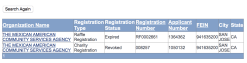
- MACSA (bottom row is the entity, top, the raffle only), Status “Revoked” (Details show, since 2014).
-

- MACSA tax returns by EIN# search only go up through 2009 (but look at the size in $$ assets) and be aware much of that was public funding.
(Above image gallery: I found a MACSA EIN# 941635200 from the IRS which also noted it was revoked in 2012. I see three tax returns from FY2007-2009 showing several million dollars’ worth of assets. It eventually registered as a charity in California; the “Details” page are full of demands for missing or incomplete information, and notices of ITS (Intent To Suspend). To view, you can repeat the search, or (for a snapshot as of several years past “Revoked” status, click “MACSA California Registry of Charitable Trusts | Details“~~>MACSA (TheMexicanAmericanCommunityServicesAgency) CalEntity 512046, EIN#941635200 CalifOAG Charity (Status ‘Revoked’ 2014ff) Details (RelatedDox Links Still Active) @ 2019May link added 5/26/2019. Note: for pdfs (vs. plain images) on this blog, you must first click the link to see page with blog & post title and beneath it a small blank page icon, then click on the pdf icon to load the document. Bonus Attached Info: When pdfs are printouts of California Registry of Charitable Trust “Details” (any entity), scroll down below ‘Schedule” to the bottom of the resulting document: any links under “Related Documents” for the filing entity should still be viewable by clocking on them.) (The California OAG RCT of course at any time may change how it loads or the user interface on this database in which case some of the above notations may not apply).
The latest charity renewal for MACSA (for FYE 2008) shows that about HALF its $10M revenues were from government sources. It was status “Revoked” since 2014 (as a California Charity) and as a tax-exempt organization, 2012 — however as late as June 2017 (see colorful image above) it was being positively referenced in association with a Santa Clara County Fatherhood Collaborative — from a University of Texas-Austin, LBJ School of Public Affairs, Child and Family Research Partnership (CFRP) in a “Policy Brief.” That colorfully annotated image and link to it above comes up again soon, below.)
This post references Santa Clara County “Domestic Violence Intervention Collaborative” (<~~DVIC is a nonprofit | “DVCC” is a named “Coordinating Council” under the county’s “Office of Women’s Policy” (OWP created in 1998)) and through it, at that level one of just two ex-judges* I just featured in the last post, Classic AFCC Combos, Collaborations, and Commonalities (Ret’d California Judge/Consultant Leonard P. Edwards, Texas Supreme Court Justice Debra H. Lehrmann) and What’s WITH Middletown, Connecticut? . *He’s ex-judge because he’s retired, she’s ex-judge now only because a state supreme court justice, is no longer called “judge.
That nonprofit DVIC wasn’t the main focus of this post but arose in connection with another nonprofit, referenced in the title which I am now reminded (through revisiting) originally framed its reason for existing as family violence prevention, too.
The relationship of the DVIC (nonprofit) to the DVCC (coordinating council) is a little complicated. I think that the DVIC was the fiscal agent for the DVCC, although with one being county-office-associated and the other not, that doesn’t even make sense.
The concept of “coordinating councils” isn’t complex, but I wonder how well the significance is generally understood; they’ve been around in reference to different subject matters, and when it comes to “DV” seem to take on a specific flavor.
The post title alone doesn’t reflect also how Judge Edwards’ “consultancy” was at the highest state level, but the post does. Before retirement in Santa Clara County, and again, he was and probably still is active in at least three very controlling and significant membership associations — AFCC, NCJFCJ and (as to child welfare), NACC.
That retired Judge Leonard P. Edwards founded the Santa Clara County Domestic Violence Coordinating Council (DVCC) is stated in this glowing commendation from California CASA Association mentioned among other accomplishments: he was also the first juvenile court judge to receive a special award from (yet another nonprofit, PRIVATE, association, the “NCSC”) in 2004, as the NCJFCJ’s publication reminded readers in 2005 when reprinting a 1992 article from Judge Edwards on “the Role of the Juvenile Court Judge.”
NCSC = National Center on State Courts is not the major focus here, but I’ve posted on it (June 30, 2017, split off from Oct., 2014, “Do You Know Your: NGA, NCSC, NCSL, NCSEA, NCJFCJ, NCCD, NACC, and NASMHPD, not to mention ICMA?) and often call attention to it.
Read the rest of this entry »
SHARE THIS POST on...

Ten Footnotes to Two Posts: “More about those perspectives…” (May 6) and “Apparently Common Family Court Reform Practice…” (May 12, 2019).
THIS POST IS: Ten Footnotes to Two Posts: “More about those perspectives…” (May 6) and “Apparently Common Family Court Reform Practice…” (May 12, 2019). (short-link ends “-9Pt”). I estimate these footnotes will total about 6,000 words, which is why they’ve been moved here, from those two related posts…
(Footnote “Susan Schechter Lab” (at UNH) updated with an “addendum” May 17= post is now 7,600 words)
I figure people who’ve read or will read those two posts and seen their references to footnotes deserve the chance to read them as promised by all those internal “See Footnote ___” links.
“Ten footnotes to two different posts become a third post — How did that happen?”
Easy to explain: While writing, I began adding footnotes at the bottom of a post; as it grew (rapidly), I then off-ramped footnote texts from the bottom to this separate post, making two separate posts, one labeled “Footnotes” but functionally so far as the WordPress (the blog software) was concerned just another post like any other.
The original post continued to grow until I “gutted” it, re-allocating the gutted material, a major section, to a third post, thus carrying along some (four out of ten) footnote references. Then I published the first and the third posts (containing a section from the first), but not the second (footnotes) one that you’re reading now, because it still needed some polishing.
You might expect a “1, 2, 3” (post A + spinoff post B + footnotes post C) sequence, however….
Next, I instead doubled back to publish a three-part series over three days this week, all titled “A Closer Look at Common Family Court Reform Practice…” written about a month earlier but not published yet. Three posts were already referencing it. The material had been waiting longer and was more substantial and relevant to the field than footnotes expanding briefly on topic’s I’d just recently summarized, so it was my next priority.
That complex post (topic) had to be split in three, and was.
Now that all three parts of “A Closer Look” have come out (May 13, 14, and 15 respectively) this “Ten Footnotes to Two Posts,” once polished and published, will display in the sequence four or five posts (respectively) and over a week later than the two originating posts May 6 and May 12.
This should be relatively painless: a short post; only ten footnotes; mostly just comments.
NAVIGATION is a bit different: people reading either post who’ve now clicked through to here will after reading need to return to either More about those perspectives and key concepts (and actors) (See Also upcoming “A Closer Look At — and Alternate Interpretation of — Who’s Funding Poverty Research..” (Started April 19, 2019, Published May 6): (short-link ends “-9MU”). (Six footnotes lead here) or Apparently Common Family Court Reform Practice (Why my Uncommon Approach is less “Flawed”) [Published May 12, 2019] (short-link ends “-9Qq”) (Four footnotes lead here) .
No problem! After each footnote, I’ve provided a shortened “GO BACK TO (the Top of)” link back to its originating post. Or, you could just remember which one you came from, read the corresponding footnote/s, then scroll back to the top here and use the appropriate one of the links above, though that’s less efficient. Either way, I cannot bring anyone back to an exact point of return in the middle of any post. WordPress reads any link “The TOP of that post,” period. It does have “block editing,” which I haven’t mastered yet, but I believe that’s within a single post.
If instead you’re starting here fresh without reference to their contexts, it may not read smoothly. I often read other publications’ footnotes, endnotes or even bibliographies all in a row, but don’t recommend it here, unless that’s your style. Most of these aren’t citations; they’re commentary.
SHARE THIS POST on...

A Closer Look At — and Alternate Interpretation of — Who’s Funding Poverty Research (Hint: The Poor….) In New York (Columbia Univ. SSW), Wisconsin (University of Wisconsin’s IRP), and let’s not forget New Jersey (Princeton University’s Welfare-Reform-Focused “…Center for Research on Child Well-Being”). (Pt. 3 of 3=”-9TC”).
A Closer Look at and Alternate Interpretation of Who’s Funding Poverty Research || PART 3 of 3
I have been referring to this post (now distributed across three posts) for about month now: first on my April 19 post, then on two others published in the interim May 6 & 12.
I’m glad to have finally published Part 1 (May 13), Part 2 (May 14) and now Part 3 today (May 15, 2019) so I can return to others in the pipeline on subjects raised in the interim posts “More about perspectives and key players” & “Apparently Common Family Court Reform Practice.”(<~~singular).
The first few inches of this post will look similar to the others until you get to ~ ||| ~ ||| ~ and shortly after those characters, this heading:
WHERE I STARTED THIS POST (on moving material from another one)
YOU ARE READING Part 3 of 3: A Closer Look At — and Alternate Interpretation of — Who’s Funding Poverty Research (Hint: The Poor….) In New York (Columbia Univ. SSW), Wisconsin (University of Wisconsin’s IRP), and let’s not forget New Jersey (Princeton University’s Welfare-Reform-Focused “…Center for Research on Child Well-Being”). (Pt. 3 of 3=”-9TC”) (Case-sensitive, WP-generated shortlink ends “-9TC” Started about April 17, 2019, post split May 13, 2019). About 8,500 words.
PRIOR POSTS IN THIS “SERIES”*:
A Closer Look At …(“Pt 1 of 3=”9Lj“) & A Closer Look At … (Pt. 2 of 3=”9Tx”)
For QUICK NOTES ON THE (QUICKLY EXECUTED) SPLIT see Part 1, top.
Part 3 (Post #3 of 3) contents relate most closely to the full title because it’s where the post began. So many of my posts are split-offs from others, I usually begin with the title identifying the main topic.
Part 3 here picks up from A Closer Look At … (Pt. 2 of 3=”9Tx”) (otherwise identical title), after repeating just the very top lead-in and images from Part 1, for context. It also (like part 2) begins with some overlap from the bottom of the prior post, which I’ve marked.
Because I’ve been working on other posts last month, this material is relatively fresh, not “hot off the press” fresh in my memory: I work on these topics daily. Research never stays in exactly one place or at exactly one level for a month at a time. My inclination on previewing the material (writing and images on the post), was that it’s ready to go and that those who wish to delve deeper should do so.
Meanwhile, I’m moving forward with my current writing topics, as reflected by the most recent post (May 12) and references to upcoming spinoff post within it. Some more comments on the Princeton University centers may be found there, too.
The next section briefly repeats material from Parts 1 & 2 for the blogging context:/recent themes:
-
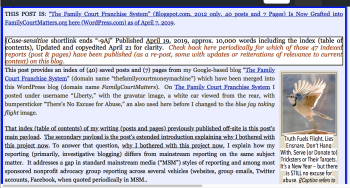
- Image 1 of 2 LGH|FCM “The Family Court Franchise System [Index] post, published April 19, 2019, short-ink ends “-9Aj”
-
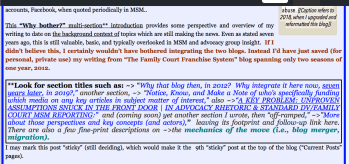
- Image 2 of 2 LGH|FCM “The Family Court Franchise System [Index] post, published April 19, 2019, short-ink ends “-9Aj”
This was extracted, with a little overlap, from the intro to a new index I’m producing and [have now published April 19, 2019]. Having completed most of THAT project, my attention has been drawn to recent developments in some familiar circles (university centers) I’ve been aware of over time.
I believe that the most important part of obtaining “solutions” to major problems is understanding what questions to ask and from there, where to look for potential factors to the situation. It’s also important to realize that what may be for some a “problem” is for others not just an opportunity, but, to put it bluntly, an ongoing profit, benefit, and desirable state of affairs, though admitting this isn’t politically correct.
This post illustrates, again, why you JUST might want to pay enough attention to public/private finances to realize, the task is just about impossible… and what happens when it stays and continues developing out of sight and out of control.
To broadly summarize, domestically, there’s ongoing flow of resources throughout a larger collectively organized landscape. {{MORE TEXT ALONG THESE LINES CAN BE FOUND ON PART 1, TOP}}
(First part of the OVERLAP is MINIATURIZED here, normal size on the other post. The main point isn’t polymerization and polypropylene, as fascinating as the information is…).
~ ||| ~ ||| ~ (OVERLAP FROM PART 2, focus on the Polypropylene/Brazilian connection) ~ ||| ~ ||| ~
…. Finally (?) here’s the Abstract to a 2003 article presented? at a conference in Japan, found (through basic Google search on this material) at ieeexplore.IEEE.org, with six authors, talking about its use in insulating electric cables, and how it’s also good for recycling because it’s not cross-linked:
“Property of syndiotactic polypropylene and its application to insulating electrical cable – property, manufacturing, and characteristics” (“Published in: Proceedings of the 7th International Conference on Properties and Applications of Dielectric Materials (Cat. No.03CH37417)“)
“IEEE” (“Eye-Triple-E”) stands for “Institute of Electrical and Electronics Engineers.” and has an interesting and clearly summarized history you can read about here (and please do!)
WHERE I STARTED THIS POST (on moving material from another one):
In finalizing the integration of an index of a blog I wrote almost exclusively in the year 2012 to this blog, I was tempted to just load on more updates** from two of FIVE university-based poverty research centers where two middle-aged men
[1] who’ve made a career, pushing public policy antagonistic and insultingly patronizing to single mothers
[2] backed by some of the largest progressive foundations around (foundations, at least one of them, with backers of murky respectability, at the best), and where
[3] both the middle-aged men (and middle-aged or older professional women who publish and proselytize alongside them) having become smart and rich through following life a course the masses of poor of the nation are NOT advised to follow, and generally are not in any position to follow, thereby guaranteeing that…
[4] “Assume the position!”~ The STUDIERS vs the STUDIED ~ The researchers vs. the human lab rats ~ basically, the Dominant few vs. the Subjected Many
…..remains the norm. Status quo preserved.
**But I didn’t. I off-ramped it and got this 3-part series..//LGH May 13, 2019
We often fail to see — but any serious, that is, long-term, diligent attempt to follow the finances quickly reveals — that the Ph.D.’d publishing, poverty- and family-center-directing or co-directing, white-collared academics are the hired hands.
They are NOT the engineers and did not design the infrastructure supporting the entire system which feeds them while they feed from information off the poor. (They are simply sustaining, endorsing, perpetuating, and prospering from it.)
That MACRO infrastructure (including its financial support) was set up decades ago, economically, through control of banking, currency, and — through taxation with less and less representation the more and more regionalized and federalized (then internationalized) it becomes over time — incrementally control of the population….
…to the point, overall, of “Do they live or do they die? What say we? Which population sectors are living too long and need to be quietly culled? Which sectors’ offspring, grown to adulthood independently thinking and not constantly stressed by poverty and work/life disruptions, neighborhood violence and disproportionate incarceration OR family breakups through the family court systems, might jeopardize our collective, “proprietary” control of the existing infrastructure?”
SHARE THIS POST on...

A Closer Look At — and Alternate Interpretation of — Who’s Funding Poverty Research (Hint: The Poor….) In New York (Columbia Univ. SSW), Wisconsin (University of Wisconsin’s IRP), and let’s not forget New Jersey (Princeton University’s Welfare-Reform-Focused “…Center for Research on Child Well-Being”) (Pt. 2 of 3=”-9Tx”).
A Closer Look at and Alternate Interpretation of Who’s Funding Poverty Research || PART 2 of 3
I have been referring to this post (now distributed across three posts) for about month now: first on my April 19 post, then on two others published in the interim May 6 & 12.
I’m glad to have finally published Part 1 yesterday (May 13) and Part 2 today (May 14) and to be anticipating Part 3 tomorrow (May 15, 2019) so I can return to others in the pipeline on subjects raised in the interim posts “More about perspectives and key players” and “Apparently Common Family Court Reform Practice.”(<~~singular).
A Closer Look at and Alternate Interpretation of Who’s Funding Poverty Research || PART 2 of 3
A Closer Look At — and Alternate Interpretation of — Who’s Funding Poverty Research (Hint: The Poor….) In New York (Columbia Univ. SSW), Wisconsin (University of Wisconsin’s IRP), and let’s not forget New Jersey (Princeton University’s Welfare-Reform-Focused “…Center for Research on Child Well-Being”) (Pt. 2 of 3=”9Tx”). (Case-sensitive, WP-generated shortlink ends “-9Tx.” Started about April 17, 2019, Split into 3 parts May 13, 2019. This part about 6,500 words after split and with some overlapping paragraphs added from Part 1.)
This picks up from A Closer Look At (Pt 1 of 3=”9Lj”) (otherwise identical title), after repeating some lead-in paragraphs and two images from the top of Part 1, and just a bit from the bottom of Part 2. For QUICK NOTES ON THE (QUICKLY EXECUTED) SPLIT see Part 1, top.
Links to all three are provided here at the top and bottom. As with all links to any posts in draft the link to Part 3 (A Closer Look At…(Part 3=”9TC”) will of course only work accurately once it’s published, currently scheduled for tomorrow, Wednesday, May 15, 2019. Before then, WordPress will try; it’ll make a “best-guess” leading somewhere else or provide a “not found” error message.
Part 2 provides a bit of a wild ride into details not typical of this blog: international conglomerates and some supporting details on the invention and even physical properties of one of the products involved. One conglomerate through acquisition of US-based plants became a major player in the producer of this product within the USA (and, separately, in Germany). Our federal government cleared the purchase as to anti-trust factors. Previous rapid growth in the 1990s was enabled by having been given a monopoly for many years by Brazil. Leveraged buyouts followed by later sell-offs (due to debt) occurred. (For more specifics, or to double-check my by-recall summary, keep reading and read more from the links provided or on-line searches). Parts of the conglomerate were later under investigation for a variety of criminal acts. The scope of business was large, and the reach of corruption within it also large, reaching high up into government of more than one country.
This post gives broader scope at the top, and more detail at the bottom of the economic landscape in which this country, federal/state, public/private (and under both) the family courts operate. I hope it also promotes the habit of doing what I call doing drill-downs beyond only specific buzz-words, sound-bytes, or commonly associated words with any cause relating to the family courts.
There are always operational systems, and it takes money to run them. So how money moves — and how much of that money influencing public policymaking has been moved legitimately (vs. criminally) is always relevant. Again, what about accountability to the public “served”?
By contrast, A Closer Look At, Part 3 (ends “9TC”) link here is provided at the bottom again and its contents are most closely related to the title because (as my writing style is) it’s where the post began.
I referred to this section [now a post] as “tangential” but in reality it’s just paying close attention, originally, when something “just ain’t right” in a reported set-up. Seemingly “tangential” information may not really be — it may be a symptom of something else. One way to find out which is by looking closer. This post and situation raises some big questions about accountability, and reminders what can take place when it’s absent.
Comments Added May 13, 2019 for Part 2 here:
The theme of “Poverty Research” is a key concept behind marriage/fatherhood promotion and deeply related, at many, many points and across many professional niches, to what is taking place in the family courts nationwide (USA). Not just because of “welfare reform” but also because of things welfare reform exaggerated (demographic divide/gender wars) and set up (fundamental changes to how the federal government interacts with the states, setting up different circuitry and ways to monitor it — or not monitor it — effectively. Along with “privatization” is proliferation of nonprofits = dilution of accountability. Along with setting up new fields of practice (i.e., “Fatherhood”) and university centers to sustain them, guess what — also comes dilution of accountability.
In this post we see a Brazilian granted monopoly which was later broken up, but before it was, become a multinational corporation in several inter-related fields (petrochemicals) with global commerce, purchasing plants in the USA making a major plastic used in producing all kinds of consumer goods.
And it’s been associated with criminal activity spanning different countries, i.e., “Operation Carwash.”
Ask yourself what kind of mentality would seek out ways to dilute public accountability through privatization, yet in the process control at a more micro-managed level the domestic population of a country? If you think these things through, Part 2 here isn’t really that disconnected in subject matter from Part 3. I hope the attention span prevails for them both. (End, May 13 Comments for Part 2)
(Next short Section, WRITTEN mid-April 2019 (except the two images added) and from the TOP of PART 1 post, repeated here)…
Having completed most of a major index project (next two images), my attention has been drawn to recent developments in some familiar circles (university centers) I’ve been aware of over time.
This was extracted, with a little overlap, from the intro to a new index I’m producing and will (I hope) publish today, April 18, 2019.** [**It was published April 19, short-link ends “-9Aj” title as shown in the first image below. I also made the above post “sticky” as key enough to be kept “in your face” with a few others. Here are two screen-shots from that originating post with the index of my 2012-only blog “The Family Court Franchise System” I’d just merged into FamilyCourtMatters.org here. ]:
-
- Image 1 of 2 LGH|FCM “The Family Court Franchise System [Index] post, published April 19, 2019, short-ink ends “-9Aj”
-
- Image 2 of 2 LGH|FCM “The Family Court Franchise System [Index] post, published April 19, 2019, short-ink ends “-9Aj”
I believe that the most important part of obtaining “solutions” to major problems is understanding what questions to ask and from there, where to look for potential factors to the situation. It’s also important to realize that what may be for some a “problem” is for others not just an opportunity, but, to put it bluntly, an ongoing profit, benefit, and desirable state of affairs, though admitting this isn’t politically correct.
This post illustrates, again, why you JUST might want to pay enough attention to public/private finances to realize, the task is just about impossible… and what happens when it stays and continues developing out of sight and out of control.
To broadly summarize, domestically, there’s ongoing flow of resources throughout a larger collectively organized landscape.
SHARE THIS POST on...

A Closer Look At — and Alternate Interpretation of — Who’s Funding Poverty Research (Hint: The Poor….) In New York (Columbia Univ. SSW), Wisconsin (University of Wisconsin’s IRP), and Let’s Not Forget New Jersey (Princeton University’s Welfare-Reform-focused “…Center for Research on Child Well-Being”). (Pt. 1 of 3=”-9LJ”)(Written mid-April, Split in 3 mid-May, 2019]
I have been referring to this post for a month now, including in interim posts published May 6 and May 12, and am glad to publish Part 1 today, and to schedule Parts 2 & 3 tomorrow and the day after:
A Closer Look at and Alternate Interpretation of Who’s Funding Poverty Research || PART 1 of 3.
A Closer Look At — and Alternate Interpretation of — Who’s Funding Poverty Research (Hint: The Poor….) In New York (Columbia Univ. SSW), Wisconsin (University of Wisconsin’s IRP), and let’s not forget New Jersey (Princeton University’s Welfare-Reform-Focused “…Center for Research on Child Well-Being”). (Pt. 1 of 3=”-9LJ”)(Written mid-April, Split in 3 mid-May, 2019] (Case-sensitive shortlink ends “-9LJ.” Started about April 17, 2019. Before split, 14,606 words; Part 1 is about 4,200 words.
OTHER POSTS IN THIS “SERIES”* Written ca. April 17-18, Split Three Ways May 13, 2019.
A Closer Look At … (Pt. 2 of 3=”9Tx”) & A Closer Look At … (Pt. 3 of 3=”9TC”)
*By “series” I mean one post written in mostly one sitting around April 17, 2019, which now, a month later, wanting to publish, I think is relevant enough to split into three parts…for easier reading (or at least much shorter posts! The original was about 14,600 words; this one, about 4,200. Those short-link references are an essential administrative help I decided, this time (“Life is Short!”), to leave in the actual post titles.
“This material was extracted, with a little overlap, from the intro to a new index I’m producing and will (I hope) publish today, April 18, 2019.” [Update: It was published April 19, short-link ends “-9Aj.” Here are two screenprints from the top of that originating post/ Click image to enlarge]:
-
- Image 1 of 2 LGH|FCM “The Family Court Franchise System [Index] post, published April 19, 2019, short-ink ends “-9Aj”
-
- Image 2 of 2 LGH|FCM “The Family Court Franchise System [Index] post, published April 19, 2019, short-ink ends “-9Aj”
Now made “sticky” as important enough to this blog to be kept “in your face,” alongside a few others. Having completed most of THAT project, my attention has been drawn to recent developments in some familiar circles (university centers) I’ve been aware of over time, featured in this post.
QUICK NOTES ON THE (QUICKLY EXECUTED) SPLIT:
Read the rest of this entry »
SHARE THIS POST on...

Apparently Common Family Court Reform Practice (Why my Uncommon Approach is less “Flawed”) [Published May 12, 2019]
Happy Mothers’ Day. Good Mothers Give a Damn! (but not always about what others think of us while we’re doing so). I hope you make it through this post which I published because I do, too.
“You are Here”~> Apparently Common Family Court Reform Practice (Why my Uncommon Approach is less “Flawed”) [Published May 12, 2019] (Case-sensitive short-link here ends “-9Qq”) (Produced earlier, moved here to shorten “More about these perspectives and key concepts (and actors)…,” published May 6, 2019. Its shortlink ends “-9MU”). About 13,600 words including footnotes.
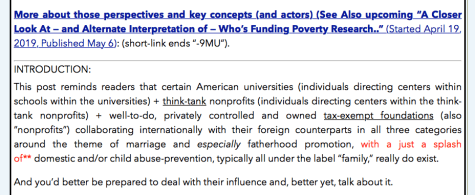
My May 6, 2019 post and its primary content.
I’m glad to have written all this but sad I had to gut the center of another post to shorten it and improve the chances of both being read.
That post begins (see nearby image)~~>
“PRACTICE”: There are apparently common family court reform practices, in the generic sense of the word “practice” not in the specialized sense as with a licensed professions (medical, law, etc. ).
Within family court reform, one can see the practices and the “practitioners” (in the most generic sense). Their own writings often show the theories and with the theories, the built-in assumptions on which those theories stand or, if based on false assumptions, fail logically — and will fail those the theories justifying the transformed practices purport to help. The “unspoken & unproven theory” situation is so common, I classified it as a practice, and am further illustrating in a separate (upcoming) post because it is, as a practice, innately, tricky. You have to Stop, Look (read), and Listen (to common sense & gut instinct). Post full title, below.
Symptoms of “stealthily delivered” assumptions typically surface around the perimeter of any article, report, resolution or proposed solutions, even in the first sentence or paragraph. Whether the deliverer/s knew or didn’t know (was just being used by others as a carrier of such assumptions) matters and sometimes can be shown by simply watching what happens after a challenge.
IF you give a damn about: due process, family courts (or children, families, or public accountability for use of public funds, i.e., representative government by consent of the governed), you should read this whole post.
Just before publishing here, I decided to add an exhortation, some “red ink” bordered in red. If the color red means “STOP” in some cultures and in traffic signals, let it mean that now: “Stop, Look, Listen!” I laid it out briefly and I believe convincingly, but on a new page. Please read!
This post Apparently Common Family Court Reform Practice … “amazingly” is comprised of a Top (“Introduction”), Middle (the section gutted from there (“More About Those Perspectives”) and deposited here; it summarizes and provides some details on “Apparently Common Family Court Reform Practices,” and contrasts with my approach), and a Bottom (footnoted comments from the intro). In that sandwich, the slices of bread stacked together probably equal the juicy middle part in length, but each part has its own flavor and spices.
The top and bottom describe and define two basic categories the family court reform practitioners (so to speak) falling into two basic categories, and the middle, common practices I’ve noticed from one of those groups.
About that Middle Part:
In writing the middle part, I looked for a public link describing just one of the practices (“Safe Child” theme and “H.Con.Res.72” a Congressional resolution just passed in 2018). What I saw occasioned another quick drill-down on an H.Con.Res.72-associated (lobbyist) organization.
That drill-down unearthed geographically and corporately other people and organizations that hold national and international significance, and expose developing situations among those people (and organizations). This is new material to me (networked chambers of commerce memberships lobbying through a regional businessman’s “council,” a specific nonprofit entity “Urban Land Initiative,” and local government planning departments or commissions are deeply involved) and I bet their collective connectivity is to most of readers. A spinoff post was inevitable and has been written (is in my post pipeline to be published). Full title and link are listed further below.
That subject matter falls within the topics of <> regionalism/internationalization and <> continual, incremental compromise of jurisdiction (which, individually and taken together, eliminate any possibility of informed public consent), which I’d noted in my two preceding posts (published April 19, May 6).
Read the rest of this entry »
SHARE THIS POST on...

More about those perspectives and key concepts (and actors) (See Also upcoming “A Closer Look At — and Alternate Interpretation of — Who’s Funding Poverty Research..” post). (Started April 19, 2019, Published May 6).
Post title and 3-character key to its case-sensitive “short-link”:
More about those perspectives and key concepts (and actors). (See Also upcoming “A Closer Look At — and Alternate Interpretation of — Who’s Funding Poverty Research..)” (Started April 19, 2019, Published May 6. Short-link ends “-9MU.” The post is too damn long (almost 17,500 words but not going to be split; read in installments!)
INTRODUCTION:
This post reminds readers that certain American universities (individuals directing centers within schools within the universities) + think-tank nonprofits (individuals directing centers within the think-tank nonprofits) + well-to-do, privately controlled and owned tax-exempt foundations (also “nonprofits”) collaborating internationally with their foreign counterparts in all three categories around the theme of marriage and especially fatherhood promotion, with a just a splash of** domestic and/or child abuse-prevention, typically all under the label “family,” really do exist.
And you’d better be prepared to deal with their influence and, better yet, talk about it.
Talking about it should not take place in borrowed terms which add to the free-publicity. They’ve already got that. We need terms which explain where they are, who is involved, and how such networks connect to policymaking at the federal levels. That information is part of a basic “who’s who and “what’s what” and where and how they connect.
We cannot continue “advocacy” and “family court reform” (etc. ) pretending that these liaisons just never happened, do not exist, aren’t funded, and don’t influence others who may be acting more directly on individual court cases — like judges, family lawyers, custody evaluators, mediators, and others!
**That splash, added for flavor and not integrated substance, typically seems to mean, assuring ongoing father-child contact no matter what (although the same cannot be said for mother-child contact) and coaching or treating as many others as possible per family unit, with a high emphasis on mediation rather than litigation. That theme prevails in both countries, despite “women’s groups” (who don’t mention this) also in both countries.
By “both countries,” in the example (situation) that inspired this post, the public/private sponsorship and partnering comes from both US and UK governments. Some so-called “partners” seem to be more recent, or at least more recently advertised on the respective websites, but the arrangement still only expands upon (or acknowledges an expansion of the reach of) existing networks of influence.
For example, the American university showing its international partnerships focused on families and children. This same trans-Atlantic partnership as reflected on a UK website (this UK charity was only formed in 2016). It administers the “Child & Family Blog” described as that partnership (image below).
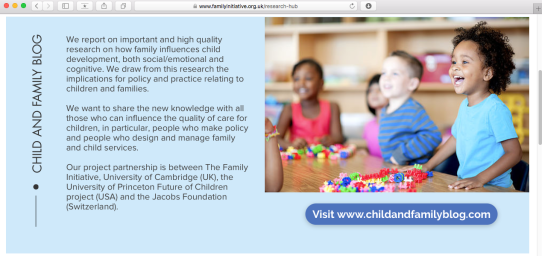
Windowframe at top displays the url, “FamilyInitiative.org.uk/Research-Hub“. Paragraph 3 describes the project and lists the two universities (actually, the US-university’s “project”) and Swiss foundation involved. The url belongs to a UK charity, original director occupation “church leader” Richard Eric Wightman (images below, as to LGH May 6, 2019 post).
Link to Search the above UK Charity’s Company#10445272 on this blog.
At least two previous (2018) posts contain my previous drill-downs (on which the many images below, and points I’ve made just touch), some in more depth and pulling in more references to the network. For example, I’d say that a director of that charity with South Africa (and possibly South African Reserve Bank) connections is a little odd. … There is some overlap. That information may help explain the intensity of my comments, and some broad-based claims on THIS post. The picturesque (?) long titles to the posts in the search results feature (identify) organizations and the specific family-court-connected professions they are promoting. After reading this post, perhaps check out that link and read the earlier ones! (Do not search the charity (on this blog) by name, “The Family Initiative,” as the search term is far too broad).
Read the rest of this entry »




 Let's Get Honest! Absolutely Uncommon Analysis of Family & Conciliation Courts' Operations, Practices, & History