Archive for the ‘1996 TANF PRWORA (cat. added 11/2011)’ Category
Families In Transition due to Parental Kidnapping | An archaeological dig on who quotes whom (Canadian CRC, Nancy Faulkner, Dorothy Huntington, ‘Parental Alienation’): [LGH Frontpage Subsection #3 Sept. 4, 2019, Publ. Sept. 19].
This post holds a section from my Front Page* September, 2019, I’ve called:
Families In Transition due to Parental Kidnapping |An archaeological dig on who quotes whom (Canadian CRC, Nancy Faulkner, Dorothy Huntington, ‘Parental Alienation’): [LGH Frontpage Subsection #3 Sept. 4, 2019, Published Sept. 19]. (short-link ends “-aWh,” as off-ramped, under 4,000 words written, probably between January and December 2018; with lead-in, about twice that). Some of my lead-in comments were made earlier, some are made just before (I expect) publishing September 19, 2019.
*That section is far down on the front page (see nearby image):
After publishing this, I found the related page which may have more substantial drill-down on the topic. Both should be read together (or in sequence!). I now have added that link to the front page also. The Page (which I posted to alert readers to also, making now three different links on the overlapping topics) is called:
Title: If Parental Kidnapping (Domestic or International) is ALWAYS Child Abuse, Where do the UN CRC and the Hague Convention fit in? (D. Huntington then ℅ AFCC-related* The (Judith Wallerstein) Center for the Family In Transition, M.W. Agopian, N. Faulkner (1999), Merle H. Weiner (2000, Fordham) (moved here Jan. 18, 2018, from my then-new home page…, published as a page Sept. 19, 2019, and a new post, Sept. 20) PAGE short-link (now published) ends “PsBXH-8q5″)
Subtitle: Do these international agreements effectively help OBSTRUCT attempted international escape from DV, while domestically in the USA, both AFCC-driven family court policy and post-PRWORA (1996), in fact, at least since “Moynihan” (1965) federal social policy also obstruct such escape?
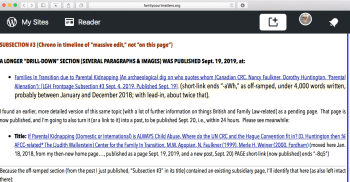
“LGH|FCM Jan 2018 One Post, One Page (Section3 offramp Sept. 2019)…| D Huntington, N Faulkner, AFCC 54th, Canadian CRC etc ~~Screen Shot 2019-Sept. “
Besides the “archeological dig” I’ve added to the top half reference to yet another “family court crisis” media posting; it came up in the context of information I did not have, timely, at the time this happened to my family line.
It comes up year after year while others are not writing about the: operations, practices, and particularly not (accurately) about the history of the family courts themselves (or, their blueprints and builders)….It’s extremely frustrating over time to see the level of comprehension and reporting has barely edged forward. But otherwise it’s basically on-topic with the post title.
This post shows drill-downs, but was written in more than one installment, is informal, and some paragraphs repeat content. Until it gets to the text originally off-ramped, it may not flow smoothly. It’s not designed as any “heavyweight” post, but I think some of the links are worth considering.
This time, that’s OK (for purposes here). It’s not my best writing, but it’s information I decided to re-post as a re-minder to do drill-downs, ‘question authority,’ question standard explanations, and just ask more questions: to pay more attention to seemingly minor details, presentation formats, and from this perspective, re-consider the overall landscape. We should exercise every right and opportunity to ask “on what basis”? and then critically examine any stated basis. It’s especially important to ask this to oneself when reading, as well as aloud and (with discretion) to others.
I’m just making a few points in hindsight, in case it may help others, and to say, I can relate to how it felt to be reading that laws exist to protect against child abduction, essays have been written about how harmful it is, and then the courts ignore it, ignore domestic violence, risk and more; and you’re there in the state of “what-the-_____??!!” and “why?”
And in this re-traumatized // indignant or outraged state, and in the fight of your life, others looking collected, organized, and with websites to match the come-on, offer suggestions why the family court professionals just don’t “get” this and why you should, with them, push for more oversight, trainings, and to hire specially qualified consultants about domestic violence IN the family courts (etc.) to make ’em better….
And tell your story (anonymously or with actual name attached) to the local investigative news reporter wanting to make a name for him or herself and/or the related media. Or send them in to the advocacy group who will then present the case on your behalf to Congress or state legislatures for better laws (when the existing ones aren’t even enforced), etc. — and pitch it to media also, making sure they are building brand awareness and personal name recognition as if genuinely concerned about the murdered and abducted children.
SHARE THIS POST on...

Health Systems Still Flushing Cash into — WHERE is it going again? (About 20 Years AFTER Tobacco Master Settlement Agreements, Other Tobacco Tax Revenues like Prop 10 in California Propping Up Public/Private “First 5” Circuitry) [May-June, 2019, Publ. Sept. 18].
Another post held in draft now being released… From its contents below:
This post punctuates the overall message with the vastness of systems change 1999-2019 IN ADDITION TO major changes mid-1990s due to Welfare Reform + VAWA (also especially advancing public relations consultants and media owners), both …set up two decades ago.
Sure, it takes some concentration to follow, but no apologies offered! Concentration is a helpful quality in life, as well as judgment on what to focus on and for how long!
Another choice quote from this post:
This fills in some of the billion-dollar-background context which sheds light on what the intense focus on “Zero to Three” “First 5” and “Early Childhood Education” special interest group coalition leaders know well that probably has escaped substantial notice of the paying public.
The coalitions happen at university and state leadership area backed by philanthropies (tax-exempt foundations) that often just do not even post their own financials, let alone post them in both legible and functional formats.
I wouldn’t dare make that last sentence if I hadn’t found it, repeatedly. Really, the situation is shocking.
One foundation associated with a center listed below, at some point during recent drill-downs, I found claiming to have donated over a four-year period a total of one million dollars to an organization which actual organization (by its name) was at the time IRS-revoked status in Florida, while the foundation tax return recorded a Massachusetts address, as I recall, directly associated with this center, i.e., with Harvard. (Foundation: Alliance for Early Success, which is listed as an investor in the center). Not posted here; that’s just my comment. If you want to see this, start looking for and looking up tax returns, then looking up among their larger grantees! I do not recall offhand whether I actually published any post containing that drill down, but probably have provided some links to it within the last three months)
Why posting this now, a bit out of sequence from recent themes? Take a look at it below! Would YOU go to all that trouble and detail and not publish? It also contains summary (first) and many valuable points of reference, I feel, below that.
It helps provide an overview of a system which the originators of the system so far have not and do not seem inclined to offer the public, from the perspective of expecting systems for fiscal accountability to exist within the United States, even in the tax-exempt sector, which we all know is interacting significantly with the public sector, which we fund every time we work and receive a paycheck, and in countless other ways when receiving or seeking services or accessing ANY of the vast infrastructure privately owned by the federal and state governments (as to USA) which frame our lives continually.
I see on reviewing this one just before publishing that in addition to the topic referenced, I’d also just recently run across “Harvard Center on the Developing Child” which intersects with subject matter of the family courts because of the psychology/education/early-childhood subject matter and professions organized, generally, into private societies by geography or special interests, so often accessing U.S. Health and Human Services grants and contracts.
THIS POST’s TITLE: Health Systems Still Flushing Cash into — WHERE is it going again? (About 20 Years AFTER Tobacco Master Settlement Agreements + Other Tobacco Tax Revenues like Prop 10 in California Propping Up Public/Private “First 5” Circuitry) [May-June, 2019, Published Sept. 18]. (Shortlink ending “-aaH,” and (unbelievably) under 5,000 words)
SUBJECT MATTER CONTEXT: The most closely related post was published August 7, 2019 (which no longer shows on the “Last Ten Posts” widgets shown below as images or on the blog sidebar): A Health System Flush With Cash — because ‘Smoking Causes Cancer’ (1998 Tobacco Class Action Litigation MSA Payments, and Tobacco-Related Taxes Impact ‘in perpetuity’ on Systems Affecting Family Courts) ((Begun Early June; Publ. Aug. 7, 2019) post short-link ends “-a6m.” Currently 5,200 words, having just been shortened (split), but this one is still a bit complex. Following the funds has been made complex. Last update, Sunday, August 11, 2019.
I’ve been trying to get out a “By Now We Should Know” post for almost two months now, while trying to deftly knit together some complex information as a backdrop to that basically simple post.

LGH|FCM post (pre-publict’n) Admin, ‘Health Systems Still Flushing w Cash’ Last Revs 3 months ~|~ 3 wks ago (June vs Aug 2019) (see June22 published post) ~~SShot 2019-09-18
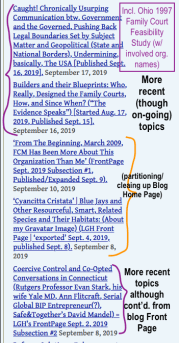
LGH|FCM Sidebar ‘Last Ten Posts’ viewed in 2 images ~~>Screen Shot 2019-09-18 (Image #1 of 2)
[Sept. 19, 2019 Pre-Publication UPDATE: “By Now We Should Know” was published June 22, 2019.]
Meanwhile, I’ve also been working on blog front-page and trying to stay current with developing (family court legislative reform and government restructuring) events. (See small image, below-right)
I could just show here an image of the top of “By Now We Should Know” but feel it’s more helpful to provide it in-post, with active links. So this post (otherwise complete at under 5,000 words) starts below with an updated section, added Sept. 18, 2019, after which I have published it basically “as-is” meaning, as it was, as written (last previous edit) August 28, 2019).
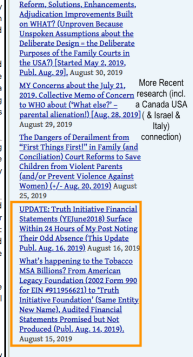
LGH|FCM Sidebar ‘Last Ten Posts’ viewed in 2 images ~~>Screen Shot 2019-09-18 (Image #2 of 2)
I’m also posting FYI here from the blog sidebar (as of today) annotated images to show the last ten posts reflecting some of the current content and (back through Aug. 15, 2019) the one most recently dealing with this Health System Flush With Cash” (see nearby, one on the left, the other on the right)…
This information is of course easy to see now (without annotation) under that sidebar widget; I’m including here only for future reference, for anyone including myself who may be reading this post possibly months or a year or more from now). That situation comes up from time to time, as you’ll see below where I reference the “Harvard/Bain/Bridgespan topic” I posted on earlier, and how large an impact it had on the US economy (for starters) in the 1980s and 1990s. Basic concepts to keep in mind and timeframes to remember (i.e., those LBO leveraged buyout years, major players, and more)…//LGH Sept. 19, 2019.
TOP SECTION, “BY NOW WE SHOULD KNOW” (encased in red borders, cream-colored background, with “Two Helpful Links” configuration also shown (as on that post)), published June 22, 2019:
“By Now We Should Know!” (Impromptu Re-cap of Key Players addressing [how to handle] Domestic Violence especially as it impacts Family Courts) (Apr 28 ~> June 22, 2019). (short-link ending “-9NU,” post drafted as insert to “More Perspectives” in late April, under 4,000 words, for starters…). (now exactly 6,000 words; latest revisions for clarity and extra links, 6/23/2019).
Read the rest of this entry »
SHARE THIS POST on...

Caught! Chronically Usurping Communication btw. Government and the Governed, Pushing Back Legal Boundaries Set by Subject Matter and Geopolitical (State and National Borders), Undermining, basically, The USA [Published Sept. 16, 2019].
Caught! Chronically Usurping Communication btw. Government and the Governed, Pushing Back Legal Boundaries Set by Subject Matter and Geopolitical (State and National Borders), Undermining, basically, The USA [Published Sept. 16, 2019] (“-b4j”, about 8,600 words with footnotes). [Over one dozen tags, only added Oct. 2. This post covers key important basics influencing family courts’ purposes & principles]
(Top part — discussion. Mostly prose, my writing. If you want the individual professors’ organizations’ or advocates’ names, more pictures, and links, scroll down! Based on the original word count above, I added about 2,200 words, including those long titles to connecting posts, so that’s not too far. Tags for this post are shown on the previous (“Builders”) one. Publishing as-is, without extensive copyediting and without apology. . //LGH Sept. 16.)
This post continues from the bottom of:
For the immediate context of that discussion, go to the very bottom of that post, which has a link to here. Handling the Blueprints/Builders topic above brought up the topics, and specific university centers, psychologists, and nonprofit government-advising institutions (i.e., Brookings Institution, in the USA) engaged in facilitating the usurpation. I’d also brought up (quoted) an article on the “Transnational Ruling Class, … or Anglo-American Establishment” referring to the historic close, friendly, relations between the RIIA (London) and the CFR (USA). I searched those two terms as symbolic of the ongoing, functional undermining/ bypassing of local (i.e., within national boundaries) representative government in “developed” countries. There’s a direct connection to the family law practices through, Tavistock Relationships (<~~that Wiki, while flagged, is still informative in this context), formerly Tavistock Centre for Couple Relationships, but also through historic development of the “psych” fields in Europe, what’s now the UK, Canada, the USA and globally. Particularly psychoanalysis (Freud & following) traditions are troubling when entrenched in government practices.
There, I had referenced and quoted:
This undermining of jurisdiction and the effectiveness of geopolitical (national, and within the USA, state, borders) process through perpetually-created crises has been taking place for at least a century, (For example, on the RIIA-CFR topic: Think Tanks and Power in Foreign Policy pp 189-214,CFR-RIIA Interconnections: A Transnational Ruling Class, Liberal Atlantic Community or Anglo-American Establishment? by Inderjeet Parmar, (“Chatham House” referring to the RIIA factor).
My post title here is generic but the original, specific details on this post cover common recent themes and situations in my blogging. If I were to list them, I’d say: “Psychologists and other Patriarchs, and their habitat: university centers” and then simply name specific ones, calling attention to in which countries they were, the specific (i.e., Michael Lamb, Nicholas J. Cummings, Milton H. Erikson) professionals’ spheres of current and recent operation (also relevant here) and who mentored them, and how (Byron R. McCandless, Frieda Fromm Reichman) — which was the “new to me” part of this post, meaning, it’s not just a re-hash of material I’ve already said, posted, or otherwise covered. There is much review, but it’s not just review!
Also, who mentored those mentors, for example, such as Kurt Lewin, at the Iowa Child Welfare Research Station (1933-1945) he ran after emigration from Nazi Germany, and how it influenced funding and directions in American psychology. I’ve also included reminders about what scope of studies are involved in the Princeton-Brookings-Columbia (and now University of Cambridge) connections, as well as the patriarchy behind “Fragile Families” research, ongoing… Just look for the more colorful parts of this post….
FYI: To think you can handle the women’s rights or “domestic (or family) violence (or abuse) prevention” field as somehow separate from all that is mistaken. They are two arms off the same tree trunk. and tap root. The important thing (in my opinion) is locating the root system, its nutrients, and in which direction its growing. Both arms off the same trunk want to treat and train as many people as possible, coordinate and saturate government with their knowledge, and, to the extent possible depending on just how gullible or vulnerable the public is, pretend the other arm doesn’t exist. In addition, they want to get to ALL children as they are being born for proper rearing, and are using “violence prevention” or, alternately, “fatherhood promotion” or “evidence-based child development” (etc.) rationale for doing this.
(Example: Harvard Center on the Developing Child and its extended reach/special sponsors, involvement of “The Frameworks Institute” and so forth). The tangled mixture of participants, if laid out side by side and sorted into their respective categories, including “unidentified” then laid onto a chronology (identified date of origin) would be, I suppose, like a combination of the finds from an archeological/anthropological dig. Except that it’s recent, and the artifacts are being created at the speed of: collaboration, electronic transmission of data, and travel expenses for personal conferences, website expenses for webinars, most of it written off as exercised in some nonprofit format.
I’ve DONE some digs like that on this blog (check out a few posts from April, 2017 on a center at Brown University involving the Annenberg Foundation: yegads!), with the results being characterized — properly — as “dense walls of text.” One recurring challenge — I’m intent to use vocabulary which categorizes according to public or private sector, entity or non-entity (which most centers within universities are), whether tax-exempt or not, and who is in which legal domicile — while the power-players and their hired/sponsored professionals in same sectors (both public AND private!) seek to do, and successfully do the exact opposite — blurred, meldedpersona… and they hire consultants to coach them how to do this! The public, thus the more confused it is (we are) the less able they are to resist sales tactics or manipulations into, if nothing else, ongoing passive consent. This is so much! like the tactics abusers also use on their targets.
I am also Tweeting on this, as it comes up (i.e., most days) along similar lines though of course mostly focused on this subject matter.
IF neither the UK and Canada has, as the USA does (however effective is another question, but we do have) any requirement to disclose their respective charities’ (tax-exempt entities’) tax returns — NOT the same as financial statements, audited or otherwise — that the public, theoretically, anyone with [un-censored by their own government] access to the internet regardless of national origin (it’s on the internet, in other words) could look up and look at, and learn from over time (and specifically as to individual tax-exempt entities which are required to file) then it’s quite possible this might only be dismantled and comprehended from the USA point of view.
Some organizations post “available upon request” or “available for inspection at our offices” but that’s impractical for any overview and financially burdensome to the person seeking it. Some organizations do seem “open and transparent” by posting theirs, but on closer look many are partial, many are not even close to the most recent tax year’s (or the year’s before) and many when it comes to tax returns, may have related entities — with money moving between them — but only post one of the entities’ 990s. There seem to be dozens, if not hundreds, of ways to put off the interested member of the public from getting to the truth of their fiscal operations or even status.
Unless there is some parallel in other countries for developing an understanding and perspective of how their own government revenues are collected, disbursed, and most important — accounted for (invested). (See “Walter Burien” (currently out of Arizona) for more and concise summaries of this type of information on CAFRs, he says, reporting on it since 1989. He has a mailing list and while emails are rare (i.e., your inbox won’t be cluttered with solicitations), when they come they are very effective communication).
SHARE THIS POST on...

Builders and their Blueprints: Who, Really, Designed the Family Courts, How, and Since When? (“The Evidence Speaks”) [Started Aug. 17, 2019, Published Sept. 15].
This post is:
One of my recent posts,
as you can see was in process since May 2, but only published nearly four months later. Why: for whatever reasons, some perhaps relating to my strong emotions dealing with the longstanding topic, it was just not coming together: Adding on wasn’t working. Off-ramping wasn’t working either. Finally I figured I should stick with the original idea, resist the temptation to elucidate so much, and let most of those extras go.
Sometimes obstructions to a smooth-flowing post may also relate to personal challenges which can impact the overall fluency of this type of writing, which requires undistracted focus. (See “Footnoted Feelings 9/13,” “Footnote: Anecdotal Narrative” and “ANECDOTAL INDIGNATION: also FOOTNOTED!” both of which came up earlier in the composition of this post). You will be able to see those footnotes better when I publish them. They are now officially evicted from THIS discussion (post)! to: ‘Anecdotal Narrative | Indignation (Aug. 2019) and Feelings (Sep. 2019) Footnoted (from Builders and Their Blueprints post) [started Sept. 14, 2019] (short-link ends “-b41” and the last character is a number).
As part of that “let it go” effort, I now have this post, which better explains a key theme of that one — common sense says, before choosing Reforms, Solutions, Enhancements** or Adjudication Improvements, ask, and find out who were the builders and show the blueprints which show purpose/design, intent.
**FAMILY COURT PERFORMANCE ENHANCEMENTS?
For a general idea and some search strings on existing family court reform movements (mostly but not all in the USA), see these tags from the first post in search results for “FCEP” on this blog That sticky post, near the top, deals with the topic of “Censorship” (although it begins “Welcome To My Blog… Let’s Talk!”).
FCEP seems to have followed up on (but not changed course much from) “The Greenbook Initiative” which was run about 2001-2008. Meanwhile, another joint Wingspread Conference was held on related topics around 2007/2008 (<=nearly a dozen years ago!). Given who was running this, what unspoken, unproven assumptions drive the last dozen years of reforms being promoted by those involved in for example, the “Collective Memo of Concern re: parental alienation” to WHO?” and similar task forces, legislative propositions in individual states in the USA?
LGH tags for post in top position on search results (on the blog only) for FCEP:
“How Freud Got Under Our Skin”, AFCC + IACP overlap, BWJP + CCI (Center for Court Innovation) + NCJFCJ ~~>FCEP Guidelines for Custody, Family Court Enhancement Project, Family Courts as a business model (and possible exit strategies for creators + profiteers from it), H.Con.Res.72 (House Concurrent Resolution #72 on Child Safety in Family Court Proceedings), IACP (Internat’l Assoc of Collaborative Professionals),
Current Family Court Reform Practice doesn’t even acknowledge blueprints or builders exist:
Why not? I can’t say for sure, but I can see why this might be a real problem to some:
- To acknowledge that builders exist would be to identify them, correctly, as nonprofits, a form many of the “family court reformists” also assume for handy references when quoting themselves and/or each other.
- To understand that builders exist and, correctly, identify them as nonprofits is to understand MUCH more about who each of them is, how (honestly or not) they fill out tax returns, where (by category at least) their revenues, if anything much, come from. Looking at organizations as nonprofits and business operations (micro, inactive, medium, or “mongo” — huge) speaks often louder than the graphics, logos, pictures, and repetitive mutual-back-slapping and footnoting (in academic publications on-line) ever does.
- To understand the above is en route to also better understanding our own government, which continues to deal with and heed the counsel of NON-representative NON-elected PRIVATE, purposes of the few who are so intent for application of their programs (developed through and run through, often tax-exempt organizations) on the many at the cost of, mostly, the many for the long-term profit of, mostly, the few. These “few” prefer to utilize tax-exempt format for organization — a format governments also operate within. Governments pay payroll taxes for their own employees BUT their profits aren’t taxed.
There’s a natural affinity between the two sectors and it’s natural to switch employment after terms of office may finish from one sector to the other sector. Former government employees with their developed contacts can be grrrreat for nonprofits who seek contracts and grants from the same.
The US government and from what I can tell the various state governments already operate, despite constant talks of BUDGET deficit, at profit, and holding those investment assets (Topic: CAFR, searchable on and off this blog). The ongoing taxation merely seems to front the long-term-debt on the front end by projecting it forward endlessly. That this goes places it can’t be tracked, ℅ chameleon, MIA, and merging/sub-merging in and out of existence nonprofit I’ve brought up repeatedly throughout this blog, and identified repeatedly in the “marriage/fatherhood” grants, but not only that funding stream.
Similar behaviors found within massive system change in public education (backing of major private tax-exempt foundations and involvement of university “center” or “Institute” for [A,B,C,or D…]” often involved: (AISR/CES** at Brown University<~on this blog, see esp. my April 11, 2017 (<~~Read!!)(shocked/indignant post) and not too long ago, an example in the “early childhood education” field involving a Warren Buffett (i.e., Berkshire Hathaway shares-backed) foundation (Alliance for Early Success) [**Annenberg Institute for School Reform/Coalition for Essential Schools].

Yes, story-telling with bright colors may distract from the fiscal outlines and behaviors of the foundations involved (see next image).
I noticed “Alliance for Early Success” through “Harvard Center on the Developing Child, which again has a lot of graphics, websites, personal profiles of involved people and lists of “investors” but when you go for the “Drill-down” by EIN# of what is registered, what isn’t, that’s an entirely different perspective: I’ve gone for this info., repeatedly, researching specific subject matter as it comes up).
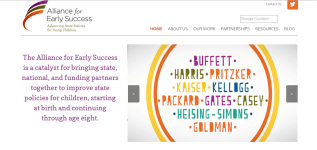
Earlier in 2019 I have some posts on this topic, just referencing it again here, 9/15/2019. Look at the foundation names at “earlysuccess.org” (home page slide-show (with left sidebar stable) continues the story-telling and advertising. Notice “Buffett” is near the top, but Pritzker (Current Gov. of Illinois is a Pritzker), Gates, Casey (big in Foster care and responsible fatherhood also), Heising-Simons (I looked up, you can too); Packard obviously computer-related. etc.
This behavior is more than ‘normal,’ it’s become seemingly standard practice. USA schools (by recall, offhand) where I’ve noticed (in course of writing this blog) include: Harvard, MIT, Yale, Brown, Princeton, Columbia University (NYC), Cornell, SUNY, University of Pennsylvania (<~private) and Duke (<~EastCoast sampler), UC-Berkeley, Stanford, UCSF (public), USF (private, Jesuit), and so forth, West Coast, and plenty more in between.
See next image: screenprint from my 2017April 11 post after looking up/for financials in the school-reform centers backed by the Annenberg Foundation and involving Brown University in Rhode Island (admitted women first time, ca. 1969; immediately diluted the curriculum). My opening statement (not to mention, the title) mentions system parts. This post might be a good review and wake-up: Under this way of doing business (public, private, mass population going through basic government-funded institutions, whether as privatized or as kept under obvious government control), no person could possibly keep track of it all in their “spare time,” and it’s questionable whether people even paid full-time to do so would.
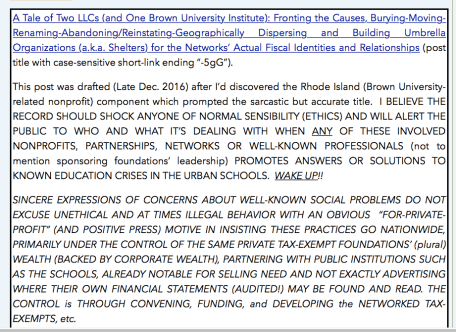
Top portion of my April 11, 2017 post (http://wp.me/psBXH-5gG), search result for “Brown University” looking for the AISR information for a Sept. 15, 2019 post insert..
Getting to this type of information, should doing so somehow cross someone’s mind in the first place between the story-telling, great causes, and brightly colored graphics and slideshows (i.e movement) requires overcoming some obstacles which seem less than accidentally strewn in the paths to that information, which situation increases personal time (which = expense) involved while decreasing prospects of even accuracy of such searches, i.e., discouraging the investment of that time and expense to start with.
Who knows whether existing databases that the public cannot access (due to power required) MIGHT, but I do know experientially that the basic public-access databases (whether state-level or via existing private nonprofits such as FoundationCenter aren’t accurate or functional enough to do so.
(Foundation Center (based in NY) again, just bought out Guidestar and rebranded as “Candid” but — I checked again last night, looking up several nonprofits related to this post via cell-phone), despite brighter colors (Black, white, BRIGHT yellow), more high-contrast user interface, what survived the merger includes the corrupted data practice of getting organizations’ names WRONG, whether by adding or subtracting a “the,” losing an “‘s”” or eliminating spaces between the words, or opting for different and unpredictable shortened versions of organization name in subsequent years.
Searchers won’t even know what they missed until they somehow repeat the search by EIN#, at which point it coughs up the tax returns pinned to mis-spelled organization names, not from the data source (which we’re told is the IRS), but by the database provider, “Candid.” (which is, the privately owned business, Foundation Center, Inc.)
Meanwhile, the one searchable field which is harder to get wrong — it’s only 9 digits and that’s “EIN#” — remains submerged in “other search options” not displayed on the top level of “990-finder” search page. To anyone simply aware that EIN#s are searchable, this is a not-very-subtle message: “GO ahead! But its’s an extra click each time” and those who, perhaps, may not think to or know to find an EIN# and use that only as the search condition, will not be alerted that even if THEIR data entry (search requests) has no typos in organization name, changes are, some are built into the database itself and may not know what they even missed. All this erects artificial barriers to getting what is really, very basic information on organizations.
Perhaps I should start a petition called “OVERCOMING BARRIERS” and show public support to demand tax-exempt organizations claiming tax-exempt status for promoting philanthropy (the tax-exempt field overall) adhere to common decency and minimal copyediting style sheets (how to abbreviate, proof-reading for spelling or spacing errors) in human data entry, or whatever automated software function produces those search result names in all FREE (non-subscription) data searches. I have done data entry, copyediting, and text-processing in professional fields and continue to be amazed by how bad the data results are here, and in some federal and other state government search sites.
If NASA, hospitals, the military, oil exploration and drilling, artificial intelligence, GENE therapy, or any large, hard infrastructure process dependent on accurate software information were that bad, there’d be even more massive failures, levee and dam failures, etc. PG&E was sued in California for failures relating to the wildfires. But somehow when it comes to tracking where government funds go — and they go to and through nonprofits, obviously — NOT even close enough for jazz it seems is just fine…
The contrast between entrancing, colorful graphics and the lack of financial details on the same websites (or, elsewhere where they should be) is often astounding. It’s clear they are learning from each other, and as of the appearance of “The Frameworks Institute” which I mentioned on this blog, receiving coaching in how to translate science into policy-making, user-friendly terms, focusing on conflating project or nonprofit names with parts of government (i.e., name-synchronization) to, probably, catch the public off-guard which sector in fact they are dealing with — and to provide a “unified front” under similar names: “Surrounded!!” Program saturation by sound byte, etc. Public relations/Advertising techniques….
[I’d show this, but I haven’t got laptop to talk to iCloud Photo properly yet. The images aren’t transferred here yet…][End, Sept. 16, 2019 post-publication insert commentary.//LGH]
More, regarding why, perhaps, current Family Court Reform Practice doesn’t even acknowledge blueprints or builders exist:
Business names (association with a university or medical/health system also seems to add to the credibility) of any reformers and alleged** paradigm-changers. Referencing them as nonprofits which have tax-filings (and showing them) might reveal just how many are filing Form 990-Ns or Form 990-EZs to camouflage just how small, really and historically, they have been and still are.
**The overarching paradigm remains public-private-partnerships, no matter what marketed in its various parts, here, as enhancements, solutions, or fixing flawed/unenlightened by the latest “science” (trauma, child development, domestic violence-related, father-engagement, etc.) practices. These PP partnerships can then, incrementally, steer change in the predetermined directions, once connected to “the grid” of decisionmaking on where public resources are spent. Personal associations, connections, and group loyalty are also developed through conferencing, publishing, etc. on each new field, or tweak to established fields…
Drawing attention to the builders organized as nonprofits and issuing “blueprints” reveals that the builders exist and organized (coordinate) as nonprofits; it also put names, dates, places, and potentially funding amount specifics, and how sources of that funding (where federal (the US) or lower-level (state, county, etc.) governments just might be part of the problem.
Read the rest of this entry »
SHARE THIS POST on...

‘From The Beginning, March 2009, FCM Has Been More About This Organization Than Me’ (FrontPage Sept. 2019 Subsection #1, Published/Expanded Sept. 9).
This Post Is: ‘‘From The Beginning, March 2009, FCM Has Been More About This Organization Than Me’ (FrontPage Sept. 2019 Subsection #1, Published/Expanded Sept. 9). (Short-link ends “-aUu,” as off-ramped, only about 1,500 words, with a mini-preview, about 2,500 words only and at the end of the day [9/9/2019] just over 6,000).
(“FCM” meaning, this blog. FrontPage on this blog meaning “FamilyCourtMatters.org“).
ANY post may be further edited (as in, condensed, or expanded, or both) after publishing. Blogger’s privilege!
(This one was edited so much before, it’s unlike to have major changes soon after, though).
The writing and images posted below (where clearly marked) were previously published on the long front page to the blog and probably written in December 2018. Originally, just meant to show a few images from my existing media library for a few key points of reference.
It’s not intended to be a full drill-down with a developed argument and many kinds of connecting points of reference to support it, but just a call-out — an alert, not an expose.
However it still exposes many things. The images are either annotated or captioned or both, providing along with the few quotes plenty of details. The organization referenced in post title here to me symbolizes a key part of the larger system, even though it also is literally (not just symbolically) a major part of my blogging and I believe source of the ongoing problems “in” the family courts in more than one country.
However, those family courts exists within systems, not vacuums. Bottom line, they employe judges, the judges are paid by governments: a major part of those systems IS government itself (yours, mine, others’…). To understand government includes understanding its financing and who it hires (contracts with and grants to, employs etc.) to do its various businesses. That’d be a great place to start. BUT if one wants to focus, first, solely on the family courts, each one, and collectively (by jurisdiction) they still exist within an immediate level of government, and surrounding components, and encompassing (higher levels of government).
Those systems must be seen and discussed in public. Complaints about system outputs should be tied to documentation of system blueprints (original design intended). (See my next, “impassioned” inset):
“Complaints about system outputs should be tied to and premised (BUILT logically) upon
documentation of system blueprints (original design purposes).”
(//LGH 9/9/2019, NOT my first time saying this)
Some premises, if true, would preclude ANY consideration of certain corrections. These ones should be disproved (if UNtrue) first, before designing a solution to the problems occurring “in” the courts and claiming a cause-effect relationship between those courts and the problems.
If they were designed, for example, to resolve conflict through ongoing compromise of basic boundaries as exemplified in the criminal codes because ongoing conflict is psychologically worse for all (especially kids, RIGHT?) than criminal behavior — then criticism that they are failing to protect from criminal behavior is ridiculous.
This seems to be one premise behind “no-fault divorce” [First in the USA: California, 1970]. No one is “at fault” — grounds for divorce can now be just “irreconcilable differences.” The other spouse person wasn’t the problem, only the relationship: forget the past, move forward, crimes or no crimes. Funny how this mentality should have, it now seems, facilitated even more ways to punish and attempt to shame (or just plain old extort) people divorcing as though divorce, (or failure to marry) WERE a crime and inspired (?) or enabled the establishment of “conciliation” courts. Whether or not they’ve engaged in anything criminal towards the other person, society, or their own children (or anyone else’s) …
If on the other hand family courts originally were designed to divert too many argumentative, annoying, obstreperous or otherwise “recalcitrant” (searchable on this blog) parents (and their kids) into behavioral modification and education/therapy-based or attitude-adjustment court-connected (local community or on-line) psycho-educational classes and treatments — to the benefit and profiting those so involved, and for the overall social good of society — then saying they’ve failed or are broken is likewise ridiculous.
OR, if they were designed not with a view to (despite all the talk) what’s best for the children, but what’s best for those in quasi-judicial, immunity-prone fields involving the social-science and psycho-based (particularly psychologists) fields (and those who compile and annotate data on effects — as in, consultants and those with database and data analysis services), as a career path looking good because courts can order it, governments MIGHT help support it, and parents will HAVE to pay it if they want to see their kids again (or, get out of jail sooner) — then I’d have to say the family court systems seem to be a resounding success. Just not for everyone run through them.
There are no doubt several other “if they were designed for, …. then ….” possibilities. I think they should be listed, together, and the most illogical ones rejected, and reasons why, noted.
However what to me is equally ridiculous is failure to look into WHEN they were designed, BY WHOM they were designed, READ what those who designed said at the time, and HOW they persuaded (on what basis of public benefit) those in power to make it happen. (Administrative ruling of a chief judge (Maryland, 1990s) it took years to effect; in another (by popular vote to re-organize the courts, Kentucky, 1990s), and I recently ran across a (1998) feasibility study for Ohio mentioning who commissioned it, who provided the study, and whose ideas they were referencing. I will be posting on this, I HOPE, soon. (Partially written draft as I write).
Failing to even reference or admit this when complaining about the family court output and demanding change to alter that output — whether the complained about output (‘outcome’) is framed as” xx children murdered, or xx children ordered into “unsupervised” custody or visitation with batterers, or convicted child-molesters/rapists, etc. — AND whether complaint is publicized (typically, on-line) by way of:
one’s nonprofit organization’s website,
or mainstream media (independent journalists),
or independent journalists to whom nonprofits are pitching a story line working mainstream, free-lance, or freelance for other nonprofit investigative media (<~~you know who you are…), all of who stand to personally gain from the branding, name recognition, and further consultancies, reputation, and access to power.
or online petitions (Change.org, etc.). Or even lobbying legislators — successfully — to get resolutions passed which fail the above “common sense — not ridiculous” test above.
The original intent of my Dec. 2018 section from the Front Page being just a call-out makes this post a shorter and easier read, unless your mind works like mine, looking constantly for supporting arguments and proof when some assertion or assumption seems questionable but is unsupported.
Being so short, it doesn’t really need much of an introduction or guide to its layout (!), but as I had to make some introduction, I chose to re-emphasize those points and add a very short (informal, not in-depth) update referring to a different, participant in the larger system, illustrating the “Across-the-Pond”flavor of the family courts.*
Which family courts (or at least their preceding and their judges’ decisions) have upset so much of America, and which from time to time, many say and I have to agree, end up getting people killed in the context of divorce and/or in the context of separating from abuses in order to NOT, with their children get killed, or allow the children to be abused. Sometimes we know there’s collateral damage (bystanders, extended family, responding officers, too). Hard to disagree that there are such problems, while assigning blame for them is still under debate**
*While doing this (summary/intro/lead-in) I as always had to deal with my tendency towards sarcasm and mouthing off. Sometimes sarcasm makes the point quicker, whether or not it proves a point…
** Family courts + professionalizing all the ancillary services they exist to order (whether by a mass-mandate or as individually, but often, court-ordered — relationship education for all… education for parents that divorce impacts kids … behavioral modification for dangerous or alleged dangerous parents…) + then professionalizing, certifying or licensing anyone hoping to become a “new-kid-on-the-block” provider apparently is expected or desirable to lessen the governmental burden of too many people seeking justice (or protection from dangerous people) in the criminal courts, so the sacrifice of life must be worth it…
(“Why can’t you all just get along??“)(with our dangerous exes, the other parents to our children).
The next footnote has a long title, but not footnoting it would make the post top-heavy. (it also pushes the total word-count just over 5,000 words).
See FOOTNOTE “FAMILY COURTS OFF-RAMPED FROM THE CRIMINAL TO RELIEVE DEMAND ON RESOURCES. IT’S NOT WORKING. SO NOW WE SHOULD ON-RAMP CRIMINAL STANDARDS INTO THE VEHICLE/VENUE/”NEW VESSELS” INTENDED TO EXCLUDE THAT “OLD” (I.e., not “behavioral science”) LANGUAGE IN THE FIRST PLACE?
Originally, the December 2018 section had only two basic topics. On it you’ll see large annotated images, some related quotes and these two headings:
- From the Beginning, More about This Organization Than Me (i.e., “thanks for all the stories, but Let’s talk about these systems!)** “Who am I and Why Does This Blog Look and Talk So Different Than Others on “Family Court” matters?), and
- Who am I and Why Does This Blog Look and Talk So Different Than Others on “Family Court” matters?
** See Footnote “Why Talk Systems more than Our Experiential Stories“?
Having now moved it here, September, 2019, there are more additions than changes:
~~>I added this summary above (and you’re still reading it), part of which I footnoted below, necessary because of my sarcastic commentary and opportunistic tendency to emphasize main points..(so, I ran my mouth and wouldn’t just delete the content..). This summary came after…
~~>I added a Mini-Preview to include two short articles about a British parallel organization (so to speak) which has now become “BFF“[Best Friends oFFicially] with “this organization,” both of them in 2018/2019 are more open about it than ever, although some of us detected this basic cross-Atlantic dyad of public policy romance, perhaps based in beliefs about how family court systems — and families — should be run (and, by whom)…
SHARE THIS POST on...

‘Cyanocitta Cristata’* | Blue Jays and Other Resourceful, Smart, Related Species and Their Habitats: (About my Gravatar Image) [ ‘exported’ from LGH Front Page, published Sept. 8, 2019].
New Post, Previously Assembled material, except part of the lead-in. As it says, shortening and taken from my January 2018 Front Page, which is undergoing a massive edit Labor Day Weekend (USA) and shortly thereafter (Sept. 2-4, so far, 2019). Other than a quick read-through for any incomplete sentences and adjusting a phrase (or paragraph break) or too, it’s basically as-written.
It used to be at the very bottom of my Front Page. I figure many people never got that far. It’s an easy read..No math challenges or fine print involved….
//LGH Sept. 8, 2019
THIS POST IS:

“Blue jays will attack humans if they get too close to their nesting area.”
‘Cyanocitta Cristata’ | Blue Jays and Other Resourceful, Smart, Related Species and Their Habitats: (About my Gravatar Image) [ ‘exported’ from LGH Front Page, published Sept. 8, 2019]. (short-link ends “–aXL” and as exported and published under 2,500 words). * Originally published missing a syllable (“Cy-an-o”), the letter “o.” Corrected Oct. 11, 2019 in all occurrences, I think, on blog, incl. the tag. “mea culpa.” //LGH.
About the Gravatar Image of a Flying Blue Jay.
Its basic image to me is “flight” but I also consider the blue jay, crow and raven (below) for some other admirable qualities which I feel people, especially women and mothers, already have, continue to need and often demonstrate in dealing with the many systems intended to continue ensnaring us in forms of abusive control AFTER we declared “No Excuse!” by filing for protection, and temporarily obtaining SOME….
Nothing too deep — it just helps me to consider the survival qualities of species common to North America.
For example, attempts to wipe out crows were made (and attempts to wipe out independent-minded mothers raising children without a resident controlling man — or “the state” instead of him — calling the shots, making major decisions, and substituting for our own good judgment and common sense, the “state” official policy towards our kind). Meaning, mothers who don’t get or stay married to the fathers of their children and aren’t apologetic about it, either. Moms who still believe they have a right to fight for what’s best for themselves and their children and no innate duty to submit to further degradation, abuse, or domination by people who don’t see what we see, haven’t experienced what we have, and may not comprehend when “NO!” means “NO!”
Businesses like birds also flourish in certain habitats and adapt to others. Sometimes they are invasive, marauding species too.
The professions, as an “economic habitat” attract certain fauna and flora. The problem isn’t just the critters, it’s also the habitat.
And as to these, where the public contributes is through public institutions that WE FUND UP FRONT and ONGOING.
IN GENERAL, THIS GETS DOWN TO…
HOW WELL DO YOU UNDERSTAND AT LEAST STATE (but ALSO COUNTY and ALSO FEDERAL) GOVERNMENT ENTITY FINANCING AND ORGANIZATION?
HOW WELL DO YOU UNDERSTAND HOW TO GAIN AN UNDERSTANDING APART FROM THE PROPAGANDA MACHINES, OR THE EXCLUSIVE PORTRAYAL FOCUSED ON POLITICAL PARTIES?
Those are aspects I had to address in my own life, and make up for the information gap. While learning myself, I also posted.
IF I HAD KNOWN about the federal incentives, dating back a few decades, to set up and follow through with the “family court fiasco” post-domestic violence, and the aggressive, consistent attempts to saturate professional journals with minimization of it (when not running media campaigns ABOUT it omitting the same government agencies funding fathers’ rights movements specifically mandated — it’s in their original documents — to counter a perceived “maternal” bias in social services and in the family courts — I would have made even fewer compromises. NOT KNOWING THIS prevents women from bonding around it.
That is also why I felt it necessary to post on the “Broken Courts, Flawed Practices” nonprofits, some from Northern California, (since 1999, 2006, respectively) on the “Battered Mothers’ Custody Conference” (since 2003) (and its adherents and regular presenters) and in the methods used to continually find new “poster child” cases to “throw under the bus” for more publicity to further the “technical consulting and training” conferences, webinars, and speaker resumes of the field.
This is, again, theater — it’s there for a reason, and that reason is NOT the ones stated on the front pages. The theater is there to derail viewers from the bedrock realities of the system, lest they mutually organize to do something effective about it. It is there to perpetuate the abuse systems, while “tweaking” and adjusting them slightly back towards “fair” — for which of course, SOMEONE has to train and sell publications.
IN CASE readers are wondering why I am adamant about certain things, and ready not to just “survive through compromise” but dismantling any system which tolerates ram-rodding decent parents into as deep a hole as possible, and which doesn’t abide by its own definitions of the legal process, or justice, or anything approaching — to put it crudely and personified, “tear ’em a new one…”
It’s because I know experientially that compromise on the basic principles of life and relationships does NOT have a good ending.
The result is further compromise, followed by yet more, and yet more, and degradation of the neighborhood, while clearing the overall habit for increasing levels of built-in criminality. This doesn’t mean all are criminal, but those who are find great places to roost, and those who aren’t, don’t have, apparently, the integrity or ability to flush them out — which would also destroy their own habitats and incomes. I am talking about the penchant to refer-out to “community services” things that deserve a track record, and protection of due process. In order to get rid of that, a whole different set of “courts” were created.
SHARE THIS POST on...

Coercive Control and Co-Opted Conversations in Connecticut (Rutgers Professor Evan Stark, his wife Yale MD, Ann Flitcraft, Serial Global BIP Entrepreneur(?), Safe&Together’s David Mandel) = LGH’s FrontPage Sept. 2, 2019 Subsection #2
Published “WYSIWYG.” The “ReadMore” link will be much closer to the top in a day or so. Revisions for basic copyediting and for better flow likely to continue over the next few days. The theme is important and timely; thank you for tolerance of the initial version in my voicing my concerns. //LGH.
THIS POST IS: Coercive Control and Co-Opted Conversations in Connecticut (Rutgers Professor Evan Stark, his wife Yale MD, Ann Flitcraft, Serial Global BIP Entrepreneur(?), Safe&Together’s David Mandel) = LGH’s FrontPage Sept. 2, 2019 Subsection #2 (Short-link ends “-aUL,” published Sept. 7, ca. 7,500 words):
“BIP” – Batterers Intervention Program”
I’d said and I still feel that:
…Many of us who’ve lived with in-home violence (rarely restricted to the home environment only) could “write the book,” on coercive control, probably without that label. Some have written their own personal accounts, but the moment this goes into “the conference circuit” that’s not really in good company — and without the travel budget (etc.) impossible to keep up with AND manage one’s own life AND continuing research.
I say, why MUST we support all these professions which then have networked nonprofits, publications, policies and of course RoundTables with people basically in agreement with SOME of the basics — like the health paradigm, coordinated community response, and in general sticking the public with if not the costs of domestic violence, the costs of treating and “preventing” it…? And why must “father-engagement” be central to all forms of abuse prevention, whether in child welfare services, or in the family courts, in child support agencies, in prison/re-entry situations — at all points?
While the term “Coercive Control” now has specific meanings, including a legal one in the UK (since it became an official crime in 2015), I’m also using it to describe a type of coercion in those co-opted conversations (around the field of domestic violence and protection from abuse, stopping violence against women, etc.). Hopefully by the end of this post, readers will understand that co-opting conversations in these fields exists; that there are “on the table” and “off the table” topics, with certain career academics in certain fields (particularly sociology and psychology) and their backers making the call. And that this is an effective form of coercion, to cut-off other plausible explanations of why it seems just SO hard to stop violence against women, and to explain the behaviors of the family court systems, here and abroad.
Doing so is morally and ethically wrong, although probably not legally wrong, that it’s been chronic in this field since “domestic violence” became a word, that is, just about from the start.
Note: laws against battering women and protests of it is not synonymous with the usage of the term “domestic violence” and development of a major state-funded industry around it, a key part of which includes NOT talking about the state-funded marriage/fatherhood/family values” industry.
One analogy for the word “table” above would be “roundtable.” There have been major round-table conferences and/or consultations on this topic (some even called that); defining features of any RoundTable are who convenes it, who is or is not invited to present, and where they occur. Also who sponsors them.
Publications catering to fields and professions (i.e., research, publication, practice etc.) which rely so heavily on state (i.e., government) funding also impact what ideas are and are NOT in significant circulation.
PREVIEW
(Up front: more text, my voice. Below: more pictures, links, and quotes)
Most of this post was previously published on my main (Front) page for at least a year. I removed it on Labor Day, (Monday, Sept. 2, 2019) to condense that page.
On finding new information since adding this segment to the Front Page (in January or as late as December, 2018), i.e. especially since obtaining my copy of Coercive Control: How Men Entrap Women in Personal Life book, (<~~that link is to a title search so you can see where it’s being promoted (notice url domain names..including “global.OUP.com”) New York: Oxford University Press, Inc., 2007, hereafter “the Coercive Control Book”), ….
Note: This is the second book in an “Interpersonal Violence” series. Series editors are Jeffrey L. Edleson, Ph.D. and Claire M. Renzetti, Ph.D. Number one in the same series is significant of a shift in (geographic) emphasis, though probably not strategies, within the domestic violence movement: Parenting by Men Who Batter: New Directions for Assessment and Intervention by Jeffrey L. Edleson & Oliver J. Williams.
Please see my Footnote “Oxford University Press, Inc.: Interpersonal Violence Series.” It’s relevant to this post. I’m footnoting because it only came up when I realized I’d referenced the Coercive Control book without posting the link. On going to post the link, I felt it appropriate to show the series. Including that information up here would interrupt the flow of this post.
…based on this new information and on general principles (reviewing some of my existing links,** and my ongoing awareness of the expansion of this field internationally, and from all of the above, my perspective about a year and a half later), I decided to develop this post further before publishing and to prioritize publishing it first among the many (about six or seven) other Front Page extracts which became separate posts now in draft.
In other words, it’s not going to be just a “block-copy, paste, re-publish as a separate post” project!
To completely distinguish previously published (2018) and my progressive updates since (Sept. 2 – 7, 2019) is probably impossible, but I’ll leave several indicators throughout the post below.
**(Especially from a long post, of Stark’s testimony January 2016 on a Connecticut Task force on Children Exposed to Violence).
I posted some of the new (to me) information on the Front page (pending publication of this post first among all the (about six) off-ramped sections during a “massive edit”) because I believe people deserve to have it brought to their attention promptly. Coercive Control conferences continue. People have been arrested for violating the new (2015ff) law against it in the UK, there is plenty of social media “buzz” around the theme.
IF there is major co-opted conversation, any censorship, or significant reporting gaps in those from the USA running (personally or professionally and in publications as only the internet and certain types of academic journals can do…) to the UK and elsewhere pushing programming, the “left-behind” sector in THIS country more acutely aware of how this field was set up and run — and what elements are historically omitted from its history — that information should be publicized, however imperfectly, as fast as possible.
Such reporting is, I’d say, right now about THIRTY YEARS behind in awareness. Mathematically speaking, given the distribution and publication networks and proliferation of DV organizations and university centers (or “Centres” as it applies), for every professional who claims “30 years experience” there are probably many more individuals who have 10, 20, or 30 years “in your face” experience off exactly what “coercive control” looks and acts like. Many of (us) HAVE been speaking out all along– but we cannot keep pace with Oxford University Press, Sage Publications, Wiley On-line (Taylor & Francis) AND government-sponsored “Centers” at various universities, or simply on their own specialized websites ending “*.org” in the USA, or “*.org.UK” or *.co.UK” etc. …
Unlike the academic professionals, many of us continue to get killed off over time (“roadkill,” or some of the children do). I’ve read of various professionals dying of old age or cancer (Schechter, Pence, others) but not so many being murdered, jailed, extorted or being full-time occupied in economic survival from onslaughts (so to speak) via the family court systems. That is a genuine hindrance. This doesn’t seem to slow down others publication and conferencing while we are so occupied, speaking for myself and others I have known over the years.
So, built-in “institutional” issues include access to funding and of course, access to media (which requires generally, access to funding). How many ideas are being squeezed out of consideration simply because those with better financial incentives and job stabilities for the respective authors (pardon me for making this reference again, but with existing PhDs, JDs, and so forth) to NOT talk about what I’ve been blogging about for ten years now? And what I am a witness was basically unearthed (at least the basics of it) a minimum of twenty years earlier (that is, 1999)? And if you include Liz Richards (NAFCJ.net) claim of having started in 1993, make that about twenty-seven years.
Having done that, now I’m working to get this post out so I can in good conscience shorten the footprint (some quotes, links, and discussion of the “new information”) left behind) making sure nothing is lost in the move.
Read the rest of this entry »
SHARE THIS POST on...

Reform, Solutions, Enhancements, Adjudication Improvements Built on WHAT? (Unproven Because Unspoken Assumptions about the Deliberate Design = the Deliberate Purposes of the Family Courts in the USA?) [Started May 2, 2019, Publ. Aug. 29].
ANY post may be further edited (as in, condensed, or expanded, or both) after publishing. Blogger’s privilege!
Today’s post is:
TITLE COMMENTS: “Why I changed “The Dangers of Derailment” to a rhetorical question: “Reforms …. built on WHAT?..“
As originally summarized in early May, 2019:** for context, see April/May posts…
WHO BUILT THE FAMILY (and “CONCILIATION”) COURTS?** WHEN, WHERE, AND ON WHAT MODELS — WHAT WAS THE DESIGN? WHO HIRED THE BUILDERS? WAS THIS DONE OPENLY, OR PRIVATELY AWAY FROM PEOPLE WHO MIGHT OTHERWISE HAVE PROTESTED, OR VOTED AGAINST IT IN PLACES WHERE VOTES MATTER?
**In the USA, in the UK…in Canada, in Australia and New Zealand… in Europe. But my main perspective is the USA because I live here.
The WHEN is an important part to understand and, if possible, prove beyond reasonable doubt.
Family Court Reform conversations from what I can see in public somehow never get around to the admitting that just perhaps, their actual current form is intentional, by design, and that this design ideally suits the purposes of those who set them up in the first place, whether or not it suits the purposes of the public at large, or people outside that apparently powerfully inter-connected inner circle.
IF an open discussion and genuinely seeking answers* with a sense of urgency existed in the first place, why rule out, eliminate by silence, consideration of any realistically potential or even probable causes or conditions?
*Answers to the problems typically cited/characterized as failure to protect/inflicting harm on children, custody of children going to batterers, children getting murdered, and (to a lesser degree but also reported), murder/suicide events of varying scope, long-term traumatic distress..
~ ~ NOW, for THIS post….~ ~
Today’s post is called:
It originally had three section titles (my spinoff post above may mention this):
1. “Preliminary Chat (Health System Flush with Cash),” 2. “Intro,” and 3. “If it was built, there was a plan.”
After trying again to wrangle (condense) the discussion, I’ve booted “2. Intro” off the list. So now we only have two sections, BOTH of which were written, primarily, in early May, 2019:
1. “Preliminary Chat (Health System Flush with Cash)” and
2. “If it was built, there was a plan.”
It was written starting with what became — it’s my writing style — the third (now second) and final section. In that section, I take the common-sense admission (“if built, there was a plan”) to prod readers, using basic logic, to look at the self-declared** family court builders for some clues as to the blueprints, (<~brief Wiki explanation) rather than the interior decor (furniture, fixtures, etc.) ignoring the architecture itself. **(The “we built it, we’re leading it” declarations seem accurate, and I haven’t found others disputing the claims. If you know of others, please contact me here or on Twitter, and publish a link to that information in a comment ASAP!).
Over the nearly four-month delay publishing this post, besides working (hard!) on the blog appearance (sidebar, top posts, table of contents, etc.) and publishing three spin-off posts directly related to the first section above I also:
<>noticed more current events in “family court reform” including legislation proposed to better protect children in the courts (task forces, commissions, study work groups, etc. in different states (USA) and countries, and a debate at the level of “WHO ICD”), and as I could, explored (extensively) included in my posts and publicized them on Twitter. (I am not a lawyer and did not delve so much into the legislation as the types of responses to them and people involved, which had people in common across several jurisdictions).##
<>continued to develop understanding and I become more acutely aware** how the AFCC has now established a firm connection to the UK’s “CAFCASS” which was established by government — but independent from the main branches — by law in 2001. This connection was predictable and seen coming, however it’s still a significant turning point. Some of this has been expressed in the top two sticky posts on the blog, the second one in more detail; the first, in a footnote: **(i.e., I continued researching and doing targeted look-ups and drill-downs…)
FYI, a CAFCASS member is now on the AFCC Board of Directors, while throughout 2018 it’s become more clear how professional perspectives — moreso than individual parents’ or families’ experiences and perspectives (on either side of the “Pond”) — are being unified in a network which extends obviously beyond the reach of the average citizen or working parent with minor children (or, domestic violence or child abuse survivors) in either country… unless they form and obtain sponsorship, somehow, for their own advocacy groups which might be heard over the already entrenched ones… I’ve been Tweeting on this since at least Sept. 2018, and again on August 9 in more detail, as well as studying it, and talking it up, generally.
## [Paragraph copyedited after posting to clarify that I didn’t propose legislation or respond officially on legislative websites, task forces, etc. I am considering how to draft and deliver/publicize a universal, formal response incorporating key things I’ve noticed which, it seems, those involved did not, or ignored..]
Trying to tweak any system designed to produce a predictable outcome, to instead produce the exact opposite: i.e., justice, and with it, protection from (for example) abuse, or keeping little children — or older ones — or in fact, anyone safe — to me is a form of insanity.
Re-reading this post before publishing it occurred what I mean by “predictable outcome” might still be unclear there. Here’s a short-list (impromptu, four short paragraphs inside maroon & teal borders) of procedures and specialized terms, professions I’m referring to, generally:
Among what seems to be the “designed to produce” structure is diverting people from the criminal justice system when dealing with potentially criminal issues into “dispute resolution” and referrals to further treatments, evaluations, and other handling by a combination of private (but court-connected or pay-to-play certified to get on the referral list) or directly court-funded professions, some of which have been created to accommodate the deluge of repeat visitors when the first sets of referrals intended to “resolve” conflict instead enabled further abuse.
Another intended outcome, it seems to me, is minimizing violence against women and children while insisting on restoring and preserving relationships — at any cost — including supervised visitation, batterers intervention, psychological assessments, custody evaluations (I forgot — start with “mediation), and after the courts allow or facilitate total separation of one parent, then putting it back together through “reunification” camps, programs and services. Parenting Coordination has been set up and tried as a profession; almost as soon as it was started, parents(USA) began suing the courts over violation of their rights.
In the process of adding in as many behavioral scientists and mental health specialists as possible and setting up professions (and making fortunes for some when these can be marketed electronically: Our Family Wizard™, Online Parenting Education programs, etc., specialized jargon increases (“differentiated domestic violence” “parental alienation” being one of them also, and my favorite now engrained one, “high-conflict,” applicable to almost anything — and with specialty courts (see Middletown, Connecticut for a good example).
Overall, increased privatization of the (civil) courts and sharing/spreading around the immunity and quasi-immunity of professions just helping, advising, supporting and encouraging the judiciary in its decision-making seems an intended outcome.
(This text added pre-publication Aug. 28, 2019//LGH)
Whether those engaged in this are themselves as “insane” or illogical as it seems — or perhaps NOT insane or illogical, but instead simply unethical (dishonest, i.e., playing assigned roles in staged battles whose goal isn’t to defeat the opponents on stage, but win over the audience, the spectators), is a good question. These are tactics many of us already know from having lived with controlling, abusive, and violent individuals with whom many of us also had children.
I have my own opinion this, which doesn’t make me welcome in many support circles. Over time, I’ve learned that weakness among protective mothers, including weak focus, follow-through and inability to make wise choices in support groups in the long run, isn’t “supportive.”
Nor is joining, essentially, court-reform cults, and turning on or harassing (passive/aggressive) those who choose not to join.
1. “Preliminary Chat (Health System Flush with Cash),” 2. “If it was built, there was a plan.”**
(**Part 2’s premise: once you admit that, generally, builders have plans and (specifically) the family courts were indeed built, by definition raises the next basic question: By Whom? Who planned it, built it, and holds the blueprints? Answering that question FIRST seems far more sensible than trying FIRST to apply solutions to make the family courts and everyone working in them (judges, and all the others) or taking business from them function to produce, perhaps, the exact opposite outcomes that their design illustrates they, most likely, were built/designed and thus intended to produce.
Section 2 delivers the content most directly related to the title. Sections 1 should provoke more thought and reflection on the much larger framework in which the family courts sit before my call to common sense and attention to specific facts countering said unspoken assumptions which have become built-into the typical solutions demanded.
I might have placed the Section 2 title up a little higher. However, right now it’s pretty far down on the post. I am also exhausted trying to complete this one, and as of Aug. 29, have opted to “punt” and publish it as-is (at this point of development). The second section is actually less complete (other than its plentiful exhortation parts) but I think towards the bottom you’ll see exactly where I’m going. Remember that originally (May/April 2019) the context was questioning the assumption about the “Safe Child” premise in association with “HouseConRes.72.” MUCH has transpired since then, nationally and internationally, so I am just going to publish now — and will update post-publication as I sometimes (often) do… Comments remain open…
1. Preliminary Chat: A health system flush with cash## through anti-tobacco litigation (MSA and the STMSA, two master settlement agreements with “big tobacco” after class action lawsuits instigated by attorneys general of the USA) and ongoing add-on taxation.
## while claiming efficiencies through increased centralization and complaining about any reduction in ongoing funds, …even when that results from successful efforts to change the public’s unhealthy habits (like smoking…) through financial penalties, deterrents and massive media campaigns …
I developed and further detailed this theme on a new post August 7, but some of my exhibits and narrative still remain on this post below. Look for the ones labeled “father-friendly”
A Health System Flush With Cash — because ‘Smoking Causes Cancer’ (1998 Tobacco Class Action Litigation MSA Payments, and Tobacco-Related Taxes Impact ‘in perpetuity’ on Systems Affecting Family Courts) (Begun Early June; Publ. Aug. 7, 2019) post short-link ends “-a6m.” Currently 5,200 words, having just been shortened (split), but this one is still a bit complex. Following the funds has been made complex. Last update, Sunday, August 11, 2019.
That post and two others posted August 14 and 16 (basically one exhibit and an update, the latter providing a link to and sample of the financial statements originally missing) develop and further detail the “health system flush with cash” theme I drafted (early May) as you see here…
This system has by legislation poured even more revenues at state and local (county) level into fields and programming which closely overlaps with those already run through the family court systems: early childhood development, parent education and coaching, consciousness-raising, behavioral modification, and building bodies of evidence that whatever each field proclaimed originally to justify the programming (and build-up of infrastructure within that field) was, of course, right all along, etc., but more research and resources are still needed…
I am certainly not the only person to have written or summarized this information, but I’ll bet I am the only one who has (correctly) connected it to its predictable and probably intentional impact on contested family court proceedings (outcomes) in the 21st century — often contested over the issues child abuse, domestic violence or other criminal behaviors by one, not necessarily both, parents.
I also wonder if anyone else has put both this extra financing together with welfare reform as heading in similar directions administratively and as to intended “designer-family” outcomes, based on gender and marital status of the ideal environments for “human development,” i.e., compliant and correct-ideologically-infused [future] corporate and government workers of [the United States of] America.
Drenching the landscape with fatherhood collectives, councils, and collaboratives, including county-based councils and collectives operating with the label “domestic violence intervention” and of course (as always) “child and family strengthening” policies, increases the likelihood that any man (including a father) or woman (including a mother) in the course of protecting a child, or seeking to retain custody of a child in the family courts, is likely to interface with someone (male or female) who has already been trained — if not brainwashed — into prioritizing “father-friendly agenda” at all levels. Keep reading, please!
-
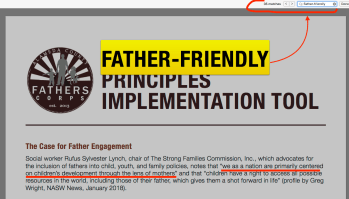
- The compound adjective “Father-Friendly” is used 35 times in 9 pages or here to see more). Same link provided in nearby text (Post, short-link ending “-a2y” in draft still 5/31/2019.
-
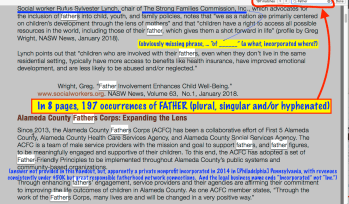
- (There are 9 pages. My original page-count was somehow just 8; I didn’t correct the “8 pages” annotation on page 1. Whether 8 or 9 pages long it’s still language saturation).or here to see more). Same link provided in nearby text (Post, short-link ending “-a2y” in draft still 5/31/2019.
SHARE THIS POST on...

MY Concerns about the July 21, 2019, Collective Memo of Concern to WHO about (‘What else?’ – parental alienation!) [Aug. 28, 2019]
You are reading:
This must be on my mind, because it came out as I was working on another post which just won’t deliver itself in usable format I feel comfortable publishing yet. I’ve put that other post’s name out so many times now, this time I’ll just skip the reference if you don’t mind….
Things with far more fine-print detail like this:** “no problem.” Putting together generic statements, even ones I’m convinced of and have done my homework before making, sometimes for some reason is personally more daunting. (**referring to the post before its Aug. 29 update, which section, explaining my use of the verb “emerged” which gets into a nonprofit by that name and by association a key theme in at least two countries’ innate system response to the abuse of women — run behavior-change (counseling, intervention, etc.) classes for men taking agency or court referrals — appears at the top. The specifics of that section tie directly into entities referenced in “Dangers of Derailment” and this preview of it, BOTH show how certain things date as far back as the 1970s and 1980s in system set-up. But, after that, get to the bottom segment of this post and you’ll see what I mean by “fine-print detail“!)
Perhaps this concern may stems from personal gut instincts — for example, having endured a decade of domestic violence (but so long ago!) then almost two decades more of an extended/expanded form of it involving the remaining, surviving (so far) immediate family members on MY side, and an assortment of non-relative strangers who chose to get involved in how I separated from abuse and was at the time raising our children — less expansive than he’d had as an ousted, violent,wife-batterer parent — constantly rejecting, debating, and arguing with each basic point I’d raise as a human being regarding.
Whatever the reason, this segment is in better shape than the post from which it “emerged”** (coincidentally, when I copied it, deleted it from there and pasted it here).
** This “Day-After” “discussion” (elaboration) also just emerged on the post.
**(That’s a joke in case you haven’t been reading enough literature about how theories and practices, concerns and psychological beliefs about the cause-and-effect relationship of human [parenting or co-parenting] behaviors mysteriously “emerge” throughout the family court systems in various countries to see how often the word “emerge” is used as a substitute for the underlying truth of who lobbied for what and how…). Let alone the batterers intervention program from Boston called “Emerge.”
…Emerge is one of 17 certified programs in the Commonwealth of Massachusetts. In Massachusetts, programs such as Emerge are called Batterer Intervention, but we try to be clear that this terminology does not speak to the services we provide.
The term “batterer” often has very negative connotations and is typically defined as someone who repeatedly physically abuses their partner. In fact, many people who have come to Emerge report that they have not been physically abusive, but have been quite emotionally, verbally or psychologically abusive. Despite the fact that these forms of abuse are not physical in nature, we challenge group members to recognize that they are still harmful and in fact can destroy relationships.
People coming to Emerge are asked to recognize how they have chosen such behavior as a pattern in their relationships and families and how those choices have harmed others.
Approximately 20% of clients at Emerge are self-referred, although we still see many people who are referred by the court systems or through child protective services (Department of Children and Families).
Does 20% (of how many “clients” in what timeframe?) + “many people” referred through one of only two other named sources = 100%?
20% of what, regarding when? Are there any hard (absolute) numbers (total people run through programs [starts vs. completes], calling for help, stepping in the door for informational interviews, submitting their emails to find out more, etc.) attached to any time frame (like last year, meaning 20__ __?)
Emergedv.com also runs (ran?) a “CaringDads Group which I found as a program associated with the London Coordinating Committee to End Women Abuse (“LCCEWA” |<~~History page) in Ontario, Canada. Look at the geography compared to Massachusetts, US Eastern seaboard (Mid-Atlantic / New England states) (Boston is actually north-east of London, Ontario, Canada) across the national border).
London Ontario Canada (geographic showing nearby US States, bodies of water) ~~(url in window frame at top) viewed 2019Aug26
The purpose is to take CaringDads™ global, of course. It must have just “emerged” as the most logical thing to do in preventing violence against women: Run “responsible fatherhood” (if the context is, within the US) programs. Get public funding to do so.
This light-gray, tiny-font descriptive page refers to 2018 as “next fall”…. From that page, a sub-link titled “Program Model” reads:
Emerge currently provides three annual Responsible Fatherhood Groups. The Responsible Fatherhood Program utilizes an adapted version of the Caring Dads curriculum, a model developed by the Changing Ways abuser education program in London, Ontario** and specifically intended for fathers with histories of domestic violence. Emerge was the first American pilot site for this model in 2002 and has been refining the curriculum since then, particularly by making it more culturally relevant for the men we serve.
Though originally intended just for men who had completed or who were still attending the Emerge Abuser Education Program, these groups are now available to fathers referred by the Department of Social Services, District and Probate Courts, other agencies, and self-referrals. Currently, about 45% are referred by Emerge, 30% from the Department of Children and Families, 15% from the courts, and 10% from others.
SHARE THIS POST on...

The Dangers of Derailment from “First Things First!” in Family (and Conciliation) Court Reforms to Save Children from Violent Parents (and/or Prevent Violence Against Women) (+/- Aug. 20, 2019)
First published August 24, 2019. For the full title with link, short-link, word-count, keep reading…
ANY post may be further edited (as in, condensed, or expanded, or both) after publishing. Blogger’s privilege!
UPDATE : Aug. 25 — expanded. Contractions (extraction of contents) is tricky and may require consultation within (sic) Blog Admin…

re: ‘TWO HELPFUL LINKS’ — Image from TopRightSidebar, ‘GO TO POSTS’ widget, shows TOC 2019 & 2018 + ‘Key Posts 2012-2017’ (LGH, @ Sept. 1, 2019)
TWO HELPFUL LINKS added Sept. 1, 2019 (for recent subject matter overview):
Table of Contents 2019, Family Court Matters’ Posts + Pages: January 1 – August 31 (so far). (Shortlink ends “-ayV.” About 6,300 words,posted August 5, updated Aug. 31) (You can also link to this TOC post any time from the top right sidebar, under”GO TO: All Posts, incl. Sticky, Tables of Contents..” widget, which holds several boxes for navigating to specific important places (posts or pages, incl. the home page), and,
Today’s post was extracted, like a Caesarean section, from
<~~that is, a post I’m still trying to get out…
And I’m calling it, all (for now, with footnotes) 10,000+ words,
The international family law reform aspects addressed here were also raised in my (second to top) Sticky post, published just last month: July 31 — mentioned near the top and footnoted at the bottom. See its title (for the link) and a single image excerpt from it (text-only/summarizes):
[2nd from the Top Sticky Post on Blog** is:] Acknowledgements, Executive Summary (Current Projects | Rolling Blackouts) and What Makes This Blog “What You Need to Know” (July 31, 2019). (Shortlink ends “-auh”, marked sticky, this is currently 9,900 words. That includes two lengthy footnotes, one of which I expect to remove to its own post.) (**as of August, 2019. Sticky post order and contents of course changes periodically — but not that often…)
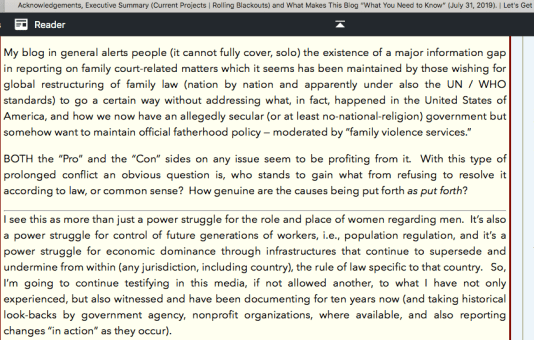
Intro (Pls. Click image (or link here) Read) to my recent post, Acknowledgements, Executive Summary (Current Projects | Rolling Blackouts) and What Makes This Blog “What You Need to Know” (July 31, 2019). (Shortlink ends “-auh”, marked sticky)
Some of the length here comes from me detailing a certain document full of its own lengthy footnotes.
Footnotes in public documents seeking major legislative change at the state, national, or here it happened to be, global (or at least UN-related) level illuminate many things which might otherwise escape attention. Often I’ll focus more on them than on the (usually predictable and repetitive in the field) main body text.
Some of the phrases in the post title come from recent campaigns discovered via Twitter* and/or a combination of the USA’s “VAWA” act and more international “CEDAW” which I’d been exploring, especially after discovering one of the concerned thought-leaders (self-described, some of them) and other types of experts referenced on Footnote 1 of the Canadian-based CREVAWC‘s** @{{website “LearningToEndAbuse.org.ca” and @learntoendabuse on Twitter}} recent Collective Memo of Concern to WHO about the inclusion of “parental alienation” in the ICD-11 classifying kinds of disease also had US/Israel/CEDAW*** ties (along with a law degree from Yale and outstanding qualifications and dedication in the field), which brings up, again, the topic of the significant challenges to obtaining a divorce in any primarily patriarchal religion and associated systems and courts.
(I will repeat this paragraph further below before detailing the “*” “**” and “***” references)
CREVAWC = A centre which began (‘was founded’) as a collaborative venture spurred in response to a federal study on (VAW) triggered by the 1989 murder of 14 women at a specific school (“Ecole”) in Montreal. As described in the website which doesn’t contain the letters CREVAWC, but references another collaborator (the third link, next paragraph) whose website does reflect its actual name (“LCCEWA”).
The third website shows clearly this is a previously coordinated network arising out of a situation dating back to the late 1970s, early 1980s. Yet somehow, a decade later, women are still getting murdered violently, generating yet more studies and centers (or “centres”) on the same, overall, topics: WHY? and “HOW STOP IT?”
The Centre for Research & Education on Violence Against Women & Children (CREVAWC) was founded in 1992 as a collaborative venture between The University of Western Ontario, Fanshawe College and the London Coordinating Committee to End Women Abuse. The Centre was established in response to a federal study on the problem of violence against women, triggered by the 1989 murder of 14 women at École Polytechnique in Montreal.
CREVAWC joined the Faculty of Education at the University of Western Ontario in 2001.
Where was it before, and how does a “collaborative venture” join anything? Does this refer to website hosting, faculty salaries, or what? I do know that once I looked at the London Coordinating Committee (and the networking) I instantly (sic) understood the Ellen Pence (USA, “The Duluth Model,” etc.) concept of “Coordinated Community Response” meaning — NETWORKED. She has studied institutional ethnography, it’s said, in Toronto (Ontario, Canada). [Bears elaborating, “explicating” separately. What’s taken place here is a window to the types of “fixes” being circulated through (existing) networks which I’ll bet the public at large (in either country — US or Canada: we share a long border!) still doesn’t comprehend, even after experiencing it with their/our own families personally or witnessing/hearing about others who have. In SYSTEM terms (public vs. private, national (federal) vs. local (here, provincial – Ontario — or more local “London” | US this’d be (mostly) State — or within states, “Counties” with inclusion, separately, of Indian tribes as their own governments within state borders, or if any cross some state borders)….
-
- CREVAWC (about|Home page)
-

- CREVAWC (more awards)
-

- CREVAWC (Collective Memo of Concern)
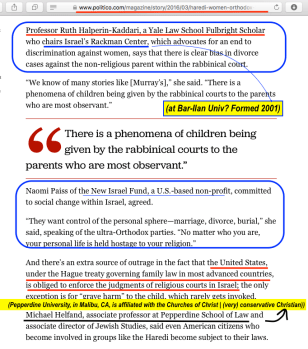
See the 2016 Politico article by Mike Ross quoted (imaged) here. It was written before the most recent US Presidential election, features a U.S. woman (Susan Murray) who can barely see her own children due to the rabbinical courts in Israel. The article also mentions AIPAC, a sea-change politically rolling back concessions or movement towards equality (i.e., for women). Not my area of personal expertise (or experience).
Catholics make it hard. Conservative evangelical Protestants in the US (whose nonprofit networks are identifiable, often predictable in board leadership, and most definitely well-connected to “go forth and multiply”) want restoration of “covenant” marriage and have pastors signing up for it; Mormons, well, have another unique perspective on the eternity of marriage (Reminder: we’ve had a Mormon contender for U.S. President not too many years back); there’s the issue of attempts to blend in ‘sharia’, while honor killings are still happening, and there’s the ongoing difficulty of getting a “get” (permission to divorce) with the Jewish traditions, in the USA and Israel both.
In this post, I have intervening comments before the explanatory *, **, and *** points which are their own section, not just a sentence or two each. I’ll enclose the intervening comments in a thick, ORANGE box and repeat the above paragraph when I move on to discussing those points. Then the *, **, and *** became its own major section. At the bottom I have the part which was extracted, like a Caesarean section,” from my other post. Look for this color scheme (and that’s the first part of it):

(Internal reference from my own post due out, I hope, Aug. 23, 2019)
Below that I have some footnotes originated in this post, different color schemes. Why? It’s complicated, if I explained it here, I’d have to footnote it, again…
Intervening comments before the *,**, and *** references:
This also brings to this discussion (it’s not “news”) the consequences of ongoing entrenchment of any theocracy in government and significant differences between civil and criminal (public and private) courts in different countries.
Obviously Israel’s (or Iran’s) or Commonwealth countries’ and the USA’s will have major differences among each other on views towards marriage and divorce and who controls it i.e., conditions of separation, divorces or annulments. Just like major powerhouse countries now (most formerly empires or kingdoms, some former colonies of the same, before organization on more massive scales, including building of infrastructures, military conquest and acquisition of enslaved populations etc as normal part of their respective “developments.”), major world religions too as ever and now, too, are naturally also concerned about controlling breeding and reproduction practices to provide more workers, followers (including volunteers in outreach and social services) which may affect, respectively, each one’s intergenerational continuance as a “going concern.” (See Footnote “USA: No Official Religion, Just the IRS.“).
One big difference (between major powerhouse countries and major powerhouse religions) is that the former are designated territorially/geographically and those subject to their ordinances and laws determined by birth or by some other elements of choice. Within the U.S., in addition to having a national citizenship, some may have allegiances and loyalties also to world religions while living in different geographies. While this is true in other “developed” countries, our public schools do not, last I looked, require a moment of collective worship as part of building national character and unity.
History shows that being the wrong religion in the wrong place has varying risks, up to enslavement/deportation, attempted genocide, dis-enfranchisement, or harsh laws creating dependent castes within a country, depending on time and place, up to and including death penalties for attempted conversion.
Yet, in a country where neither divorce nor failure to marry or stay married when having children (i.e., conceive, gestate, give birth) is a crime, and where assault, battery, stalking, kidnapping, extortion, terroristic threats, and very many other categories of person-to-person behaviors ARE crimes, still children and at times their mothers and at times, their fathers (sometimes, as individual judge, jury, and executioner when the family court or other courts’ decisions are rejected; sometimes as victims of perpetrating women, too) are paying the ultimate penalty: “Version one” death by violent means; or, “Version two” long-term enslavement — ongoing litigation draining resource and the ability to continue obtaining them through normal means (i.e., stable, ongoing work where it’s available and a person is qualified — without the abuse).
How “nuts” is that? How dangerous are the courts which precede or preside over it? [This para. added shortly before publishing and shortly after hearing of another little three-year old girl Autumn or Zoe Pereira (mother Cherone Coleman, father Martin Pereira, Court Referee who ordered the visitation on which little child was murdered (BUT no judges name turned up so far, that I saw) Margaret M. Mulrooney; burned alive, alone in a car whose back door had been chained shut, by (her father) after a so-called “bitter custody battle” in Queens County, NY. This para. was not in my earlier drafts.] This is not the first child-burned-alive-in-car we’ve heard of over many years. Perhaps these men learn from each other.
Over time, I’m realizing how much, in whichever country, the existence of “family courts” (however designated) as opposed to other kinds, is itself a major reflection of the country’s religious values — and this is very much so in the USA too. We just don’t admit it so openly.
That’s another reason why I believe the family courts’ respective blueprints, designers, approximate age (when came into existence) in the USA, in the UK, in Canada, Australia, Italy, and Israel, as to the countries primarily referenced above in “Collective Memo of Concern to WHO) should be made known — honestly.
We (USA) have a tendency here to substitute social science, psychology and population rationale studies for religious tenets on the role of families, the roles of fathers, mothers, and children and the rights of each. It’s more politically correct, especially the more the words “evidence-based” or ‘promising practices” can be attached. How much of this is functionally the expression of a religious belief, whether conservative, progressive, or “humanist” (new age)?
That’s also another reason, I believe, to also take a closer and (more) honest look on the correspondence between the development of the field of, specifically, psychology (and from which quarters/countries as to the USA, and from which dominant perspectives)…alongside the development of the family courts.




 Let's Get Honest! Absolutely Uncommon Analysis of Family & Conciliation Courts' Operations, Practices, & History