Posts Tagged ‘Family Courts Problem-Solve SOMETHING by reframing the criminal as low-level disputes — not that WHAT is clear….’
In About 2,500 Words,** Why I Still Bother… [Published June 29, 2019/#1 of 2]
In About 2,500 Words,** Why I Still Bother… [Published June 29, 2019/#1 of 2] (short-link ends “-ac4”).
**Post title originally: “In About 1,000 Words…” I had to adjust the title several times but quit, cold-turkey, before 3,000 words.
Then I <>added two image galleries with captions and connecting text and three or four more individual images ….<>expanded one of the early “**” references while copyediting for grammar, then footnoted it… <> added to the very bottom a bio blurb from one of the added image captions for a Mark Rodgers, of The Clapham Group (Charlottesville, Virginia), on the Alliance for Early Success‘s (“AES” in Kansas but legal domicile Nebraska) Board of Directors, which information is fascinating, I’m currently writing on because its a classic example of why we all need better language and to establish the habit of identifying, digging up the financials, and comparing them to the public relations material, even when it shows up at Harvard University (https://developingchild.harvard.edu), or backed by people (with heirs) listed in Forbes if not THE richest in a state, others in the same class.
Please see after this, Footnote “Clarification“ at the bottom of this post, (Three Footnotes to About 2,500 Words on Why I Still Bother (to Blog). (#2 of 2,June 29, 2019) (short-link ends “-ad3″| published the same day).
Here, it does and there are already major discrepancies surfacing. It’s also interesting in its own right.
I have to bite my tongue even now to not add to that information, knowing as much as I’ve just discovered within the past week (but had made mental notes of as far back as September 2016)…
It did only take about 2,500 words to state my case. The rest is “for example” and some examples, details behind the declaration.
Details matter. They reveal who’s involved in which roles in any mass social transformation targeting public institutions (i.e., source of ongoing revenues). Discernible practices discourage fair and open debate before any side has enough backing on questionable methods, or even purposes.
Privately networked, cross-jurisdictional collaborations and layered tax-exempt entities obscure full awareness of how few are at the top. Like any pyramid (marketing) scheme: highly networked, compartmentalized by cause at the lower levels.
… Still under 6,000 words (or so) …
Why I still bother to blog: Not just for fun!
I write to communicate what I see in fields whose established leadership do see, but have chosen not to say — including in fields developed essentially within the last two decades or so.
I write for those who like me, should’ve had better validation over two decades ago of things which just didn’t smell right in and around the family courts, on-line complaints and media exposes of the family courts. Those things that weren’t and still aren’t right, if you, like me, have smelled but (unlike me) haven’t yet found the source, know that the “what’s not right” can be seen and identified in objective terms — but not the cause-based rhetoric we are all being fed, constantly. So there’s a matter of functional vocabulary leading to expression in forms of what is seen — and from there, what to do about it, and only from there, how.
It starts with understanding there’s an existing taxonomy, the scaffolding of any operational support for ANY cause, to be considered. IS IT PUBLIC or IS IT PRIVATE — IS IT AN ENTITY or IS IT A PROGRAM POSING AS AN ENTITY shows WHERE IT TIES INTO THE ECONOMY. For collaborations and coordinated programming or any cause, the whole still has parts, and these parts still should be identified.
I also write to show how suppression of functional vocabulary is commonplace, cannot be accidental, it’s nearly universal, and the intent is subjugation of an entire population (and engaging them in keeping others down). In this language and vocabulary are a technology… key tools… leverage. The antidote is self-education. It takes some time and practice, but it’s achievable. One challenge will be time when people’s time is spent fighting to survive economically.
Basic literacy on how we are governed must be in economic terms, and must deal with concepts on submission to taxation in exchange for accountability for use of those tax receipts. Not just trust in leadership, and not just rebellion without understanding how to govern ourselves. (The intended level of dissonance with reality seems to parallel with a historic intent for South Africa: “Hewers of Wood and Drawers of Water”). That’s not the ideal society or a “just and sustainable world” when applied globally.
I write so women (mothers, in particular) might have a choice not just between forms of exploitation or abusing others (& becoming an abuser because it seems safer) or having been driven out of one field, need to make “family court reform” the new one — but walking in without a perspective on the usual guides to “family court reform.”
If what I’m saying is: untrue — challenge it; true, but irrelevant — show me how*; If it’s true and relevant — deal with it, which will require making hard choices.
I know that challenging, or proving irrelevance, or dealing with this material would be itself challenging — because you’d have to consider enough of the material to debate it, and then figure out ways to dismiss it.
It seems to me that too many “thought-leaders” have not accepted that the easy route — dismissal, silence, censoring the discussion, encouraging dependency of followers; let them run interference — won’t work forever.
Read the rest of this entry »
SHARE THIS POST on...

About Holidays, Speaking Personally (Personal Backdrop to Post-PRWORA Social Policy towards Women Who ~Just Say No!~ to Abuse and Proceed in Misplaced Belief They can actually Exit it) [started Sept. 18, Publ. Oct. 9, 2017, see also Collaborative Justice post/page].
I might as well get this over with, and am taking the opportunity at the same time to say I finally published a related PAGE, How and When Problem-Solving (make that ‘Collaborative Justice’) Courts were Institutionalized and other Consolidate/Coordinate/Standardize/ PRIVATIZE Stories at Courts.CA.Gov (Page started 8/29/2017, published Mon 9/18 evening. With case-sensitive shortlink ending “-7w9″).
Together, that page, another post introducing that page (full title soon, just below) and this post About Holidays, Speaking Personally (Personal Backdrop to Post-PRWORA Social Policy towards Women Who ~Just Say No!~ to Abuse and Proceed in Misplaced Belief They can actually Exit it) [started Sept. 18, Publ. Oct. 9, 2017, see also Collaborative Justice post/page](case-sensitive shortlink ends “-7AD“) are “good stuff” and history on some major program-propagation vehicles in New York and in California, with more in their middles on Minnesota-related events, people, and even a few nonprofits.
What’s here below was originally an insert or aside. At the bottom here, I again provide the link to both the page and my post introducing the page. I hope readers will go back and read both if they haven’t yet.
There are reasons we are continuing to have “family court fiascoes” and destructions of household wealth generation after generation by way of prolonged litigation IN these courts.
Why not take a closer look at how they were assembled, systematically, in recent decades (generation or so) and the pieces from which the parts comprise the whole, or the engine, chassis, fuel, guidance system, [I’m no auto mechanic, but consider the essential parts — and the roads as part of the infrastructure too] and ensuring a constant stream of passengers, with “no stone left unturned” and no child, or life, left unscathed….?] That’s what I tend to do, when not speaking personally..take closer looks. Lots of them.
“ABOUT HOLIDAYS, SPEAKING PERSONALLY:”
About Holidays, Speaking Personally (Personal Backdrop to Post-PRWORA Social Policy towards Women who Say No! to Abuse and Proceed to Exit it) (WordPress-generated, case-sensitive shortlink ends “-7AD.”)
This post, while written (except this foreword) around Sept. 4, Labor Day Weekend 2017, was taken from another post then still waiting publication; its full title (and basic background-color) is “Introducing A New Page, How and When Problem-Solving (make that ‘Collaborative Justice’) Courts were Institutionalized and other Consolidate/Coordinate/Standardize/PRIVATIZE Stories at Courts.CA.Gov. AND Some of the Backdrop (Personal Experience of Turn-of-Century Social Policy towards Women Reporting Abuse and Their Efforts to Exit It… ).”(case-sensitive short-link ends “-7xs“)
Exactly one week later, in fact another historic (but not “holy”!) day in recent history, I was still working on both post and page, as I was over Labor Day weekend, a major US holiday from September 2, 3, and (Monday) Sept. 4, 2017,* through to that day, Sept. 11, 2017…
{*The aside added for international visitors to the blog. I don’t know all their national holidays, and they might not know all ours, either. While this blog covers some international issues because it covers private associations dealing with US courts — many of which make sure to advertise that they have an international membership— FamilyCourtMatters still primarily addressed to people dealing with Life In The USA… because the courts here are tax-supported and public institutions in every state, and in territories, of the USA. We pay plenty for them, while we also through our system here (as to the income tax, corporate taxes, and tax-exemptions) sponsor, incubate, and overall, encourage the formation of tax-exempt corporations to fix whatever national, state, or local governments omit, forgot, or “got wrong..”}
BELOW HERE (within this blue box) is “Soap Box” talk on public vs. private. If you “get this,” skip it this time. If you don’t, please consider the stakes are high in blurring one with another, which is a known practice and agenda now commonplace in the country (and not USA only).
These tax-exempt and other corporations can legally register as domiciled in one place, but operate and influence operations across state and national lines. But the family courts regulating life within the states are subject to state legislatures for individuals once they obtain jurisdiction over a case — and through that, the family members involved — do not have innate jurisdiction over people outside the state except as related to something anchored in it. There’s a division, in other words, between jurisdictions within states, and federal. What I’m saying here – it seems to take corporations to overcome legal boundaries to representative government at the state level — and that seems to be the intent and purpose of a variety of such corporations who would rather “legislate” or at least influence, rule, and have power, over whole regions, or nations, at a time, and the streamlined ability to also influence legislation in multiple jurisdictions without having to fight it locally, place by place — and deal “face to face” with those who might, were they aware of the purposes — have cause to oppose them. (See “Big Seven Associations” and/or the variety of “Do You Know Your NGA, NCSC” etc. posts I’ve written within the last year, or maybe two.. for how this seems to work when those on the private corporations ALSO hold public office, either concurrently, or in revolving-door fashion, recently…
{{As I understand it, there ARE no “regional governments” under the US Constitution, that I’m aware of. Some people have a problem with that (search “functionalism” on this blog for more info), and want it changed. The more and more functions that can be “outsourced” to regionally organized private-sector organizations (or JPA’s — Joint Powers Authorities) — the less and less individually responsive less-than-regional governments become. They feel the pressure and appreciate the prestige of “belonging” as evidence of good governmental behavior.
Sure, federal government’s Executive Branch Departments (like HHS, which was formerly — taken together with the part that split off, the Dept. of Education and any other — “HEW”) organize operationally by regions (cross-state lines), as do Districts of the Federal Court system yes — but even those are not independent government entities.
To organize legally cross-jurisdiction WITHIN government here, one must either be anchored in some part which IS either federal OR state, i.e. be state government or something underneath it– or simply be a corporation, including tax-exempt ones. Joint Power Authorities such as I’ve been blogging, like WestED, SWRL, or FWL (Far West Labs, South West Regional Labs — subject matter, education) still must anchor with a state domicile. WestED’s state domicile, so far as I know, is in California, although other states are spanned in its OPERATIONS (shared programming).}}
That’s why, at a time when “Public/Private Partnerships” (or, strategic operating relationships in the forms of Memos of Understanding — one shown below here as to CENIC and California’s HighSpeedRail Authority) are MOST popular with those already in power — we really should be able to tell the difference between that which is public — and its LEGAL power over individuals, including the power to tax, incarcerate, seize assets, seize children, etc. — and that which is NOT public, over which when we are not consumers of the product or entering into conscious contracts with the corporations, we don’t have many real rights. So government uses corporate to cross jurisdictions, and to (as privatized) avoid full responsibility for its actions, and streamline (efficiency) and corporate uses government to encourage conditions it finds conducive to operations and bottom-line profits. This may or may not include the public interest or health; it depends on the situation. [[end of “SoapBox” commentary.]]
Personal timing & publication dates:
The weeks between Sept. 11 and now (early October, 2017), I was working again on some personal writing for an ongoing situation, which was because of its nature and, shall I say, “tenacity,” triggering PTSD and some deep, deep considerations about how far I should or dare take the push for justice in that situation and with these particular individuals who have gained a legal inroad into my life recently, caused damages, and then inflicted further distress through minimizing/dismissing the same. Classic gaslighting and strategy for controlling personalities and/or abusers.
In “About Holidays,” I also speak about some of the long-term tenacity of the prior personal situations, without naming names — because the names aren’t the point. The patterns are. I realize this type of communication is anecdotal, and speaking about it here is for general info.; expressive, not presented as a basis for policy.
When that communication (or at least the initial stage of it) Sept.11 / end of Sept. was handled (or, at least, delivered) I worked again diligently to update this post’s Table of Contents page, a project I am finally, for the most part, satisfied with (for now) and which led to more fascinating subject matter to research, involving consolidation of telecommunications (broad-band-providing) companies servicing government entities (like schools, public and private universities and research institutes), and such.**
**[Corporation for Education Network Initiatives in California, “CENIC.org”; its network “CalREN,” and as it’s a membership association, one of its Auxiliary Associate members (in fact the only one currently) “City of Hope” (hospital, institute, development corporation, foundation all inter-related) and dark-fiber network subcontractor, “Level 3 Communications” with its own fascinating history, intersecting with some of the giant telecommunications providers (esp. broadband) mergers of the turn of the century — and its predecessor entity “Kiewit Diversified Group,” which came out of Peter Kiewit & Sons (or similar name), the construction industry. This is basic communications history in the US, and fascinating. It also speaks to the access to high-quality internet capacity and speed of higher education institutions (membership to CENIC or groups like it) vs. the average person, who is the subject matter of so many of the programs, including the social science R&D, federal designer family, poverty research, behavioral mod etc. — while when working as employees, contributing to support the same infrastructure financially based on the trickle-down premise.
Californians are aware of longstanding plans, highly political in nature, for a high-speed physical, commuter (to carry human beings!) rail system connecting Northern Cal. to SoCal (take another look at the map of the USA and see — that’s a good distance!).
So, it looks like CalREN’s (CENIC’s network name) involvement with this high-speed rail project may result in communities along the intended route getting an upgrade to their free? Broadband service. Amazingly, the researchers figured out that poorer, less-educated people living in rural areas are less likely to have internet connections –aren’t they smart? Courtesy “California Emerging Technologies Fund” field research poll, I see.

CENIC article referencing Calif. HighSpeed Rail Authority (a gov’t entity) plans to make broadband communities. CENIC is private nonprofit, so that’s another Public/private partnership, assuming it goes through.
Announced at “Cenic.org” · PRIVATE UNIVERSITIES & NPS, RENS & NRENS
In general, the HSR will connect Los Angeles to San Francisco at 200mph or in about 3 hours by (2025? see info). Another phrase that comes up is “Silicon Valley to Central Valley” with Central Valley being an area where unemployment (and poverty) are high. I see from HSR website that ARRA funds were involved:
SACRAMENTO, Calif. –The California High-Speed Rail Authority today announced it has met federal American Recovery and Reinvestment Act (ARRA) of 2009 requirements by fully investing the more than $2.55 billion granted to the State since 2009 to build the nation’s first high-speed rail system. These funds have helped to create thousands of new jobs and generated approximately $4 billion in economic activity in the Central Valley and across California. Read our News Release to see what Board Chair Dan Richard is saying about meeting the ARRA deadline. For more information, read the full Investing in California’s Future through the American Recovery and Reinvestment Act of 2009 report.
Wow. I remember where I was in high-employment area SF Bay Area in 2009, after child-stealing events, retroactive reduction of child support arrears owed, dramatic curtailment of my own work as I went repeatedly to court in an attempt to resolve the household who stole the kids’ reluctance to comply with court orders granting me: visitation, or even at its lowest point, weekly phone calls placed by the children (after my attempts to reach them weekly went unanswered time after time), and by 2009 I had not one job in the profession left. No one in the agencies or law enforcement seemed to care about enforcing any court orders which would mitigate the situation, and I was running out of the wherewithal to keep coming back to court (let alone even get TO the courthouse) time and again. During that time I had not yet “figured out” what I have since (on this blog) regarding potential financial DISincentives for continuing any government OR nonprofit advocacy group, i.e., the whole systems, to protecting maternal parenting time once it’d been eradicated without legal cause stated on the record, let alone proved on any record…
In other words, those “access and visitation” grants aimed at increasing non-custodial parenting time, apparently lost their motivational impact when that non-custodial FATHER time had been increased to 100% and mother’s to “0%.” I had never been offered or encouraged to do supervised visitation to prevent the stealing in the first place, and when it was brought up, a commissioner said “there’s no money for it here..” — AFTER which I realized, well, yes there was, in the form of those grants to the state of California for such supervised visitation and exchange — to protect the children from being stolen, and myself from injury or repeated forced dealings with traumatic situations absent support for them, in the context of known prior domestic violence…
That fall 2009, I also had learned my children had been abandoned by their father (physically and it appears financially) and was dealing with both stalking while attempting to extract information from ANYONE involved on WHEN this occurred (including what month/year) or in what manner (two conflicting versions were presented by the ex-girlfriend and my ex-batterer (husband) and father of two children by then both almost adults, with me. Abandonment is also a felony, so I was working through both shock and again attempting to speak with law enforcement on this (district attorney’s office, as I had when they were stolen the first time three years earlier). This went nowhere — other than that in my need to speak to their father for this information, he somehow decided again to claim me “before God” as his wife, resulting in the need to at this low point now deal (again) with the stalking issue — which was terrifying… especially without funds to leave the area even temporarily which was a need.
But that commentary is getting ahead of the subject matter of this section…. Just correlating the State-level developments with my personal timeline developments. Back to “HighSpeedRail”….
Read it from the HSR.CA.GOV (HSR=”High Speed Rail”) point of view — this is their MOU (Memo of Understanding) which, actually, clarifies that one is a 501©3 and the other a state agency, and that a partnership, this absolutely does not make!. The signatures of each party are shown — but not dated (so this is probably not an executed copy of any MOU, despite its title page):

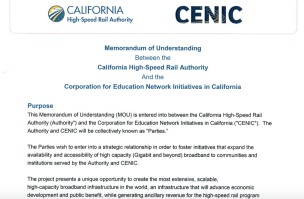
MOU as shown (Nov. 2016) header.
REGARDING OTHER CENIC or “NATIONAL LAMBDARAIL, LLC” referring to a different kind of “rail” with different kind of cargo (the optic fiber kind) images I may include below — these are obviously another story waiting to be posted (here — it’s already posted elsewhere!), consider these footprints and reminders for now.//LGH 10/9/2017

This excerpt of a Form 990 shows Nat’l LambdaRail as a related entity of CENIC, though not the largest one… || … “NLR” has a major, and dramatic though short history, and was purchased in 2011 by a billionaire from its university (public/private) membership. Won’t fit in a single caption. Stay tuned (or look up yourself!)It is a 12,000 mile optic network and the first one to go transcontinental (See Wiki or Bloomberg.com for more; also IO.com)

just web page header.
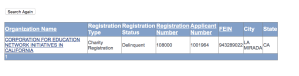
CENIC corporation, California Registry of Charitable Trust (search results page)
These sprang from an unusually-named corporate (nonprofit) visitor to the blog, but in general reflect major themes and turning points in U.S. history, i.e., control of access to the internet, and characteristics of the organizations controlling this access. For the general outline, see my 2017 Table of Contents page, about half-way down, and the bottom section, and the second section of my Oct. 9, 2017 post talking about SIZE STILL MATTERS. …..
WOW: See that image on National LambdaRail, LLC, above? Well: from Wikipedia:
…National LambdaRail was founded in 2003 and in 2004 its national, advanced fiber optic network was completed. In addition to being the first transcontinental, production 10 Gigabit Ethernet network, National LambdaRail was also the first intelligently managed, nationwide peering and transit program focused on research applications.
In 2008, a company named Darkstrand purchased capacity on NLR for commercial use.[1] By the end of the year the Chicago-based company was having trouble raising funding due to the Great Recession.[2] On May 24, 2012 the NLR network operations center services were transferred to the Corporation for Education Network Initiatives in California.[3] In October 2009 Glenn Ricart was named president and CEO.[4] On September 7, 2010 Ricart announced his resignation.[5]
In November 2011 the control of NLR was purchased from its university membership by a billionaire Patrick Soon-Shiong for $100M, who indicated his intention to upgrade NLR infrastructure and repurpose portions of it to support an ambitious healthcare project through NantHealth.[6] The upgrade never took place. NLR ceased operations in March 2014.[7][8][9][10]
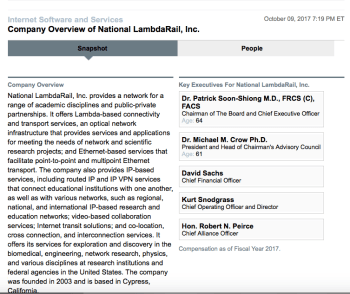
Bloomberg.com on National Lambda Rail. Bloomberg.com gets its data from S&P Global Marketing, part of S&P Global Group (S&P = Standard & Poors, probably)
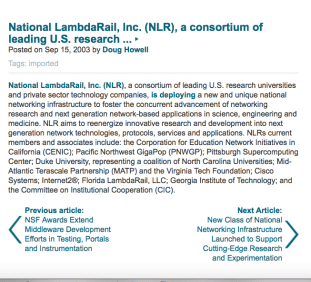
http://internet2.edu/news/detail/3695. Not shown — this is a 2003 article. See Wiki for follow up info on NLR.
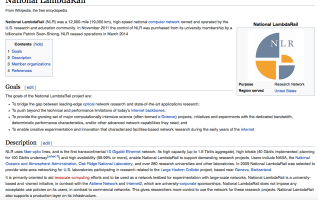
Please click link (or image to enlarge) and read: https://en.wikipedia.org/wiki/National_LambdaRail#cite_note-5
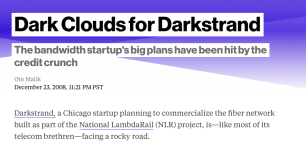
At Bloomberg.com, but can’t read more w/o subscription to “Professional Services.”See more at NLR “Wiki” page.

Internet2® started in 1996 and has a timeline. See website for more info.
Internet2® doesn’t post its financials With offices in these states, perhaps they could be found. If “internet2” isn’t an entity, then some membership organization ENTITY does have financials somewhere…

Found at Internet2.edu home page, blog article Sept. 17, 2017.
Separately, which I know from email news alerts and family court reform advocacy groups’ social media sites, there are also pending “current events” in local (California) “family court reform” news making the rounds which I feel urgent to address in new posts. I have an idea of a better way to present the situation to people new to it (those familiar with it are welcome to watch from the sidelines, or inbetween rallies, re-blogging, or complaints about the overall injustices in the system, judge by judge or jurisdiction by jurisdiction, something I can’t remember the last time I EVER signed onto that approach as halfway sane, or effective, given the disparate resources….). Some of that way is blended into this otherwise more anecdotal, expressive post about the personal backdrop to our so-called problem-solving courts.
I keep hoping to squeeze enough blogging and activism in between my own ongoing, though more periodic, life events which have been incited by the systematic disruption of my household, work and relationships through the family court and now, probate court, systems and self-important, self-congratulating, and overlapping circles of well-endowed and court-AND social-service-systems-connected “fauna and flora.”
That is, just as in any domestically violent relationship, while there may be at times a “plateau” between incidents (events), during which not a whole lot can be done to push them forward (whether through availability, regulations, or simply personal stamina), and then, responding to moves the individual (here, me) might make to change the status quo or resolve the conflict — there’s an escalation, or other way in which “power-over” is communicated. This communication may be first made in private, but sooner or later can be gestured towards (by the abuser) should it go public, “we attempted to communicate with [____].” Communicate in that context is a euphemism. Something WAS communicated — message of intent to continue the dynamic was sent-and-received — but it’s not what witnesses or outsiders are, for lack of tangible substance, or facts in context, unable to do anything other than assume might be meant were both parties above-board and honest. [I don’t know how that last sentence in green may read to others, but I do know what I meant. There are just multiple layers of meaning, and a style of speaking — which I hate! in trying to actually get down to the facts and resolve the situations — which is more theatre than written communication of important truths. It’s for show, but only those closest to the situation and “in the know” about the overall pattern of the relationship in question, realize how fake it is.
So, again, stamina, or consequences, etc. I don’t know how much longer this can be kept up, either the personal fight, or the writing. It worries me, and may be prompting to get what’s done already in order, backed up, and on-line. And it’s no way to live… with constant risk management while resources are drained, year after year.
Moving on….
Blogging Context/Sequence:
“Introducing A New Page… Problem-Solving (‘Collaborative Justice’) Courts…,” (for short) has a case-sensitive short-link ending “-7xs” and is now published.
See next inset block:
[That] page (#28901) I have named: How and When Problem-Solving (make that ‘Collaborative Justice’) Courts were Institutionalized and other Consolidate/Coordinate/Standardize/ PRIVATIZE Stories at Courts.CA.Gov
I was talking on [the] post — NAATPN, Inc (2000ff, Total Current Assets, $0) and Caffee, Caffee and Associates PHF, Inc. (Hattiesburg MS, 2003ff, Total Assets $0, Tax Filings Questionable), and others trying to squeeze a California Race-Based Stop-Smoking Network (AATEN) into that recipe. .. [Published 8/28/2017 evening and as usual may be updated for clarity, basic copyediting, or length (splitting)//LGH] —— about how the 1996ff (PRWORA-related) events overlapped with my current blogging interest, the 1998 (Tobacco Master Settlement Agreement) events, and similarities (not to mention overlap) of involved networking nonprofits, along with the stories told the public omitting the details of Who’s Who and the gradual, (dare I say “progressive” in today’s political climate, but referencing the generic, not political, meaning of the word?) incremental erosion of local or even state-level accountability to citizens living within those state, as opposed to privatized special-interest nonprofits continually telling us all that the same are protecting against other privatized special-interest FOR profits as though these two were unrelated….
Again, the genealogy (so to speak) of that page, includes ITS originating post, on the NAATPN. So, the sequence is from NAAPTN {already published} ==> Page “How and When Problem-Solving..” ==>Post “Introducing New Page” + ===> before I publish either that Page (or the post introducing it), I sequestered my expressive/reflective section “About Holidays” which you are now reading.
The originating post (“Introducing a New Page…”) will contain some lead-in and concluding material from below for a “footprint,” as is my writing style.
Impediments / Other reasons for the delays:
SHARE THIS POST on...

“Clear and Present Danger”…fuzzy usage by AFCC (Publ. Dec. 1, 2009, format Fixes May 7, 2023).
POST TITLE::
“Clear and Present Danger”…fuzzy usage by AFCC (Publ. Dec. 1, 2009, format Fixes May 7, 2023). About 3,000 words.
(Case-sensitive short-link ends “-lD”. First character is lower case “l,” not capital “I” or number “1”.=)
The purpose of my post is to expose how a certain organization, called “AFCC,” which has openly stated it seeks transformative language (from “old” definitions of criminal to newer ones with a sociological flavor) is — as we speak — attempting to co-opt a phrase addressing the danger (to citizens of the state of California) a spousal batterer presents, for its own use.
The law — and we have an elected legislature, right? — is already clear on this. I’d have to affirm, the shoe fits this definition:
[[The LexisNexis Link had expired; I replaced it 2023 with one from eScholarship, which at least give proper citation format, and a few pages of intro. See also (from that link) a nearby 1991 by the same author.
ACTUALLY, I found a link to ones by author Shiela Koehler, not “Donna Wills” (from basic search on the title, including the year and issue number). So link replacement isn’t exactly on target.]]
From 1997, Women’s Law Journal:
Copyright (c) 1997 Regents of the University of California
UCLA Women’s Law Journal
FORUM: MANDATORY PROSECUTION IN DOMESTIC VIOLENCE CASES: DOMESTIC VIOLENCE: THE CASE FOR AGGRESSIVE PROSECUTION
Spring / Summer, 1997 // 7 UCLA Women’s L.J. 173
Author: Donna Wills *
I. Introduction
Prosecutors throughout the country, and especially in the State of California, have begun taking a more aggressive stance towards domestic violence prosecutions by instituting a “no drop” or “no dismissal” policy. 1 Based on my experience as a veteran prosecutor who specializes in these cases, I firmly believe that this policy is the enlightened approach to domestic violence prosecutions. Fundamentally, a “no drop” policy takes the decision of whether or not to prosecute the batterer off the victim’s shoulders and puts it where it belongs: in the discretion of the prosecutors whose job it is to enforce society’s criminal laws and hold offenders accountable for their crimes. The prosecutor’s client is the State, not the victim. 2 Accordingly, prosecutorial agencies that have opted for aggressive prosecution have concluded that their client’s interest in protecting the safety and well-being of all of its citizens overrides the individual victim’s desire to dictate whether and when criminal charges are filed.
Aggressive prosecution is the appropriate response to domestic violence cases for several reasons. First, domestic violence affects more than just the individual victim; it is a public safety issue that affects all of society. Second, prosecutors cannot rely upon domestic violence victims to appropriately vindicate the State’s interests in holding batterers responsible for the crimes they commit because victims often decline to press charges. Third, prosecutors must intervene to protect victims and their children and to prevent batterers from further intimidating their victims and manipulating the justice system.
Timeframe: 1994 — VAWA (and National Fatherhood Initiative) started, and 1998-1999, Congress getting ready to pass more fatherhood resolutions, nationally. This is, again 1997.
Here (already blogged by me) is a section from the Giles Amicus (I believe), describing SOME of the clear dangers domestic violence poses to its targets. Judge for yourself if some of these effects represent danger or not:
[[2023 note: This section is quoting later versions of state law (2004, 2005, therefore is probably from that Giles Amicus. Unfortunately I didn’t fully documented (either a link, now broken, or adequately as to place, date, year and where I found it) this time. Over the years, I got better at citations. So this next would NOT be a quote from the above 1997 UCLA Law Journal. Impossible to reconstruct such old posts 100%, I guess.. An Amicus would be in support of another case; it was apparently well-known at the time, but at the moment I cannot recall even its topic…. That doesn’t change the main point of this post, which was showing that AFCC has different definitions of “Clear and Present Danger” than does the law. Or even what looks (below on this post) an Encyclopedia…//LGH]]
Furthermore, the California Legislature has defined domestic violence to include violent and various non-violent acts, supporting the proposition that victims may reasonably fear many forms of reprisal. Specifically, the California Evidence Code states that domestic violence is “physical or sexual abuse, neglect, financial abuse, abandonment, isolation, abduction, or other treatment that results in physical harm, pain, or mental suffering, the deprivation of care by a caregiver, or other deprivation by a custodian or provider of goods or services that are necessary to avoid physical harm or mental suffering.” See Cal. Evid. Code § 1109 (West 2005) TA \l “Cal. Evid. Code § 1109 (West 2005)” \s “Cal. Evid. Code § 1109 (West 2005)” \c 2 (following the meaning of domestic violence set forth in TA \l “Cal. Pen. Code § 13700 (West 2005)“ \s “Cal. Pen. Code § 13700 (West 2005)” \c 2 Cal. Pen. Code § 13700 (West 2005) TA \s “Cal. Pen. Code § 13700 (West 2005)” ). Additionally, the California Family Code defines abuse as causing bodily injury, sexually abusing a person, or placing a person in “reasonable apprehension of serious bodily harm to that person or to another” and, further, it provides that a victim may obtain a restraining order to protect against the batterer’s non-violent reprisals, such as “stalking, threatening,…harassing, telephoning,…[or] destroying personal property.” Cal. Fam. Code §§ 6203, 6320 (West 2005) TA \l “Cal. Fam. Code § 6203 (West 2005)” \s “Cal. Fam. Code §§ 6203, 6320 (West 2005)” \c 2.
[[2023 interjection: Notice that while describing the PENAL Code Section 13700, it also admits to there being a California Family Code (two completely different sections of the California Code) are entitled, above.]]
Most commonly, a victim reasonably anticipates a physical assault, including sexual assault or even death, if the victim attempts to end a battering relationship and assist in the batterer’s prosecution. In fact, victims are at the highest risk of severe abuse or death when they challenge the batterer’s control in their attempts to leave. Hernandez, 345 F.3d at 837 TA \s “Hernandez v. Ashcroft, 345 F.3d 824, 837 (9th Cir. 2003)” ; see also Martha R. Mahoney, Victimization or Oppression? Women’s Lives, Violence, and Agency, in The Public Nature of Private Violence 59, 79 (Martha Albertson Fineman & Roxanne Mykitiuk eds., 1994) TA \l “Martha R. Mahoney, Victimization or Oppression? Women’s Lives, Violence, and Agency, in The Public Nature of Private Violence (Martha Albertson Fineman & Roxanne Mykitiuk eds., 1994)” \s “Martha R. Mahoney, Victimization or Oppression? Women’s Lives, Violence, and Agency, in The Public Nature Of Private Violence 59, 79 (Martha Albertson Fineman & Roxanne Mykitiuk eds., 1994)” \c 3 (describing the phenomenon of “separation assault” in domestic violence relationships and finding that the majority of domestic violence homicides occur upon separation).
Victims may also reasonably fear serious, non-violent reprisals. For example, a victim may fear that the batterer will abduct or injure the couple’s children. See Town of Castle Rock v. Gonzales, 125 S. Ct. 2796, 2800-2802 (2005) TA \l “See Town of Castle Rock v. Gonzales, 125 S. Ct. 2796 (2005)” \s “See TownCity of Castle Rock v. Gonzalesz, 125 S. Ct. 2796, 2800-2802 (2005)” \c 1 (describing incident in which batterer violated his wife’s restraining order against him, abducted his three children, and murdered them.); see also Maureen Sheeran & Scott Hampton, Supervised Visitation in Cases of Domestic Violence, 50(2) Juv. & Fam. Ct. J. 13, 13-21 (1999) TA \l “Maureen Sheeran & Scott Hampton, Supervised Visitation in Cases of Domestic Violence, 50(2) Juv. & Fam. Ct. J. 13 (1999)” \s “Maureen Sheeran & Scott Hampton, Supervised Visitation in Cases of Domestic Violence, 50(2) Juv.enile &and Family Ct. Journal 13, 13-21 (1999)” \c 3 (citing research that establishes a definitive link between parental child abduction and domestic violence). In fact, twenty-five percent of batterers directly threaten to kidnap the couple’s children if the victim pursues legal action. Buzawa & Buzawa, supra, at 183.
Additionally, because many victims depend upon the batterer for financial support, they may reasonably fear financial ruin or homelessness if they assist the prosecution. A batterer’s control of the victim’s access to money and employment is common in domestic violence situations. Diane R. Follingstad et al., The Role of Emotional Abuse in Physically Abusive Relationships, 5 J. Fam. Violence 107, 109 (1990) TA \l “Diane R. Follingstad et al., The Role of Emotional Abuse in Physically Abusive Relationships, 5 J. Fam. Violence 107 (1990)” \s “Diane R. Follingstad et al., The Role of Emotional Abuse in Physically Abusive Relationships, 5 J. Fam. Violence 107, 109 (1990)” \c 3 . A victim may reasonably fear that, without the batterer’s financial support, she and her children are at risk of becoming homeless. U.S. Conference of Mayors, A Status Report on Hunger and Homelessness in America’s Cities: A 27-City Survey (2004) TA \l “U.S. Conference of Mayors, A Status Report on Hunger and Homelessness in America’s Cities: A 27-City Survey (2004)“ \s “U.S. Conference of Mayors, A Status Report on Hunger and Homelessness in America’s Cities: A 27-City Survey (, December 2004)” \c 3 (citing domestic violence as the primary cause of homelessness in forty-four percent of the cities surveyed).
What do you say? Well, here’s the law (as quoted on my blog earlier)– you can google it yourself:
CAL. PEN. CODE § 273.8 : California Code – Section 273.8
The Legislature hereby finds that spousal abusers present a clear and present danger to the mental and physical well-being of the citizens of the State of California. The Legislature further finds that the concept of vertical prosecution, in which a specially trained deputy district attorney, deputy city attorney, or prosecution unit is assigned to a case after arraignment and continuing to its completion, is a proven way of demonstrably increasing the likelihood of convicting spousal abusers and ensuring appropriate sentences for those offenders. In enacting this chapter, the Legislature intends to support increased efforts by district attorneys’ and city attorneys’ offices to prosecute spousal abusers through organizational and operational techniques that have already proven their effectiveness in selected cities and counties in this and other states.
[Emphases changed, 2023. Notice this is in the California PENAL Code, not civil and not family codes…
(Blogger Opinion based on experience and deduced definition over time (It was my opinion in 2009, this qualifier only added 2023. I believe it’s understood in my (somewhat sarcastic tone) at the time that this was my opinion):
In order to understand family law venue, you MUST understand that part of its primary purpose is that these offenders NOT be convicted or prosecuted. One great way to shut up a parent or a child from reporting is to simply switch custody (or force repeated contact with) an abuser. In war, this is understood as a form of coercion and torture. Yet in our Golden State here, it’s business as usual. How can this be?
“It’s not abuse, or domestic violence, it’s a “high-conflict” relationship. let us “explicate” — at your expense…” (Give me a break…)
How can you explain away a law passed by a legislature?
Easy — a language shift. Co-opt the phrase and apply it to something different, and train — first, your cronies — to adopt the new usage. When said Cronies are practically RUNNING the courts, it’s kind of hard to override them. . . . . But here you are (and I’m almost out of time here. Figure out the rest yourself….).
——————-
AFCC’s explication of “Clear and Present Danger” is running out of money for them. I can certainly understand why these professionals are much more concerned about the COURTS running out of money than the parents litigating in the courts, or — as the US Governors have already stated, domestic violence being a significant cause of homelessness, evidently it includes economic abuse somewhere in there. . . . .
As you may infer, I’m upset about this. With good cause, too. I have uncollectable child support, and the guy STILL isn’t out of my life, although thanks to this system, my own kids are….Like many women, I lost a livelihood fighting this uphill battle, until someone spoke some common sense to me. Well, we are still not done exposing the money trail here. Anyhow, til later . . . .
According to AFCC, the “clear and present danger” is any cessation of the everflowing (cesspool?) of federal funds to the family courts to bastardize the legal process. That’s MY version of it, of course. It kind of does remind one of a toilet that won’t stop running, however….. The water being, public, tax-funded funds with inadequate oversight….
As I showed in a previous post, the brochure even says so:
<!—more—>
Here is the advertisement for this Feb 2010 conference:
California Annual Conference
The Crisis of Under-Funding Family
Court Resources: A Clear and Present
Danger to Our Children
Sheraton Delfina Hotel
Santa Monica, California
February 12-14, 2010
For more information
Here is the graphic, once you click on “for more information.”

Note: co-sponsored by the L.A. County Superior Court. Huh??
Finally, below here, I simply googled the phrase, and pasted a reference and discussion on this phrase. No, I have not thoroughly explored it, but at least this is a discussion of the history of the phrase.
You’d think the assortment of legal professionals in AFCC (there are judges and attorneys) might be interested in more precise language — but they are also hanging out with sociologists, psychologists, and whatnot, and surely the waters are somewhat muddier than they are in the clear law, and the cold hard facts showing up in the newspapers, weekly, daily, and year after year. . . .
Below this, I pasted a “lethality assessment” (Barbara J. Hart, Esq. Google it, it’s well-known. Why can’t we bring this stuff up in a family law case? )
Clear and Present Danger Test (Encyclopedia.com)
[2023 note. This is a very long quote and paragraphing it seems was removed. I quickly added some back in, probably not in the same places. I’m also formatting it for quote, although that’ll make the vertical much longer…//LGH 5-7-2023]
The words “clear and present danger,” first used as a casual phrase by Justice Oliver Wendell Holmes, became an important test for determining whether speech is protected by the First Amendment. Holmes introduced this phrase in Schenck v. United States, a 1919 opinion for a unanimous Court upholding against First Amendment challenges the convictions of socialists who had distributed antiwar circulars to men accepted for military service in World War I.
In explaining why the defendants could constitutionally be punished for violating the prohibition in the 1917 Espionage Act against obstruction of recruitment, Holmes wrote, “The question in every case is whether the words used are used in such circumstances and are of such a nature as to create a clear and present danger that they will bring about the substantive evils that Congress has a right to prevent” (p. 52). Relying on the prevailing bad tendency test he himself had applied in previous cases involving speech, Holmes reasoned that in the circumstances of war these circulars had a tendency to obstruct recruitment.
In Frohwerk v. United States and Debs v. United States, two companion unanimous decisions that also invoked the bad tendency of antiwar speech in affirming convictions under the Espionage Act, Holmes did not mention clear and present danger. Even though Holmes used the phrase “clear and present danger” only in Schenck and relied on the bad tendency test in all three opinions, Zechariah Chafee, Jr., then a young professor at Harvard Law School, soon wrote a law review article claiming that Holmes intended the clear and present danger test to make “the punishment of words for their bad tendency impossible.”
As Justices Holmes and Louis Brandeis rapidly became more sensitive to the value of free speech during the “Red Scare” following the war, they found it useful to rely on Chafee’s misconstruction of clear and present danger in Schenck to express their developing views without repudiating their prior decisions. From the dissent by Holmes in Abrams v. United States (1919) through the concurrence by Brandeis in Whitney v. California (1927), Holmes and Brandeis elaborated the meaning of clear and present danger in ways that transformed it into a First Amendment test providing substantial protection for dissident speech. Most significantly, they infused an immediacy requirement into the clear and present danger test that precluded punishment of speech unless it imminently threatened an illegal act. Brandeis’s concurrence in Whitney, moreover, belatedly responded to the majority’s assertion in Gitlow v. New York (1925) that both the bad tendency test and the clear and present danger variant apply only “in those cases where the statute merely prohibits certain acts involving the danger of substantive evil, without any reference to language itself” (p. 670).
A statute that itself defines speech as criminal, Brandeis insisted in Whitney, is also subject to judicial review under the clear and present danger test. The Supreme Court majority continued throughout the 1920s to apply the traditional bad tendency test and did not refer to clear and present danger when it first overturned convictions on First Amendment grounds in the early 1930s. From the late 1930s to the early 1950s, many majority decisions did rely on the clear and present danger test previously developed by Holmes and Brandeis to protect speech in a wide variety of contexts, and the Court never referred to clear and present danger in decisions that denied First Amendment claims.
Yet at the height of Cold War fear about a communist conspiracy, the Court in Dennis v. United States (1951) removed the immediacy requirement and accepted Judge Learned Hand’s reformulation of the clear and present danger test: “whether the gravity of the ‘evil,’ discounted by its improbability, justifies such invasion of free speech as is necessary to avoid the danger” (p. 510). Applying this new standard, the Court upheld the convictions of eleven Communist party leaders for conspiring to advocate the violent overthrow of government (see Communism and Cold War).
Since the Dennis decision, the Supreme Court has largely ignored but has not entirely abandoned the clear and present danger test while developing different doctrines to analyze a proliferating range of First Amendment issues. The clear and present danger test may have resurfaced in the Court’s 1969 per curiam opinion in Brandenburg v. Ohio, which reversed the conviction of a Ku Klux Klan leader under a state statute prohibiting the advocacy of criminal syndicalism.
In an abrupt holding accompanied by scant and unconvincing analysis of prior decisions, the Court declared that “the constitutional guarantees of free speech and free press do not permit a State to forbid or proscribe advocacy of the use of force or of law violation except where such advocacy is directed to inciting or producing imminent lawless action and is likely to incite or produce such action” (p. 447). Several scholars have interpreted this passage, although it does not contain the phrase “clear and present danger,” as combining the immediacy requirement derived from the Holmes‐Brandeis opinions with a further requirement that speech constitute an incitement to illegal action.
The Court has not subsequently elaborated its analysis in Brandenberg and has applied it only infrequently, leaving its meaning uncertain, particularly in contexts other than subversive advocacy. See also Speech and the Press. Bibliography David M. Rabban , The Emergence of Modern First Amendment Doctrine. University of Chicago Law Review 50 (Fall 1983): 1205–1355. David M. Rabban
(I believe this is also part of the same quote, but am not sure.//LGH 5-7-2023).
[[I realize the link to AFCC usage (2010 conference) is broken, which is the point for my post, but fortunately nearby posts (i.e., also from Dec. 2009) have posted much of the brochure’s contents (listed at the time as “Upcoming 2010” with their Speaker bios. Use Calendar Widget to browse Dec. 2009 posts by date.]]
LETHALITY ASSESSMENT SHOWS THESE CLEAR AND PRESENT INDICATORS OF DANGER:
Predictors of Lethality Include:
- Threats of suicide or homicide including killing himself, the victim, children or relatives.
- Fantasies of homicide or suicide in the guise of fantasizing “who, how, when and/or where to kill.”
- Weapons owned by the perpetrator who has threatened to used them or has used them in the past (the use of guns is a strong predictor of homicide).
- Feelings of “ownership” of the victim.
- “Centrality” to the victim (idolizing and extreme dependence).
- Separation from the victim (this is an extremely dangerous time when perpetrators make the decision to kill).
- Dangerous behavior increases in degree with little regard for legal or social consequences.
- Hostage-taking
- Depression
- Repeated calls to the police.
Lethality assessments are more an art than a science and cannot be considered precise by any means. They are not a tool for certain prediction, but rather one for risk assessment and safety planning or intervention. Social service providers should error on the side of caution and inform their clients that any abuser can potentially be lethal.
Blogger note. I might put (a little) more time into reformatting this and nearby posts, but after several tries, with detailed html code revisions, I find they are not being saved when I hit “Save” so, for now putting extra time into that project is “counter-indicated” until I find out why, or use a different input device (my full-size laptop is down for a month or so recently).
POST TITLE (To go back to the top of this post, click on it);
“Clear and Present Danger”…fuzzy usage by AFCC (Publ. Dec. 1, 2009, format Fixes May 7, 2023). About 3,000 words. (Case-sensitive short-link ends “-lD”. First character is lower case “l,” not capital “I” or number “1”.=)




 Let's Get Honest! Absolutely Uncommon Analysis of Family & Conciliation Courts' Operations, Practices, & History