Posts Tagged ‘NACC-CAI- First Star (connections: see also Sherry Quirk & Eileen King)’
Child Justice, Inc. , First Star, Inc., and the Tennessee Valley Authority — All in the Family? (Eileen King, Sherry Quirk) (Child Advocacy + Energy Law). [Begun Feb. 9, Moved Here Mar. 30, Publ. Apr. 29, 2022].
In this post, “NSPC” represents the website National Safe Parents Coalition which became active shortly before February 9, 2022 — it seems to be February 4 — obviously timed as something to refer to and publicize an VAWA reauthorization testimony featuring Angela Jolie and others, and (yet another) law named after a needlessly murdered child. This time, this law was named after Kayden (but the website references others, which I have posted recently also). (VAWA Reauthorization 2022).
No post on the NSPC with the goal of sharing drill-downs on its claimed membership, that is those on display as logos with links would be a short post. I’ve been whittling it down by sections, while continuing to research, post, write, and where I can stay engaged in social media on these themes. My last few posts have diverged a little, but not too far, as they tie into one of the partner websites of NSPC.
It’s been taking weeks, sometimes over a month, to get these out, and is quite stressful to see what I know to be “fake advocacy” and diversion from following the economics by the loudest (most public) actors involved in the campaigns. Two centers at two different law schools are supporting the agenda, with the entourage of protective parents organizations (one, so delinquent and status-suspended for now legitimate reason, it’s embarrassing), and a nearly two-decade-long conference which still isn’t incorporated, vaguely refers to a nonprofit it’s part of, but doesn’t identify it (referring to the Battered Mothers’ Custody Conference), along with an entire administrative networks along two or three lines only: resource centers (DVRN) and state coalitions against domestic violence all claiming concern about it and responses to it.
Today is April 29, 2022. I am about to be “off” blogging for a while (household move upcoming, major logistics involved), and in looking for which of these drafts to put out next, I chose this one begun February 9th! That soon after the activation of the NSPC website tells you its high priority — but it was not an easy explanation, and so has waited.
Child Justice, Inc., First Star, Inc., and the Tennessee Valley Authority — All in the Family? (Eileen King, Sherry Quirk, Child Advocacy + Energy Law). [Written Feb. 9, Moved Here, Mar. 30, , Published Apr. 29, 2022]. (short-link ends “-e4O” –> final character is capital “O” as in Ohio). As published (before any revisions), about 5,200 words only.
The information may not be commonly known; I only found it (several years ago) from excessive curiosity on how things work, and what was driving the strange, ritualistic behavior of certain people and organizations.
There were a few other honorable mention (drafts in the pipeline) and I’d also considered (and still recommend you use archives to review), six years old now, what I laid out in a series of posts during March, 2016. I went back and cleaned up the appearances of those posts. In doing so, I found about twelve more I’d written during the same time frame.
I want this information out, and understood — the situation we are dealing with (“We” because VAWA was reauthorized with the alterations to “incentivize” states to do better at keeping kids safe IN the custody courts, and if you’re in the USA, that includes you.. If you’re not and think this is a legitimate or responsible action by us, you’re deluded.).
These movements have affected a major part of my own prime working years, and of course relationships with adult children, by effectively turning as many people as possible in power aside from a rational cause of what’s driving poor judicial decision-making into one which better suits those who wish to profit from exactly that. Read my definitions of “hierarchical” below, which was the first term which came to mind in describing the situation, overall.
~~>This post is about a specific portion, one of the “members” of NSPC. It’s a short post, not hard to read, but you need to think about it for the impact to sink in.
~~>Because of my housing situation, I’m not going to polish it, add transitions, or babysit readers to show them what A + B + C + D add up to. I may (maybe) come back and do that in a few weeks. Questions are welcome, here (there is a comment option for every post), or if on Twitter, include short-link and date published, at least part of the title if you want an answer from me, or where more answers may be found.
If you consider what I just did in a quick run-down on NOW Entities (4/28/2022) or, did in part (“Table Talk on Task Forces,” 4/26/2022), that’s the kind of work that could/should be done with the tax-exempt entities mentioned here (First Star apparently has more than one now). Get to the Tax Returns.
But this one, beyond that, ask (yourself) some hard questions: WHY are these people pushing this agenda? How is it that on both the east and west coast** of USA, leadership with very close ties to and background in the energy / utilities provision industries are so into helping vulnerable children / foster children/ cleaning up the family courts through more training, featuring all the murdered and abused children / talking constantly about ritual child abuse (CPPA et al.), and soliciting — all these years — case information from traumatized mothers, and using that to get laws passed to (allegedly) fix the situation?
**For the energy part, Child Advocacy Institute, see also background of Robert Fellmeth, who has or at least had connections to First Star also. Below, I’d blogged earlier in some detail; links and partial quotes are below.
I’d be interested to see what conclusions others come to after asking some hard questions: Again, WHY doesn’t NSPC choose to file for business entity / membership organization status up front? Why put out numbers it can’t back up as to how many members, and much more.
(WHY is it so necessary to have people in power already (see “TVA”) steer the futures of those who are not?)
THIS POST IS:
Child Justice, Inc., First Star, Inc., and the Tennessee Valley Authority — All in the Family? (Eileen King, Sherry Quirk, Child Advocacy + Energy Law). [Written Feb. 9, Here, Mar. 30, 2022]. (short-link ends “-e4O” –> final character is capital “O” as in Ohio).
A post on the NSPC became necessary the moment it surfaced. There are still some “survivor mothers” (fka battered mothers) out here who don’t believe in and don’t join cults like this one, and while we’ve lost a lot, haven’t yet lost our minds… or powers of observation as campaigns develop. I happen to specialize in rapid-fire drill-downs of the new, and an elephant’s memory (and I take notes) of existing tax-exempt entities known to have impacted, or attempted to impact, negatively and needlessly, my and my own offspring’s safety and prosperity, tax-exempts specializing in demographic and profiling terms we happen to match. (single mother, noncustodial mother, domestic violence survivor, “protective parents” in the family court (that last — “give it a break!!”), etc.
The (reference deleted: think bovine excrement) never stops, it just gets repackaged and piled higher, spread wider, too.
SHARE THIS POST on...

Communities In Schools Model (When You Hear This Rhetoric, Go Find Those Tax Returns!) From Oct. 17, 2016: Feb 2018 Intro on Continuing Relevance of Awareness of CIS and Related Models [Publ. Feb. 23, 2018].
Communities In Schools Model (When You Hear this Rhetoric, Go find those Tax Returns!) From Oct. 17, 2016 (short-link ends “-8Fb”; moved here 2/17/2018. Hate to waste all that earlier work by not publishing it!)
Extended Version of Title, same link: Communities In Schools Model (When You Hear this Rhetoric, Go find those Tax Returns!) From Oct. 17, 2016: Feb 2018 Intro on Continuing Relevance of Awareness of CIS and related models. Currently about 11,400 words.
The term “Communities in Schools” represents a national nonprofit and its similarly-named affiliates, although these are NOT considered “related organizations” at the tax level. To its credit its recent tax returns or financial statements are posted at its main website under the link “Financial Information.” I posted tax returns for the national organization and at least a few affiliates at the bottom of this post. I was interested that the national organization increased its “Total Assets” by $5M over just two years, to $56M, for the year ending 2015, and that (on a more recent website check) its mostly-male board of directors did have six women, including the former First Lady of Texas, and other powerhouses. (Shown with the bio blurbs below the “affiliates” map image.)
Here’s a recent Map from their “affiliates” page of “Where we are” for a general concept. Note: having an entire US State colored in doesn’t necessarily reflect how much of a presence (or what size operations, how many schools they’re involved with — or in fact, much other than a location) throughout that entire state. And there are some “multi-state” affiliates listed.
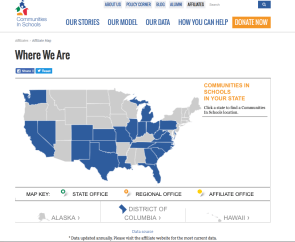
Interactive map. For a list, see Affiliates page. Interesting what sections of the country it is NOT in… Map is interactive on the website, not this image.

Image #1 of 3, CIS Bd of Directors (incl. 2 of 3 “National leadership” — Wynn & Milliken but not Erquiaga also) alpha by last name, as thumbnail photo directory. Wynn & Erquiaga both functional or previously IN public education in NEVADA. But this National entity is legally domiciled in Georgia (which I note has many affiliates) with a Virginia (i.e., closer to W.D.C.) address.
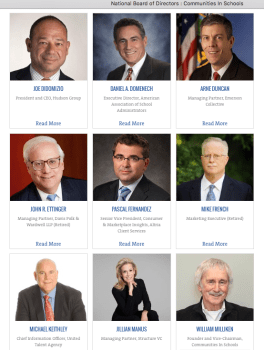
Image #2 of 3, CIS Bd of Directors (incl. 2 of 3 “National leadership” — Wynn & Milliken but not Erquiaga also) alpha by last name, as thumbnail photo directory.
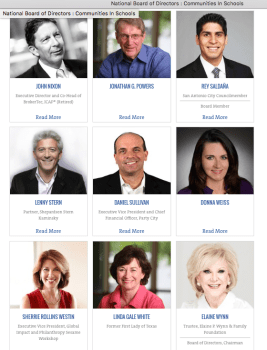
Image #3 of 3, CIS Bd of Directors (incl. 2 of 3 “National leadership” — Wynn & Milliken but not Erquiaga also) alpha by last name, as thumbnail photo directory.
Communities In Schools, Inc. (national) board of directors each has a bio blurb. Out of 24 total (incl. former Educ. Secretary under Pres. Obama, Arne Duncan; above three images), here are the six women so privileged in slideshow format (some bios may take two — Chairman Elaine Wynn’s takes three — images):
 Interesting while the FY2016 and FY2017 audited financial statements are posted, no tax return past FY2015 (Fiscal year ending Sept. 30, meaning, now (Feb. 2018) that’s considerably “odd.” Also, the latest tax return says financials are “available upon request” when they are made available (except tax return for 2016, so far) on the website. Also while the tax return specifies only “children in schools” it’s clear from the website that, children in poverty, esp. children of color, is the “issue” and this nonprofit’s main focus.
Also, unspoken but fairly obvious, “Schools” is a subset of all legal schools within the country, and seems to mean PUBLIC schools; where poor kids are mostly warehoused…except those that have somehow broken out and gotten scholarships to better educational situations… (Keeping in mind that charter schools are still public, not private).
I’d like to raise certain financial issues up front here (for example, how the most recent available (FY2015) tax return shows “Gross receipts” $40M+ but Revenues less than half that, which were overspent, too. Why such a difference was found on “Statement of Revenues” which showed $25M of securities sold for $26M+ — i.e. at a loss. … Then there’s the matter, showing in Form 990 Part XI (Reconciliation of $$ differences between tax returns and audited financial statements) a $56M “Donated Services” reported as shown on the FS but NOT on the tax returns (for an organization reporting total assets of $56M at year end on the tax return. Turns out that $56M “Donated services” were in media, and from one of its major subcontractors, Causeway Agency. Having received the $56M, they simply expensed out the exact same amount (an accounting tactic?) on the FS).
I have decided against putting together the exhibits up top. See their “Financials” page for the links. This is fascinating, but for later. Except the following image gallery(!)
SHARE THIS POST on...

Parades, Charades and Facades — Mother’s Day and Beyond
[about 3,200 words, plus a section on the Guggenheim Family and Foundations = about 3,000 more, making it about 6,000 words… It links to post on another of my blogs “The Family Court Franchise System,” quoting parts of it here. As I often do, the original writing is closer to the bottom of the post, and the top part is context. I brought in the philanthropy examples in preparation for specific situations in upcoming posts, and not just in a random reference.]
Seeing as it’s almost Father’s Day, I thought it was time to put out a post inspired this past May, 2014, on Mother’s Day, after revisiting one I’d drafted on a different but related blog in 2012. The basic dynamics it described haven’t changed.
Along the lines of the recent post Accounting Literacy Matters. Cause-based Literacy Doesn’t (even though it’s dealing with a different topic), I then looked again (hindsight sure does help) at some of the players helping compile various Judges’ or Attorneys’ ToolKits” which, I guess, we are to hope might function as some magic wand, or special panacea, if waved around in hearings for custody and visitation matters after having separated because of domestic violence, or for general knowledge.
Excerpt, and basically about:
“How California Protective Parents Association Doesn’t — and Why“
It was drafted in 2012, and finished, of course, supplemented, in 2014. Related “exhibit”
The fine print (footnotes) to that sheet revealed “good cop/bad cop” discussions in one put out by the ABA Commission on Domestic Violence. As usual, taking a second look leads to more information about who’s been backing all the policy studies, for example the Harry Frank Guggenheim Foundation *backing a well-known social scientist at the University of Pennsylvania, who also turns out to be AFCC-friendly:
*Harry Guggenheim established this foundation to support research on violence, aggression, and dominance because he was convinced that solid, thoughtful, scholarly and scientific research, experimentation, and analysis would in the end accomplish more than the usual solutions impelled by urgency rather than understanding. We do not yet hold the solution to violence, but better analyses, more acute predictions, constructive criticisms, and new, effective ideas will come in time from investigations such as those supported by our grants.
The foundation places a priority on the study of urgent problems of violence and aggression in the modern world and also encourages related research projects in neuroscience, genetics, animal behavior, the social sciences, history, criminology, and the humanities which illuminate modern human problems. Grants have been made to study aspects of violence related to youth, family relationships, media effects, crime, biological factors, intergroup conflict related to religion, ethnicity, and nationalism, and political violence deployed in war and sub-state terrorism, as well as processes of peace and the control of aggression.
[from “FAMILY” hyperlink on the site ] All men are not violent, and all violent men are not alike. We encourage more research into typologies of violence and the implications for treatment of distinguishing different types of batterers. However, explanations for spouse abuse must also recognize that two people contribute to a dysfunctional marriage, and the dynamics of family relationships should be explored to understand family violence more completely. The ways both masculinity and femininity are understood in particular cultures should be explored in order to explain how male dominance and marital violence are “normalized” in different and similar ways across cultures. …
Does that not shed some light on why certain people would rather study domestic violence perpetrators and batterers than actively separate them from their victims, PERIOD, sending a public policy message to others that this is socially unacceptable? And why some are prone to publishing where the grants money is (“let’s characterize batterers and provide and evaluate treatment interventions”) than expecting it to stop by separating the batterer from the battered, as a deterrent, and sending a message that it’s completely unacceptable? (including if women are perpetrating….)
Read the post to find out which Pennsylvania sociologist I’m referring to.
Would I have known this if I didn’t look behind the rhetoric? NO. I read. I never heard of “Harry Frank Guggenheim” foundation, although the Guggenheim family are well known as philanthropists. Harry Frank (1890-1971) was born into this family of eight sons and wealth from various industries, especially smelting.
The Guggenheim Family (Jennifer Schaub, Grand Valley State grad student, 2005):
The Guggenheim Family left a strong mark in the industrial smelting industry of the early 1900’s. By 1918 Forbes reckoned that the Guggenheims were the second richest family in America (Kaufmann 2004). However, they are more widely remembered as a long line of philanthropists. Five key philanthropists have emerged from this extensive family. By creating a series of foundations, the family is credited for promoting the development of individuals {{??}} by funding research and the development of scholarly thought. . . .
Historic Roots
Meyer Guggenheim (1828-1905) was a tailor of Swiss-Jewish decent who immigrated to the United States in 1847 (John Simon Guggenheim Foundation, Oppenheim, 2002). He and his wife had eight sons. Meyer created the family fortune in the late 19th century beginning with 300,000 from an investment in railroad stocks (Oppenheim, 2002). From there he moved to importing Swiss embroidery and then eventually into the production of metals including silver copper and lead (Infoplease, the John Simon Guggenheim Memorial Foundation). Meyer started the Philadelphia Smelting and Refining Company, and eventually took over American Smelting in 1901. At one time the Guggenheim family was said to control 31 industrial, import, and farming companies in the US and abroad (Wooster, 2005) ….
Daniel Guggenheim (1856-1930) was credited for shaping much of the family business; he combined and presided over, the Guggenheim and American Smelting companies. Solomon Robert Guggenheim (1981-1949) was also active in the family business creating mining strong holds most notably in Colombia (The John Simon Guggenheim Memorial Foundation). Simon Guggenheim (1867-1941) was for a short time, a Republican Senator for Colorado, and the chief ore buyer for family factory. He worked in Colorado for a number of years overseeing the Leadville mines (American Israeli Cooperative Enterprise)….
Harry Frank Guggenheim (1890-1971) was the son of Daniel Guggenheim. Harry fought in two world wars and was the ambassador to Cuba from 1929-1933. Harry was also the co-founder, along with his wife Alicia Patterson, of Newsday Magazine (Newsday.com).
Peggy Guggenheim (1898-1979), the daughter of Benjamin, was an art collector and gallery owner. Noted as one of the most important art patrons of the 1930s and 40s. She owned and operated 3 galleries in the US and Europe. Her New York gallery, Art of This Century was one of the first to show such artists as Rothko, Pollock, Dali, Moore, and Brenton (The Solomon R. Guggenheim Museum).
Importance
As a philanthropist, Daniel Guggenheim is best known as an aviation pioneer. Along with his wife Florence, and their son Harry, Daniel Guggenheim created the Daniel Guggenheim Fund for the promotion of Aeronautics in June 16, 1926 (Wooster, 2005). While the fund was operational, it invested 2.6 million for the creation of aeronautical schools and research centers at 11 different universities. By conducting competitions to create innovations, and funding the research of individuals, projects sponsored by Daniel Guggenheim are said to have increased the safety of Aeronautics …
[para. out of order]
- Robert H. Goddard (1882-1945) was a physics professor whose contributions to rocket science included a rocket that could travel in a vacuum, and one of the first high altitude rockets. For these and other aeronautical innovations, Goddard has been named one of Time’s 100 Most Important People of the Century. Goddard’s research was funded by Harry Guggenheim for 4 years and the Daniel and Florence Guggenheim Foundation for 11 years (Kluger).
Although Harry Guggenheim also financially contributed to the Daniel Guggenheim fund he began his own foundation, the Harry Frank Guggenheim Foundation, which was formed to contribute critical thought and analyses of the world issues of violence and conflict (The Harry Frank Guggenheim Foundation).
Solomon Guggenheim began collecting non-objective paintings in 1929, and began the Solomon R. Guggenheim Foundation to purchase and increase the appreciation of modern art. After beginning to amass a large collection, Solomon began plans to create the Solomon R. Guggenheim Museum in New York Solomon died before his project was complete and Harry Guggenheim saw to the completion of his Uncle Solomon’s dream (The Solomon R. Guggenheim Museum).
[[…Also the Guggenheims, or their foundations, funded: composer Aaron Copland, artist Jackson Pollock [“American Abstract Expressionism”] , and Charles Augustus Lindbergh.]]
[…obviously this is just a sampler of information …]
The world we now live in has been vastly influenced by industrialists of last century; of the late 1800s and early 1900s. Some of them were challenged on their monopolies and faced anti-trust actions; any biography of such families shows how they acquire their wealth, diversify often, and set up major foundations, in part as great public relations (sometimes necessary considering how the wealth was acquired), and in return for this, get to restructure the world and institutions we live in — because their wealth and influence enabled them to.
When it comes to a MAJOR aspect of the family courts, ordering treatment for abnormal or violent behavior (or, originally, to avoid divorce) — we can see today that many of the professionals and professors of course owe their studies, and sometimes the centers or institutes, or even schools at which they teach and research — to philanthropists.
We should be looking at this. When I saw this connection, I better understood what’s the fascination with “treating” everyone, including “batterers,” and families. It makes NO sense to me to continue dialogues “pretending” the professor/researcher classes are not themselves funded by either private foundations, or government grants, or both, and that we are all on an equal playing field when it comes to setting major policies in the courts, without discussing the power and money behind them — and the power of private wealth to direct public policy.
FOR EXAMPLE — in SAN DIEGO, and regarding GALs:
In the field of Child Welfare Law — here’s an example. The group “Children’s Advocacy Institute,” which I will post on shortly — has influenced family courts through, with others, pushing for more “counsel for the child” in contested custody cases, a.k.a., adding GALs wherever possible. Previously, the same professor was NOT interested in family or children’s issues at all, but instead public, environmental, energy (utility) laws.




 Let's Get Honest! Absolutely Uncommon Analysis of Family & Conciliation Courts' Operations, Practices, & History