Archive for July 2017
Who? (Besides Harvard, MIT and Other Boston-area Institutes) is Funding and Promoting/Soliciting for Personal Genomics (volunteer your personal, identifiable, genetic code for the PGP, a global database to be shared internationally) — GET Research (fine-tuning and equipping the Nature vs. Nurture debate) as Essential for Global Public Health? (publ. 7/31/17)
Who? (besides Harvard, MIT and other Boston-based Institutes) is Funding and Promoting/Soliciting for Personal Genomics (volunteer your personal, identifiable, genetic code for a global database to be shared internationally) — GET Research (fine-tuning and equipping the Nature vs. Nurture debate) as Essential for Global Public Health Issue? (title’s short-link ends “-7m3”; published 7/31/2017)
[ “MIT” added to the title at some point, but not the internal record of the title. With MIT’s involvement with both the Broad Institute (named on its corporate papers in MA) and the Whitehead Institute (which calls itself independent, but uses “MIT” in its website URL(!)), it’s “not just Harvard.”
Well, just the other day I learned more about one of the terms in the post title in the typical way — while updating one post, referring to one website in passing, I took a second, closer look at other parts of the website (“conferences” link), which revealed both the GET conferences and the name of a nonprofit sponsoring them. That’s how “GET” and “PersonalGenomes.org” came up to my attention.
So, in this post expect to hear about:
~|~ PgEd.org ~|~ PersonalGenomes.org/Open Humans Foundation ~|~ the GET conferences ~|~ “volunteer your personal genetics” solicitation as a recurring theme ~|~ (leaving aside the Broad Institute for a while) more on the Whitehead Institute for Biomedical Research (“Whitehead Institute”) ~|~ and Treatment Advocacy Center (“TAC”) associated with the Stanley Medical Research Institute (“SMRI”) ~|~ Which of the above have (as it applies) boards of director personnel, funders and/or it seems, well-coordinated purposes in common.
~|~ And several images + a table tax returns, because of their support of the Human (and “Personal”) Genome Project, the Coriell Institute for Medical Research (formed 1953, it says, in Camden, NJ). They provide the Biobank, cell lines (and more), funded by, currently it says, seven NIH awards.
I talk about and show some of their financials, and how at least one them went to special efforts NOT to show them, at least on the main website while promoting its cause, scientists, research, and outreach (and soliciting more support, preferably $10K at a time or more). I took a short enough (hopefully) look at the source of Whitehead wealth in the sale of the clinical diagnosis instrument company (“Technicon”) to Revlon in 1980, and what happened to Revlon not long after — because it’s interesting, and relevant.

When and Where? Of these, PersonalGenomes.org/Open Humans Foundation and The Whitehead Institute (“WI.MIT.edu) are in the Boston area (although one of their legal domiciles isn’t in MA but NC) and PgEd.org web page gives contact address at Harvard Medical School Dept. of Genetics (PgEd.org doesn’t appear to be a separate entity), SMRI is in Bethesda MD, TAC which SMRI supports, is in Arlington, Virginia, and the Coriell Institute in NJ (website + tax returns don’t match).
The oldest entity in the list (until I added Coriell to it!) seems to be the Whitehead Institute, (<= EIN#061043412, that’s a link to an older Form 990, which I’ll show below, at Nine Cambridge Center, Cambridge MA)(website says 455 Main now) started in, says its Form 990, 1982. SMRI (per tax return) started in only 2001, and, which is interesting, the TAC, three years earlier, 1998. Coriell started in the 1950s..
In this post, you will also hear about two more entities who have worked side-by-side for decades to shape government-sponsored research in particularly cancer (smoking cessation), heart disease, biomedical research into genetics, and to push for more and more NIH funding:
~|~ Research! America (est. 1989), and ~|~ the Albert & Mary Lasker Foundation (it seems 1974)
Briefly, how they came up.
When the Whitehead Institute’s famous founder is looked at, and through basic Google search on my part (I didn’t know who he was…), this also brings up his participation/founding of Research! America (inc. 1989, a VA-based entity with a D.C. legal domicile — and apparently some legislators (or at least “Hon.’s”) on its board over time)*, with its push for doubling NIH funding for biomedical research in five years, and in general PR for BioMedical Research (incl. on stem cells) as a public and global health benefit.
I put that discussion (several annotated images from its timeline) towards the bottom of the post, but it will pull together, I believe other parts of the narrative in a timeline. The website gives a timeline of events, and shows how many other foundations (incl. Bill & Melinda Gates, Robert Wood Johnson, and others, and not a few Congressmen, were involved, and spinoff organizations (at least two 501©4s) in pulling this off. Where I found this information was on a multi-page, all-text, highly linked (although some have expired) and detailed tracking of networked families, companies and foundations, especially related to the anti-smoking campaign (American Cancer Society), America Heart Association, and pushing money towards biomedical research. I spent hours (in fact, a full work day just reading, not writing) looking at this after the first exposure nearly a week ago, when I looked at certain parts of it.
It challenges the paradigm — the public promoted website purposes– but in the process uses some volatile and at times offensive language (bilge, shucksters, Nazi fascism of the health system, pseudoscience and more), BUT it also resonates and as an interpretation makes sense with information outside the website, and my strong gut instinct that some things are drastically wrong with the overall picture. It definitely got me looking further, and more understanding on previously covered topics, as well as on new ones. I have a title (short version, long version) and a start on that write-up (post in draft status Now Published), at:
First, shorter title:
About the Anti-Smoking Campaign and its Backers from “SmokersHistory.com” (started 7/31, published 8/5/2017, case-sensitive short-link ends “-7na”
Why I’m including it better reflected in the longer title, still a WIP (Work In Progress):
Much as I enjoy looking at the detailed and colorful photos of cells, or hearing about the discoveries in scientific fields, including genetics…and in part because of the prominence of the Whitehead Institute (and with it, Edwin C. Whitehead, his surviving son John, and other siblings till on the institute’s board of directors (Susan, Peter), I still feel responsible to bring up alternate views of both the above organizations, and their founders’ (and friends’) overall purposes, and how they achieved them.
* (by recall from review of the Research! America returns)
- the Hon. Paul G. Rogers (d. 2008)
- the Hon. John Edwards Porter
- the Hon. Louis H. Sullivan
- not to mention also former US Surgeon-General, C. Everett Koop.
About Whitehead Institute (pausing to note its website is at MIT):
Whitehead Institute is based at MIT,** but as a separate nonprofit; famous originally for its major contribution to the Human Genome Project.
**Notice MIT’s “About” page (READ!!) mentions the Human Genome project and CRISPR, also its summary of current initiatives and projects, and estimate of $1.9 trillion annual revenue generated by its alumni (over 130,000 — MIT started in 1861 –). That was a 2014 estimate. )
Current research and education areas include digital learning; nanotechnology; sustainable energy, the environment, climate adaptation, and global water and food security; Big Data, cybersecurity, robotics, and artificial intelligence; human health, including cancer, HIV, autism, Alzheimer’s, and dyslexia; biological engineering and CRISPR technology; poverty alleviation; advanced manufacturing; and innovation and entrepreneurship.)
So Whitehead Institute’s location within MIT as a free-standing 501©3 school is a very big deal!)
Another on-line source referencing Mr. Whitehead’s work mentioned the Albert & Mary Lasker Foundation (est, 1974?) as involved in some of the same politics and public health promotions (although around a different cause), so within the past few days, I was also looking at its website, board of directors, and you betcha, tax returns.
BLOGGING CONTEXT/TIMELINE ON THESE TOPICS:
Over time and two related (but not consecutive) FamilyCourtMatters.org posts I have shown several of these institutes’ (entities’) tax returns in table format, so people might see: Total Assets, State, and (if they clicked through) on page 1 of any individual return, (for Form 990 filers, and only FY2008ff for them — Form 990PFs for private foundations don’t show this, or Form 990EZs…) a year of incorporation and related website if identified on the Form990’s header info.), and quickly (from page 1 summary) whether its main revenues were contributions, program services revenues, or something else (such as investment-related income, whether from dividends or sale of assets at a profit). In general this locates any organization in time, space, characteristics and size, activities as told the IRS (not the public) including whether it bothered to follow IRS form instructions. It also reveals if looked at further, or earlier returns are checked out, subcontractors, if there are grantees, related organizations, and where they are holding their assets.
The two related posts (I’ll link to these again further below, in the same format):
These are my most closely related recent posts: #1 posted 7/23 and updated 7/24-76:
With similar, multi-component title reflecting how many components (institutes, websites, elements) there are to these situations, although two university names continue to come into play: Harvard, and UCBerkeley, #2, posted 6/18/2017:
…..And of course, MIT (Massachusetts Institute of Technology)
Whitehead Institute
Just one of its tax returns gives several points of reference you won’t find on “Wikipedia,” or most likely analyzed on its own website. Patience, please! with a bit of tax return show-and-tell. These “factoids” shown from Forms 990 provide a series of good mental “memory tags” helpful in putting time, size and place on any organization points of comparison (like an “LCD,” lowest common denominator) relative to other institutes/nonprofits and its position relative to public funds.
- Without objective, basic “quantifiable” points of comparison outside the self-descriptions on the websites, or personal knowledge (eyewitness) experiential information of the programming or professors, directors (etc.) of ALL members of the entities working the field, how can they be understood, outside of hearsay and PR? They are not “the whole story,” but they give all other stories a basic structure. “Read my lips! Read the 990s!
- WITH such points of comparison, there is at least a basis for conversation or discussions with people who may not share common experiences, or outside one’s professional niche/s or “expertise.” It’s a descriptive, vital language (including vocabulary) for transmission of meaning across time and distance. It helps with categorization and understanding of reality — including the reality of public economic support of private infrastructure. This language is apparently NOT meant for common understanding across the US population. Instead, we are often given promotions and propaganda to justify public policy and the costs. (This point added post-publication during a review).
- What’s in common with other for-profit industries working with the organizations towards a global or public health goal? For assembling any concept of who’s been doing what, and to a degree, how (financially) and under what cause (which any public (vs. private foundation) 501©3 must state as its program purpose, that is, reason for existing in the first place), getting to the tax returns before the website rhetoric cannot hurt.
- One thing I also tend to notice on any “for the public good” organization website is how forthcoming is it about its own financials (especially the 990s) as opposed to advertising “G&S” (Goods & Services) and soliciting donations or participants, i.e., selling.
The Whitehead Institute hasn’t posted an annual report since FY2014 (I write in nearly August 2017) and not one Form 990 is shown. Getting even to the Annual Reports is a reach, and there are no posted audited financial statements anywhere on the site, that I can see. Look at the top and bottom of the home page; between this like a newspaper layout of awards or recognitions for its famous people involved or their accomplishments. I have no problem with that — BUT not when financials are omitted, or even a reference to the EIN#. Many organizations will post this — why doesn’t this one?
To show this, I’ve annotated the next two images from the top and the bottom of the main page, one from the donor form, and a single image from their magazine which “special” donors (who give from $2.5 – $10K) get.
The website has beautiful, colorful and intriguing images from their research, and plenty of their people also. My annotations on the image obscure much of that. If you want to see the vivid pictures without all my notations, go to the main website which is easy to remember: WI.MIT.edu!
To ensure I wasn’t making a false claim either here, or on the annotations about the “MIA” financials, I went also again to the “Support” Page (another place sometimes an EIN# may be mentioned). Of course I have their EIN# already, but the point here is, does the W.I. think it’s worth a token gesture or not? That answer is: “Not!” Even a link labeled something like “Financials 2014” under that Support menu looks like a single page (fine print) from the Annual Report, with two piecharts and a list of personnel. That is not the only place some of the labeling and statements are vague and misleading.
A good question might be: If this is how the institute handles communications and solicitations — i.e., misleading statements and labels, missing information which the public deserves to know — how reliable is their scientific statements and information? (I have the same issue with more than one organization in the “~|~” -marked list, above). Of course, I have no scientific expertise to judge, or reason to suspect that the science behind this institute is less then stellar. BUT, my other comments stand. Its failure to divulge financials I believe is odd and inappropriate. Having looked at the tax returns already, I suspect that one motive might be not wishing the public who might donate more to comprehend just how much public financing is already involved. Its failure to provide CURRENT annual reports as well (at least) is also disrespectful, and the organizational history narratives, spread over many pages, are designed not to go very far in depth, and are notably absent backup links.
I noticed this tone and quality on the website from the start; it bothered me knowing what level of diligence and detail must occur for the level of science (and technology) taking place both here, and at the prestigious MIT. I think it is disrespectful overall, and smacks of arrogance and condescension — while I am, as who wouldn’t be, still interested in the discoveries and descriptions of those discoveries in the field.
This is NOT a valid format OR substance for presentation of significant financial information. Nor is any offer made how to contact the organization and get these. Apparently, we’re not supposed to think about these things, but what a privilege it is to be involved, and support it out of pocket. The impact of this will be seen when (a) you look at the Whitehead Institute’s tax return (one provided below), and (b) when you read about Research! America’s push for doubling that NIH funding within five years (said to have been achieved by 2003). It’s entirely fair, when being solicited in conditions like this, and honest, for any U.S. citizen to say, “I already gave at the office!” because we did!
SHARE THIS POST on...

The Broad Institute (MIT, Harvard, TBF*, 2008) and Stanley Family Foundation (see MBI, Inc.)-funded Center for Psychiatric Research (“schizophrenic, bi-polar”) Testing and Treatment Advocacy (“TAC”) and Gene-Editing (CRISPR-Cas9) USPTO Patent Wars with UCBerkeley et al. (written 6/15/17, posted 7/23/2017)
Post name and shortlink: The Broad Institute (MIT, Harvard, TBF*, 2008) and Stanley Family Foundation (see MBI, Inc.)-funded Center for Psychiatric Research (“schizophrenic, bi-polar”) Testing and Treatment Advocacy (“TAC”) and Gene-Editing (CRISPR-Cas9) USPTO Patent Wars with UCBerkeley et al. (written 6/15/17, posted 7/23/2017). (case-sensitive shortlink ends “=71z”)…
This post had a preview, published in June, with similar, multi-component title reflecting how many components there are to these situations (and, institutes):
More info on/from the “Speaking of Projects and Nonprofits” post:
That post also looked at a website “PgEd.org” supposedly helping educate readers on basic concepts (genotype v. phenotype) although on closer look, doing a good job of soliciting for participants and (if I recall it right) PR for the cause. It’s located at Harvard Medical School Dept. of Genetics (i.e., NOT a separate 501©3? Only a thorough search would say for sure), but acknowledges a recent “generous contribution” from Professor Jennifer Doudna. On closer examination of the PgEd.org page (in that post) I showed how it’s more promotion than education (poor definitions, circular references, in between plugs for participation in getting personally genome-sequenced…)
PgED links to GETed conferences (started in 2010?) which go global, and are hosted by a 501©3 “PersonalGenome.org” started only in 2005 (at Harvard Med School). Again, they want volunteers to give their personal data and for it to be shared globally and across institutions. Meanwhile, The Broad Institute wants those CRISPR patents… The PersonalGenomes.org simplified website, to its credit, does post under “Donate” its own street address, IRS status and even EIN# 26-2973607 but, shamefully (it’s been now a dozen years!) not one Form 990 or audited financial statement.
There is no “financials” page. Having browsed their very few Form 990s (2008 first –> current) and seen employees ranging from “0” to “4” and a board of only 6, with minimal contributions until a single $1,000,000 grant given 12/31/2011 (and afterwards, times of running in the red nevertheless) I can see why they may not be encouraging a closer look. Then in 2015, organization changed its name to “Open Humans Foundation.” This website DOES post prior Forms990 (and reference the namechange). Another surprise: its legal domicile is North Carolina, not MA.
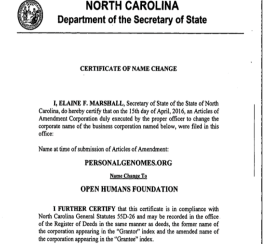
(NC filing shows timing of the name change).
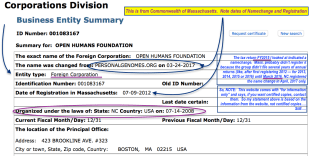
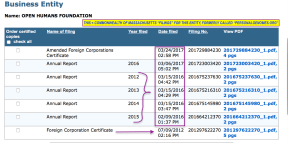
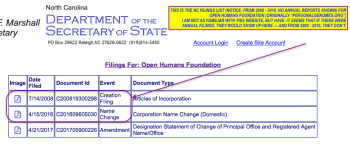
Only registered for MA in 2012…(per state-level websites recording corporation names in both states.
Note: These typically come with disclaimers, but a search will show that on-line as of today (7/26/17 by now). Also interesting — in neither state were annual reports showing as filed. First, it didn’t file them (at least visible on-line, see “disclaimer” comment) for several years in NC, then after 2012, it didn’t file for four more years, until 2016. Guess if there’s enough professionals, MDs, PhDs, or important people on the organizations, they don’t have to obey normal laws regarding nonprofit registration, and corporate annual reports at the state level??
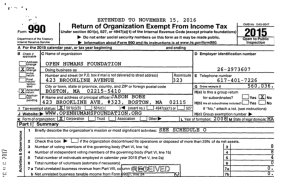
Same EIN#26-2973607 Diff’t Name. (Open Humans Foundation in Boston, formerly “PersonalGenomes.org”). The indication “MA” as legal domicile (Header Info, bottom-right) doesn’t match Business Entity records in MA or NC, which say it’s NC…

Same EIN#26-2973607 Orig. Name, Form 990EZ for 2008; this form doesn’t prompt for legal domicile…
This section and info. was added post-publication on 7/26/2017 (along with the Two Tax Returns excerpts and “PgEd.org” images extending below this section’s border) and will be discussed separately, soon. I’m just bringing it up here to “prime the pump” for a future post.

PgEd.org home banner (a Project of Harvard Med. School Dept. of Genetics) says it got a generous contribution from UCBerkeley’s (See “Doudna Lab”) Professor Doudna (Harvard + MIT’s and TBF’s “The Broad Institute” meanwhile warring with UCB (and Prof. Doudna) over CRISPR patents). No caption, no date on the pix…how “educational.”

PgEd.org home banner (7/2017). Emphasis on personal genetics + sequencing.

PgEd.org home banner (a Project of Harvard MedSchool Dept. of Genetics

PgED: Alfred P. Sloan Fndtn, Sundance Festival into it too…(No caption, no date, on the photo. How “educational”…)
“(MIT, Harvard, TBF,* 2008)” refers to the leadership (per its inc. papers available at Commonwealth of Massachusetts business entity search site). “2008” refers not to “TBF” but to The Broad Institute’s incorporation date. I mention this because records show that just before 2008, TBF changed its accounts (EIN# and legal entity registered with the state, as I recall, as next paragraph mentions. I wonder if the two planned events were somehow related.
This also affected or related to filings regarding (but not the topic of this post) two other, much smaller, Broad-funded nonprofits active in training individuals urban school leadership with a view towards its reform. That seems a lot of shifting identities shortly before the major recession IN 2008. (Those nonprofits featured training of school leadership. See previous posts.)
*TBF = “The Broad Foundation,” which as “it” changed EIN#s ca. 2006-07, but specially IRS-ruled “not a termination,” fiscally (or, at minimum two different entities associated with/filing under two different EIN#s), I guess one might say it was a paranormal succession of two-into-one foundations, with some name-shifting between which was the d/b/a of the other. (I posted on it earlier, some images here for reminders). Not the main point in this post, except for the ability to pull off some phenomenal societal shifts, when there’s enough financial and famous philanthropic names weight to be thrown around, with friends and associates, towards causes they believe in.
Like many philanthropists, Eli and Edythe Broad are active in many areas — the arts, education, architecture, development, and for purposes of this post, scientific research with a focus on the biomedical, genetic, psychiatric and the Human Genome with a view towards applications.
It’s a fascinating field, it’s a mark of this century (and the last part of the 20th), and even just the technology facilitating study or experimentation in it, is a whole other story. If I weren’t doing this blog, I’d be interested in that field in general and as it intersects with our family line which seems to have a scientific streak (as well as manipulative, bullying streak) somehow “bred into” it. But in blogging it here, my focus after posting some of the fairly recent news, is still on reconstructing the “genealogy” and “DNA” of its major philanthropic and university (collaborating) investors/funders and funding families.
Blogger comments re: timing of this post (see title). Other than this update, and adding information on one more institute (Whitehead Institute for Biomedical Research — at MIT, but its own EIN# since the 1980s, say its tax returns) and that is a short post, for a change!
I have been working and focusing hard for more than a month to update the “Do You Know Your…” theme in three major parts, and ancillary posts. These are major networked nonprofits, each with its own tax returns — many parts, and a patterns developing over time within them, each with its websites, and all with their sponsors, and interrelationships.

#4 from USTreasury OCC’s BankDerivatives Rept March08
I needed a mental break and “time-out” for a bit from that subject matter and clicking through the same websites over and over to dredge out the pieces of the puzzle. I enjoyed the detail (especially on the state CAFR and US Treasury reports), but the drudgery of poorly-organized, repetitive posts and finding more and more evidence of “skullduggery” in the nonprofit sector with not one, but several different organizations… It’s not without its rewards (like increased understanding), but while study and posting on a single topic, I am immersed in that subject matter, sometimes to the point of dreaming about posting on it, or discovering key points about them.
So having accomplished several legs of this project I decided to return to the previous topic here for a while, around themes and organizations listed in post title. It’s also a fascinating one. The “heavy lifting” on this post was already done. I’m not re-viewing the content in detail (I did re-read it), but am adding some on the Whitehead Institute for Biomedical Research organization mentioned on the Wikipedia which I believe puts the development of the Broad Institute in some chronological perspective.
Read the rest of this entry »
SHARE THIS POST on...

To Identify and UNDERstand is To Know Why (and How) to WITHstand. (The Public’s Assigned Place on the Tax Continuum Pecking Order). [from “Do You Know Your ABA, APA…?” Oct. 2014 Post Update @07/18/2017]
Post title reflects both the subject, and part of the originating (updated) post title from which it was taken to shorten the original:
To Identify and UNDERstand is to know Why (and How) to WITHstand. (The Public’s Assigned Place on the Tax Continuum Pecking Order). [from “Do You Know Your ABA, APA…?” Oct. 2014 Post Update @07/18/2017] (case-sensitive shortlink this time ends “-7dX”) (That post’s full title shown next…).
Like many of my posts, it will undergo some post-publication editing, usually for clarity or layout (how images display). [[In fact, this next segment added post-publication update, on 7/19/2017. I’ll mark where the added segment ends.]]
[[Segment added post-publication update, 7/19/2017]]
The ongoing theme has been …”DO YOU KNOW YOUR NGA, NCSC, NCSL, NCSEA, NCJFCJ, NCCD, NACC, NASMHPD, not to mention ICMA?” that is, do you know? about the network of private nonprofit associations named after public offices or officials who are networking together to function as government without being government entities? In this theme, drafted October, 2014 under basically that title, I split it into three basic parts, with the last (“Part 3”) about the ABA (Bar) and APA (Psychological). I also wrote at length and an extra post about the pushing of the mental health/illness theme when it came to the NASMHPD (National Association of State Mental Health Program Directors) which is operating under a cooperative agreement with the “NGA.” (National Governors’ Association).
The NASMHPD is problematic through: (a) involvement with the objectionable TMAP (Texas Medication Algorithm Project), a way of getting around failed clinical trials to promote excess and more expensive types of (unsafe, injurious it turns out) medication for use statewide, an area over which, obviously, groups like the NASMHPD would have some influence as its members are state-level heads of “Mental Health Programming.” (b) in general, taking funding from some of the same “Big Pharma” (Rx) companies developing and pushing some of the drugs, including several who are now being sued by state attorney generals and others for their responsibility in current very unhealthy (except for business profits) opioid abuse epidemics and ===>>> (c ) patterns of networking AS nonprofits with a specific theme intended to go national, which brings it into an area I have now researched as to several different fields (including marriage/fatherhood, domestic violence prevention, child abuse prevention, supervised visitation and related, and more recently, school reform initiatives (public/private liaisons with big foundation money behind them). I believe that the extent of such networking when it comes to mental health (and related Rx possibilities = major financial incentives to at times inappropriately control population, and bill the public for it) is pervasive and should not be ignored. However, it’s the organizational tactics in the nonprofit sector (regardless of “theme”) to also be aware of, and how organizations copy other organizations’ successful models.
Another factoid is that many of these same pharmaceutical companies can ALSO sponsor or get to government officials more easily ( for membership or Corporate Donor/Partner fees — which they can certainly afford to pay) — which brings us back to the NGA, NCSC, NCSL, etc. list above. The fact that the organization (as to that list) is in the private sector makes it legal, and because these organizations themselves are not usually in the headlines AND on Forms 990, donations are aggregated, at least as far as public gets to see (i.e., contributions are lumped together into a single number on the return), harder to follow. The collective influence is also harder to see simply when it is dispersed among many entities. This influence is not less for being less seen — it still is there, but when results are showing up inappropriate, specifically WHERE to resist or protest should be known. My point is, the nonprofit sector PER SE sets the stage for this. The nonprofit sector understood as a factor of everyone else (incl. corporations) getting taxed, brings it back to the point of taxation, specifically the income tax.
That’s also WHY the “CAFR” material is so important to grasp!
re: (a) TMAP (Texas Medication Algorithm Project) (just a reminder):
Two screenprints, one from TMAP Wiki (part not shown describes whistleblower Alan Jones’ experience, including being fired from his state’s OIG after reporting on this). You can see readily how it would intersect with politics and government:

Annotation bottom right actually comes from p.2. Click image to access the 2-pager document (but p1 w/o annotation) as found at BHRM.org (in IL)
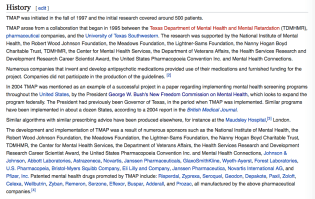
Texas Algorithm Project “wiki” (click image to see) also references the whistleblower and “New Freedom Commission on Mental Health” connections (i.e., from Texas governor George W. Bush to U.S. President George W. Bush (pls. read if unfamiliar with it!) [NOTE: WIKI References insufficient: 2 link to CCHR, one to AHRP (which quotes an Oct. 2005 Alan Jones interview w/ Rutherford Institute (VA, John Whitehead), link broken and no search site there. AHRP doesn’t post its financials (which I looked up to verify its statement that whistleblower Alan Jones was on its board) and I found a tiny and irregularly-filing NY entity, no Forms 990 [vs. 990EZ] showing (which’d show date founded) before ab. 2008, no return found readily before then either (perhaps filed Form 990-N). A 4th Wiki “Reference” viewed, it said, 2006, and not well framed, misdirected to a site MHC on “trucks” and the one to “Texas Dept. of Health” lacked specifics, leading readers to flounder (there are algorithms for many different diseases, not just the psychiatry-related ones for which TMAP became so (IN)Famous.
 At least they post audited financials and Form 990s. Mission description from a recent 990. (EIN#680005541):
THE CITIZENS COMMISSION ON HUMAN RIGHTS (CCHR) IS A NON-PROFIT, NON-POLITICAL, NON-RELIGIOUS MENTAL HEALTH INDUSTRY WATCHDOG WHOSE MISSION IS TO ERADICATE ABUSES COMMITTED UNDER THE GUISE OF MENTAL HEALTH. WE WORK TO ENSURE PATIENT AND CONSUMER PROTECTIONS ARE ENACTED AND UPHELD AS THERE IS RAMPANT ABUSE IN THE FIELD OF MENTAL HEALTH. IN THIS ROLE, CCHR HAS HELPED TO ENACT MORE THAN 150 LAWS PROTECTING INDIVIDUALS FROM ABUSIVE OR COERCIVE MENTAL HEALTH PRACTICES SINCE IT WAS FORMED OVER 48 YEARS AGO.
re: (c ) patterns of networking AS nonprofits with a specific theme intended to go national (just a reminder):
I also looked at, if you read these (my) posts, other mental health/illness-named nonprofits, which have “umbrella” or “parent” organizations (Mental Health America, National Association on Mental Illness, now branded as “NAMI”) and “DBSA” (Depression Bipolar Support Association), including in “Even More Considerations on NASMHPD (and DBSA, and NAMI), and MHA.…” Each of the above associations has spawned, launched, inspired, and helped support (including sometimes through direct grants ) the creation or organization of many — several dozen similarly-named (after originating nonprofit) for each, or more, for some, as I recall — but I did post sample screenprints showing the list– fiscally independent (filing their own tax returns, not under a group membership) and “unrelated” (NOT referenced as “related entities” on the main group entity’s tax returns — MHA, NAMI, or DBSA) nonprofits also, typically named after a state, metropolitan region, or county.** Each entity may have different by-laws on how this works (for example, I believe it was NAMI which allowed only ONE state-level affiliate per state). In other words, networks of “kinda/sorta related” organizations, but not really when it comes to the IRS.
**So does CCHR (look at its organization-posted FY20015 Form 990, Schedule C (Schedules come after all Roman-numeral identified Parts of the Return, That is, I, II, III etc.), which provides a two-page list of affiliated entities all named “Citizens Committee on Human Rights” — and add a geography identifier (i.e. state or city name, etc.). While there look at its Schedule B named contributors and see that one couple gave $886K and other individuals over $70K each such that ⅓ of its contributions/donations (See Pt I and Pt VIII) came from just a few people. Advertising (Pt IX) occupied about ⅓ of its functional expenses, while a pittance (Sched I) was returned to affiliates and some to the Church of Scientology, nearby on the same street. There were some membership fees and there was some (Schedule F) recorded international activity.
The APA and the ABA are also so organized, which I also gave in sample screenprints in previous posts. My point is become aware of the networking in the private, nonprofit sector as organized nationally (or, internationally) targeting specific functions or services provided by government, with the purpose of controlling in which direction they are moved. Also become aware of them as a financial force if and when their assets and investments are collectively pooled. This happens in both the private and the public sectors, which also interact (trade, buy, sell, etc.) with each other. This type of information isn’t “journalistic” and doesn’t tend to sell newsprint and may lack social media “curb appeal”– but it’s part of how our country operates, and has its core basis in WHERE one falls along the tax spectrum or continuum (exempt, or not). It’s essential to know and come to terms with!
[[This ends a segment added post-publication update, 7/19/2017]]
I have been putting out some long posts recently. But this one is shorter at about (with above addition, now) 8,800 words. It introduces the concepts from and links to some of my key prior posts on the same (I picked out five specific ones), then continues on a post that references them, published 07/12/2017, called Featuring Five Vital Posts on …. Our Assigned Places in the Tax Continuum Pecking Order (from ABA, APA post update). That continuation post has more substance on the Five Vital Posts. This one (that you’re now looking at) serves as an introduction, and has some extra material not on the continuation post (in light-blue background section).
The originating post itself actually I see reflected three major subject matters, although that length of title also reflected what was actually covered in the post three years ago. The three subject matters are reflected in the post title’s three sentences:
Do You Know Your…ABA, APA (Founders, History, and via their Forms 990/O and Financial Statements, As Nonprofits?), Or How the ABA from its start maneuvered around Membership Admission for “men of color” despite existing suffrage and qualified men until long after women also got the vote? If Not, Then You Also May Not Yet Know Your [the Public’s] Assigned Place in the Tax Continuum Pecking Order. (Oct 2014 update, Pt. 3A) (Post title with case-sensitive shortlink ending “-76j” generated by WordPress) (Bold – Italics – Bold to indicate the three subject matters, or three sentences).
THIS POST CAME FROM THE MIDSECTION OF A POST on the MIDDLE SUBJECT MATTER, BUT REFLECTS THE THIRD-SUBJECT MATTER IN THE LONG TITLE ABOVE — OUR PLACE ON THE TAX CONTINUUM PECKING ORDER, AND THINGS ABOUT TAX RECEIPTS, FEDERAL GOVERNMENT BUDGET FUNDING, AND CONSEQUENCES TO ONGOING TAXATION IN THE CURRENT SETUP (AS REFLECTED IN CAFRS, AND THESE NETWORKS OF NONPROFITS INTO “PUBLIC/PRIVATE PARTNERSHIPS” I KEEP SHOWING OVER TIME….SIMILARLY, the material for SECOND SENTENCE of the TITLE actually was towards the BOTTOM of the originating post. So, some re-arrangement of sections was called for.
I have now published parts 1, 2, and 3 of the original, and, separately, an extension of this post (link appears again at the bottom) as Featuring Five Vital Posts on …. Our Assigned Places in the Tax Continuum Pecking Order (from ABA, APA post update) (with short-link ending “-7bR”). <==almost 13,000 words, contains about 50% update and addition of images to explain concepts.
SHARE THIS POST on...

State-Run Banks? At Least Two Activists Who Understand CAFRs, How Governments Stockpile Assets, Take Polar Opposite Stances on What to Do About It (Burien, Herman). And Perhaps Why.. [Published 7/17/2017]
This post references financial reporting formats (CAFRs) for government entities, and the enormous significance of this format to public consciousness of (our) position vis-a-vis those entities. That information is a real gateway to understanding. I’ve been considering and posting on CAFRs often since I discovered it in Spring 2012, thanks to, as I recall first, this website CAFR1.com
This post references some material I’ve been working on since I became aware of it over five years ago, with increasing detail. This is probably, however, not the place for first-time readers of this blog to start! Try instead either the “Vital Info / Sticky Posts” link, the Table of Contents (both links shown right below), or elsewhere!
This post, full title, published 7/17/2017: State-Run Banks? — at Least Two Activists Who Understand CAFRs, How Governments Stockpile Assets, Take Polar Opposite Stances on What to Do About It (Burien, Herman). And Perhaps Why.. (case-sensitive short-link ends “-7gN”) (About 11,500 words) (+ Information + images added to the bottom 7/18 on two authors M. Chussodovsky + M.G.Marshall related to the platform from which one of the pro-State Banking articles I discuss was posted, and other places they are published (such as at truthout.org, RT.com) = about 13,850 words, including all image captions) .
Read the rest of this entry »
SHARE THIS POST on...


Do You Know Your…ABA, APA (Founders, History, and via their Forms 990/O or Financial Statements, As Nonprofits?), Or How the ABA from its start maneuvered around existing suffrage for “men of color” long after women also got the vote? If Not, Then You Also May Not Yet Know Your [the Public’s] Assigned Place in the Tax Continuum Pecking Order. (Oct 2014 updated + Publ. July 10, 2017, Pt. 3A)
Elongated post title reflects content after a three-way split of a previously unpublished (because I mistakenly thought it had been published!) post from late October, 2014, a situation I am now correcting in late June 2017 after trying to cite to this post to better explain the recurring topic of networked nonprofits named after public agencies. AND to increase public awareness of major professional associations in the tax-exempt sector collaborating together for population control, behavioral modification, etc., all allegedly for the public interest.
This is “Part 3.” Blog followers may have heard that explained twice before, but newcomers may have not. This post is a blend of updated information and previous insights + narrative; the updates include more visuals (especially excerpts of tax returns).
Do You Know Your…ABA, APA (Founders, History, and via their Forms 990/O and Financial Statements, As Nonprofits?), Or How the ABA from its start maneuvered around Membership Admission for “men of color” despite existing suffrage and qualified men until long after women also got the vote? If Not, Then You Also May Not Yet Know Your [the Public’s] Assigned Place in the Tax Continuum Pecking Order. (Oct 2014 update, Pt. 3A) (Post title with case-sensitive shortlink ending “-76j” generated by WordPress)
The APA and ABA
They are the American Psychological Association (since 1892, incorporated 1925, last “Gross receipts” from the tax return posted on their website, $160 million, assets $236 million) [@ tax latest return posted Oct. 2014; update below shows $200M gross receipts but total assets $230M], and the American Bar Association (since 1878, incorporated ____,** last “gross receipts” posted tax return, $152.6 million and the assets $329 million) [*@ Oct. 2014; updates below]. **This info left blank because: the last 3 tax (FY2012, -13 and -14; 2016 not posted yet on “Form990finder”) returns left it blank; before that, some said 1905, before that, 1878. Before 2008, the IRS Form didn’t ask legal domicile and year founded as part of the header info. I went to Illinois Cyberdrive Search to look up the corporate registration (which comes with plenty of disclaimers), and it currently says, in the details page, only 1992- – which cannot be right. I went to D.C. business entities search (a site I’m familiar with) — the web page and URL had been changed and my username (free registration) no longer recognized — at which point, I figure, leave it blank!]
Both the ABA and APA organizations have related entities -a specific term which relates to and affects their tax returns and financial reports; the term means related if one controls the others, or with common leadership but with separate EIN#s and legal names. For example, from an independently audited financial statement FY2012 for the American Bar Association references some, but not ALL its related entities. But this wouldn’t be known at first reading — the tax returns reference others (See first image. Screenprints from the APA’s recent financial statements, including its “Note 1” describing APA’s related entities reflected in the statements, are shown further below on this post.)

ABA statement regarding which entities are in its Consolidated Audited FS for those years (2012, 2013) show only three, however there are more ABA-related entities shown on tax returns…
And, as you realize if you think about it, both the ABA and the APA also have affiliates or chapters at the state and county level, although these are not registered as “related entities” on the main organizations’ (APA + ABA’s) tax returns or audited financial statements. However these may be organized or named as fiscally separate business entities, these also are linked together and networked by both purpose and long association (meaning, within each major discipline, i.e., whether law or psychology).
For example, some recent Form 990 search results (FY2015 only, ABA only) of such state-level associations and within two of our larger states (NY, CA). You will be able to see which column they are sorted by (next link, and three images with gray-and-white striped tables with blue header rows). Some major states (California, Texas, Florida) Bar Associations didn’t even show up in the search results which raises another question: How many of us would know nationally, off-hand, about how many state and county-level (a) bar and (b) psychological associations exist, and where to find their exact names in a list, from which their tax returns could be looked up, for size, leadership, or activities? Would the ABA and APA main websites tell this? (I checked ABA for “Member list” and was asked to join, and warned that the list was proprietary– but that may be for individual ABA members). State level bar associations don’t appear to be required to follow an exact name format, probably, and even if they did, would the capacities and/or quirks of the standard charitable databases that might be searched reveal all of them? (990finder.foundationcenter.org despite its convenience, often has search results whose organization names do not match the underlying tax returns, which I’ve known for a while now).
- Actually, here’s the ABA interactive map of the US for search of “State and Local Bar Associations“). Under California (of course — where I live!), the State Bar of California, is described as an arm of the Judicial Council, and “Unified.” It’s listed among the 38 pages (for the state). It would then take several other steps to locate their respective tax returns for a generic idea of the assets maintained, or operations. State Bar of California website says it processes $30M of grants to legal aid organizations throughout the state, that it was organized in 1927, and more.
- So, to get a national result, I guess one would have to do at least 50 searches and compile results…
I then did two Form990 searches specifically for NY (one of the largest) and for California (and THE state bar association didn’t show up in those results, but it gives a flavor of the diversity of named bar associations, whether by geography (county, city or for some larger cities, parts of a city), or by demography (Asian American, Black, Hispanic, Women, Mexican, etc.) — each one a separate organization, many likely with their own related entities, such as foundations. The next link is simply an interactive search (entity names links on it are clickable). I had done FY2016 only, but so few results showed, I backed it up one year.
Form 990 Srch Results YR=2015 NAME= State Bar Association Of bring up only 18 (Org Names=Active Links in the pdf) printed July8 2017 (2pp of results)<==Why several major state’s listings aren’t shown, DNK — may be a factor of the database’s labeling, or how they are titled. But the absence of state bar associations tax returns from MAJOR states in such a search is unusual…Note most are filing Form 990Os).
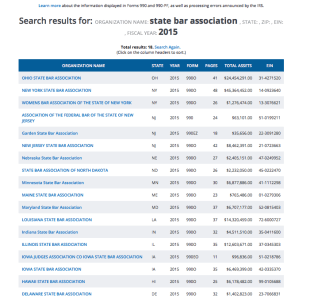
2015 State Bars sorted by Total Assets 7/8/2017. Click to enlarge (true for most images herein).
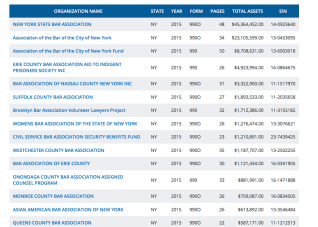
Search Results within NY, Year 2015, sorted by $$
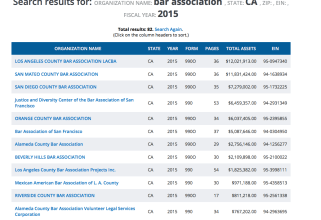
Search Results 2015 within CA, sorted by $$
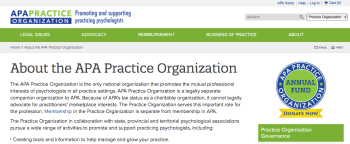
Currently, the APA (P for “Psychological”) shows only one related tax-exempt entity, formed in 2001, but a recent (FY 2015) tax return shows it’s focused on promoting the profession across national lines (i.e., states, territories and provinces), by lobbying and organizationally, and as small as it is, relatively speaking, it shares about 50% of its revenues (“expenses”) as for “Payments to Affiliates” — which the fine print shows means the APA itself and possibly another related entity, the APA PAC (political action committee), EIN#000522094 also in D.C.
 The same tax return then granted out a portion of is proceeds to others — and a three-page printout of “to whom” reveals minor grants ($15K, $20K range) to a variety of more local psychological associations, most by geography. While those grantees are not showing as “related entities” to either APA or the APAPO, they are benefitting from its operations…
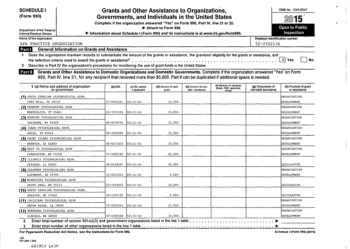
Grantees from p2 of 3 APA PO entity reflect various state-level psychological assoc’ns (see FY2015 return, or link to Sched I of Grants, all 3 pp, nearby in this post.
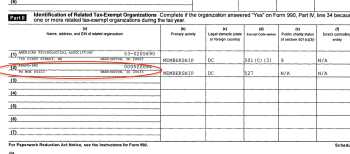
the APA PO lists two Related Entities, one of which (red oval) is a PAC, the other is APA proper.

the APA PO decribes what its reason for existence is, notice not limited to US only

The APA PO (EIN# on image) references Two Categories of Members, Practice Constituents and Education Constituents (who pay into a certain trust, not identified readily on the Form 990.
APAPO EIN#522262196 FY2015 (45pp) (Sched I of Grants only Grants were USD 471 268 Other Exps (mostly Paymts back to the APA) USD 3 687 269 (link to entire return provided above in text).
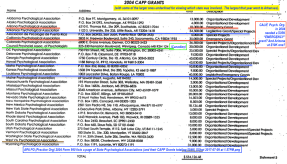
State (Territory,DC+ one Canadian) psychological associat’ns supported by the APA PO entity); click to enlarge.
Below (colorful annotations, thumbnail size) is image of a FY2004 list from the same organization’s Form 990. I am simply reminding readers that these state-level organizations exist and interact with the APA, or rather, its related entity.
Back to the “Related Entities”:
For example, the ABA “Financials” link shows combined financial statements and that two corporations were recently dissolved: the James O. Broadhead Corporation (“JOB” EIN#521874598) and the ABA Museum of Law. Not referenced on the “Financials” page for some reason is the National Judicial College (EIN#942427596) in Reno, NV, listed as a Related Entity at least to the dissolving JOB Corporation in 2012. The NJC in Reno (street address at “Judicial College Building,” formed in 1977) is of moderate size and gets grants (I just looked at recent Form 990) from the USDOJ, the USDOT (transportation) and the State Justice Institute — about $2M worth (next five images after the three (keep reading) with this-background-color captions from the unrelated-to-the-ABA NCJFCJ, were added 2017 from the ABA Financial Statements page which is one of the images).
Meanwhile, the financially small, but still influential NCJFCJ formed in 1975 (EIN#362486896), a completely separate entity (not ABA-related) on whom I’ve blogged so much, shows a PO Box 8970 in Reno Nevada (and said to be at the University of Nevada-Reno), and per a FY2004 Form 990 it received $12M of government grants.
So, just for comparison — one paragraph, a link, and three annotated images from the NCJFCJ (Nat’l Council on Juvenile and Family Court Judges, Inc), a FY2004 Form 990.*
Read the rest of this entry »
SHARE THIS POST on...

Even More Considerations on NASMHPD (and DBSA, and NAMI), and MHA. See Also Recent Epidemic? of Attorneys-General Suing Big Pharma over the Opioid Abuse Epidemic. [Publ. July 6, 2017]
The theme, continued, is still …”DO YOU KNOW YOUR NGA, NCSC, NCSL, NCSEA, NCJFCJ, NCCD, NACC, NASMHPD, not to mention ICMA?”
Even More Considerations on NASMHPD (and DBSA, and NAMI), and MHA. See Also Recent Epidemic? of Attorneys-General Suing Big Pharma over the Opioid Abuse Epidemic. [Publ. July 6, 2017] (post short-link ends “-79i”)
This post being published July 6, 2017 evening is about 8,000 words (shorter, for a change!). It comes in two basic sections — ICMA-related, and The Four Organizations-related (NASMHPD, DBSA, NAMI, and MHA). I might later add more images showing the networked DBSA entities, but as written, I feel it’s written clearly enough (especially with the visuals) to be published now.
“DBSA” stands for Depression and BiPolar Support Alliance, formed in 1985 in Illinois. “MHA” stands for Mental Health Association.
An aside, for this post, who is ICMA?
It takes a few paragraphs and several images, but I’ve used the reference in post titles and themes often enough I felt it time to identify the acronym “ICMA” here again.
While I’m including information from its website, on a related entity and a partnering entity before getting into the main subject matter, remember that this ICMA section and information near the top of this post is included now only for a point of reference in the landscape of membership organizations involving public employees, and for awareness of its existence, and some of its scope — not as main post content. As I showed before, along with the NGA and others, ICMA is considered part of the “Big Seven Associations” by those so-associated (!):
The “Big 7” is a coalition of seven national associations in Washington, D.C., whose members represent state and local governments. The leadership of these organizations works together regularly to discuss issues of mutual interest affecting state and local governments. Members of the “Big 7” include: The National Governors Association, the National Conference of State Legislatures, The Council of State Governments, the National Association of Counties, the National League of Cities, The U.S. Conference of Mayors and the International City/County Management Association.
There’s a wikipedia “stub” (doesn’t say much, except that they are influential in lobbying for their interests) on “the Big Seven,” and as you can see, the ICMA (the “C” standing for the two-word descriptor (adjective) “City/County” seems to show up in its logo):
The Big Seven is a group of nonpartisan, non-profit organizations made up of United States state and local government officials. The Big Seven are:
- Council of State Governments
- National Governors Association
- National Conference of State Legislatures
- National League of Cities
- U.S. Conference of Mayors
- National Association of Counties
- International City/County Management Association <==
These groups are influential in national government, often lobbying Congress to represent their members’ interests.
References[edit]
- Patterson, Bradley H., Jr. (2000). The White House Staff: Inside the West Wing and Beyond. Washington, D.C.: Brookings Institution Press. pp. Ch. 13. ISBN 0-8157-6951-2.
Bringing up the “power of the GASB” (a post I’m still working on talks about how), know that a tax-exempt foundation in Norwalk Connecticut, the “Financial Accounting Foundation” (FAF”) actually set up and controls both the GASB (Government Accounting Standards Board), some time after the FASB (Financial? Accounting Standards Board) for the private sector, in the early 1970s. They delegated powers to the respective boards, but still maintain ultimate (veto, etc.) power over them.
(This diagram also on FAF “About” page, shown nearby)

FAF outlines its identity and purposes (FASB and GASB)
Rules change from time to time, and rule-changes can make or break a city county, or possibly even state — and often around the issue of pension funding. So in 2012, “The Big Seven” responding to a rules-change drafted a policy response for how much people should contribute to their own pension plans (ARCs and Annual Designated Contributions):
“Big Seven” Focus on Pension Funding Policy October 01, 2012 (found at “leg.Wa.Gov”) WASHINGTON—The executive directors of the Big Seven state and local associations today released draft “Pension Funding Policy Guidelines” for state and local governments. [Same announcement on the same date provided through National League of Cities, this one with a link to the (2page) guidelines.**]
The Governmental Accounting Standards Board (GASB) recently issued new standards that focus entirely on how state and local governments should account for pension benefit costs. However, they did not address how employers should calculate the annual required contribution (ARC). To assist state and local government employers, the seven associations are engaged in an ongoing effort to develop policy guidelines. [[some points raised. Note: this doesn’t have an active link to that released draft, just advertised it on an NGA website, apparently.]]
“Government leaders have to make difficult budget decisions every year, said Robert J O’Neill, ICMA executive director. “Having a rational way to calculate their annual required contribution helps them stay on track to meet their retirement obligations.” [[Para. listing “The Big Seven” omitted]]
The National Association of State Auditors, Comptrollers and Treasurers; the Government Finance Officers Association; the National Association of State Retirement Administrators and the National Council on Teacher Retirement helped draft the guidelines.**
**Link to the Pension Guidelines (now almost five years old) shows why (see last para. in quote) those particular organizations helped draft — because the Big Seven asked them to! (next screenprint) as convened by a “Center for State and Local Government Excellence” which the guidelines don’t bother to mention is taking ICMA Retirement Corp funding and working with them:
Natl League of Cities Oct 1 2012 Link to 1209PensionGuidelines
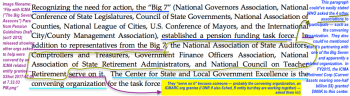
(annotated excerpt from 10/1/2012 Big 7 Pension Guidelines (a 2pp release)
What’s ironic about this — the Big 7 Associations advising governments how to address pensions are themselves subject to FASB (not GASB) standards — because they are in the private sector. This information was a search result on “The Big Seven” but included because in the ICMA section below, an entire corporation managing public employee retirement plans for ICMA (it’s called ICMA Retirement Corporation) comes up. The convening organization is an LLC listed in ICMA-RC’s “Sched R -Pt I” (disregarded entities, at the same street address and floor like its other Sched R Pt. I Disregarded entities. It is controlled and apparently funded by ICMA RC to conduct research on municipal and local retirement plans, specifically. Website says it was created for this purpose in 2007.
Take a look at the FY2008 ICMA RC Salaries (totaling $13M for Part VIIA — includes not just Directors and Officers, but also Highest-Paid and Key Employees). In later years it’d be $19M !! I see the President at this point had a salary of four million dollars and at least three others, over $1M each….

It’s not the primary purpose of this post, which focuses more on the four entities in the title, all dealing with and named after topics surrounding “mental health,” and involved individually and at times with each other in the strategic push for a paradigm-shift, intended to make and keep, nationally and by communities, provision of mental health services a regular part of basic primary health care, and so covered by insurance for that primary health care. To do this, considerable marketing and social communications sector, and affiliate organizations are involved.
I’m including the short(er) section on ICMA up front because I think it’s time to do so. There’s also a certain element of comic relief — well, at least of comedy. You’ll see….
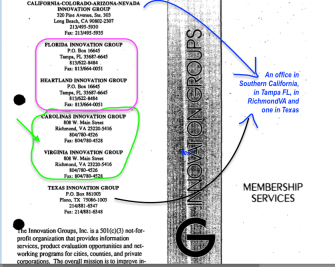
(These might be separate entities also; however I saw that the California group merged into the main one).
After looking more closely I see what ICMA’s acknowledged partner “Alliance for Innovation, Inc.” f/k/a The Innovation Groups” is doing, or at least how it’s been operating (since 1979, it says), although why ICMA would partner with such incompetence (speaking as to their tax returns), one wonders…. The Innovations Groups is plural because it has regional offices and at least one merger (for the region “California-Colorado-Nevada-Arizona”) in its 40-year-plus history. (See two images from their “founding documents” — link part of the California OAG link provided below). “The Innovation Groups, Inc.” is the prior name (one of several) for what is now “Alliance for Innovation, Inc.”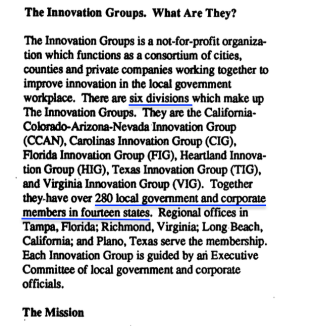
Alliance for Innovation, Inc. also registered in California (now as a Florida Organization with an Arizona Entity address) since 1991, but quit filing with the Office of Attorney General Registry of Charitable Trusts (“OAG RCT”) its required annual tax returns and RRFs — with the annual fees based on revenues — (as a 501©3) since 2006, was not marked “Delinquent” until August 2010, despite its last known annual revenues being over $1M, and remains active as a corporation. In other words, it wasn’t “FTB Suspended” by the Secretary of State, nor is there even any uploaded information that the California OAG even ASKED it for the about eight years of missing tax returns AND RRFs, or threatened suspension if they didn’t cough them up — which it does for other entities. I wonder why not…and am tempted to compile enough related facts to write a letter (anyone reading this, also feel free to, or call to find out if there is some legitimate reason).
If you’re curious about that aspect, look here (about 2pp): AllianceForInnovatn (does bus w ICMA) Calif OAG Chart Details EIN# 591936650 No Filings Since FY2006 not marked Delinq til Aug2010 – WHY? I didn’t address the OAG delinquency in the section on ICMA (tan background color) below; there’s plenty of other things to report. Note: The many links on the above pdf to uploaded filings that were made (towards the bottom of its about 2pp) should still be active; they won’t fade with time unless the OAG moves the documents.
ICMA INFORMATION:
“ICMA is the professional and educational organization representing appointed managers and administrators in local governments throughout the world. It sponsors, develops and implements a number of programs that provide local government managers and administrators with expertise on a variety of topic areas.”
| ORGANIZATION NAME | ST | YR | FORM | PP | TOTAL ASSETS | EIN |
|---|---|---|---|---|---|---|
| International City/County Management Association | DC | 2015 | 990 | 65 | $15,057,789.00 | 36-2167755 |
| International City/County Management Association | DC | 2014 | 990 | 63 | $15,570,124.00 | 36-2167755 |
| International City/County Management Association | DC | 2013 | 990 | 58 | $16,443,151.00 | 36-2167755 |
Since 1914 (odd timing, 1 year after the income tax was established through US Constitutional Amendment). Tax returns show it’s an IL corporation with a D.C. address and two related (Sched R) entities, one I reference below, and the other is an REIT holding their D.C. Headquarters. They receive income from both (see Sched R), and spent around $7M in overseas activities (Sched F) the last year shown above, FY2014 only. They took in $11M+ Contributions and $11M “Program Service Revenues” (including membership fees, a good chunk” and, per page 1, spent over $12M on salaries (158 employees) and over $12M in “Other Expenses” resulting (when combined with $349K grants to others) in an about $250K Deficit. The year before they had radically higher contributions ($18M) but still overspent the budget. The related “ICMA Retirement Corporation” while I’m here, has its separate tax returns. WOW.. An entirely different picture. Also, this one is FY1972 (it says, started with help from a Ford Foundation grant) and a Delaware Corporation — same street address except the Suite#. The difference in size is predictable because after all, it’s handling retirement plan benefits:
Total results: 3. Search Again.
| ORGANIZATION NAME | ST | YR | FORM | PP | TOTAL ASSETS | EIN |
|---|---|---|---|---|---|---|
| INTERNATIONAL CITY MANAGEMENT ASSOCIATION RETIREMANT CORPORATION | DC | 2015 | 990 | 53 | $489,002,619.00 | 23-7268394 |
| INTERNATIONAL CITY MANAGEMENT ASSOCIATION RETIREMENT CORPORATION | DC | 2014 | 990 | 54 | $493,889,563.00 | 23-7268394 |
| INTERNATIONAL CITY MANAGEMENT ASSOCIATION RETIREMENT CORPORATION | DC | 2013 | 990 | 51 | $452,312,085.00 | 23-7268394 |
SHARE THIS POST on...

Other Considerations on the NASMHPD, MHA, and This Type of Networking (Oct. 25, 2014 post updated June/July, 2017, Publ. July 3)
Theme, continued…”DO YOU KNOW YOUR NGA, NCSC, NCSL, NCSEA, NCJFCJ, NCCD, NACC, NASMHPD, not to mention ICMA:”

click on image to see website.
This post, renamed as second part of the original started October 2014, being published early July, 2017. It is “Part 2 of 3” from that original, although each has a slightly different focus and title. This one’s full title is:
Other Considerations on the NASMHPD, MHA, and This Type of Networking (Oct. 25, 2014 post updated June/July, 2017) (short-link ending “-761” and all three characters there are numbers).
I am publishing it July 3 (Tuesday) evening, 2017 at 18,000 words (!!). Some images will be removed and others updated within one or two days, post-publication. The removed images and/or quotes will be seen on Post #3; they represent an overlap. Also, know that at least half the contents (top part) and anywhere you see a screenprint image in the bottom half (or where otherwise marked) are 2017 updates. The updates are to best clarify the material, or display it better than I could in 2014.
“The ocean is wide, and my boat (room to describe it on a single post) is so small!” if I may borrow (and apply differently) a motto from the Children’s Defense Fund. The topic is a big one…this post does provide some signposts and navigation points on the compass…
(I see I omitted the first, and more important, part of the motto — “Dear Lord, be good to me” see logo):

self-explanatory logo and motto: CDF claims to be strong, effective, INDEPENDENT voice for ALL the children of America. It is, in fact, a 501©3 and as such is benefitting from tax exemption, and its revenue sources, as well as the strong reputation of its founders and leaders.
While I’m there (section in next background-color):
INDEPENDENT — REALLY? Any tax-exempt organization, whatever its cause, either operates on the strength of 100% volunteers, or has some revenues, expenses, assets and liabilities, and many of them also have employees. This one has 303 employees (latest tax return shown below), but spent slightly more on “Other expenses” than on its employees.The tax exemption is courtesy a situation in this country where it’s very easy to go tax-exempt, but those who do not do this individually, will generally speaking, if earning enough to be taxed, be paying a higher percentage than those corporations which do not, providing an incentive to form as many as possible nationwide. Money is attracted to (tends to flow towards) places which increase tax-exemption and better preserve profits, in general.
CDF’s claiming to represent ALL the children of America actually goes against the grain of the existing systems of representation in place for them, including state legislatures, U.S. Congress, and local representatives. I am well aware that saying this regarding a well-known civil-rights oriented organization may read like one-step from blasphemy and is a volatile statement. They certainly didn’t represent my children…
This post isn’t about the CDF, but it takes only a few minutes to look up most tax returns (other than those which are simply nearly impossible to find — and one came up in this post below, the NASHMPD Research Institute, a.k.a. “NRI-inc.org.”
| ORGANIZATION NAME | ST | YR | FORM | PP | TOTAL ASSETS | EIN |
|---|---|---|---|---|---|---|
| Children’s Defense Fund | DC | 2015 | 990 | 62 | $27,749,303 | 52-0895622 |
| Childrens Defense Fund | DC | 2014 | 990 | 86 | $31,911,729 | 52-0895622 |
| Childrens Defense Fund | DC | 2013 | 990 | 46 | $35,047,275 | 52-0895622 |
Briefly, (a stroll/scroll through even one Form 990 above) notice that this particular organization (Sched R) has two related entities in D.C., a total of three out of the same street address in D.C., benefits from a $4.9M tax-exempt revenue bond from D.C., took government and private grants both, and $1.6M from fund-raising (of which about 50% was expenses), and (program service revenues) earned $3M running “Freedom Schools.” However, (the same page, Part VIII, Revenues) shows that in selling $13M of securities it amazingly, earned only $802. How does one do that? …. Its $1.6M grants to others (Sched I) are part, but not the major part of operations, however, a quick look shows what was granted out went, some to school districts, some to schools, some to direct to religious organizations (judging by the names) and some to foundations, in various cities.
In addition, the President of the Board (Marian Wright Edelman) presumably received also a tax-deduction in renting a room in her SC home for $1/year to an office in the state (Sched L).  In the process of paging through the tax returns, one repeatedly sees “See additional data” where, for some reason, this major organization didn’t feel like coughing up basic information on the forms provided even when there was plenty of room. One thing however that was not skimped on, in the place provided on those IRS forms, was the organization’s purpose on Page 1, and again the top of Page 2.
My point being here, take a little time to take a look at the tax returns when hearing about (and certainly before donating to) ANY charity. Don’t just toss a coin and don’t judge just by whether the cause is progressive or conservative, or has emotional appeal based on civil rights themes from the 1960s. Also, I personally would not donate to any organization claiming, on its website, to represent ALL the children of America (further qualified — somewhat — on their tax returns), or claims to be an independent voice, when it’s a 501©3s.
(See more at Slogans vs. Speech-by-IRS-Forms 990: When the Resonance is in Conflict (A Quick Look at a Well-known Nonprofit, Children’s Defense Fund) (Independence Day 2017) (case-sensitive short-link ends “-7af”)((link is active now but only accurate when the draft is published).
By contrast with Children’s Defense Fund, and all 501©3s, -©4s, or -©6s not specialized as I’m describing in these posts, the type of organizations I’m focused on in this theme (opening words to this post: “…NGA, NCSC, NCSL, NCSEA, NCJFCJ, NCCD, NACC, NASMHPD, not to mention ICMA”)
- obtain and receive/exchange among themselves at times, money (actually, resources of various kinds) in the name of representing more than “all children” — but as representing the states as a whole,** or departments or public institutions (courts, legislatures, state mental health program directors or city/county Managers as to the ICMA) within state (and some, local – ICMA) governments. **(not mentioned in that list, but I have mentioned, “CSG — Council of State Governments and its CSG Justice Center, Inc.” — boasts about being the only national organization to represent ALL THREE branches of (state) governments: Executive, Legislative and Judicial).
- They do this by implication and justification as if on behalf of all people — but have chosen to operate from within associations formed in the private sector out of reach of the average person, or the common man — but NOT out of reach of the corporate + foundation sponsors, who are solicited to participate. This includes, for several of the above not just one or two, as I recall from having previously looked, representatives of major pharmaceutical, chemical, telecommunications, investment management, real estate development, law, and other fields.
- They mix corporate and currently-serving government boards of directors, AND funds, AND are operating in a coordinated, “in-synche” fashion with each other towards (a) their elected leaders constituents (respectively, wherever they be) and (b) the federal government.
In other words, they are playing intermediary, doing it nonprofit, and at public expense — but without adequate public oversight and certainly without informed consent or representation.
Their, this type of organization’s, individual and collective existence, let alone purpose and operations, concerns me far more than exaggerated claims or funky tax returns from, for example, a single though well-known entity, the CDF. The NGA, NCSC,… organizations’ significance is easily under-estimated through a general unconsciousness of their existence thanks to under-reporting on them as nonprofit entities, let alone as they are: specialized nonprofit entities with government names representing government offices or functions, working in an intentionally coordinated fashion towards privately-determined agenda, on say, the major news media (on-line or print)). How often do you overhear ANY conversations about them as a significant influence upon governments (plural) in the country, whether in passing, from friends, strangers, or in general social discussions of the challenges of this country, or possible source of its present problems?
In this post’s singling out the NASHMPD, I am pointing to this type of organization whose purpose and “reason for being” is focused on the mental health field which, in parts, deals with drugging of patients, or helping people detox from other drug and alcohol abuse, and in systems involving intricate, and expansive (expanding) networks of similarly-named nonprofits in, it seems, every state and no doubt also territories. And, thanks to recent Presidential Executive Orders both over time, and specifically, the 21st Century by former President George W. Bush (“Bush, Jr.”), relating to the so-called “New Freedom Commission on Mental Health” with its focus on transforming the entire field.
So now, you have a good idea what I’ll be discussing below, and I hope, also why. The Oct. 2014 section of this post, marked by these words in red
WHERE THE 2014 DIALOGUE STARTED (as taken from original post to this new one):
starts right after several five rectangular images of corporate and foundation donor logos (notably, in the Rx or Healthcare field) to the organization NAMI (National Association on Mental Illness, Inc.), a Missouri organization with its own network. MHA has a MHA-named network, and NAMI has their networks also. One uses the word “Mental Illness” as a point of reference, the other the word “Mental Health” but they have much in common and at times, leadership in common I seem to remember from the websites. In Part 3 of 3 I show more (visually) of the MHA affiliate network scope and agenda as self-described.
The 2014 section below that dividing line (the above title in red), you’ll notice has more to say on the history of Mental Health America and founder Clifford Beers, while still mentioning by name many of these related organizations, and quoting some of their tax returns.
To review see also Part 1, the post just published 6/30/2017 called:
Original/full post title: Do You Know Your: NGA, NCSC, NCSL, NCSEA, NCJFCJ, NCCD, NACC, and NASMHPD, not to mention ICMA? [Written Oct. 25, 2014,** split in three; this part published June 30, 2017] {obviously the italicized words=title update}, with case-sensitive short-link ending “-2FW”,
Posting Context: I mistakenly thought it had been published when first written. After not posting anything to FamilyCourtMatters.org (then “____.wordpress.com”) most of 2015 and starting to post again on January 23, 2016, I stayed on that year’s topics (and 2017’s), summarized key blog themes, and worked on a more complete table of contents, so I didn’t pick up on the “MIA” post until recently, when I had occasion to quote (link to) what I remembered writing up, rather than just re-explain the same material.
Having found it was still in draft, and reviewed, I found its 30,000 words, in hindsight, still relevant and worth the time to update and publish. Especially after more time refining my understanding, scope of organizations, and some expansion of ability to present the evidence.
Part 2 Update, Spinoff Post from this one: Considering this situation and filling in some of the missing information might distract from what’s already in this post, so I made some of the update into a spinoff post (written, but still currently in draft), and for lack of a shorter or better label, called it:
Even More Considerations on NASMHPD (and DBSA, NAMI),and MHA + Their 501©3 Affiliate Networks. And Recent Epidemic of Attorney-Generals Suing Big Pharma over the Opioid Abuse Epidemic (Case-sensitive short-link ends “-79i” previously-written contents moved there July 2, 2017) (link active now but only accurate when published)
About that situation:
Showing the current relevance, more on how MHA is set up to network through its many affiliates, and connecting this also to NAMI, and the recent trend of state attorneys-general to file major lawsuits against some of the same “Big Pharma” corporations over the costs to government (and, secondarily, human life) of dealing with the opioid abuse epidemic, took considerable show-and-tell (images, quotes, and narrative).
Meanwhile the same states and their state mental health directors (which NASMHPD here represents) surely knew about the same drug companies (Johnson & Johnson, and its subsidiary Janssen, and others) were already funding major networked nonprofits and with/through them promoting major use of other, known to be harmful and expensive medications (patented atypical antipsychotics, specifically) on populations under state control. The whistleblower on TMAP and PennMAP came out in the early 2000s, and now a decade later, the states are surprised at the results — although in a different class of medications?
(Why not go after the FDA?)
About this post, Part 2 of 3 from the October 2014 original “Do You Know Your NGA,….?,“
For updating that portion, to conserve what time is left, I’ll simply be condensing some of the quotes (reformatting to fine print) and not attempting to retrace or reconstruct my original purpose, for example, in exploring relationships between MHALA (Mental Health America of Los Angeles) and the “MHA Village”
Realize that this shows affiliation with and promotion by then-U.S. President Bush’s New Freedom Commission of 2003, which comes up in the post, extensively though in a different context.
Here is some reference to the MHA Village, and background on the “New Freedom Commission,” started as an Executive Order (April, 2002), and part of a trend and intention to transform mental health care nationally, with some of its immediate history shown.




 Let's Get Honest! Absolutely Uncommon Analysis of Family & Conciliation Courts' Operations, Practices, & History