Posts Tagged ‘Access-Visitation’
CFFPP and FVPF, where the word “families” really means “fathers..” [First publ. March 3, 2010 with July 27, 2016 update, and Nov., 2017 related posts referencing this one].
Post title (updated to identify later posts referencing this one):CFFPP and FVPF, where the word “families” really means “fathers..” [First publ. March 3, 2010 with July 27, 2016 update, and Nov., 2017 related posts referencing this one]. ( With case-sensitive, word-press generated shortlink ends “-pG”).
This background-color and box (text inside borders) is a 7/27/2016 Update
(see related post “SFFI- CFFPP – JustGive...” Published 7/26/2016; see also, same day, “Do You Know Your Social Science PolicySpeak?”
Both those posts have details on CFFPP (the second, more where it fits in the larger picture), but the “SFFI” one is more focused one of its listed “Funders” — “JustGive.org” as a substantial ($32M or so) on-line funding platform — and who THEY are related to.
FORMATTING: This short statement (post) I wrote March 3, 2010, a VERY tough time in my life personally. I see I was not too “html-competent” at the time (it may have to do with input equipment also, which wasn’t a laptop as I recall). Apart from that, CFFPP is a LITTLE (size-wise) nonprofit with famous people on its board (mostly unpaid) but somehow two pages of famous foundation funders also. The corporation/tax return history of this organization reveals some oddball (although not for the field of “fatherhood practitioner” sponsoring 501©3s, I’ve learned since). Also, several of the links to documents quoted on this page are, as happens, “Page Not Found” over at the CFFPP.org website. Here in this update are some similar, if not necessarily, identical links:
In the “Technical Assistance Series” — on Fatherhood Promotion: {{2017 update: both these next two links became broken sometimes between it seems July 26-27, 2016 (my posting this) and late Nov., 2017 (my revisiting this for follow-up information.) lhe website has been updated, so that’s not too surprising. Large portions of them are quoted below, however.}}
- http://cffpp.org/publications/TA_Father_PubPolicy.pdf co. 2003, Technical Assistance Series Author Jacquelyn Boggess:
- Please notice Esta Soler and Tangir Mangat, as well as Board of Directors CFFPP — and their organizational or university affiliations — as well as Staff. Which (unformatted) for this document is:
- Board of Directors Esta Soler • Interim Chairperson, Family Violence Prevention Fund /Tanvir Mangat • Treasurer, Private Consultant /Margaret Stapleton, J.D. • Secretary, National Center on Poverty Law /Adrienne Brooks • Private Consultant /Carole Doeppers • Consumer and Health Privacy Consultant /Earl S. Johnson, Ph.D. • California Health and Human Services Agency / John Rich, M.D., M.P.H. • Boston Public Health Commission / Beth Richie, Ph.D. • University of Illinois at Chicago /Gerald A. Smith • IBM /Oliver Williams, Ph.D. • University of Minnesota {{See “IDVAAC.org”}}
- CFFPP Staff Jacquelyn Boggess, J.D. • Senior Policy Analyst / Rebecca May • Policy Analyst /Louisa Medaris • Office Manager /David Pate, Ph.D. • Executive Director / Marguerite Roulet, Ph.D. • Research Associate Scott Sussman, J.D. • Legal Analyst
- http://cffpp.org/publications/TA_Fthd_DomViol.pdf by Marguerite Roulet, also C. 2003, and about “two meetings held in Madison 2001 and 2002.” Slightly different Board of Directors lineup, starting with “Wendell Primus, Ph.D.” of Center on Budget and Policy Priorities listed first, and Esta Soler, J.D. of FVPF second.
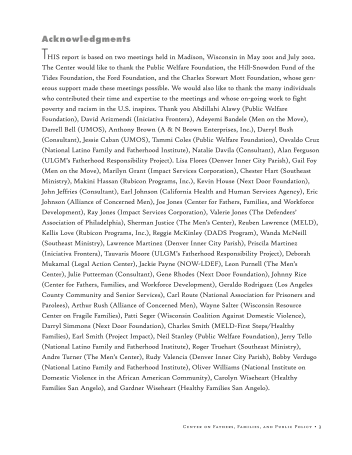
THIS report is based on two meetings held in Madison, Wisconsin in May 2001 and July 2002. The Center would like to thank the Public Welfare Foundation, the Hill-Snowdon Fund of the Tides Foundation, the Ford Foundation, and the Charles Stewart Mott Foundation, whose generous support made these meetings possible. We would also like to thank the many individuals who contributed their time and expertise to the meetings and whose on-going work to fight poverty and racism in the U.S. inspires. Thank you Abdillahi Alawy (Public Welfare Foundation), David Arizmendi (Iniciativa Frontera), Adeyemi Bandele (Men on the Move), …
“Sentence” highlit in yellow above is an incomplete sentence, missing a final word (probably direct object) after the word “inspires”. My posts also have long but grammatically incomplete sentences — on the other hand, I don’t do this with help from major tax-exempt foundations and a significant staff including at least two people with advanced degrees (I see (Jacquelyn Boggess — J.D. and David Pate, a Ph.D.) or even a budget for the writing.
Because now I know how to show the images, I’m going to add two pages here — the CFFPP people (first image) and the EXTENSIVE “Acknowledgements” page — both the organizations that funded the meetings, and lots of other people…//LGH:

click image to enlarge as needed
click image to enlarge as needed
page 2, left, has figures in background, page 3, right is the plain text one.
CFFPP (“Fathers” in its name, co2003) Fatherhd & DV TA, Page 2 CFFPP personnel ONLY viewed Jul2016
CFFPP (‘Fathers’ in org. name|co2003) Fatherhd & DV TA, Page 3|Acknowledgmts| ONLY viewed Jul2016
[the pdf links above produce same result as clicking on the image. Technological tweak (setting adjustment) on the image upload menu I hadn’t noticed yet, but now use regularly, making the extra “pdfs” unnecessary except where they are for files more than a page (i.e., one image) long].
Next quote (inside this 2016 update) shows Resources and References from this CFFPP “Fatherhood and DV” Document make NO reference to the multi-million-dollar HHS-backed “responsible fatherhood/ healthymarriage” grants stream which — trust me — plenty of the participating groups knew about (see http://TAGGS.hhs.gov to compare which of them may have been recipients).
I notice heavy references to “Oliver Williams” including the “IDAAV” under “resources” which (in this part) doesn’t specifically mention his name, but which he’s basically (with steering committee) been leading — for years… and probably back then, too. NOTE: the “IDVAAC” does NOT appear to be an independent 501©3 or registered business entity– at least not in Minnesota, where it’s been operating from:
References
Carrillo, Ricardo and Jerry Tello, eds. 1998. Family Violence and Men of Color: Healing the Wounded Male Spirit. New York: Springer Publishing Company, Inc.
Raphael, Jody. 2000. Saving Bernice: Battered Women, Welfare, and Poverty. Boston: Northeastern University Press.
Williams, Oliver, Jacquelyn Boggess, and Janet Carter. 2001. “Fatherhood and Domestic Violence: Exploring the Role of Men Who Batter in the Lives of Their Children” in Sandra A. Graham-Bermann and Jeffrey L. Edleson, eds. Domestic Violence in the Lives of Children: The Future of Research, Intervention, and Social Policy. Washington, DC: American Psychological Association, pp. 157—187.
Williams, Oliver. 1999. “Working in Groups with African American Men Who Batter” in Larry E. Davis, ed. Working With African American Males: A Guide to Practice. Thousand Oaks, CA: Sage Publications, pp. 229-242.
Williams, Oliver. 1999. “African American Men Who Batter: Treatment Considerations and Community Response” in Robert Staples, ed. The Black Family: Essays and Studies, 6th edi- tion. Belmont, CA: Wadsworth Publishing Company, pp. 265-279.
Resources
• Building Comprehensive Solutions to Domestic Violence: a Collaborative Project of the National Resource Center on Domestic Violence, University of Iowa School of Social Work, and Greater Hartford {{CT}} Legal Assistance—a series of policy and practice papers
• Connecticut’s Evolve Program: a 26 and 52 week culturally competent, broad based, skill building, psycho-educational curriculum for male domestic violence offenders with female victims, by Denise Donnelly, Fernando Mederos, David Nyquist, Oliver Williams, and Sarah Wilson. State of Connecticut Judicial Branch, June 2000
• Men of Color Fatherhood Education and Violence Prevention Project, a joint project of the Domestic Violence Program and the Father-Friendly Initiative of the Boston Public Health Commission
• National Institute on Domestic Violence in the African American Community ((Not mentioned — Oliver Williams’ involvement in this..I don’t know also whether the word “National” was ever in its name. See idvaac.org website))
• National Latino Family and Fatherhood Institute (not mentioned — See Jerry Tello)
Basically, they (participants/conference leadership) are referring to themselves and their own work. Re: references to states of Connecticut and Massachusetts: AFCC has had a strong presence in both states for years (see my Jun/July 2016 posts for more; not necessarily legally incorporated the whole time) and Connecticut also had — starting about this time — a significant “Fatherhood Initiative of Connecticut” (i.e., statewide)
Shortly after this (and after having corporate status suspended in Illinois) CFFPP underwent a corporate name change — and address change. This was, however, recorded on an improper EIN#, using “39” where the correct number was “36.”

p17 ONLY, IL (Form NFP112.45:113.60) Appl for Reinstatemt (not stamped “Rec’d”) @CFFPP’s Amended FY2003 Return as EIN#394038873 (2nd digit should be “6”) showing Req for Namchange Signed 2-24-2005 in WI (Certific of Diss: Revoc Dec1, 20014 (19pp)
(End of 2016 Update Section);
March 3, 2010, post (vs. its update, above) Begins Here.
In the last post, a FVPF (Family Violence Prevention Fund) Program targeting fathers was supported by several groups, one of them “CFFP,” a name I recognized (along with most of the others). Which prompts me to finish this draft, a few days old, which began…
“I am tired and ornery today, and instead of blogging current news, I’m going to blog “vocabulary news.” Because I believe the gap between theory and practice in the courts is a vocabulary problem. Yes, you heard me right.”
There’s an established group (since 1995) called “CFFP.” For what that acronym stood for (originally) and stands for (now), read on. It doesn’t take much scrutiny to figure out that what originally said “fathers” now says “family.” On their home page, currently, is a 40 page pdf summarizing the marriage/fatherhood movement in lay terms.
Those at sea in terminology might wish to read this:
Read the rest of this entry »
SHARE THIS POST on...

Grandparent Visitation, Father/mother visitation — 2 links
Here are two links, one showing (in considerable detail) that, whether father or mother has visitation issues, the bottom line is, at least one parent’s $$ bottom line is going to drop — as evaluators, therapists, case managers, and mental health professionals are called into make their expert opinions known.
This first link discusses a case where the father first brought up parental alienation, asked for an immediate custody switch on that basis, and called upon the powers that be — including the (now deceased) Richard Gardner, M.D. — whose theme song and swan song was parental alienation.
This time, Gardner did NOT support the father, which obviously upset him. A special case manager (a former judge) resigned after being threatened by the father, and so forth. Sooner or later, the final of 3 children aged out of this childhood, or almost.
(1) Kansas Opinions | Finding Aids: Case Name » Supreme Court or Court of Appeals | Docket Number | Release Date |
No. 93,450
IN THE COURT OF APPEALS OF THE STATE OF KANSAS
In the Matter of the Marriage of
JANET BOULEY, f/k/a KIMBRELL,
Appellee,
and
WILLIAM DAVID KIMBRELL,
Appellant.
[[LINK TO:]] SYLLABUS BY THE COURT
This is just a sampling. If you’re familiar with how some of these cases go (where there is some money in the family), you’ll recognize a few patterns, namely, that no matter what, SOMEONE is going to be in therapy, generally both parents AND the children. SOMETIMES I think this need for therapy is directly generated by the court procedures, not the parents….
Also note (last sentence of expcerpt here), that the father does make some good points, regarding questionable reliance on expert opinion, and due process. He is RIGHT about this. However, let us all note who started bringing on the experts to discredit his wife….
I think this link is appropriate in that this is AFCC Conference month (one of many), which I have blogged on earlier. This is a sampling of some experts that might get involved. Remember what the JohnnyPumphandle post (Marv Bryer overview) reminds us: the court respects those opinions more than sworn facts or statements under penalty of perjury from non-experts who may be more familiar with the facts of the case. That’s the nature of the beast. Excuse me, system.
In July 2001, David moved to modify the 1996 divorce decree and for an emergency change of placement for Dylan and Evan. In his motion, David asked that he be given residential custody of Dylan and Evan, that the trial court order strict supervision of Janet’s contact with the boys, and that the trial court order a psychological evaluation of Janet, Dylan, and Evan to determine whether Janet was alienating the children from him. David maintained that Janet had “commenced a program and concerted effort to alienate the three children” from him and that she had interfered with his visitations and the parenting time and visitation schedule. At David’s request, these motions were dismissed in March 2002.
For summer 2001, the parties agreed to a split parenting arrangement where the children would essentially spend alternating weeks with each parent. In addition, the parties agreed to participate in psychological evaluations and testing. The agreed parenting plan was to continue until psychological evaluations and reports were completed.
Upon agreement by the parties, the trial court appointed Susan Vorhees, Ph.D., to conduct evaluation and testing of the parties and their minor children.
Who is Dr. Vorhees? Well, here’s a Google result:
{NOTE: I didn’t read of any accusations of abuse or Domestic Violence in the case at hand in this link, .i.e., the parents of Dylan, Anna, and Evan… I am simply curious about Dr. Vorhees…as the trial court recommended her to evaluate}:
Quoting Dr. Vorhees: (NOTE: court syllabus spells last name “vorhees”. This summary below is from Shawnee, KS area…)
Put another way, people minimize boys as victims of sexual assault when the perpetrator is an older woman, said Susan Voorhees, a doctor of clinical psychology whose patients include child victims. People smirk when word gets out an underage boy had sex with an older woman.
“Everyone has their fantasies,” Voorhees said, as in, ” ‘It would have been nice to have had some older woman teach me the ways of the world.”
n sentencing Liskey to probation, Shawnee County District Court Judge Jan Leuenberger said there was no evidence the victim suffered in the relationship. The judge also said the youth is “dealing with the situation fine,” and concerns by his parents that he might “crash” in the next four to six years are “speculative.”
“Sexual abuse haIs lifelong implications for the mental health of both victims and their families,” Voorhees said in a letter dated Sept. 14 to Chief Judge Nancy Parrish to express her “grave concern” about the Liskey sentencing.
“I’ve never heard in my 30 years working with sexual abuse victims of a victim doing fine,” Voorhees said. Noting Liskey was psychologically evaluated, Voorhees questioned why the judge didn’t seek evaluation of the boy.
Boys don’t just fly right through the aftermath of abuse, Voorhees and Stultz-Lindsay said.
“The impact may not hit him until he is able to move away from the relationship,” Voorhees said.
“These boys feel like they’re in love with their perpetrator,” Stultz-Lindsay said.
Often the perpetrator is a member of the family or someone trusted by the family, and for the child, the abuser “may be one of the kindest people in their lives.” In the Liskey case, there was a double whammy because she was a paraprofessional in the victim’s gifted education program at Robinson Middle School and the best friend of the boy’s mother, Voorhees said.
“It’s not the face of evil,” the psychologist said of abusers. “It’s the actions of evil.”
It is to bad the judge did not see it that way.

BACK TO THE KANSAS CASE, LINK (1)….
Although David later moved for a protective order to prohibit the dissemination of Dr. Vorhees’ proposed report, the trial court ordered that Dr. Vorhees’ evaluation be provided to the court. Dr. Vorhees’ report, which was filed in December 2002, indicated that David was alienated from his children due to his own behavior. According to Dr. Vorhees, “[David] is alienated from them by his own inability to accept that they and their mother are independent individuals, that they need and want a relationship with both parents, and that he cannot be in control of either of these relationships.” Dr. Vorhees indicated that David’s alienation from the children could be resolved by David trying to accept his children for who they are and by listening to his children.
The trial court, on its own motion, appointed retired District Court Judge James Buchele as the case manager in January 2002. The trial court’s decision in this case indicates that the parties had been voluntarily working with Judge Buchele since October 2001. Judge Buchele recommended in January 2002 that the children reside with Janet and that David’s parenting time be “as approved by the Case Manager or as ordered by the Court.” David moved for review of these recommendations and also for an order for family therapy and other relief.
In February 2002, Judge Buchele made additional recommendations, including that Dylan and Evan be with David on Wednesdays after school until 8 p.m. and on alternating Saturday and Sunday afternoons. Judge Buchele again made recommendations in March 2002. Judge Buchele recommended that David spend a week during spring break with Evan and that the parties participate in family counseling with Michael Lubbers, Ph.D. At that time, Dylan and Evan were seeing Dale Barnum, Ph.D., and Janet and David were each working with a mental health professional. David objected to both the February 2002 and March 2002 recommendations.
Brief search on Michael Lubbers, Ph.D. shows that a Michael Lubbers got his Ph.D. in 2005-2006 year from the
January 16, 2001 – SRS Secretary Schalansky appoints Dale Barnum, for 20 years area director in Garden City, as new director of Rehabilitation Services.


Department of Social and Rehabilitation Services (SRS) Secretary Janet Schalansky today announced the appointment of Dale Barnum as state director of Rehabilitation Services, effective February 4, 2001.Mr. Barnum has been the area director of the SRS Garden City office for the last 20 years, where he was responsible for program and resource management in the 25-county area. He oversaw a $10 million administrative budget and all SRS programs in the Garden City area, including services for children and families, adult services, rehabilitation services, child support enforcement, medical services, and economic and employment support services.
On June 12, 2002, Judge Buchele submitted his report and recommendations and also responded to David’s objections. In his report, Judge Buchele addressed David’s allegations that Janet had alienated Dylan and Evan. Judge Buchele’s opinion was that Dylan’s and Evan’s alienation from David was caused by David’s own conduct. Nevertheless, Judge Buchele was encouraged by the fact that David had spoken with Dr. Barnum and had agreed to work on a new approach to communicating with Evan.
In his report, Judge Buchele recommended modification of the existing parenting plan. Judge Buchele expanded David’s parenting time with Evan, setting forth specific times that Evan would spend with David. Judge Buchele’s recommendations assumed there would be some change in the status quo. Judge Buchele recommended that David’s parenting time with Dylan be “as they may agree.”
After David and Janet separately filed objections to Judge Buchele’s recommendations, Judge Buchele issued a supplemental report on June 27, 2002. Judge Buchele indicated that the brief attempt to expand David’s parenting time with Evan had been disastrous. Judge Buchele concluded that the problems in this case could not be resolved by additional time being spent between Evan and his father. Judge Buchele recommended that Evan be with David on Wednesdays from 4 to 8 p.m. and for one 24-hour period every weekend. Both David and Janet objected to Judge Buchele’s June 27, 2002, supplemental report and recommendations.
In November 2002, upon David’s motion, the trial court appointed Dr. Richard Gardner, M.D., to conduct a parental alienation syndrome (PAS) evaluation of the family. [[FOLKS< this is 2002!! Still going on!!]] The trial court terminated its order for counseling with Dr. Lubbers but ordered Dylan and Evan to continue therapy with Dr. Barnum. Moreover, the trial court ordered that the contact between Evan and David continue under the current arrangement and that the contact between Dylan and David be as Dylan desired.
Dr. Gardner completed the PAS evaluation and filed a written report in January 2003. Dr. Gardner found no evidence that the children were suffering from PAS or that Janet was a PAS alienator. Instead, Dr. Gardner indicated that the primary source of the children’s alienation from David was David’s own psychiatric problems, especially his obsessive-compulsive personality disorder and paranoid trends.
[[In which we see that this diagnosing one’s spouse in order to get even is a two-edged sword. Names can be called either way… And will… Name-calling by experts are far more damaging to the situation than names called by mere parents, or children…]]
Dr. Gardner recommended that Janet continue to have primary parenting time with Dylan and Evan, that Janet have primary legal custody, and that the court rescind the order requiring Dylan and Evan to participate in therapy. Dr. Gardner indicated that the family could be helped with appropriate treatment given to David, Dylan, and Evan, but that such treatment should be on a voluntary basis.
[[UNDETERRED…]] In September 2003, David moved for the appointment of another case manager, for an order for the parties and children to participate in therapy, and for an order enforcing the joint decision making required under the parties’ joint custody agreement. Attached to David’s motion were letters from Nancy Hughes, Ph.D., LSCSW, who had conducted an adoption home study with David and his [[his NEW??]] wife, and from John Spiridigliozzi, Ph.D., a licensed psychologist who had been working with David for approximately 3 years. [[FYI: Spiridigliozzi appears to work with people with addictions…]] Both Dr. Hughes and Dr. Spiridigliozzi recommended the appointment of a case manager.
Obviously, both of them are working with David, not Nancy….
Moreover, Dr. Hughes indicated that she had read some of the file that David had compiled in this case and that it did not fit with her impression of David.
How comforting that expert professionals are brought in to give their “impressions.”
In November 2003, the trial court appointed William F. Ebert, III, as special master, whose duties included recommending therapy for the parties and their children as well as preparing findings of fact and conclusions of law for the trial court to review if the parties could not agree on child-rearing decisions or therapy.
Now who is William F. Ebert, III? Any relationship to THIS one? (I do see an attorney in the Topeka, KS area…) (THIS one is in Nebraska, and I note, no “III,” AND there are a lot of William Eberts around. Kind of makes you wonder, though…)
William F. Ebert, appellant, v. Nebraska Department
of Correctional Services et al., appellees.Ebert v. Nebraska Dept. of Corr. Servs.,
11 Neb. App. 553Filed February 11, 2003. No. A-01-906.
INTRODUCTION William F. Ebert was sentenced in July 1997 to serve 10 years on each of three convictions of second degree forgery and being a habitual criminal. Ebert brought a declaratory judgment action in the district court for Lancaster County against the Department of Correctional Services (DCS); Harold W. Clarke, the director of DCS; and Ronald Riethmuller, the records manager of DCS (collectively the defendants), alleging that his sentences were improperly calculated in that he had not been given good time credit. The trial court found that the defendants were entitled to summary judgment, based on statutory language mandating a minimum 10-year sentence on a habitual criminal conviction. The trial court further found that DCS was entitled to sovereign immunity and that the parties sued in their official capacities were entitled to immunity from Ebert’s request to compel them to credit him with good time. For the following reasons, we affirm.
BACKGROUND
Ebert was originally sentenced on March 26, 1996, to a term of 4 to 6 years’ imprisonment. The nature of Ebert’s original offense is not clear from the record in the present case. On July 1, 1997, Ebert received sentences of 10 years’ imprisonment on each of three separate convictions of second degree forgery and being a habitual criminal. The offenses for which Ebert received these sentences occurred in January and February 1996. These sentences were to run concurrently with one another but consecutively to Ebert’s previous sentence. Ebert has not received any good time credit toward the service of his 1997 sentences.
Ebert filed a petition on December 28, 2000, initiating an action under the Uniform Declaratory Judgment Act, see Neb. Rev. Stat. § 25-21,149 et seq. (Reissue 1995 & Cum. Supp. 2002), to determine his rights and legal interests in relation to the calculation of his 1997 sentences.
Phil Lewis Medal of Distinction |
|
1995 |
J. Nick Badgerow, Martin W. Bauer, Patricia Macke Dick, William F. Ebert III, Hon. Jerry G. Elliott, and Carol G. Green |
After meeting with the parties, reviewing the court file, which included the reports issued by the various professionals, reviewing email communication, contacting individuals identified by the parties, and discussing the case with the parties’ attorneys, the special master issued his written report in January 2004. In an order issued in February 2004, the trial court adopted the following proposed conclusions of law of the special master:
“1. If David Kimbrell genuinely desires to re-establish meaningful relationships with his children, it will be necessary for him to participate in individual therapy with a therapist who is knowledgeable about parental alienation syndrome and knowledgeable about parents who are emotionally abusive, especially those with significant psychiatric problems.
“2. If the individual therapy process with David is successful (i.e. if David can be helped to . . . appreciate . . . how he has contributed to the damaged relationships with his children and helped to understand how to modify his expectations and behavior accordingly) then the door should be opened to including Evan and/or Dylan in the therapy process, if they choose to participate (as per Dr. Gardner’s recommendations, §6, Pages 117, 118, Gardner Report).”
David moved for reconsideration of the trial court’s decision or, alternatively, to modify its previous orders. In his motion, David requested specific orders relating to the following: parenting time and visitation, exchanging information regarding the children, counseling, and terminating the special master’s appointment. In his motion, David argued that there could not be a therapy precondition to his contact with his children. In addition, David argued that the special master’s report was unreliable because it was factually flawed, placed undue reliance on questionable expert opinions, and did not comport with due process.
If so, those are legitimate complaints and concerns. How can one have justice with factual flaws, undue reliance on questionable expert opinions, and violation of due process? On the other hand, it does seem that he started that ball rolling to start with.
In a memorandum decision filed in September 2004, the trial court granted in part and denied in part David’s motion. The trial court concluded:
“1. Based upon the case history, recommendations filed with the court, and the lack of any success with court-ordered therapy, the court will not order any of the parties in this case to participate in therapy. However, the court concurs with the special master’s recommendation that Respondent participate in therapy to attempt to gain some insight into his relationship with his biological children and that any of his children participate in that therapy as they would like.
“2. Dylan, DOB 09/05/86, is now eighteen. His parenting time is no longer under the jurisdiction of this court.
This one above, I actually read in detail, fine print and all. I wish I’d been a fly on the wall on the case in point. While readers are told of the various professionals involved, one wonders whether abuse was or was not, given the degree of control, and bittter anger. s might do well to go through the case (as I did some months ago on the Oconto, Wisconsin case, listing the staggering amount of “players” involved).
(2)
NEWMAN-13-1-A2-PV 3/15/2004 9:55 AM
(PUBLIC INTEREST LAW JOURNAL…)
The second link (I confess — a referral) is a lengthy discussion about using the assumption of a model, functioning family as the basis for families going through the family law system, when in fact these are typically NOT the functional ones. It comes from Boston University, and deals with the Troxel case. I have only glanced at this link, not read it.
GRANDPARENT VISITATION CLAIMS:
ASSESSING THE MULTIPLE HARMS OF LITIGATION TO FAMILIES AND CHILDREN
“In fairness, how much confrontation and litigation should a child be expected to bear?”
1
[[Or a parent, particularly a single custodial parent…]] [[note: the quote below is a little scrambled — technical cut & paste issues on my part — but gives an idea of the issues raised. ]
I
NTRODUCTION
Family law has made significant progress in the last several decades by gradually discarding two models of “family” for legal decision making purposes: the “conventional” family and the “well-functioning” family. In constitutional terms, the conventional family’s monopoly on legal rights loosened considerably in 1972 when the Supreme Court, in Stanley v. Illinois, to maintain custody of his “illegitimate” children when the children’s mother died. be unfit and made his children wards of the state. In subsequent years, a wide array of state decisions conferred family recognition and benefits, in varying degrees, upon families headed by single mothers, gay and lesbian couples, unmarried cohabitants, and others who failed to fit the conventional mold. In Stanley, The Court stuck down an Illinois law that presumed the unwed father to5Grandparent visitation laws, the subject of this article, provide an example of the law’s ill-advised use of the model of well-functioning family relationships
visitation with a child “at any time” if visits would “serve the best interest of the child.” In Troxel, the Supreme Court confronted one of the most sweeping visitation15 Tommie Granville and Brad Troxel lived together and had two children.16They separated in 1991, and two years later Brad committed suicide. Tommie allowed Brad’s parents to continue seeing the children following the suicide, but five months later she decided to adjust the visitation schedule, limiting the Troxels to one visit per month. Tommie for increased visitation, pursuing their claim through six and a half years of litigation to the United States Supreme Court.
17 At first,18 Two months afterward, the Troxels sued19The case generated six opinions from the Supreme Court. Despite the controversial nature of the substantive due process doctrine, a clear majority of the justices agreed that parents possess a due process liberty right to the care, custody, and control of their own children. Scalia would deny the existence of such a right. Washington statute, as applied, violated the mother’s constitutional rights. justice, David Souter, would have gone further and declared the statute unconstitutional on its face, effectively making the plurality opinion the operative constitutional ruling. parents’ fundamental right to direct the upbringing of their children resolved the case. existence of the right to parent.20 From the opinions, it appears that only Justice21 A four-justice plurality found the22 A fifth23 Justice Thomas agreed that the Court’s recognition of24 Justices Stevens and Kennedy, though dissenting, also acknowledged the25
The plurality started its analysis by noting that the conventional family is only one of many modern family forms. “While many children may have two married parents and grandparents who visit regularly, many other children are raised in single-parent households.”26
According to cited census figures, some four million children reside in the household of grandparents, and a substantial minority ofgrandparents act in a parental role, assisting single parents in performing the“everyday tasks of child rearing.”27
The opinion also made clear that it would not rely upon an idealized version offamily relationships:In an ideal world, parents might always seek to cultivate the bonds betweengrandparents and their grandchildren. Needless to say, however, our world is
far from perfect, and in it the decision whether such an intergenerational
relationship would be beneficial in any specific case is for the parent to make
in the first instance.
28
Tactfully, but unfortunately, the justices did not identify the realities thatcontradict the classic stereotype of the well-functioning grandparent in the familylife of children. A more realistic picture of these grandparent visitation caseswould have emerged had the opinion acknowledged some of the ways in which
stereotypes involving grandparents sometimes fail. A mention, for example, of
situations in which grandparents are not doting, loving and helpful, but abusive,
demeaning, controlling, meddlesome or belligerent, would have placed these cases
in a more realistic light. In fact, the cases in the nation’s family courts regularly
feature such untraditional grandparents.
29 The only hint of such realities in the
Troxel“recognition of an independent third-party interest in a child can place a substantialburden on the traditional parent-child relationship.”plurality opinion is a possible inference from the Court’s observation that30
Again, my main purpose is to provide the two links, and a little commentary for those who are interested in the topic, and a sampling (as ever) of who ARE some of those professionals involved here (although, this time, I didn’t get much background on that…)
SHARE THIS POST on...

Warning: ALL of you just got Outsourced!
Apologies in advance if this post is a little ill-tempered. So was I, at the time.
The need for the most human of functions in life is rapidly becoming obsolescent. We are becoming, I fear, a patriarchal society modeled on the Queen Bee and hive mentality. Assets are collected centrally, larvae (adjust term for biological precision) nursed, and workers sent out to collect more, for more of the same.
Those with too much drive, individuality, and just dang eccentricity will be dumped, and not allowed to breed. Or if they do, not keep their own. Or, if they do manage to keep their own for a few years, they will be forced to break that “unnatural” parental bond and be coached on REAL parenting from, I suspect, people who haven’t gone through the most challenging aspects of it — like: poverty, exposure to racism, sexism, and the familycourtism(s).
This is only half in jest. And in order to express this, I may have to incorporate some scatalogical terminology. Otherwise, it just doesn’t make sense…
I am trying to think of some sphere of human activity — character-formation that has NOT become a market niche. That I could engage in, PRIVATELY, without being told by some expert how to do it better.
Certainly no one could state that the basic human functions of eating, copulating, and (sometimes, sometimes not) a product of the second, parenting are not now major market niches. Similarly, communicating, and making basic decisions relating to, say, their own lives….
Decisionmaking has been outsourced in the courts, obviously, to those more expert in (well, the facts and the law) than the general peasantry.
Face it, you’re either expert, or you’re not. The key to determining whether a person is a true expert, or not, is language.
If they use simple, declarative prose with concrete active verbs and nouns, they don’t know what they are talking about, obviously.
If they use passive tense, and speak in terms so ridiculously vague no one could prove or disprove a single fact regarding (whatever the subject matter is), t hey are “one of us” and should be given more power over more people (and said people’s money, children, and futures).
If they behave in a generally moral fashion without being educated, forced, bribed or threatened in order to do so, they are living in an alternate economic system, and should be quarantined, or otherwise silenced, and prevented from propagating more of their kind.
If they show signs of independent THINKING, ditto.
============
How did I come to this jaundiced opinion? Well, on my way to this particular internet access, I am confronted coming and going with signs encouraging the (unwary) to open a child support case. A beautiful photo of a young, light-skinned black girl tenderly holding a growing plant claims that it’s quick, easy, and free to open a child support case. Please do so.
NOTHING, friends, in life is truly free except life itself from (so far) sperm & egg when it comes to humans. You may squeak out a little privacy between him and her (initially), but institutionally, there are sperm banks and egg donors, too. THOSE are not free.
TurboCourt has fostered a collaboration between the California courts and the Department of Child Support Services
07/01/2008TurboCourt has also fostered a collaboration between the California courts and the Department of Child Support Services where Domestic Relations court filers are directly linked to the Child Support application allowing them to immediately request IV-D services. And the data from TurboCourt’s Family Law application is transferred to the Child Support application, speeding up the process.
Not in the fine print: http://fatherhood.gov/
Now, the logo changes to a profile of one adult male holding a child (boy’s?) hand, and the motto to “Take Time to Be A Dad today!” (I couldn’t copy it, but you can go look….).
The National Responsible Fatherhood Clearinghouse (NRFC) is funded by the Administration for Children and Families’ Office of Family Assistance’s (OFA) and supports efforts to assist States and communities to promote and support Responsible Fatherhood and Healthy Marriage.
Primarily a tool for professionals operating Responsible Fatherhood programs, the NRFC provides access to print and electronic publications, timely information on fatherhood issues, and targeted resources that support OFA-funded Responsible Fatherhood and Healthy Marriage grantees. The NRFC Web site also provides essential information for other audiences interested in fatherhood issues.
http://fatherhood.gov/documents/promisingpracticesreport.pdf
If you THINK you understand government, read this and think again. . . . . There is NOTHING that can’t be sold, taught, marketed, and summarized in a slick brochure paid for by (your donations and/or taxes).
Target population? Anyone that has a problem with practically anything relating to human life (raising children, personal relations) or supporting it (low-income families especially welcome for subject matter, or those in prison, or under other distresses — possibly from the same institutional sources that are now going to illuminate and fix the problems that “emerged” during the passage through some other institution(s).
Seriously now, I printed this one out and read it….
INITIAL SALES PITCH: We love your CHILDREN and we want to make sure they are SUPPORTED. (aren’t we nice?).
ACTUAL INTENT: We need CHILDREN to participate in RESPONSIBLE FATHERHOOD PROGRAMS as run (substantially) through the OCSE (Office of Child Support Enforcement):
http://www.acf.hhs.gov/programs/cse/
On the bar to left of this page is one called “Access Visitation.” Click on it:
The motto on THIS page is “Giving Hope and Support to America’s Children.”
[[Doesn’t that sound noble enough? It had BETTER, when it involves wage garnishment, possible incarceration for contempt of orders (but never mind, Big Brother will contact you in prison to teach you how to be a better man, or woman, and give you FREE legal help to get back with your children, possibly even job training… and that child support payment which –in typical ‘rational’ system manner, continues to accumulate while you’re IN prison — reduced, therefore helping you, if not the kids, experience “success” and “support.”]]
Whoever wrote this cannot have been on the requesting help in the form of CHILD SUPPORT end of a custody battle, and attempting to get a consistently straight, honest response out of this agency.
If I had ONE piece of valuable advice for women leaving a battering relationship, which I well know usually includes economic abuse as well (else we’d LEAVE, right?) it is — Do NOT, I repeat, do NOT entangle yourself in this system. Figure out SOME other way.
Here’s from that Access/Visitation page:
Overview
With an annual appropriation of $10 million, 54 States (*including the District of Columbia, Guam, Puerto Rico, and Virgin Islands) have been able to provide access and visitation services to over a half million non-custodial parents (NCPs) and their families since the program became operational in 1997! In FY 2006, States contracted with over 300 court and/or community- and faith-based, non-profit service providers for the delivery of access and visitation services to NCPs and their families.
I. Enabling Legislation
The “Grants to States for Access and Visitation” Program (42 U.S.C. 669b) was authorized by Congress through passage of the Personal Responsibility and Work Opportunity Reconciliation Act of 1996.
Goal: “..to enable States to establish and administer programs to support and facilitate non-custodial parents’ access to and visitation of their children…”
II. Allowable Services
According to the statute, States are permitted to use grant funds to develop programs and provide services such as:
- Mediation
- Development of parenting plans
- Education
- Counseling
- Visitation enforcement (including monitored and supervised visitation, and neutral drop-off and pick-up)
Development of guidelines for visitation and alternative custody arrangements.
Mothers attempting to leave abusive relationships with kids intact, FORGET THIS ROUTE! Do anything (legal) to avoid the emotional and fiscal prostitution of Y OUR soul, time, and potential loss of your children (and money) in the long run anyway. Put extraordinary and superhuman effort in UP Front.
Think about it: If he was going to pay willingly because of the goodness in his heart and concern for the kids, he would, without being forced, or bribed to with more time with the kids.
How hypocritcal — the same theory that is to teach “morality” (relationship counseling) and so forth, is doing it in the form of a bribe, and not because it’s just the right thing to do. Go figure.
MEANWHILE, on the outside (for the custodial parent, often a MOM), SHE is repeatedly told, there is NO connection between payments and visitation, and if she withholds visitation on teh basis of the person simply won’t pay support (No, I do NOT recommend this either), SHE could be jailed for custodial interference. But on the INSIDE (and out of her hearing) he gets free legal help and reduced support assignments for moving a few steps in the direction of payment, i.e., we got here a serious double standard, and dishonesty.
And this is who is telling us how to raise kids and be better parents?
Caveat Emptor and Beware unsolicited helpers bearing ridiculous, vague, and ( unenforceable) promises. Get enough help to get out and then develop good boundaries and if possible a cash flow system.
Keep your self away from that agency. Think about it: Why are they soliciting parents with cute fuzzy pictures in high commute areas?
Why don’t they instead go to the soup lines and ask the mamas and papas what’s up? That’s where to find at least SOME people that truly need some help (if divorced) with child support payments. . . . .
Add this to the Moral Reconation Therapy — which was first tested on female inmates, then males, then I guess trademarked, bundled, and marketed. Beginning with a truly “captive” audience.
To “get” this first read the history of it, and then the variations. A sense of humor will be required.
SHARE THIS POST on...

Access and Visitation, only $10 mill/year (annually, since 1997).
Oh No!
I just lost the top half of my last, colorfully-illustrated, and highly annotated, sarcastic scatalogical post, “Thrusting Abstinence Education on the Unwary Public” (as summarized, with links, by Wikipedia, in about 2005). It’s coming. I’ll expose it soon. It exposes the money that traded hands in private before the PR professionals, using their media connections, pushed two policies that are now coursing through the bloodstreams of the 2 largest United States Executive Branch departments and affecting, I say, all of us. These were the Healthy Marriage/Fatherhood/Abstinence Education initiatives (as to HHS) AND . . .. AND . . . .the “No Child Left Behind” policies (as to Educ.)
Regarding that. . . . .
I figured, since the Bush Admin public servants want to Push its way into the public’s thoughts (first) and pants, skirts, or burqas, etc. as to trying to regulate whether (let alone with whom!) we (or our children) do or do not engage in sexual intercourse, whatever they find where they don’t belong is their own problem, and any tone of response communicating “get out!” is appropriate. The moral being, #1, don’t take rides from strangers promising Health, Human Services, or any other ecstatic experiences or transportations, or accept candies from them, either, and #2, more of us need to restructure our lives so as to keep better track of our track of our Congressmen, and whatever % of them are Congresswomen who vote on how to dispense $$ collected from us through taxes. If these are being used Inappropriately (and failing kids K-12, then trying to back track and teach an abstinence Congresspeople themselves do not exhibit, either as to finances or their personal sex lives (not unilaterally for sure is most definitely INappropriate).
Who knows, the candy {whether in form of ideas, or psychotropic, as in Ritalin, etc. through the school systems, etc.) might have drugs. Besides which, anyone calling you, or people in general “Human” probably isn’t. Would such a person call their own offspring, or spouse, a “human”?? Then how come other, more distant people of the same species become suddenly “humans” and need “servicing.”
Marriage affects health, sure, but in definition is a commitment between two individuals who have exchanged vows, generally in front of witnesses in their community, and have also a certain public document. By definition, and usage, it’s private! Where it becomes public is only where an individual in it breaks a law, particularly as to domestic violence and child abuse, but also any others.
Similarly, a nation is not a living, throbbing organism to be run from the top and have its temperature taken by elected officials and parts re-arranged at (its will). We are not bees, we are not ants, we are not to be treated like them either. Our elected and/or appointed officials are not bee-keeprs or ant farmers, even if and (when) they may think they are and such activities have apparently given their otherwise meaningless lives purpose, by labeling others misery or happiness.
In PARTICULAR, we mothers are not to be bred for our children, and then judged as to our health by virtue of whether the “sire” of the kids is in the house or out of the house. And that, friends, is what this nation is currently (at our own expense) in the business of. Studying itself. The top half is studying the bottom half, only it’s not even close to “half.” The bottom half (sic) exists to serve, and pay the top half (sic) to study it.
That’s how I read the situation currently, anyhow. I may be jaundiced by my particular run through the last 20 or so years, but I have networked, read, studied, and collaborated plenty, as well as read what others are networking and collaborating about as well. When it’s one own’s life & kids (as opposed to, say, job) at stake, one tends to study more closely.
Moroever, the columnists promoting this already had their hands in the till by taking money from the public in the form of grants. So the hand was ALREADY in our pockets financially. Moreover, it appears the infamous (to me at least) “No Child Left Behind” (which takes the cake for vague, amorphous rallying cry if I ever heard one. First of all, it’s false — what about private schools? What about where are we going? what about the talented children already being held back in the schools, which is from what I can tell, probably the majority of them. What about keep your hands off my kids too, until you can talk sense? This initiative also started in similar manner — a man was paid to promote it, but failed to mention the pay.)
So, as to Abstinence Education, thus I figure anyone (promiscuous, married and faithful, or married and hot-Mike-Duvall, or abstinent, or celibate, or in fact ANYONE) should be able to give them a hard time about this. Especially because what was NOT exposed was whose $$ (ours — federal grants) was in whose pockets before the inspired (by $$) PR eulogies began. I guess you get the general idea of how I felt about that. The moral there, and with this Access and Visitation grandiose talk is, when someone on the federal dole comes up to you UNSOLICITED especially, saying “you need a ride? You look lost, you need some direction? You look poor! I’ll help you — just sign on the line (and give me your offspring) here. Come, let me give you a (mind/face/family-) lift — then the appropriate response is to ignore the talk and survey the surroundings, particularly for the closest exit. And any other strangers (to you) in the vicinity behaving oddly.
ANYHOW, another post. THIS one, is on a grants system set up back in, I gather 1996:
- 2 years after National Fatherhood Initiative (1994)
- One year after Clinton wrote the (in)famous, “let’s revamp the Exec. Dept. to include more Dads (1995).
- 3 & 4 years before Congress voted”inexplicably” that the true crisis for the United States was fatherlessness, and they “resolved” (National Fathers Return day being one such resolution) to DO something about it (in both houses: 1998/1999)
- only 5 years before the half-bald, mustached, slightly-smiling, white guy to the right (see photo) was “unanimously” appointed Secretary of the HHS (2001-2007), and I gather in 2007, he kinda sorta was encouraged (??) to step down. At least he resigned.
- But not before the ball was really rolling on this idea that the REAL problem is Kids Minus Dads.
Since he’s white, middle-aged and half-bald,(and right-wing conservative), (and apparently well-off) why doesn’t he limit his concern to what he actually has lived? But know, he and his NFI prominent thinkers are going for the usual suspects, African American mothers who aren’t married to their children’s fathers. But attacking African American mothers, unmarried, isn’t QUITE PC enough, so the circuitous route is to express for or the kids lack of ROOTS (as defined , to their Dads).

- Psychologist Wade Horn, from NFI to HHS, and out again.).
DO YOU think I’m kidding? I’m not!
JUNE 17,1999, Congressional Chronicle(tm)
Topic: National Fathers Return Day
Mr. LIEBERMAN. (speaking) Mr. President, I want to say just a few words on the jarring statistics from that report and column for my colleagues. Of African American children born in 1996, 70 percent were born to unmarried mothers. At least 80 percent, according to the report, can expect to spend a significant part of their childhood apart from their fathers.
(in some cases, those fathers got shot, in some cases those fathers were not interested in them to start with. In some cases those Dads may have been in a war and gave their lives for the country. In some case those fathers were violent. Perhaps in some cases those fathers may have been sports idols and are on the road. Does THAT put them at risk, per se? In some cases those fathers were womanizers. Should we put the Dads back with their sons and daughters to learn that this really doesn’t matter, when it’s Dad? In some cases, perhaps Mom OR Dad had a religious awakening, mabye like Mr. Horn’s, in which case the uninterested (in that brand of God) spouse may wish to continue (or re-act) by doing drugs or watching pornography, or being promiscuous.
I know one family (not African American) whose Dad decided to come out of the closet, with his new paramour, while his offspring were adolescents. Guess what. Those kids didn’t sleep in his home. Those poor (well, they weren’t poor) kids would have fallen under the Access Visitation grants definition programs. They had a noncustodial parent. If their Dad were nasty, or either parent poor, he could’ve been recruited through the child support program to further harrass her or impoverish the kids. It only takes one bad apple to get the whole family ensnared til kids reach age of majority.
Suppose Mom finds a second, healthy marriage. According to these theories, the kids are still at risk, because it’s not “Dad” in the home.
(LIEBERMAN, to CONGRESS, 1999, con’td.) We can take some comfort and encouragement from the fact that the teen pregnancy rate has dropped in the last few years. But the numbers cited in Mr. Kelly’s column and in the report are nonetheless profoundly unsettling, especially given what we know about the impact of fatherlessness, and indicate we are in the midst of what Kelly aptly terms a “national calamity.” It is a calamity. Of course, it is not limited to the African American community. On any given night, 4 out of 10 children in
this country are sleeping in homes without fathers.
We are NOT amused at what’s actually taking place in government grants la-la-land.
Well, since all my technical (wordpress) wits was far below the level of the rhetorical wit, this crudely dropped the readers midstream, with no buildup or momentum, into the usual back-story commentary on the Wikipedia entry on the not-exactly-breaking-news that columnists and PR sorts sometimes do pay attention to what side their bread is buttered on be for buttering up the ideas of the person with the butter.
Ah well. . . . .
So I decided to “punt” and go to this topic: ACCESS & VISITATION GRANTS, where the real “conflict of interest is” in the courts.
Anyone that doesn’t like my profiling Wade Horn according to his race, gender, state of follicle challenge, age, and demeanor can go jump in a lake. I don’t like being profiled according to my gender, or having my household profiled according to how many adult males biologically related to my children in it, rather than to whether or it has a violent, battering, assaulting, property-destroying and chaos-inducing male (biologically or not biologically related to my children) in it. He can’t change his race, I suppose. He could even change his gender, if this were part of his right-wing religious preferences which I bet it ain’t.
I can’t change my DNA, nor can my ex, nor can my kids. But what I CAN change is whether or not I am going to sit around my home being slapped because I’m female in front of children, and mine happened to be female. Then let some (male) _______ (or female) come to me, after having ignored years of that, and then push this dogma that the real problem is, there’s not a “man” in the house.
There WAS a man in the house, and that was solved with a restraining order, temporarily.
I don’t feel like changing my gender either. And it makes equally as much sense (i.e., NONE) for a bunch of men (and some women) to get up there and saying, it’s a GENDER problem, starting with African American children (of either gender) — and they did! See below! — not having their OWN fathers living with them as it does to say it’s a RACE problem. I dare a bunch of Congressmen to get up there and have a national white folk day. And get it nationalized, with a straight face. CALL it that. Push it all over the state, county, and nonprofit institutions just like fatherhood and healthy marriages has been. State that as a lot of black folk are in prison, obviously the problem is their race — not the prisons, not poverty, and not communities, not behavior. And not racism. I am waiting for the day.
With President Obama now, no one would dare (let’s hope!) But one profile we CAN all gang up on is mothers, especially single mothers. Good grief! In another day and time, this would be Jews. In another, Tutsis. In another Hutu. In another Armenians. But the gender for all times to hate (and particularly if it stops hating its own, or protests) is for sure female. They must give up their kids and make sure that they have contact with Dads, even if Dad kills them (and this has happened), kidnaps them (and this has happened) and even if the ongoing conflict with a chaotic or controlling personality introduces years of needless conflict — AND more poverty — into the children’s home. And if Dad can’t restrain himself, or might rape, kidnap, beat, or hurt the kids during a visitation, no matter. There is ANOTHER government-funded and/or free-market-niche to make sure they still have contact: “Supervised Visitation.”
Now that’s not really safe either. No matter. There’s ANOTHER program to train the supervisors. How’re they going?
2008:
“Danger Zones: Battered mothers and their children in Supervised Visitation“
Supervised visitation centers (SVCs) have developed rapidly across the United States. Increasingly, courts are restricting contact between abusive intimate partners and their children by ordering visitation or exchanges to occur at SVCs. This article describes some of the key lessons the authors learned over 18 months of planning and then another 18 months of implementation at a SVC developed specifically to serve families for whom domestic violence was their primary reason for referral. The authors have organized their experiences around five major themes: (a) battered women in supervised visitation, (b) how battering continues during supervised visitation, (c) how rules at the SVC evolved over the first 18 months of implementation, (d) the importance of well-trained visit monitors, and (e) the need to embed SVCs within a larger context of coordinated community responses to domestic violence.
Key Words: battered women • batterers • children • supervised visitation centers
This version was published on November 1, 2008
2004:
There is no way to predict whether a specific batterer is likely to kill his partner. {!!}} Even though data are available about batterers who actually commit such murders, the batterer’s violence behavior alone does not provide enough information about accurate predictions about which batterers will go on to kill the partners. Psychotherapists can use a variety of checklists and other instruments to help determine the level of risk for a lethal incident, but these assessment devices have not been validated by empirical research. [16]
Who conducts risk assessment?
Despite their close ties with domestic violence shelters in their communities, many supervised visitation program staff do not have the level of expertise necessary to conduct formal risk assessments. Therefore, it should be domestic violence professionals who should conduct the assessments, not visitation personnel:
For those who haven’t “got” this yet, the majority of these studies are, (I finally “got” this) not about our safety or our children’s safety, or our children’s best interest, or to prevent family violence. From the front lines, and a front lines person who knows many families going through this AND has attended conferences, and probably reads as much as a lot of the professionals (at least to pass for one in a number of situations; all I lacked was the degree) on this, and has a REAL vested interest — my life, my family’s lives, my livelihoods, the safety and well-being of the communities I was in during all this stuff (before and after separation) and so forth — I pay attention, and try to place accumulated information in a growing database and I refile as necesary when stuff “doesn’t fit.”
It’s not about our lives, it’s about the professions. Here is a statement from a real well-respected site, now 5 years old, saying that the issue is not that we are bringing supervised visitation into the picture at all, but that it’s just that the visitation personnel are not properly trained by professionals, domestic violence professionals.
Here’s a question raised (finally!) by someone addressing a(nother) conference of ALL kinds of professionals associated with this topic about preventing violence, protecting children, and all kinds of REALLY nice healthy topics. I am thinking that PROBABLY the conference (Jackson’s Hole, Wyoming?) might have been an clean safe place. This (male) professional in the field started the first Domestic Violence Unit in Washington, D.C., he says in his opening remarks.
He broaches again the question I’ve twice posted on this site, in articles from 1989 and 1992, as to whether children need relationships with their (abusive) fathers. Let’s see if he qualifies in our eyes as a Professional. But first, the quote.
2009, June 2:
Do children need a relationship with their fathers even when their fathers have been abusive to them and their mothers in the past?
Even the question is a little “framed.” “have been abusive . . . in the past” is not the typical situation of a woman trying to leave abuse with her children. This mindset implies it was “over with” and that while broken bones, teeth, bruises, and blood may indicate “being abusive” (i.e. COMMITTING a pattern of misdemeanor or felony-level domestic violence), stalking, property destruction, intimidation of relatives, or keeping one’s ex in a nonstop pattern of defense against allegations in family court arena do not.
Oh yeah, incidentally this was the U.S. Attorney General Eric Holder, and his short speech is on the date link.
It appears to me to be the present policy (I include practice) that mothers moreso than fathers, are considered dispensable to children.
Do children need a relationship with their fathers even when their fathers have been abusive to them and their mothers in the past?
Actually, by the time one sorts through how contradictory one policy is from the otehr, and then read about the conferences where organizations sponsoring BOTH sides of the contradictory policies collaborate together (but the parents involved are not invited, generally, nor their kids) I’d have to say that in the long run, one concludes that when it comes to dispensing TAX DOLLARS (my shorthand for grants, federal, local, state, and private) what’s really dispensable, and is being lost, are:
1. Justice.
2. Children.
(With justice, children will be safe, as long as laws against domestic violence and child abuse remain on the abuse, and SHOULD they ever start being consistently defined, and enforced).
and
3. OPM. Other People’s Money AND OPL. that’s other People’s Lives.
What really seems INdispensable, once underway, appear to be the systems dispensing 1, 2, and 3, above.
I am going to (re-)introduce you this concept “Access and Visitation” and its costs, starting with the HHS own site describing it. If the prose is lame and lacks vigor, just understand that I blew my wad on the first topic, so this is a pale second offering from a drained commentator.
However my commentary cannot possibly be as lame, nonsequitur, and incoherent as the concept of Designer Families at Public Expense, as executed by a centralized opaque bureaucracy in cooperation with private and nonprofit businesses, not to mention religious organizations that haven’t quite yet “got” that hitting women ain’t legal.
This is where “Access Visitation” concepts meets the “Supervised Visitation” concept. One encourages and ALLOWS certain services (this is the HHS source of grants) and the other DISCOURAGES but does not forbid, practically the same types of activity (this is the DOJ/VAWA source of grants, as I recall).
One is the government paying a LOT of government institutions (you have no idea, but I assure you, I do!) to make sure “NONCUSTODIAL PARENTS” have “ACCESS AND VISITATION” to their children, even if it means getting them free legal help while in prison to modify their custody orders, something I don’t recall getting of one second past the time our case hit the family law venue.
The converse of this is, when a parent is really bad and needs to be “spanked” or “supervised” somehow, then there is SUPERVISED VISITATION. I could’ve used solme of this and requested it, in fact, one reason was, I didn’t want the kids kidnapped. i asked for this in 2005 and was told No. Then when my kids were taken on an overnight in 2006, and we show up in court, I asked for it again, and was curtly told, there’s no money (meaning WE didn’t have some to fork over) for this. The result was, visits were so traumatizing I was hard put to get them. There was also no real exterior witness or regulation of the fact that the second this man got our children, theyw ere basically, not going to be seen by me again, even when a court order had stipulated, every othe rweek. So there you have it on SUPERVISED VISITATION.
Sometimes this also is used to punish mothers by forcing them to pay to see their chlidren after they speak up about something (seems like it could be almost anything — child abuse, harm done to the kid by the other parent, or some other violation of existing standards) and are silenced by having their kids switched, SUDDENLY, to the other parent. This has been described elsewhere better than I am summarizing here.
But, til I find the missing witty intro to a version of BUSH-WhACKED around MARRIAGE INITIATIVE type post, I give you:
OCSE Access and Visitation Grants Information
I suggest filing this under Congressional Linguistic Cognitive Dissonance.


Overview
With an annual appropriation of $10 million, 54 States (*including the District of Columbia, Guam, Puerto Rico, and Virgin Islands) have been able to provide access and visitation services to over a half million non-custodial parents (NCPs) and their families since the program became operational in 1997! In FY 2006, States contracted with over 300 court and/or community- and faith-based, non-profit service providers for the delivery of access and visitation services to NCPs and their families.
NCP is a “NonCustodial Parent.” Primarily, fathers. Note, that the CP (which obviously is another adult) does not even exist as an entity. it’s NCP’s and “Families.”
“STATES CONTRACTED” — Yes, the feds pay the states, and we’re not yet QUITE sure what happens once it hits state level, although some diligent research DOES ascertain that it’s pretty darn hard to track after that.
I. Enabling Legislation
The “Grants to States for Access and Visitation” Program (42 U.S.C. 669b) was authorized by Congress through passage of the Personal Responsibility and Work Opportunity Reconciliation Act of 1996.
Goal: “..to enable States to establish and administer programs to support and facilitate non-custodial parents’ access to and visitation of their children…”
Cognitive dissonance: “It’s about money. It’s not about money, it’s about the children. It’s about reducing welfare distributions. No, it’s not, it’s about noncustodial parental access. Aw heck, Im not really sure! No it’s NOT a pay-per-hour-per child scenario (i.e., children as property), it’s about families. Well, on the other hand, though we really need to entreat these men to get on the stick and get some work (including after they get out of jail) so we will help them for free, LEGALLY, to get back at those Moms, get more time with their kids, in exchange for which we will then lower child support obligations (but, listen closely, this is NOT, we repeat, NOT a pay per child per hour arrangement) (unless it refers to SUPERVISED visitation) and maybe then, if we treat the disgruntled — or unemployed — or incarcerated — NCPS nice, they will respond in kind, step up to the plate and pay the past due child support.
Alternatively, we can switch custody and put HER in jail if she doesn’t pay, because women don’t need to be BRIBED to support their own children, generally speaking. And, again, we’re not ordering, we’re just “supporting and facililating’ (modification of custody orders). Without telling the custodial parent in advance, of course.
II. Allowable Services
According to the statute, States are permitted to use grant funds to develop programs and provide services such as:
- Mediation
Mediation is “premitted” for the States, but “mandatory” for the parents in many states, including mine, and that’s a PROBLEM when violence has been involved, already. Typically by the time the order was obtained (at least I know my case and many others), attempts to “mediate” the concept of not being hit, abused, threatened, etc., have already failed. Hence the protective order to start with. For protection, not negotiation! Well, mediation puts two parents in front of one mediator, which typically (given the little time he/she is going to have) will pick a side and stick to it, throughout the course of the case, which, given these factors, will probably stop when ALL kids hit 18. Or one parent has worn out, given up, or simply gone homeless, meaning, can’t fight back.
Moreover, all the opposing, “NCP” has to do is start a debate on almost any issue between them, and then it goes to mediation. This is simpler than presenting facts and evidence in the courtroom, adhering to all those rules of court, etc. All he/she has to really do is win the favor of the mediator, who then (although this isn’t strictly legal, it’s practice) sways the judge who then upends whatever the last status quo was. Note, abusers are great manipulators, it’s kind of their profession, that two-sided thing, or the abuse couldn’t be kept up for so long.
- Development of parenting plans
- Education
(And a REAL market niche for the would be parent educators, therapists, and counselors (see next item)
- Counseling
- Visitation enforcement (including monitored and supervised visitation, and neutral drop-off and pick-up)
Development of guidelines for visitation and alternative custody arrangements.
III. Annual Funding
- $10 million is divided among the States annually based on a funding formula contained in the statute.
- Funding Formula (according to statute):”The allotment of a state for a fiscal year is the amount that bears the same ratio to $10,000,000 for grants under this section for the fiscal year as the number of children in the state living with only 1 biological parent bears to the total number of such children in all states.”
- Minimum Annual State Allocation $100,000 This statutory provision ensures that states with small populations of single parent households with minor age children are guaranteed a base amount of $100,000. Those states with larger populations are awarded an allotment according to the prescribed funding formula.
Required State Match States are required, by law, to provide a minimum 10% match of the Federal grant amount. This match requirement can be fulfilled via cash or in-kind contributions by the state and/or local grantees.
IV. State Administration
- Designation of State Agencies Following enactment of the AV Grant Program in 1996, the then-Governors of States were asked to designate a State agency that would be responsible for receiving the grant funds. Roughly half of the State AV Grant Programs are administered by State Offices of the Courts and the other half by State IV-D Agencies.
In California, it’s the California Judicial Council, which is THE policysetting arm of the Judicial branch in the state. Then it goes to the Administrative “office of the Courts,” and so forth. So we have pretty much a socialist type setup here. Read on.
- Funding Responsibilities States are required (that’s “REQUIRED“) to ensure that funds expended under the Access and Visitation Grant respond to and support the program goal which is “…to establish programs to support and facilitate noncustodial parents’ access to and visitation of their children…”.
Comment: The thing that facilitated noncustodial parents’ access to their children PRIOR to this was called a court order. It was signed by a judge, stipulated some terms of custody & visitation, and people who interfered with this were (depending on when the law I am thinking of was passed) to comply, or suffer possible contempt of court (order) sanctions, and fork them over to the otherr parent. The thing was done in a process called, formerly, the “LEGAL” process, also casually referred to in some circles still as “DUE process.” It’s what our country is about at its most basic denominator: Constitution, Bill of Rights, and so forth. Remember those? So, these grants and grant programs can’t quite come out and say “ORDER NONCUSTODIAL PARENT ACCESS” because, after all, they come from the U.S. Exec. Dept., which is supposedly separate from the Legislatives, which is supposedly separate from the Judicial.
This was actually intentional, from what I understand of the ffounding fathers. They wanted these strong powers distributed among different players. NOT centralized in one or just a few players, in which case we’d be an oligarchy, not a republic (cf. Pledge of Allegiance, US Citizens, if you forgot what that means). “I pledge allegiance to the flag of the United States of America. And to the republic for which (this flag) it stands, one nation, under (expletive deleted, according to some sources), indivisible, with Liberty, and Justice, for all.” While we know it doesn’t exist yet, this is the pledge and that is the gol. Notice: “Justice” not “program goals.
JUSTICE is a process. It is a MEANS. “Program Goals” is an end, and apparently the end justifies the means here.
- shall administer State programs funded with the grant directly or through grants to or contracts with courts, local public agencies, or nonprofit entities“;
- shall not be required to operate such programs on a statewide basis; and
- shall monitor, evaluate, and report on such programs
- Reporting Requirements The enabling legislation requires states to monitor, evaluate, and report on services funded through the Access and Visitation Grant Program. This statutory requirement is satisfied through the annual completion – by states – of the “State Child Access Program Survey” which includes:
- State agency contact information;
- Services funded; {{Note: “permitted activities,” above.}}
- Provider agency contact information;
- Number of parents served; {Define “SERVED!” — forced through the programs??}
- Socio-economic and demographic information on families served; and
- Outcome data (i.e., number of noncustodial parents whose parenting time with children increased as a result of services).
DCL-07-15
DATE: May 24, 2007
TO: STATE IV-D DIRECTORS AND STATE ACCESS AND VISITATION PROGRAM COORDINATORS
RE: New publication which assesses selected State Access and Visitation programs client outcomes especially with respect to subsequent payment of child support
Dear Colleague:
I am pleased to provide you with a copy of a new report entitled: “Child Access and Visitation Programs: Participant Outcomes.”
Since 1997, the Office of Child Support Enforcement (OCSE) has been responsible for administering “Grants to States for Access and Visitation.” To date, OCSE has awarded $100 million dollars to states ($10 million per year) to “…establish and administer programs to support and facilitate noncustodial parents’ access to and visitation of their children,” as mandated by Congress.
I cannot speak loudly enough to express how profound a conflict of interest this remains. Parents are recruited through jails, through child support offices (when in arrears) and sometimes flat-out through courtrooms by flyers, to participate in programs that are intended to sway the legal process, and THROUGh these programs. Many women leaving violence, or protective mothers, protest that the safety of their children should be left in the hands of someone who is having business funneled to them through these courts and through government mandate (and how are we to know whether or not actual money? It has happened, from what I understand) to tip the balance in the courtroom. THIS PROCESS makes a farce of the courtroom process.
In order to achieve this end, States are allowed to fund a range of services including (hint, hint, hint…) : mediation, development of parenting plans, education, counseling, visitation enforcement (including supervised visitation and neutral drop off), and the development of alternative custody and visitation guidelines. Between FFY 1997-2005, over 400,000 parents were recipients of AV services.
I’d estimate then, about 50% of them unwillingly, or unwitting that they have a right to refuse. Moreover (personal experience), quite often the mediator’s report is not even received before the hearing! I have twice out of three times received it IN the courtroom, which is hardly the place and sufficient time to reply and consider its ramifications!
This study assesses participant outcomes resulting from the Access and Visitation Program in 9 states for mediation, parent education and supervised visitation services. Mediation was studied in Missouri, Rhode Island and Utah. Parent education was assessed in Arizona, Colorado and New Jersey. Supervised visitation was looked at in California, Hawaii and Pennsylvania. The primary findings for the 970 cases studied are as follows:
Let’s review this report here. Out of, in their own words “54 States (*including the District of Columbia, Guam, Puerto Rico, and Virgin Islands)” only 9 (literally, only 1 in 6 states) were studied, and only 970 cases total. That’s approximately how many per state, and now we have math lesson #1 about this department: DEMONSTRATION SAMPLE — hardly any. APPLICATION FROM DEMONSTRATION (or even EVALUATION) SAMPLE — to the rest of the country. This study was in 2007 (10 years after program started).
- Child support payments increased from 53 percent to 93 percent by service in the 12 months following service provision. {{DOES THIS INCLUDE THE SUPPORT ORDERS HAVING BEEN MODIFIED DOWNWARDS, WHICH IS ALMOST INVARIABLY THE RESULT OF SUCH PROCESSES, AND THE PURPOSE OF THEM, TOO}}
- Child support compliance rose by 20 percent to 79 percent for unwed cases; but did not increase for divorce cases.
(I’M A DIVORCE CASE, AND THE REDUCED CHILD SUPPORT ARREARS WAS BASICALLY TREATED AS A JOKE AFTER THIS PROCESS. IN OTHER WORDS, YOU GIVE A PERSON WHO ISN’T IN COMPLIANCE AN INCH, AND THE DOOR THEN OPENS WIDE TO NO COMPLIANCE. THIS IS WHY THROUGHOUT THE SEPARATION, I WAS TRYING TO STABILIZE ADN INSIST ON COMPLIANCE, AND AT EVERY TURN, I WAS DISCOURAGED FROM THIS, AND EXHORTED TO GIVE. FINALLY, I HAD TO “GIVE” MY CHILDREN. WELL, NOT FINALLY, ALSO A LOT MORE, INCLUDING THE SENSE THAT ANY COURT ORDER HAS ANY VALIDITY OR FORCE. THIS IS THE CONSEQUENCE OF JIMMYING THE COURT PROCESS FOR A DESIRED OUTCOME, I BELIEVE.}}
- The level of child contact by the noncustodial parent rose from 32 percent to 45 percent by service in the 12 months after service provision. (HOW ABOUT 13-15 MONTHS?)
- The behavior of the youngest child as reported by the custodial parent improved by 26 percent to 41 percent by service in the 12 months after service provision.
WAS THIS ABOUT WORK OPPORTUNITY OR PERSONAL RESPONSIBILITY (REFERRING TO ADULTS!), OR ABOUT GRADING CHILDREN’S BEHAVIOR? LET ME RE-READ THE LEGISLATION. ALSO, I KIND OF WONDER ABOUT THE WHOLE CONCEPT OF WHO IS MEASURING KIDS’ BEHAVIORAL PERCENTAGES, AND ACCORDING TO WHAT, AND SUPPOSE THE CUSTODIAL PARENT EXAGGERATED? GOOD GRIEF! “MY KID WAS 10% BETTER, THE OCSE SHOULD KNOW….”
- Twenty-five percent of both parents reported an improved relationship in the 12 months after service provision. The rate was the same for all service types.
Another way of stating this is that “75% of parents reported it didn’t make a damn bit of difference as to their relationship, high-conflict, violent, or casually friendly.
- Seventy percent of parents who mediated a visitation/custody agreement reached agreement.
If some of these cases were anything like mine, a good deal of threat was involved in the process. For example, when my kids went missing, I wasn’t about to be allowed in front of a judge unless I went through the gatekeeper, the mediator. I requested another one, but no one available for over month. So what would you do? Let the kids stay MIA or try to get it to court? That’s called extortion! it’s not a real choice!
- Nearly all of the parents who received parent education were satisfied by the education.
(or so they said, supposedly).
- Ninety percent of parents who participated in supervised visitation characterized this service as a safe place to conduct visits.
Applying the findings in this study should help states design, fund and measure better programs. For additional copies of this report, please contact OCSE’s National Reference Center at 202-401-9383 or OCSENationalReferenceCenter@acf.hhs.gov
Sincerely,
Margot Bean
Commissioner
Office of Child Support Enforcement
| State/Jurisdiction | Federal Allocation | State Match | Total Funding |
|---|---|---|---|
| Alabama | $142,379 | $15,819.89 | $158,199 |
| Alaska | $100,000 | $11,111 | $111,111 |
| Arizona | $169,198 | $18,799.78 | $187,998 |
| Arkansas | $100,000 | $11,111 | $111,111 |
| California | $957,600 | $106,400 | $1,064,000 |
| Colorado | $125,800 | $13,977.78 | $139,778 |
| Connecticut | $100,000 | $11,111 | $111,111 |
| Delaware | $100,000 | $11,111 | $111,111 |
| District of Columbia | $100,000 | $11,111 | $111,111 |
| Florida | $497,059 | $55,228.78 | $552,288 |
| Georgia | $295,222 | $32,802.44 | $328,024 |
| Guam | $100,000 | $11,111 | $111,111 |
| Hawaii | $100,000 | $11,111 | $111,111 |
| Idaho | $100,000 | $11,111 | $111,111 |
| Illinois | $344,357 | $38,261.89 | $382,619 |
| Indiana | $191,496 | $21,277.33 | $212,773 |
| Iowa | $100,000 | $11,111 | $111,111 |
| Kansas | $100,000 | $11,111 | $111,111 |
| Kentucky | $122,440 | $13,604.44 | $136,044 |
| Louisiana | $139,592 | $15,510.22 | $155,102 |
| Maine | $100,000 | $11,111 | $111,111 |
| Maryland | $166,481 | $18,497.89 | $184,979 |
| Massachusetts | $161,374 | $17,930.44 | $179,304 |
| Michigan | $292,451 | $32,494.56 | $324,946 |
| Minnesota | $133,277 | $14,808.56 | $148,086 |
| Mississippi | $109,483 | $12,164.78 | $121,648 |
| Missouri | $171,561 | $19,062.33 | $190,623 |
| Montana | $100,000 | $11,111 | $111,111 |
| Nebraska | $100,000 | $11,111 | $111,111 |
| Nevada | $100,000 | $11,111 | $111,111 |
| New Hampshire | $100,000 | $11,111 | $111,111 |
| New Jersey | $217,801 | $24,200 | $242,001 |
| New Mexico | $100,000 | $11,111 | $111,111 |
| New York | $549,720 | $61,080 | $610,800 |
| North Carolina | $271,792 | $30,199.11 | $301,991 |
| North Dakota | $100,000 | $11,111 | $111,111 |
| Ohio | $349,127 | $38,791.89 | $387,919 |
| Oklahoma | $108,016 | $12,001.78 | $120,018 |
| Oregon | $100,213 | $11,134.78 | $111,348 |
| Pennsylvania | $327,030 | $36,336.67 | $363,367 |
| Puerto Rico | $100,000 | $11,111 | $111,111 |
| Rhode Island | $100,000 | $11,111 | $111,111 |
| South Carolina | $142,115 | $15,790.56 | $157,906 |
| South Dakota | $100,000 | $11,111 | $111,111 |
| Tennessee | $188,867 | $20,985.22 | $209,852 |
| Texas | $687,405 | $76,378.33 | $763,783 |
| Utah | $100,000 | $11,111 | $111,111 |
| Vermont | $100,000 | $11,111 | $111,111 |
| Virgin Islands | $100,000 | $11,111 | $111,111 |
| Virginia | $207,722 | $23,080.22 | $230,802 |
| Washington | $175,056 | $19,450.67 | $194,507 |
| West Virginia | $100,000 | $11,111 | $111,111 |
| Wisconsin | $155,366 | $17,262.89 | $172,629 |
| Wyoming | $100,000 | $11,111 | $111,111 |
| Total | $10,000,000 | $1,111,108.34 | $11,111,108 |
|
Number of rows returned: 54
NOW, the THEORY behind “access visitation” includes the concept that doing this will help the deadbeat NCP (Noncustodial parent) to be more warmly inclined, or able, or less discouraged, or have incentive, to pay up. This is why it’s related also to welfare reduction. So, basically, it’s a project about reducing outstanding deficits, and is of course administered by the OCSE. So we should presume that its purpose is somewhat related to the OCSE, which is child support collection. SO, at $10/million/year for (so far about 12) years, is this enough? NO, there is still more unexplored territory when it comes to Child SUpport Demonstration projects. Even after they reported on a whole 970 cases nationwide in 2007. I just looked under a different code (see chart) and here are the new explorers: WELL, the first one below, Center for Policy Research isn’t exactly new, in fact Jessica Pearson is behind a whole lot more in these matters, and in the family law field, than meets the average eye. (See website). She most definitely qualifies as a heavyweight, along with her (and six other’s) “Center for Policy Research” and an apparently? related “Policy-Studies.com which (I have to double-check, but it’s already posted recently) got a whopping $4 million (one year) recently for abstinence education too. Coincidentally, both organizations out of Denver. When you click on the site, it reads (on the URL address frame, at least on my computer): “Health and Human Services Outsourcing and Consulting.”
POINT BEING, if we already have all these other Child Support, Child Welfare, and other special demo projects going on, why all the extra, extra funds for Access Visitation?
http://www.glassdoor.com/Reviews/Policy-Studies-Inc-Reviews-E22614.htm (Funny review from two employees: “Its not just a job, its only a job!” Pros A stable paycheck and the coworkers are usually pleasant. A great place for people looking for just a job and who don’t want to work too hard. Cons Some of the technical folks seemed hesitant to make changes or use newer technologies. Bureaucracy was rampant and individuals could not make changes or improvements. Communication was completely lacking, and senior management would decide what they though was best rather than listen to the folks who were doing the job. Advice to Senior Management Be more open to the experience of the people in the remote offices. Discuss ideas before making broad policy and business practice changes.
“Proceed with caution” Pros Work with human services agencies, the people at the project level are usually very talented Cons Sr. Management has driven off key staff, few opportunities for advancement, poor communication about important events, high spend on initiatives that are risky Advice to Senior Management Get back to the basics of what made PSI successful.
Search on “Center Policy Research” (modest results, really). |

| Fiscal Year | Grantee Name | City | State | Award Title | CFDA Program Name | Award Activity Type | Award Action Type | Principal Investigator | Sum of Actions |
| 2009 | CENTER FOR POLICY RESEARCH | DENVER | CO | SPECIAL IMPROVEMENT PROJECT/PRIORITY AREA #3 | Child Support Enforcement Demonstrations and Special Projects | DEMONSTRATION | NON-COMPETING CONTINUATION | JESSICA PEARSON | $ 50,000 |
| 2008 | CENTER FOR POLICY RESEARCH | DENVER | CO | SPECIAL IMPROVEMENT PROJECT | Child Support Enforcement Demonstrations and Special Projects | DEMONSTRATION | NON-COMPETING CONTINUATION | JESSICA PEARSON | $ 124,829 |
| 2008 | CENTER FOR POLICY RESEARCH | DENVER | CO | SPECIAL IMPROVEMENT PROJECT/PRIORITY AREA #3 | Child Support Enforcement Demonstrations and Special Projects | DEMONSTRATION | NEW | JESSICA PEARSON | $ 99,908 |
| 2007 | CENTER FOR POLICY RESEARCH | DENVER | CO | SPECIAL IMPROVEMENT PROJECT | Child Support Enforcement Demonstrations and Special Projects | DEMONSTRATION | NON-COMPETING CONTINUATION | JESSICA PEARSON | $ 124,820 |
| 2006 | CENTER FOR POLICY RESEARCH | DENVER | CO | CHILD SUPPORT ENFORCEMENT DEMONSTRATIONS AND SPECIAL PROJECTS | Child Support Enforcement Demonstrations and Special Projects | DEMONSTRATION | NON-COMPETING CONTINUATION | JESSICA PEARSON | $ 24,730 |
| 2006 | CENTER FOR POLICY RESEARCH | DENVER | CO | SPECIAL IMPROVEMENT PROJECT | Child Support Enforcement Demonstrations and Special Projects | DEMONSTRATION | NEW | JESSICA PEARSON | $ 198,664 |
| 2005 | CENTER FOR POLICY RESEARCH | DENVER | CO | CHILD SUPPORT ENFORCEMENT DEMONSTRATIONS AND SPECIAL PROJECTS | Child Support Enforcement Demonstrations and Special Projects | DEMONSTRATION | NEW | JESSICA PEARSON | $ 100,000 |
| 2004 | CENTER FOR POLICY RESEARCH | DENVER | CO | EXPANDING CUSTOMER SERVICES THROUGH AGENCY-INITIATED CONTACT | Child Support Enforcement Demonstrations and Special Projects | DEMONSTRATION | NEW | DR JESSICA PEARSON | $ 99,926 |
| 1996 | CENTER FOR POLICY RESEARCH | SYRACUSE | NY | HOW POOR HEALTH INFLUENCES WORK AND RETIREMENT | Aging Research | SCIENTIFIC/HEALTH RESEARCH (INCLUDES SURVEYS) | NEW | DWYER, DEBRA S | $ 35,910 |
And here, FY 2000-2009, is a cute little chart showing the top 10 states for receiving these Access/Visitation grants from USASPENDING.GOV. IN 2002, apparently someone was very enthusiastic or reported differently, whereas in 2006, the data (or its reporting) took a nosedive. However, it’s at least a resource for CFDA 93597, “Grants to States (again, to designated agency in each state, and then distributed locally to get the PROGRAM GOAL OF MORE TIME FOR NONCUSTODIAL PARENTS WITH THEIR KIDS.”




 Let's Get Honest! Absolutely Uncommon Analysis of Family & Conciliation Courts' Operations, Practices, & History
Intergenerational Impact of Ongoing Molestation…McNeill/Vargas case
with one comment
Sunday, the SF Chronicle (print edition) had a front page article on a young man who, after years of molestation by a certain older man (from the time he was ELVEN [11] into his TWENTIES [20s]) took matters — and a gun — into his own hand, and calmly shot the guy, to death, in front of his wife. The young man was Vargas, the older one, McNeill.
There are lessons to be learned in the article, and in how the press handled it.
Mr. Vargas has a young daughter, per the account I’m linking to today, and the older one, McNeill, apparently having finished his run of molesting the young adult, was seeking contact with this granddaughter.
Let’s think about the Grandparent Visitation issues, as well as the ACCESS/Visitation issues, acknowledging that where abuse HAS occurred, either of beating a parent in front of a child, or of using a child for one’s personal gratification (either one is illegal, inappropriate, and consists of USING a person, whether an adult person, or a young person, to satisfy one’s primal instincts, rather than finding a creative — and LEGAL — outlet for expression of them.
I too, searched on-line for this, and it was NOT featured under front page links to the same newspaper. Our society is so communally stressed, I think they just cannot handle the hard truths until they hit home. Even then (collectively), only temporarily.
So here are some High School Seniors from San Mateo (per blogsite) commenting on this event. The blog is: “The Hitchhiker’s Guide to National Affairs.” As I have found personally, the younger people are, typically the more honest they are going to be in general on some of the deep issues of life.
The focus of the article had been what the TOWN thought about how to punish this young man, as well as the surviving widow. My paragraphing is probably different than on their site..
Sunday, February 21, 2010
Cold-blooded murder. Town says it was justified?
I searched on this same site for “Domestic Violence” and found a link to a huffington post article. A “Tip O’ the Hat” to the blogsters….\
When Getting Beaten By Your Husband is a Pre-Existing Condition
My personal experience, both in marriage, and in court, is that when human terms clash with economic terms, the economic terms, in general, prevail. However, economically-motivated practices — like endless attempts to TEACH judges and others that woman-beating and child-molesting is wrong, but NOT wrong enough to deprive the woman-beater or child-molester of ongoing contact (supervised — at someone’s expense — or Unsupervised, with eventual consequences to society) — or even of contact PERMANENTLY (as a deterrent to OTHER woman-beaters or child-molesters) – – are often sold with a human-terms window-dressing.
That’s how Bush sold Abstinence AND marriage education. We can see who is and who isn’t supposed to abide by those standards by reading the headlines involving political, sports, and celebrity headlines. Or by taking a typical look at one’s local high school.
The fact is, economies are BUILT around allowing abuse to continue — but just to certain populations. And other economies are BUILT around, supposedly, handling it.
Here’s a link to the fact that the SF Chronicle’s PRINT-ONLY policy (and the 9 headline stories it did NOT have on-line. May be on-line Tuesday?).
Worth The $3? Today’s Print Only Chronicle With Bonus Video!
by Eve Batey [[Thank you, Eve]] February 21, 2010 3:00 PM
February 21, 2010 3:00 PM
——–
WHY NO NEWS ABOUT AARON VARGAS — JAILED FOR KILLING HIS ABUSE (Fort Bragg forum, Sept, 2009)
The relevant factoid I just picked up — Mrs. Liz McNeill is a second wife — the former wife reported his abuse. A lot of “next women,” will need to overlook prior abuse, or naturally discredit it, in the interests of their new relationship.
Don’t think men don’t know this. I’m glad Liz McNeill is doing the right thing — thank you. I’m sorry for HER loss as well — including the loss of the illusion of who was that man she was married to. And maybe a better understanding of his former wife.
I feel required to say, from experience, that men like McNeill know where to find their next women, and how to charm them. If we are society that undervalues women and over-values men, this is a partial consequence. People will NOT NOTICE things they otherwise would, in interest of relationship #2.
I do not doubt Mrs. McNeill when she says, there was NO evidence of the abuse. Child molesters can’t keep it up without secrecy. Vargas’ own mother didn’t know, either, til her told her.
[[Back to my commentary, here…]]
PEOPLE NEED TO KNOW THAT THEY CAN GET JUSTICE IF THEY ARE GOING TO REPORT THEIR OWN ABUSE AND TRUTHS ABOUT IT.
This is not that hard a crime to prosecute from evidence of who shot whom, and as such, the prosecutors went right for it. Abuse is harder, because abusers have to maintain secrecy, lies, and so forth. It’s HARD to speak up.
I have been repeatedly, repeatedly, citing this SITE:
Bridging the gap between childhood trauma and negative consequences later in life
But, We have a different “Clear and Present Danger” according to the professional organization basically running the family court system:
Is clear and present danger to the physical and mental health of the citizens of the State of California, a spousal batterer? (like the California code says, at least last time I read it, and it’s on this blog, too).
Is clear and present danger the economic crisis? Here’s a search result from last April, as this man says?
Commentary: Budget a ‘clear and present danger’ to our kids
Sen. Gregg wrote:
Let’s see what the AFCC conference has to say. I already blogged twice on this
First time:
“Clear and Present Danger”…fuzzy usage by AFCC « Let’sGetHonestBlog
Second time:
AFCC Feb. 2010 Presenters — Family Law Vocabulary 101… « Let …
AFCC – The Association of Family and Conciliation Courts
www.afccnet.org/conferences/chapter_conferences.asp –
A Legacy of Innovation and Collaboration
The Association of Family and Conciliation Courts (AFCC) took root in California in the spring of 1963 with the creation of the California Conciliation Courts Quarterly, the first publication to promote the interchange of ideas between California’s conciliation courts. Judge Roger Alton Pfaff, presiding judge of the Superior Court of Los Angeles, wrote:
Judge Pfaff’s words proved truly prophetic. The publication, which now goes by the name Family Court Review, is presently read by thousands of subscribers around the world in countries including Argentina, Australia, Canada, Chile, Denmark, Germany, Israel, Japan, New Zealand, Portugal, South Africa, Spain, Sweden, the United Kingdom, and the United States. Meanwhile, AFCC has grown from a handful of California counselors and judges to an international association of judges, lawyers, mediators, custody evaluators, parenting coordinators, parent educators, court administrators, counselors, researchers, academics, and other professionals dedicated to the resolution of family conflict.
For more on that, see JohnnyPumphandle site and “free Richard Fine” sites!
SHARE THIS POST on...
Written by Let's Get Honest|She Looks It Up
February 22, 2010 at 1:03 PM
Posted in After HE Speaks Up - Reporting Child Sexual Abuse, Fatal Assumptions, Lethality Indicators - in News
Tagged with Access-Visitation, Child Molestation, domestic violence, family annihilation, social commentary