Archive for September 10th, 2022
Accounting Literacy (Recognizing RICO and other Deceptive Practices) Is THE Language to Master and of the “Masters”; Cause-Based PolicySpeak is Deliberately Dissociative and Dysfunctional [Most Written Jan., 2020, Current Commentary, Sept. 10, 2022].
Quickly written the first time, quickly updated the second. Embeds two recent and one pinned Twitter thread. References a lookup I did recently based on a phrase circulating on-line. I applied some of basic “find-the-entity” principles and, as often happens, uncovered more nonprofits involved than at first meet the eye. This example was Milwaukee (City and County, as it turns out)’s “Housing First.”
(At first I footnoted that discussion because it takes a while to explain, but on review (of just-published post here), I added an extended Foreword showing how it came up and some images). So the 2022 comments sandwich the middle section, simply a statement of my position and reasoning on emphasizing basic public/private accounting literacy for the masses, written in January 2020, in the middle.
Post Title and Short-link:
Accounting Literacy (Recognizing RICO and other Deceptive Practices) Is THE Language to Master and of the “Masters”; Cause-Based PolicySpeak is Deliberately Dissociative and Dysfunctional [Most Written Jan., 2020, Current Commentary, Sept. 10, 2022]. (short-link ending ‘-c5h’). This post is under 6,000 words long.. With post-publication (Foreword) additions, make that under 7,000 words.
Before I get to the main content (which I’ll announce; I’ll re-post the title above when I do):
FOREWORD (How I ran Across and BRIEF (not thorough) summary of why it matters.):
How I ran across it:
A Sept. 2, 2022 long (at least 25-post) Twitter thread by Aaron Carr (@AaronACarr) talked about Venice, California, with a reply Sept. 2 by David Graham-Caso (@dgrahamcaso) referencing the Los Angeles Times and Villanueva and another reply Sept. 3 by Jason Haas (@hazah) referred to Milwaukee.
Venice (Beach), California has some connections with my family history (and re: making lots of people suddenly homeless in the process of redevelopment). I didn’t hang out in Venice, but that’s why the thread caught my attention at first.
Regarding other geographies (cities across the country) and some years ago on this blog, I have looked at the housing and redevelopment models targeting specific cities, and how models in one place can migrate cross-country to another. In some of these, I also did “drill-downs” just in the process of satisfying my own questions on what I was looking at. One case originated out of Atlanta, but made it to Oakland, California (that’s in Northern California), and a civil grand jury had sued those running it. Youth Outreach (of course) was also involved. I’m not looking the posts up now, but estimate (my write-ups) were 2018 or earlier.
(Back to the Sept. 2-3, 2022 Twitter thread):
There were several replies but at the time I was just browsing and chose Milwaukee’s example. Carr’s 25th post (re: Venice, not Milwaukee) read:
While this thread mostly deals with chronic homelessness, the majority of homeless people in America don’t have mental health or drug issues (and keep in mind there’s some overlap between the two) – they just need housing: 25/
Another individual located the entity “HousingFirstInitiativeNY.org” where Carr was (still is presumably) an Executive Director. Revisiting this now (I always revisit my posts right after publishing them), I remember looking into that nonprofit also under “CharitiesNYS” (it’s undergone some name and website changes since, i.e., now HousingFirstUS.org, but it’s legal-domiciled on the East Coast (NY), not in California. I am not writing it up (or the Milwaukee one, which isn’t its own entity) for this post, but I did notice and wonder, how such a small (financially) organization formed only in 2016 expected to take something national.
Haas (for Milwaukee’s version) replied:
Housing First has made a tremendous positive impact here in Milwaukee, Wisconsin. It really works! https://county.milwaukee.gov/EN/DHHS/Housing/Housing-First
As you can see, that link leads straight to a county website, Dept. of Health and Human Services, but a quote says it was soliciting to donate to the Housing First Endowment ℅ “Keys to Change.”
DONATE NOW
Your contribution to the Housing First Endowment through the Key to Change program helps house the chronically homeless. It also ensures that the people we help won’t suddenly find themselves back outside due to political decisions made hundreds of miles away.
I looked for “Key to Change” and noticed that donations were ℅ Milwaukee Downtown, Inc., which I then looked for. Solicitation is definitely creative (retracing some of the steps — looks different on different devices) I see that repurposed parking meters in certain areas (where’s a map) can take donations, which may be tried in other cities also. Hence the name “Key to Change” (double-meaning).
(Next images are from bottom of the same page as the map image, but expanded to show detail). For post spacing reasons, I’m showing them above, not below, the map:

2. Same page, bottom, notice it’s © 2022 Key To Change (which doesn’t show entity name)
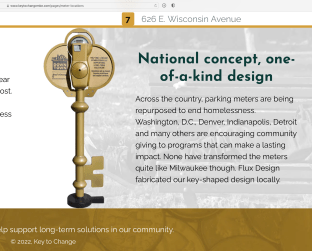
3. Detail of bottom page shows the parking meter has been transformed into a giant Key, with solicitations (from the public) stating what purpose donations are for, but not (on its front at least) to whom they go. It also mentions “Flux Design” as the designer.

1. Meter Locations on a map of (downtown) Milwaukee; see fine print description to the right.
On the website KeytoChangeMKE.com the fine print doesn’t reveal this; only the Pledge Form does, and even that form, only at the bottom is Payee named. I notice the pledge form url contains domain name “Shopify.” I’ll post two imore mages for the single page (top and bottom) to magnify the words.
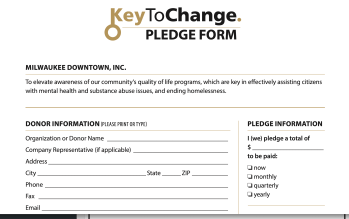
KeyToChange. Pledge Form (TOP) Accessed Sept. 10, 2022 (for post I published today) from Milwaukee County DHHS website on Housing First)

KeyToChange. Pledge Form (BOTTOM, see “Make Check Payable To”; notice “I (we) would like our donation to go toward: with option to check “Housing First Endowment Fund,” i.e., within Milwaukee Downtown, Inc.) Accessed Sept. 10, 2022 (for post I published today) from Milwaukee County DHHS website on Housing First)
[END OF “FOREWORD” section.]
(MAIN CONTENT HERE; FOREWORD image overlaps some):
I often wonder whether if there were fewer nonprofits (effective, ineffective, warring, and or just “there” below the surface), there might be more tax revenues, more justice, and fewer people held artificially too long on the margins of society: many times on main street, but still living marginally.
Let me re-state that: I often wonder whether if “non-profit” (i.e., tax-exempt) status for private entities — ALL of them — was removed– including for religious groups or other ones exempt from even having to file tax returns, not only churches — this sector wouldn’t attract so many unethical sorts and so effectively hide the money trails.
I know nonprofits also attract truly sincere volunteers (not that sincerity means diligence in exploring and considering the financials, the reports and statements in the appropriate forms) we might be better off, over all. Is it really necessary for a nonprofit executive to make, as some really do, salaries over $1,000,000 (or, even over $500,000 or $750,000) to outsource someone else to decide who gets the grants and who manages the investments, and how wide to spread the individual enterprise. Sometimes that high-salaried person isn’t the chairman of the board, but an executive director. Others don’t always make much — but what would these make in fair competition with people NOT working for well-endowed nonprofits backed by corporate wealth, government wealth, or a combination of the same?
I say this after a dozen years of diligently looking for and reading (thousands of!) tax returns, and probably thousands of audited financial statements, connecting the dots (where feasible) between and among nonprofit after nonprofit with an emotionally and financially closer relationship to government than to the people they are supposed to be helping. I have a basis for saying: “it’s NUTS out there!” and “you have NO idea” how many entities exist within the average state or county program, which may have been organized and promoted nationally to start with. //LGH.
Post Title and Short-link:
Accounting Literacy (Recognizing RICO and other Deceptive Practices) Is THE Language to Master and of the “Masters”; Cause-Based PolicySpeak is Deliberately Dissociative and Dysfunctional [Most Written Jan., 2020, Current Commentary, Sept. 10, 2022]. (short-link ending ‘-c5h’). This post is under 6,000 words long.. With post-publication (Foreword) additions, make that under 7,000 words.
This post doesn’t show how to “recognize RICO” — there are sites that do outline it, define it, give examples, by lawyers who’ve prosecuted for it. There are official descriptions of what it is. I’m just here pointing out how ripe the field is for racketeering within and across government and private sectors when the public doesn’t become aware and maintain that awareness AND talk about (and in terms of) entities and in accounting terms besides the occasional word “budget” or, more often “budget deficit,” without reference to assets and liabilities.
Understanding what RICO is and can look like I believe is helpful in understanding what an UNcorrupt — or at least far less corrupt — system or enterprise would look like, and how we might recognize and correct when it goes off-course.
It’s a matter of basic awareness of operating terms, concepts, vocabulary and (as it were) “moving pieces.”
What is the bottom-line? What’s the lowest common denominator of government and of our lives in relationship to our governments?
It’s not just “government service effectiveness” by subject area.
To understand the condition of any major public (i.e., government) cause, sooner or later you must understand that the involved actors (entities), at any point in time, are going to come from different sectors, and when these have names that are other than individual human beings’ names, these actors must link at some point, generally, to some recorded business (= private)* or some recorded government (=public) “entity.” Private and public regulations differ.




 Let's Get Honest! Absolutely Uncommon Analysis of Family & Conciliation Courts' Operations, Practices, & History