Archive for March 2014
A Different Kind of Attention Develops Sound Judgment [Original, March 23, 2014. Reformat + Reminders March 14, 2017][+July2017]
Post title with case-sensitive, WordPress-generated short-link ending “-2qM”:
A Different Kind of Attention develops Sound Judgment [Original, March 23, 2014. Reformat and Reminders March 14, 2017, Three Years Later]. The post is too long. On the other hand, I take on key entities involved, do some drill-downs, and put timelines and participant names to cover-ups.
Apparently I am not showing solidarity within “the movement,” said a comment below (see “Comments”). I responded to the assumption that the “movement” (coalitions, groupings of professionals towing traumatized parents around for show-and-tell, and encouraging them to tell their stories as a platform to the reforms wanted by the groupings of professionals [“Let’s get yet more Technical Assistance and Training (domestic violence consultants — aware of the custody issues) in there” — like us and our friends”] was really “the movement” and that those so engaged had battered mothers’ or the public best interests even as a priority.
Post in Update Process. Recent (Oct. 2014) introductory material will may be reduced shortly.
I tend to revise published posts as my understanding increases, and often in the process or drafting a related one. Here, I felt inspired to elaborate some more on the role of the Ford Foundation, Center for Court Innovation, MDRC, and the economic influence on setting in motion systems-change elements (including court changes) at public expense.
This is a recent find when I was explaining and showing the Center for Court Innovation to a person completely unfamiliar with it. It didn’t take too long for the individual** to “get”once the tax returns and other materials were shown in person. It probably also helped the understanding process that the individual was familiar with project development and budgets, and hadn’t been indoctrinated NOT to talk finances or economic systems through any court advocacy group which is more interested in selling books, promoting conferences, and getting in on the “train the trainers, educate the judges” routine…. **Incidentally, said individual was a man, not a woman with a cause, or in trauma or fight-or-flight mode regarding the safety or even location of minor children. Not a father with either of those two situations. Just a guy.
It’s not rocket science– it’s just a different kind of attention, and but, yes, it still takes sustained attention and awareness of what kind of information one is focused on absorbing.
NYC 2014 BUDGET — READ! Center for Court Innov got $400K (Fund for City of NY not mentioned), Man Up, LIFT, Vera — ec (439pages…) About 61 pages of summary, followed by a few hundred of fine-print detailed tables, “Appendix A”. <===CLICK THE LINK TO SEE IT ALL.
Qualifiers (added 2017, now that I can do screenprints) — this Report is a Schedule C, dated June 2013, of Adjustments to the FY2014 Budget for the City of New York.
I wish to point out the use of the name “Center for Court Innovation” associated with the EIN# for “Fund for the City of New York,” which this document shows…instead of the EIN# & legal business name “Fund for the City of New York,”
In, fact the Fund (in association with this “Center”) was identified a few times up front (the phrase “Fund for the City of New York” does occur repeatedly throughout the document, the words Center for Court Innovation” just a few times. However, that “CENTER” is not its own entity, neither government nor business, but (as described on its website) a joint project from the Unified NYS Court System AND the (tax-exempt foundation) Fund for the City of New York.
Here are some screenprints from the front of that budget, and a few showing the use of both the Fund for the City designation (with EIN#) and the “Center for Court Innovation” (without; in fact an “initiative” is actually named CCI). MY main point is — be aware of this powerful combination, and of the CCI, as its intents (tax returns and related entities do show) are to test programs, then go national (outward from NY) and international with them. Click any image (in this section on FCNY+CCI) to enlarge; you have the NYC 2014 Budget (Sched C Adjustments) link above.
Among those shown, the light-blue captioned image here, top line of the chart refers to a certain Adolescent Portable Therapy Program under agency DOP (Probably Dept. of Probation) The second row reads “Alternatives to Incarceration (ATI) and was recommended to receive much funding, and the third, “Center for Court Innovation,” $400,000.
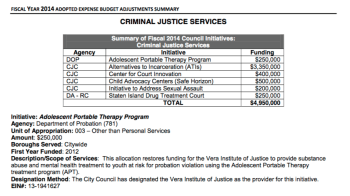
Here a “Center for Court Innovation “Initiative” through Agency “CJC” is allocated $400K. Notice also the Adolescent Portable Therapy Program (APTP) by the Vera Institute — this is an “import” from a UK group (Anna Freud Centre), or at least featured by it.
I also took a closer look at “Adolescent Portable Therapy” in NYC and who’s referring youth and their families into it.
The light-blue caption (Image referencing “Adolescent Portable Therapy Program”) in association with the CCI initiative under “Criminal Justice Services” (from that Budget Adjustment Schedule C).
Enough was found to move to a separate post, however I’m leaving one of the referring agencies, nicknamed “CASES” and showing its recent increases in Total (Gross) Assets for a joint of reference.
Total results: 5.** Search Again.
| ORG. NAME [“CASES”] | ST | YR | FORM | PP | TOTAL ASSETS | EIN |
|---|---|---|---|---|---|---|
| Center for Alternative Sentencing and Employment Services | NY | 2017 | 990 | 44 | $8,879,354.00 | 13-2668080 |
| Center for Alternative Sentencing and Employment Services | NY | 2016 | 990 | 38 | $8,330,660.00 | 13-2668080 |
(**Above: I added two more years, YE2016 and 2017, of search results during Aug. 2018 (slight) post cleanup).
| ORG. NAME [“CASES”] | ST | YR | FORM | PP | TOTAL ASSETS | EIN |
|---|---|---|---|---|---|---|
| Center for Alternative Sentencing and Employment Services | NY | 2015 | 990 | 39 | $8,229,096 | 13-2668080 |
| Center for Alternative Sentencing and Employment Services | NY | 2014 | 990 | 32 | $5,288,689 | 13-2668080 |
| Center for Alternative Sentencing and Employment Services | NY | 2013 | 990 | 31 | $3,916,408 | 13-2668080 |
SHARE THIS POST on...

Suppose I’m Right, here. . . What Would You Do when the Lights go On? [Published Mar. 5, 2014].
[post is 20,000 words [3/6/2014], will probably be split in half later. Has many examples. Much of this length comes from a TAGGS table of “Faith-based” grants]
(Suppose I’m Right, here. . . What Would You Do when the Lights go On? [Published Mar. 5, 2014]. <=includes case-sensitive, WordPress-generated shortlink ending in “-2os”).
See also nearby post published 3-23-2014, “A Different Kind of Attention Leads to Sound Judgment” also being reformatted in 2017). I have upgraded the blog (allowing more media storage of the type of image used to SHOW what I’m talking about in annotated screenprint form). If and where you see an annotated screenprint (of a tax return, or any other web page) in THIS post, it’s been added recently, and may contain information which came on any entity discussed since this post was first published three years ago (as I now write). I also incorporated these two post titles, shortened & with publication dates, into the blog motto and moved the former “Uncommon Analysis” motto into the blog’s Title (which now will display on window frames in most browsers, below the individual URL open at the time). “Different Kind of Judgment” title now reads:
A Different Kind of Attention develops Sound Judgment [Original, March 23, 2014. Reformatting and Reminders March 14, 2017, Three Years Later]. [<== Post title with case-sensitive, WordPress-generated short-link ending “-2qm”]
Upgrading the storage capacity of the blog affected its fonts and color display; in addition since producing more (though not 100%) complete Tables of Contents in easier-to-view (and click to access) word-processing (printed to clickable pdfs) format, I found myself increasingly bringing back some formatting techniques I just did not have earlier on, into the earlier posts, as well as (for some key posts) writing 2017 updates on organizations, entities, and initiatives I did notice and name back in, for example, 2011 and 2012. //”Let’s Get Honest,” writing 3/15/2017.
P/REVIEW (3/15/2017): Despite the length, this post has many single sections, many are clearly marked inside thick-bordered boxes with colorful background, which I believe distill and explain the problem mothers face when attempting to make sense of their treatments in the family courts after identifying and reporting abuse (of themselves or their children) IN the courts.
To Whom It Concerns — Suppose I’m Right?
. . . . In general, and in what I’m about to prove, right now? . . . . Suppose that when I report what I see (and hear), I am seeing and hearing quite well, based on my report versus independently observed reality?
Even though it’s quite the minority opinion, suppose it’s far closer to the mark than others?
In fact years after some of this started hitting the Internet, people reporting consistently, diligently (and accurately) on these matters are so few and far between that we get confused with each other by outsiders, the language is just that different. “….all you people look alike….”
To Whom It Concerns among the:
- 254 or so followers, [@2017 — now over 1,000. Not that this is a lot, but it is a change…”followers” referring only to those who’ve submitted email addresses to be notified on each new posts; not to be confused with visitors, which count is much higher over time…]
- Others who receive each new tweeted post because they follow Lets Get Honest on Twitter, or
- Among those I report on, and who are monitoring to see how much, how close to the mainline truths are “out” so far, (bloggers do get to know this in back-office functions; I’ve even posted a few samples on an About This Blog page, i.e., who was watching this blog when), and are curious if and when their gigs are up;
- Or those who click after reading some comment I submit elsewhere along the lines of “get real!” or “What about this?” that indicate some of us simply don’t talk like the others, when addressing:
Family (and Conciliation) Court Matters
(and an Uncommon Analysis of the Operations, Practices & History, thereof)
Suppose I’m right?
Some holes are fathomless, they seem to have no end. But, suppose, we have already hit the bedrock, here in this blog[*], of: Fundamental, Urgent and Relevant Truths — what would you do when the lights go on?
[* including the many links to other sources, but what’s here, is my assembly of that information, my general roadmap, and “Analysis.” Incidentally, it’s also copyrighted to me, Let’s Get Honest (i.e., this blogger), except where quoting other copyrighted material, and subject to wordpress Terms of Use]
Or is the dark more comfortable, because the lights tend to show things that need to be cleaned up,
. . . . .for example nationally respected [by whom?] experts and consultants whose Don’t Ask Don’t Tell policies on major aspects of the truth is resulting in too many dumbed-down, distracted and misled mothers,
. . . .who (have been) willing to mortgage the greater truth [entire categories of it] for a stripped-down version, minus accurate vocabulary and plus folklore on “how and why judges (etc.) make decisions,” but at least with the press coverage of the personal drama, and a nice supportive group of on-line friends who also don’t do lookups, use TAGGS, or apparently question their leadership much, but are quick to fight back in comments fields others who do.
Over time, while new generations of roadkill, children STILL being murdered in or around supervised visitation (or court-ordered) exchanges, sometimes and/or with the father, or mother, other times with bystanders — and lives are disrupted (and bankrupted) — the conversation from this assembly of experts has barely changed, except “hitch your story to this wagon, and hope for results through self-selecting intermediaries…” and they have now picked up, year by year, more connections with the “court-connected corps” crowd, who are hardly about to get confronted on matters such as relate to misdirected, diverted, and otherwise inappropriate federal grants to the states [i.e., such as some of us DID report on] to help increase the misery level in the average contested custody case.
Other than what I’ve been saying (show and telling) all along, the next two to three posts, I have recently seen and come to a (firm) understanding of some rock-solid and hard-to-accept truths. BUT, I believe the assessment is good. First, let me outline them (and it is in out-line form).
Then, below, I’ve referenced some math (proof) terms, i.e., Proof is a Process with Elements. Propaganda, on the other hand, is a swirl of insinuations. My “SUPPOSE” are in “SUPPOSITION” format, an IF/THEN process. I feel we have to first establish that it matters! And that truth (or at least proofs of it) have a form. So the words:
LEMMA, THEOREM, PROPOSITION, and COROLLARY — we’re talking, how to talk some sense, instead of NONsense — have to make an appearance. Look for this photo, below (twice):

Etymology On-line (good reference for understanding words’ origins). It has an index; all definitions below from this:source.
lemma (n.)
1560s, first in mathematics, from Greek lemma (plural lemmata) “something received or taken; an argument; something taken for granted,” from root of lambanein “to take” (see analemma).
So the word “lemma” apparently means “taken,” (“taken for granted,”) or in our terms, we might call it the opposite, a “given.” (“Given that so and so is true, then . . . . “)
analemma (n.)
You’ve probably heard of this next word — which means, “oh my, both can’t be right– I’m going to have to choose between two.” Hence, “di-lemma.”
dilemma (n.)
So the “Lemma” is a sort of given; next words: the Corollary, is something attached to it — “if that’s true, so is this” — a PROPOSITION is putting them side by side to come to a conclusion about the situation, and a THEOREM is a little stronger, we got something going there as to truth…
corollary (n.)
The corollary to be “correlated” must actually come from something proved, and it’s not a corollary unless logical deduction was the path from one to the other proposition.
I guess if someone hits two (truth) birds with one stone, that’s rewarding — a corollary. If one is looking to assess the situation, and by determining whether or not ONE proposition? (or “lemma,” whichever!…) is true and then obviously there’s a corollary, it’s like a bonus point in the pursuit of truth. the pursuit of truth, for example, is important when one is in protection, survival, rescue, or defense situations — or simply looking to understand what’s going on!!
proposition (n.)
theorem (n.)
Proposition is “let’s discuss it.” Theorem points towards something seen (evidence which can be beheld — viewed — looked at).
Pythagorean (adj.)
So, language really counts; it matters. To SPEAK (on-line, includes to write) means placing words into a coherent (or incoherent) pattern of statements, either at one place and time, or many places, over time.
When someone’s, or some group’s, or group of groups’ (including but not limited to self-selecting group of professionals within certain fields) SPEECH continues incoherent (in meaning; things don’t add up) — this could be accidental, because the speakers are distracted or somehow disabled (for example a PTSD state or outside influence may be involved). Or, you could be listening to a sales pitch designed to distract.
Over the long-run, if it’s consistently internally and externally incoherent, it’s likely intentional, and designed to manipulate, not just persuade through reason. There could be a group motive; i.e., what’s the relationship with others outside the immediate conversations? What is the pattern of the other relationships in the room? When they are better known (which takes some time, and definitely some attention, some lookups), probable intentions and motives become more clear.
So that’s what we’re looking at here.
I’m not a math brainac (and don’t even do calculus), math and logic are about proof and disproof. But if things don’t add up, they just don’t add up, so why continue yakking along the same lines, or listen to others who do?
Would it not help to have some way of screening the information, or sorting it (INbox, OUTbox), to distinguish “doesn’t add up” from “adds up,” and to make better decisions on when “where do I put my focus and spend my time, en route to regaining contact with my kids, staying alive (or keeping them alive), with a long-term view to figuring out whether OR NOT these family and conciliation, problem-solving, holistic, unified, high-conflict docket (etc.) courts are worth saving and fixing, and/or whether a more appropriate practice for the public (nationwide) might be quarantining them, or administering a shut-down, like any hazardous waste, or hazardous construction zone — or HUD slumlord property, someone’s real estate investment en route to a political career — as unfit for human habitation?
SHARE THIS POST on...

Table of Contents (Posts, most Recent First)
|_|_|_|_|_|_|_|_|_|_|_|_|_|_|_|_|_|_|_|_|_|_|_|_|_|_|_|_|_|_|_|_|_|_|_|_|_|_|_|_|_|_|__|_|_|_|_|_|_|_|_|_|_|_
The Table of Contents, titles and links, is a visual panorama of the blog.** If this subject matter grips your gut-instinct, catches your attention — first, look at some of the evidence.
**UPDATE: Make that, a visual panorama of how free blogging platforms lose their formatting as you can see at the bottom (titles of posts, and many links remain, but now rows and columns do).
For a colorful, orderly Table of Contents, many with abstracts, click HERE (“Posts, Most Recent First”) …
…actual Table of Contents, with a link to every single post April 24, 2012 back through Sept. 24?, 2012.
For Summary/Introduction, keep reading.
Start seeing where to find more. Take some time, rub your eyes, look again. Search, start doing lookups yourself, until the process of searching, I hope, awakens some curiosity, and that “say WHAT?” as it did with me, drives you to want, and get, understanding! Get to the point where you can show and tell, not just “quote and tell.” Trust me, please, when I say that, “the answers needed most are NOT in mainstream media,” Symptoms, yes. Answers, No.
Trust me please, when I say that when you let others define the problems, you have just let others limit the answers. And that once you at least consider looking at: Grants, Corps (court-connected corps) and Tax Returns — things start to flow together better. Put that in a historical context (WHOSE idea were these courts anyhow?) and understanding can be built.
Search, click, look, go “Hmm!…” and repeat — goes a long ways when you’re within range of a vocabulary that leads to something solid you can actually look at a government, or IRS database from.
Then please start talking with others (or, if you want, with me) about those topics; if you want to talk back, every post has a comments field, and there are even a few feedback forms [Here’s a Feedback Form (and a LONG rant about DV agencies)]. If you quote me, link to that post, and cite to this blog, like I do to others’ work!
The Table of Contents is a work in progress, chronological backwards in time, while as I can, the blog is moving forward.
And the introduction getting a little longer. Please utilize scroll bar if this annoys you, or read if it does not! Shutting up is not my long suit.
Check back periodically, for a larger listing, or more links to individual posts, as I can. Until (which project is still an IF) the table of contents is complete, for any post listed below that doesn’t yet have its hyperlink, or for unlissted posts, the date can be used under blog’s “Archives” function (sidebar). The blog goes back to 2009, but so far this Table of Contents does not. In fact, some of the material is so rarely even covered, you also might get to a certain post lacking the direct link, by a simple searching Google for its title.
Another issue — I’m UNsticking what are marked sticky posts (so more current ones stay closer to top of blog), but leaving the designation in the left column. The left column marks ones formerly sticky or that I otherwise consider keynote, or critical information to understanding the system.
This information requires a different kind of attention span and for most people (particularly people who may come to this blog because of a custody horrors case) the ability (which is basically just a decision) to look at this very large, very complex problem with nonstandard vocabulary. I assert that this vocabulary MUST include the economic/corporate-government factor (the “Operations”) in terms that convey meaning to those who use them.



 Let's Get Honest! Absolutely Uncommon Analysis of Family & Conciliation Courts' Operations, Practices, & History