Posts Tagged ‘“A Common Thread of Service: A History of the Department of Health Education and Welfare” [“HEW”] {@1972] See also “FSA” Federal Security Agency (predecessor)’
Happening NOW: Locally and Within the USA, Matching Nonprofits to Legal Entities and Tracking Them Remains at Best (for Most) a Messy, Expensive and Unreliable Process, But Internationally — More Streamlined, Monitored, and Standardized for Faster, Easier, and More Profitable Trade. See FSF, FSB (G20-formed, 2009), LEI Legal Entity Identifier [global database + system], GLEIF (Swiss Foundation), LOUs (who issue LEIs) and ‘KYC’ (Know Your Customer) [Publ. Nov. 23, 2017].
Post Title with Shortlink…
Happening NOW: Locally and within the USA, Matching Nonprofits to Legal Entities and Tracking Them Remains at Best (for Most) a Messy, Expensive and Unreliable Process, but Internationally — More Streamlined, Monitored, and Standardized for Faster, Easier, and More Profitable Trade. See FSF, FSB (G20-formed, 2009), LEI Legal Entity Identifier [global database + system], GLEIF (Swiss Foundation), LOUs (who issue LEIs) and ‘KYC’ (Know Your Customer) [Publ. Nov. 23, 2017]. (case-sensitive short-link ending “-7To”; moved here Nov. 3, 2017, publ. Thanksgiving Day). (About 8,000 words with some post-publication revisions).
…and Geneaology.” Where it was moved from (which post also has its own “Footnote Post” published 11/22/17):
Before WHO’s HiAP there was UN’s Agenda 21; As Usual, Internationally-Networked Nonprofits such as ~ ICLEI-Local Governments for Sustainability USA, Inc.** ~ (1991ff, MA legal domicile; first HQ in Boston, then Berkeley, then Oakland, and lately Denver) Help Spread the Latest Version of the Global Gospel. (with case-sensitive short-link ending “-7N2,” post started 10/14/2017 as one of two spin-off posts from my “HiAP” one; being published ca. Nov. 3)
Miscellaneous (blog-related) FYI: Images here (and as a rule) are clickable to enlarge unless otherwise noted that clicking on them will lead to the website quoted. Sometimes quotes and images may display similarly; one indicator is that the images usually have borders and a caption. And are more likely to have logos, photos, etc. I’m about to stop saying this on each caption, to simplify image captions and save space on them. “CLICK IMAGE TO ENLARGE (if needed) is the default…. Why: One drawback of linking directly to the website is that websites change so often, links later end up broken. A saved image, however, is a saved image (Printed from the website, saved as “png” or “Pdf” files on my computer, then uploaded and stored on this blog domain; not the Internet-at-large. I’ve been blogging for over nine years; “change happens” in those URLs meanwhile!!).
Foreword.
As detailed as my post titles are, they typically don’t name all topics covered in the post. The next two numbered paragraphs summarize what didn’t make it into the title but did into the post. Between numbered paragraphs (1) and (2) I added a quote and images reviewing the background and timeline of the HHS and its previous incarnations as it relates to these topics.
Para. (1) is just below this Foreword, and starts:
(1) This post also contains a section reviewing the greatest ad agency of the 20th century (Lord & Thomas) and the philanthropist Lasker family’s (who controlled it since the early 1900s) political and HHS-expanding* influences…
For reference and because of the sizeable explanatory gap between them, Paragraph (2) starts:
(2) Oh yes, “Choose Chicago” is the name of aI 2012-formed 501©3, with a board of just about three individuals, but it’s related to and was formed by a different 501©6 dating to 1970.
The TOP “HALF” OF THE POST deals with FIRST HALF OF ITS TITLE, demonstrating how messy it can get following LOCAL nonprofits (Prime example: Paragraphs (1) and (2) as mentioned above).
The BOTTOM “HALF” (not including a “experiential footnote” section at the bottom) CONTRASTS BY SHOWING EFFORTS TO STANDARDIZE AND ORGANIZE INTERNATIONAL ENTITY TRACKING AND IDENTIFICATION. This section has less explanation and more and larger images in a series numbered “#1/11” through “#11/11.”
TWO MAIN TOPICS, but in “A-B-A” format: The post has basically two subjects, but as previously written, then expanded to add the HHS background and “Choose Chicago” IRS Form 990 tables (in interactive format), I see there are actually three major sections, making for an “A-B-A” format: the third section (after the 11 images and International section with all those acronyms: LEI, LOU, GLEIF, KYC etc.) returns to the subject matter of both ad agency and Choose Chicago. Then there’s a minor commentary footnote at the very bottom. Switching it back to “A-B” format I feel would push the International Section too far down on the page, also some of the third section may be review for people who have been regularly reading the blog or followed my posts on Tobacco Cessation and Big Tobacco Litigation, Settlements, etc.
Different sections are shown by large subtitles. The first two are easily seen, and here’s the third (the return to original subject):
Two Famous Ad Agencies, one succeeding the other, and a client, “Choose Chicago” and related philanthropy
In General. What concerns me is where nationally-based errors (which are built-in and at times, “beyond belief” for how large, and how many they are, based on what I’ve seen so far as just a single blogger, though I say a consistent and diligent one) will be uploaded to the global level, let alone who will control it. If you amplify corruption, you get more corruption concealed, potentially, and harder to fix.
Consistently dishonest reporting on nonprofit entities is corruption. I’m not sure the international level of business identifiers referred to here is directed at the nonprofit sector, but it comes along with the corporate sector; they are interlaced and “joined at the hip” through funding and asset investments. We are dealing at the G20 levels in this topic. (See “G20.org” for more info.)
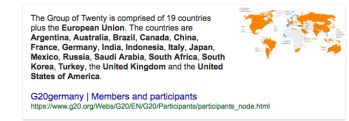
Just a reminder….(Google Search results). Click here (G20Germany.org) to expand the map and for more info.
A few reminders of who are the G20, the G7, and its purposes:
Quote July 2017 from “theBalance.com” should be taken “as-is” (website uses independent contractors as contributors):
What does the G-20 Do? | World Leaders Address Terrorism, Climate Change, and Economic Crises, by Kimberly Amadeo in “The Balance” (Updated July 18, 2017)
The G-20 is the G-7 plus developing nations such as Brazil, China, India and Russia. The G-20’s members represent two-thirds of the world’s people and 85 percent of its economy. Since 2007, the media has covered each G-20 summit. That recognizes the members’ role as significant drivers of the world economy.
The G-20’s primary mandate is to prevent future international financial crises. It seeks to shape the global economic agenda.
It lends the perspective of Asian and Latin American growing economies. That “broadens the scope of international economic and financial cooperation.” (Source: “The Group of Twenty: A History,” G-20 Study Group, 2007.)
The finance ministers and central bank governors of the G-20 countries meet twice a year. They meet at the same time as the International Monetary Fund and the World Bank. (Source: “G-20 Information Centre,” G-20.)
In 1999, these ministers and governors created the G-20. They needed dialogue between developing and developed countries. They were responding to the 2007 Asian currency crisis. The meetings started as an informal get-together of finance ministers and central bankers.
2017 Summit Meeting
July 7-8, 2017: Hamburg, Germany. The meeting focused on climate change and global trade. It made little progress. U.S. President Donald Trump opposed the views of the other 19 countries.
From the G20.org website (Germany was President in 2017, and the meeting in Hamburg in July 2017). Some general facts: (I replaced “bold” with “underline” here):
Partners – key international institutions
At the invitation of each Presidency, international organisations also regularly attend the G20 meetings. These organisations include the International Labour Organization (ILO), the International Monetary Fund (IMF), the Financial Stability Board (FSB), the World Bank (WB), the World Trade Organization (WTO), the Organisation for Economic Cooperation and Development (OECD) and the United Nations (UN). The German G20 Presidency has also invited the World Health Organization (WHO) in 2017.
Participation – the most important guests
Spain attends the G20 Summits as a permanent guest. The Presidency can also invite representatives of regional organisations and guests to the G20 Summit. The German Presidency has invited Norway, the Netherlands and Singapore as partner countries to the G20 process, as well as the African Union (AU), represented by Guinea, the Asia‑Pacific Economic Cooperation (APEC), represented by Vietnam, and the New Partnership for Africa’s Development (NEPAD), represented by Senegal.
And in case there is any question whether the 2008 financial crises led to the formation of the G20, and from there, a Financial Stability Forum and “FSB” (Financial Stability Board) now resulting in the global LEI system, second decade of the 21st century, with (see the 11 images below) intent to better control “Shadow Banking”, next image also from G20.org says this:

This time, Click IMAGE to access website. (G20.org describing role of 2008 crisis in elevating participation to the “heads of state” from central bank leaders, etc.)
Also interesting is how recently this level of business identifier was developed. It’s still evolving and registration I’m sure so far is incomplete.. [End “Foreword”//LGH.]
Identifying Underlying Realities* Domestically and Keeping Track of them over Time: “How Messy It is!”
*MATCHING NONPROFITS TO THEIR OWN LEGAL ENTITIES AND FOLLOWING THEM IN, FOR EXAMPLE, THE PRESS OR OTHER (LIKE “WIKIPEDIA”) DESCRIPTIONS.
See first ½ of post title:
(1) This post also contains a section reviewing the greatest ad agency of the 20th century (Lord & Thomas) and the philanthropist Lasker family’s (who controlled it since the early 1900s)political and HHS-expanding* influences, then checking back in with current successor ad agency Foote Cone & Belding(“FCB”)’s new CEO (German, in the process of becoming an American citizen) and according to some descriptions (incl. “Wiki”) one of FCB’s key Chicago clients, “Choose Chicago,” promoting international (especially from mainland China!) tourism to this Great Lakes City.
*(so to speak; HHS was only formed in 1980, predecessor HEW in 1953, before that see “FSA” (Federal Security Agency) (Suggested review includes at ALLGov.com, or @ HHS.gov (Highlights)
(This, and next image, from “ALLGov.com”)
One of the largest civilian departments in the federal government, the Department of Health and Human Services (HHS) oversees the implementation of numerous health and welfare-related programs. HHS’ budget accounts for almost one out of every four federal dollars, and it administers more grant dollars than all other federal agencies combined. HHS’ Medicare program is the nation’s largest health insurer, handling more than 1 billion claims per year. Medicare and Medicaid together provide health care insurance for 25% of Americans. Many HHS-funded services are provided at the local level by state or county agencies or through private sector grantees. With its large size also has come a large number of troubles and controversies involving birth control, prescription drugs, food safety and more. …
[[See next annotated image for Public Health Service (1902) with Food and Drug Act, NIH (1930), up through Carter Administration’s 1980 HEW becoming in part, the HHS + (separated from “HEW”) the DOE (Dept. of Education). Not referenced, but generally known — a few World Wars, Korean War, Viet Nam War meanwhile, and (less well-known but still relevant) Congressionally-granted (to the U.S. President) the authority to reorganize the executive branch, particularly relevant and utilized by FDR in 1939 (on the eve of WWII) and not rescinded until 1980. Basically, it seems the drastic expansion of what is now HHS occurred during the years this Reorganization Authority was in force.
Read the rest of this entry »
SHARE THIS POST on...

UNESCO’s IIP@Rutgers|”Partners” + ISD and the Strong Cities Network (Reorganizing the World through International Strategic Institutes, cont’d.)
Obviously terrorist events may happen while one is in the middle of doing something else. Also true of the miniature versions of this, domestic violence incidents, which can also be terrorizing in that they’re not just single-events, they tend to be ongoing, deliberately unpredictable, and with the ultimate goal (typically) of control and exploitation. There’s a lot more in common with the two scenarios — and with the state’s response to countering them, I just learned today while reading a US Ambassador’s speech in Berlin on how some of the “best practices” in preventing radicalization of their own legal citizens.
The Global Campaign Against ISIL, ….continued
Annual Meeting of the Federal Office for the Protection of the Constitution
The Islamic State – A Global Threat Berlin, May 2, 2016 Ambassador John B. Emerson
Speaking of Strong Cities, and Munich, most of this post (obviously not the part referring to the shootings) written yesterday 7/21/2016 revisited “Strong Cities Network” only because I got two of the similar but not identical sounding international institutes for strategic studies and peacemaking dialogues for a more sustainably developed world presided over by — of course — the UN (Anglo/American/European primarily) ….and both of these were also headquartered in a London-based charity

“The SCN is made up of mayors, municipal-level policy makers and practitioners united in building social cohesion and community resilience against violent extremism in all its forms. The global network is currently made up of 56 cities with membership set to grow to around 200 by the end of 2017. Membership is completely free of charge.”
The shooting happened Thursday evening, but by the time I learned about it, I had already written this below. Because of the type of studies I’m doing, including curiosity about such things as why the United States Department of Justice does not provide for the public a functional Grants Distributed database (there appears to be some disjunct, inflexible pages listing grants by year AND by title or type — but nothing comprehensive or really functional for the public to study any of the various funded programs, so many of them aimed at PREVENTING violence).
This is an announcement from “De.USEMBASSY.gov” I believe the website would be US Department of State.
I’ve quoted it also further below.

U.S. Embassy Berlin Security Message for U.S. Citizens: Travel Alert Europe
June 1, 2016
As part of the State Department’s continuous efforts to provide Americans travelling abroad with information about relevant events, we are alerting U.S. citizens to the risk of potential terrorist attacks throughout Europe, targeting major events, tourist sites, restaurants, commercial centers and transportation. The large number of tourists visiting Europe in the summer months will present greater targets for terrorists planning attacks in public locations, especially at large events. This Travel Alert expires August 31, 2016. ……
And now that “MUNICH” has happened, an addendum at the bottom of this US State Dept. message (latest update, 21:33 presently, shows at top of page; I switched the only other one on there, “19:52”, to first place).
Emergency Message for U.S. Citizens: Shots Fired at Multiple Locations in Munich
[19:52] Media is reporting shots fired at the Olympia shopping mall in Munich, Germany, resulting in casualties. There are subsequent reports of shots fired in other locations in Munich. There is a major police operation underway. Mass transit around the city is also reported to be halted during the police operation.
[Update 21:33] Media are reporting that Munich authorities have declared an emergency using the city’s smartphone warning system. Residents have been warned not to leave their homes: For your own safety, avoid squares and streets: perpetrators are on the run. Train and bus transport suspended. Turn radio and TV on. Munich’s mainline railway station is closed, and mass transit remains halted.
U.S. citizens are advised not to come to the U.S. Consulate due to the uncertain security situation. Continue to shelter in place, contact your family members to let them know you are safe, and follow the instructions of police and emergency personnel. Continue to monitor local news stations for updates. Maintain a high level of vigilance and take appropriate steps to enhance your personal security.
Since this is an added section to my post, I’ve given it the different background color you can see starting with the first article. Below that background color is the previously-written post on the Rutgers Institute for International Peace “Partners Page” with the material I’d added on Strong Cities Network last night, as a matter of general public interest
This section has: four brief news links on “MUNICH” (ABC News, The Telegraph.UK, the Guardian.UK, and (link only) The Financial Times (published I believe also in the UK), and Two on Strong Cities Network (A Briefing Paper #2, and a May 2, 2016 speech posted at US Department of State (I think it is) — same site as the warning to US Travelers’ above — on the Global Threat of ISIL by a US Ambassador to Germany, and probably given in Berlin. It has some important information and indicators I felt readers should know — which ties into the family counseling / family law sector practices over here, vis a vis “Violence Prevention.” But I will discuss those parts separately.
Press and Some feedback on Munich mall shootings:
ABC News, “At Least 6 Dead, ‘Possible Terror Attack” Manhunt underway ”
SHARE THIS POST on...

Re-Organizing The World through International Institutes, Strategies, Dialogues, Peacemaking and Programs Targeting Fragile Families, Communities — and Countries…
Related posts:UNESCO’s IIP@Rutgers|”Partners” + ISD and the Strong Cities Network (Reorganizing the World through International Strategic Institutes, cont’d.) (next in this sequence, about to be published) and, because “Munich” happened meanwhile, “Munich,” and the Strong Cities Network [ISIL/ISIS aren’t the only ones who want to control the World] also upcoming)
Also, a shortlink (if you copy the url) to THIS post: ‘“Re-Organizing” The World through International Institutes, Strategies, Dialogues, Peacemaking and Programs Targeting Fragile Families, Communities — and Countries...
“Tags” were copied between posts, there is some overlap and some tags may actually be referring to the next one in the sequence, here, of three. As of first “Publish” this post is 9,300 words. It may [and did] change after publication.
I hope you enjoy this informational, conversational post which comes from a systematic lookup of “Partners” link at a single university website combined with my awareness of similar related activity. Read the “tags” for a generic idea of just a few organizations using the words shown in the post title. The post has undergone a few changes (significant, and to a middle section) in the two days after it was published on 7/22/2016 and is currently about 12,000 words. I expanded some on “MDRC” and because of its tax return reference to “Atlantic Philanthropies” which I already knew had been registered outside of the US for anonymity purposes, and which wealth was based on marketing duty-free products internationally, to military and tourists to start with, it got longer.
In the process of not shutting up or stopping “just one more” lookup, I discovered that the Atlantic Philanthropies which provided MDRC a $7M matching grant in 1999 (not long after it was forced into the public when one partner of the underlying company “DFS” (Duty Free Shops, I guess) decided to sell it for around $3.8B, and the other partner protested via lawsuit, resulting in a pre-emptive disclosure to the public of who — and where– it was.
It announced in 2002 it would be winding down (distributing everything), and I learned that, announced this past May, 2016, the two final largest grants totaling around $200M would BOTH go to British institutions — one of them which exactly matches this post title: “International Institute on Inequalities” at the London School of Economics (and the other to the Rhodes Trust to set up scholarships — see Fulbright, Rhodes famous scholarships — under the Atlantic Philanthropies name). This Institute was only launched in 2015.
Another major sponsor of the same institute was the well-known (in the UK) “Leverhulme Trust” (since about 1925), with the underlying corporate wealth behind it (Lever Brothers, later Unilever) involving a Lordship who made his initial fortune in SOAP on the backs of Congolese laborers, in part from a close friendship with the King of Belgium (per Wiki, anyhow). https://en.wikipedia.org/wiki/William_Lever,_1st_Viscount_Leverhulme (1851-1925).
A 2014 book by David Hollett (Amazon.com link) “The Dark Side of Sunlight – The Story of King Leopold, Lord Leverhulme and the Congo.” Abstract:
With a great deal of political manoeuvring, and the able assistance of the famous explorer, Sir Henry Morton Stanley, in 1885 King Leopold II of Belgium founded the Congo ‘Free’ State. However, this was not as a Belgian colony, but as his own private domain which extended to 905,000 square miles of Central Africa. Leopold then set up a system of forced labour under which millions suffered and died due to brutal treatment, exhaustion, hunger or disease. Eventually, in 1908, the Belgian government took control of the Congo away from Leopold and the worst excesses of his despotic rule came to an end. However the forced labour system established by Leopold remained largely in place. It is against this historical background that Lever Brothers, the soap manufacturers of Port Sunlight, became significantly involved in the affairs of the Congo. In 1911 the Belgian Government offered the company land “Concessions” to develop as oil palm plantations. A decade later William Hesketh Lever was controlling vast palm plantations, oil mills and a fleet of 74 steam vessels on the Congo River. In 1930 the firm was employing no less than 28,000 Congolese workers. The rise and rise of Lever Brothers wealth and good fortune was to continue, throughout the Congo and West Africa in general
A 1987 article in The New Internationalist is interesting reading on how the US fits in (what other brands were bought up, the UAC (United Africa Company) and more:
Today Unilever is one of the world’s largest corporations, employing
300,000 people and spanning 75 countries – with pre-tax profits in
1986 of $1.8 billion. This is the story from its humble beginnings
Three other things I noticed from Wiki on William Hesketh Lever — his involvement in freemasonry (founding lodges), and his practice of “monopoly”, as learned, it says, from the Rockefellers, it’s said, and with this wealth, buying up Villages or setting up model villages with which better to control (intrusively) the workforce. If THAT doesn’t remind you of current situations in the USA, urban areas and welfare policies, you are simply asleep! “PORT SUNLIGHT” (the brand was “Sunlight Soap”)
In 1887, Lever looking to expand his business, lought 56 acres (230,000 m2) of land on the Wirral in Cheshire between the River Mersey and the railway line at Bebington. This site became Port Sunlight where he built his works and a model village to house its employees. From 1888, Port Sunlight village offered decent living conditions in the belief that good housing would ensure a healthy and happy workforce. The community was designed to house and support the workers. Life in Port Sunlight included intrusive rules and implied mandatory participation in activities. The tied cottages meant that a worker losing his or her job could be almost simultaneously evicted.[15]Even workers’ social lives were policed from the head office. W.H Lever stated “a good workman may have a wife of objectionable habits, or may have objectionable habits himself, which make it undesirable for us to have him in the village.”[16]
REMINDER — my only connection of the above info. to this post comes by way of a look at NY-based “MDRC: Knowledge to Improve Social Policy”‘ involvement with Atlantic Philanthropies; the interesting history of Atlantic Philanthropies and its (first-generation US from Ireland) Chuck Feeney, and in that Mr. Feeney felt the International Institute for Inequalities at the London School of Economics, was worth a big chunk of the Atlantic Philanthropies’ final distributions, this Leverhulme Trust also agreed. In the US, the MDRC, studying the poor, is still maintaining $56M of investments, while taking $41M in government grants — I’d say something is “off-kilter” in that scenario.

Which all just goes to show why many philanthropies all around the world had BETTER make a good show of caring about the poor, given what they’ve done to perpetuate inequalities worldwide and maintain riches by avoiding taxation in the first place.
http://iip.rutgers.edu
The International Institute for Peace (IIP) at Rutgers University, Newark is a UNESCO Category II organization dedicated to peacebuilding, conflict transformation through nonviolent struggle, and the promotion of peace education and a culture of peace. The IIP builds partnerships locally and globally by working with grassroots organizations, youth leaders, activists, journalists, educators and researchers to promote peacebuilding, nonviolent conflict transformation, and just and sustainable peace. The IIP promotes research on issues of peace and conflict as well as education about peacebuilding and nonviolent struggle.
IF there was a genuine intent to relieve poverty within the US first, instead of restructure the world according to some private visions (and saving women overseas while attacking women, as women, in the United States, is a pretty sorry state of affairs indeed), it would not be done this way.




 Let's Get Honest! Absolutely Uncommon Analysis of Family & Conciliation Courts' Operations, Practices, & History