Archive for October 21st, 2018
Family Court Analysis {Lit., Breaking It Down* into Basic Elements} Is Still Too Uncommon! | Blogger’s Recent “No More!” Nomad Status (Generic Personal Info) | Impact of PTSD & Safety Concerns on My Two Writing Modes [Written mid-Sept., published mid-Oct. 2018].
Post Title: Family Court Analysis {Lit., Breaking It Down* into Basic Elements} Is Still Too Uncommon! | Blogger’s Recent “No More!” Nomad Status (Generic Personal Info) | Impact of PTSD & Safety Concerns on My Two Writing Modes [Written mid-Sept., published mid-Oct., 2018]. Case-sensitive WordPress-generated shortlink ends “-9gi.” Published Oct. 21, 2018.
* ..I “couldn’t” resist: (below: see Etymonline.com, or the “OED” for “Analysis” and how many related words — including “psychoanalysis” come from that root “leu” to loosen, dissolve, free, or (break it down into basic elements)… But I’m talking about the basic elements of “Family Court.”
How can so much analysis of how to fix family courts (or, as some call them, improperly, “custody courts”) so often omit and so confidently so many basic elements — such as: the membership associations (plural) driving policy; the related public funds beyond basic public funds for the infrastructure flowing to the courts and to “community services” the courts refer to and often mandate parents attend AND often pay for privately; and/or any quantitative OR qualitative analysis (or even overview of) the nature, character, and filing habits of such community service providers? {{the last phrase in navy blue font just added Dec. 2018//LGH.}}
What’s “analysis” about most common “syntheses” — such as protecting children IN the family courts, training professionals in “domestic violence awareness and sensitivity” — that omit key basic elements of the whole and skip straight to “what we want to do!” as if the analyses were complete — or as if organizations hadn’t been engaged in such trainings for decades, including how to dismiss or minimize it?
What’s “analytical,” even coming from expert (lawyers and psychologists) about omitting key evidence on the creation, maintenance, driving organizations, operations, and in general tendencies — basic character indicators — of the family courts as a system WITHIN a country attempting to standardize it ACROSS country lines, importing ideas foreign to the U.S. (specifically) Constitution itself as “best practices”??
What’s accurate and respectable about assuming that batterers’ intervention, supervised visitation, access and visitation should ALWAYS dominate right to separate — and because of this, generate professional networks taking public and private resources both from divorcing or “in-conflict” parents — that just need to undergo “Coordinated Community Response” trainings to become more sensitive to safety issues ,that is, to endorse the DuluthModel circle of control?
This approach not only perpetuates the private ‘trainings” endlessly (public-private funded, run often under tax-exempts while most of the population is not “tax-exempt” at all..), it also
- undermines the concept of representative government at the local (state or county) jurisdiction level…
- complicates the accountability for public funding beyond reasonable transparency.
- privatizes control of what ought to be public institutions.

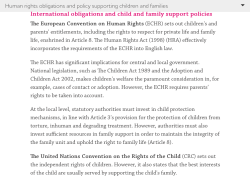
This is just an annotated image sample. Look up “BIHR” (British Institute of Human Rights) and read for more understanding. Equality & Human Rights Commission | BIHR “About” & (Sept. 2017, The Guardian, “The Observer” Britain faces rebuke over refusal to back more than 100 UN human rights targets” with concerns about worse conditions after Brexit)
See above image.
As I remembered from many years ago, and as I am seeing again — while the UK is setting about to revise its own divorce-laws (with backing from a private foundation, the Nuffield Foundation) and through incorporation of the “Convention on the Rights of Children” the “EU Human Rights” into the British “Human Rights Act” standards (a basic part being right to ongoing contact with both parents) — what’s right, fair or even honest about attempting to put the USA, NOT a signatory to the UN CRC, under its authority in practice, if not in letter of the law, by aligning family court standards with Commonwealth countries? (Membership as typifies the international, interdisciplinary membership association “AFCC.”)
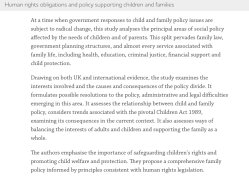
Besides the links to nearby “BIHR” image, I just found the following article which I’m including although it’s dated 2005, not more recently, because it summarizes the “contact” issues and impact on family law of the CRC, EU Human Rights, and other things of parallel references.
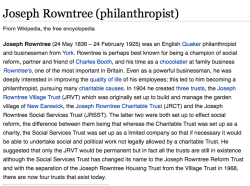
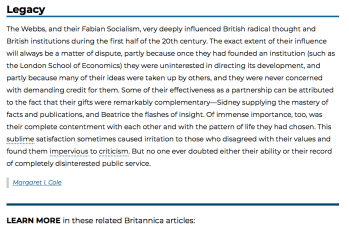
I know little about the “JRF.org” (Joseph Rowntree Foundation) other than, per his “Wiki,” Joseph Rowntree (d. 1925) was an English Quaker chocalatier, businessman, and philanthropist who set up three entities (now four trusts) for social reform and associated with Charles Booth. (<==Encyclopedia Britannica) whose cousin, Beatrice Potter Webb, with her husband Sidney Webb is associated with the Fabian Society, Labour movements, George Bernard Shaw, London School of Economics etc.; see second gallery below the next one — just two images)
Human rights obligation and policy supporting children and families by Clem Henricson and Andrew Bainham (posted at JRF.og) 26th May 2005 (first two images of the three just below):
-
- 1
-
- 2
-
- Joseph Rowntree “Wiki”
-

- Encyclopedia Britannica
-
- Encyclopedia Britannica
What’s historically valid about talking as though family courts were not (speaking the USA) a fairly recent creation, in some states (Maryland, Kentucky come to mind) as recent as even the mid-1990s?
Read the rest of this entry »




 Let's Get Honest! Absolutely Uncommon Analysis of Family & Conciliation Courts' Operations, Practices, & History