Archive for October 2018
ADR Group (1993), I.D.R. Europe (1989, incl. its recent demise and sale to ADR Group), Family Mediation Council (only 2015), the Civil Mediation Council (2014), and lastly, Resolution – Family First.** (2004), all ‘Ltd.’ Basically ‘AFCC Across the Pond,’ with Significant Interpretation Help from Beta.CompaniesHouse.gov.UK)[Written Feb. 2, Published Oct. 22, 2018].
** A tradename for a specialty lawyers’ association: “Solicitors Family Law Association,” formed only in 2004. Rather than call attention to what type of professionals, the focus is redirected to a values statement: “Resolution,” perhaps also as an abbreviated expression of the international push, here too, for “ADR” that is, “ALTERNATE Dispute Resolution.”
I was just following some policies (and AFCC trainers) across the pond. This is where it led.
ADR Group (1993), I.D.R. Europe (1989, incl. its recent demise and sale to ADR Group), Family Mediation Council (only 2015), the Civil Mediation Council (2014), and lastly, Resolution – Family First.** (2004), all ‘Ltd.’ Basically ‘AFCC Across the Pond,’ with Significant Interpretation Help from Beta.CompaniesHouse.gov.UK) [Written Feb. 2, Published Oct. 22, 2018]. short-link ends “-8yb.” Just about 6,200 words (and that link is: Beta.CompaniesHouse.gov.UK).
Since on this blog I so often use the four-letter acronym “AFCC,” or post its materials on Alienation Prevention, Collaborative Divorce, Parenting Education nonprofit “Kids’ Turn” (San Francisco- former; San Diego — current) and so forth, I figured it’s time to take another webshot for any “newbies” to this blog or that terminology. You’ll see some “AFCC” screen shots further down on the post.
In this post, I discovered through use of the above UK-based companies lookup page, and comparing one to another, as contrasted with the impressions given by the very large, and mutual-reference organizations, that they are:
~ Typically smaller than it would seem for such a “national” and “premier” accreditation/services council or company name. ~ For most, more recent than I expected, which may explain why I didn’t hear about them until recently.
The fast-startup and quick networking also shows pre-existing common interests (interdependent relationships) and understanding of how to move fast, move assets & ownership from one place to another (in the case of ADR Group/I.D.R. Europe and of the only recent (2015) incorporation of the Family Mediation Council with its six membership organizations.
These “membership organizations” it seems are in fact part of the “guaranteeing” entities (as in, “Private Company Limited by Guarantee”) and the guarantee is rather small — only 10 GBP each, and as to limitation of the liabilities of individual directors, to only 1 GBP each also.
Regarding the comparison to AFCC — there are parallels in the difference between claims and size/ start-dates of operations, not just: apparently aligned goals; expanding the field continually; promoting specialty professions – particularly mediation– of privately negotiating OUT of the courts, all kinds of “disputes” covering all kinds of “relationships,” but there are strategic differences in how companies are recorded, organized AND in how governments help promote or fund them, cross-country.
There are also strategic differences within between countries in how much they tax their citizens, how “nationalized” their industries and public systems are, and, of course, forms of government and judicial + court systems, along a spectrum at one end of which, there is MORE individual choice and freedom, and another, there is LESS, despite and in spite of plenty of class differences within each country, too. Some forms of governance are more intrusive, aggressive, and burden the public more for “services” than others respective to how citizens’ voices can be and are heard than others.
Speaking as a U.S. citizen who in my fifties and sixties has been dealing with the transformed “family court systems” post-Internet, post-PRWORA, post-9/11 (World Trade Towers, NYC + Homeland Security, Patriot Act, etc.) and following continued pressure to erode basic individual rights under the law “for the cause” as well as, in the case of the USA, post-“faith based initiatives” Executive Order (2001), “Family Justice Centers” (2003ff) and the Family Justice Center Alliance, and ongoing marriage/fatherhood promotions…and speaking as a woman, and a mother, if this, including the “new, revised” family court systems I and my offspring were just dragged through, a gauntlet / marathon, and come to find, in hindsight, in part from the push to “end welfare as we know it” incorporating major (and often wrong) assumptions about men (as fathers), and women (as mothers), represents “liberty and justice for all” and “government by the consent of the governed,” or even moving TOWARD it as opposed to AWAY from it, I’d like to see how.

Flag of the United States of America (from Britannica.com)
I think this country has among the most to lose (still) IF the standards are diluted to better align with a country we originally fought two wars AGAINST (1700s, 1800s), and at least one world war WITH (1900s), yet women didn’t even get to vote until the first quarter of the 1900s. It’s also not too much of a secret that it’s been prosperous, it has a large geographic span (though not the world’s largest obviously) and plenty of revenue-producing population.
~ ~ ~ ENCLYOPEDIA BRITANNICA — ON THE UNITED STATES of AMERICA ~ ~ ~
Looking for either a good visual or a good description of the extent of (my) country based on land mass/geography only, I didn’t find a one, however, (of all places), the Encyclopedia Britannica article on the US says it’s the fourth largest in the world, after Russia, Canada, and China. The article also talks, respectfully I feel, about its prosperity (and the basis for it), dramatic diversity in both population and terrain, and about the government — how it was the first to separate from its European colonizer and to have a constitution delegating sovereignty — a BIG deal — to the citizens, not the government. So I’ve included several quotes.
BUT this post began, and remains, information on UK-based, Family-Court (primarily but not exclusively) aligned organizations and how they are networking there. And, at points, how this interacts with associations and aligned professionals in the US and admits to the same…
Read the rest of this entry »
SHARE THIS POST on...

Family Court Analysis {Lit., Breaking It Down* into Basic Elements} Is Still Too Uncommon! | Blogger’s Recent “No More!” Nomad Status (Generic Personal Info) | Impact of PTSD & Safety Concerns on My Two Writing Modes [Written mid-Sept., published mid-Oct. 2018].
Post Title: Family Court Analysis {Lit., Breaking It Down* into Basic Elements} Is Still Too Uncommon! | Blogger’s Recent “No More!” Nomad Status (Generic Personal Info) | Impact of PTSD & Safety Concerns on My Two Writing Modes [Written mid-Sept., published mid-Oct., 2018]. Case-sensitive WordPress-generated shortlink ends “-9gi.” Published Oct. 21, 2018.
* ..I “couldn’t” resist: (below: see Etymonline.com, or the “OED” for “Analysis” and how many related words — including “psychoanalysis” come from that root “leu” to loosen, dissolve, free, or (break it down into basic elements)… But I’m talking about the basic elements of “Family Court.”
How can so much analysis of how to fix family courts (or, as some call them, improperly, “custody courts”) so often omit and so confidently so many basic elements — such as: the membership associations (plural) driving policy; the related public funds beyond basic public funds for the infrastructure flowing to the courts and to “community services” the courts refer to and often mandate parents attend AND often pay for privately; and/or any quantitative OR qualitative analysis (or even overview of) the nature, character, and filing habits of such community service providers? {{the last phrase in navy blue font just added Dec. 2018//LGH.}}
What’s “analysis” about most common “syntheses” — such as protecting children IN the family courts, training professionals in “domestic violence awareness and sensitivity” — that omit key basic elements of the whole and skip straight to “what we want to do!” as if the analyses were complete — or as if organizations hadn’t been engaged in such trainings for decades, including how to dismiss or minimize it?
What’s “analytical,” even coming from expert (lawyers and psychologists) about omitting key evidence on the creation, maintenance, driving organizations, operations, and in general tendencies — basic character indicators — of the family courts as a system WITHIN a country attempting to standardize it ACROSS country lines, importing ideas foreign to the U.S. (specifically) Constitution itself as “best practices”??
What’s accurate and respectable about assuming that batterers’ intervention, supervised visitation, access and visitation should ALWAYS dominate right to separate — and because of this, generate professional networks taking public and private resources both from divorcing or “in-conflict” parents — that just need to undergo “Coordinated Community Response” trainings to become more sensitive to safety issues ,that is, to endorse the DuluthModel circle of control?
This approach not only perpetuates the private ‘trainings” endlessly (public-private funded, run often under tax-exempts while most of the population is not “tax-exempt” at all..), it also
- undermines the concept of representative government at the local (state or county) jurisdiction level…
- complicates the accountability for public funding beyond reasonable transparency.
- privatizes control of what ought to be public institutions.

This is just an annotated image sample. Look up “BIHR” (British Institute of Human Rights) and read for more understanding. Equality & Human Rights Commission | BIHR “About” & (Sept. 2017, The Guardian, “The Observer” Britain faces rebuke over refusal to back more than 100 UN human rights targets” with concerns about worse conditions after Brexit)
See above image.
As I remembered from many years ago, and as I am seeing again — while the UK is setting about to revise its own divorce-laws (with backing from a private foundation, the Nuffield Foundation) and through incorporation of the “Convention on the Rights of Children” the “EU Human Rights” into the British “Human Rights Act” standards (a basic part being right to ongoing contact with both parents) — what’s right, fair or even honest about attempting to put the USA, NOT a signatory to the UN CRC, under its authority in practice, if not in letter of the law, by aligning family court standards with Commonwealth countries? (Membership as typifies the international, interdisciplinary membership association “AFCC.”)
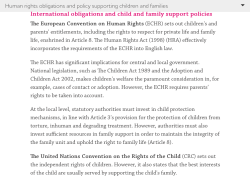
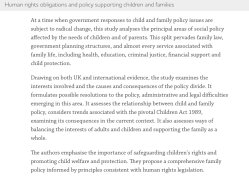
Besides the links to nearby “BIHR” image, I just found the following article which I’m including although it’s dated 2005, not more recently, because it summarizes the “contact” issues and impact on family law of the CRC, EU Human Rights, and other things of parallel references.
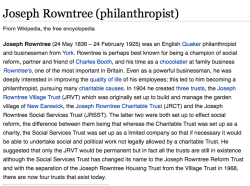
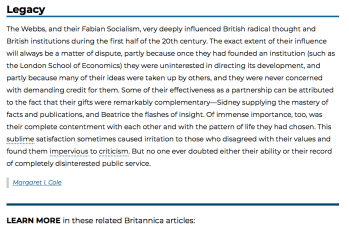
I know little about the “JRF.org” (Joseph Rowntree Foundation) other than, per his “Wiki,” Joseph Rowntree (d. 1925) was an English Quaker chocalatier, businessman, and philanthropist who set up three entities (now four trusts) for social reform and associated with Charles Booth. (<==Encyclopedia Britannica) whose cousin, Beatrice Potter Webb, with her husband Sidney Webb is associated with the Fabian Society, Labour movements, George Bernard Shaw, London School of Economics etc.; see second gallery below the next one — just two images)
Human rights obligation and policy supporting children and families by Clem Henricson and Andrew Bainham (posted at JRF.og) 26th May 2005 (first two images of the three just below):
-
- 1
-
- 2
-
- Joseph Rowntree “Wiki”
-

- Encyclopedia Britannica
-
- Encyclopedia Britannica
What’s historically valid about talking as though family courts were not (speaking the USA) a fairly recent creation, in some states (Maryland, Kentucky come to mind) as recent as even the mid-1990s?
Read the rest of this entry »




 Let's Get Honest! Absolutely Uncommon Analysis of Family & Conciliation Courts' Operations, Practices, & History